
Aquaculture Vaccines Market Trends and Analysis by 2028
Published Report - Aquaculture Vaccines Market Forecast to 2028 - COVID-19 Impact and Global Analysis By Type of Vaccine (Live Vaccine, Inactivated Vaccine, and Others), Species (Tilapia, Trout, Salmon, Shrimps, and Others), and Route of Administration (Injection Vaccines, Immersion Vaccines, and Oral Vaccines)
- Status : Published
- Report Code : TIPAR00005403
- Category : Life Sciences
- No. of Pages : 190
- Available Report Formats :


- Last update date : June 17, 2024


2021 Market Size
US$ 245.13 Mn
Base year value
2028 Forecast
US$ 569.72 Mn
Projected by 2028
CAGR 2022-2028
12.9 %
Growth rate
Addressable Market
US$ 2,870.65 Mn
(2022-2028)
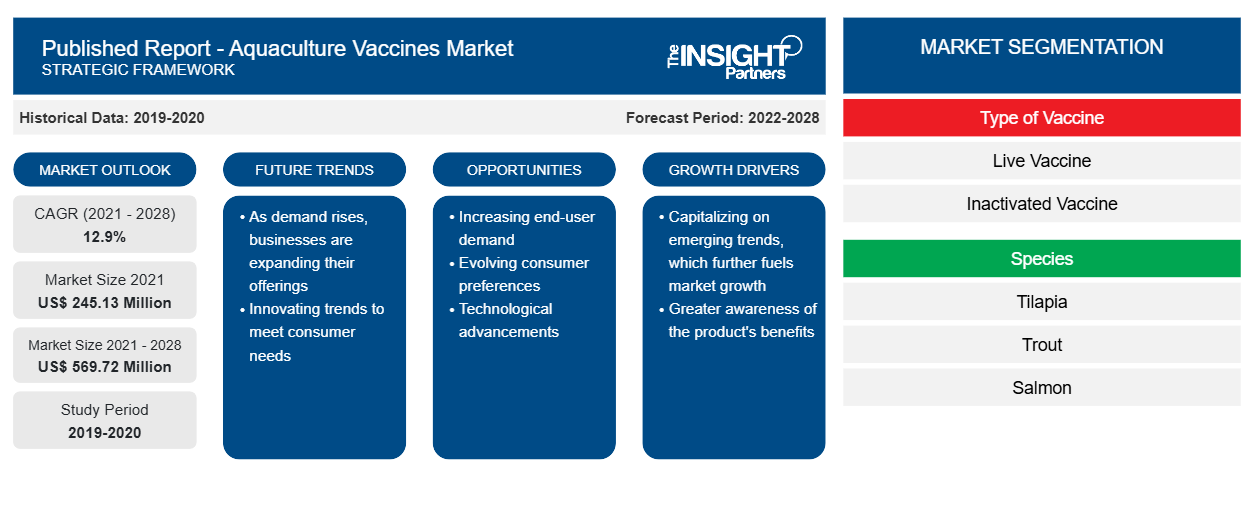
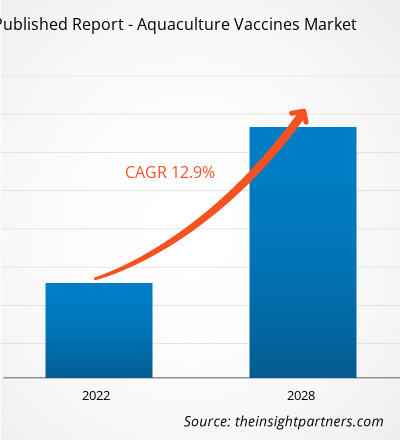
[Research Report] The aquaculture vaccines market is expected to grow from US$ 245.13 million in 2021 to US$ 569.72 million by 2028; it is estimated to grow at a CAGR of 12.9% from 2022 to 2028.
In aquaculture practices, there is always a chance of pathogenic outbreaks, which affects the farm production. Aquaculture vaccines are used to protect fish from any pathogen. Vaccination is a simple, reliable, and preventative technique of disease control for aquaculture.
Market Insights
Growing Aquaculture Industry Drives Market Growth
According to the data in a report titled "The State of World Fisheries and Aquaculture" published by the Food and Agriculture Organization of the United Nations in 2022, global consumption of aquatic foods, excluding algae, has increased by more than five times the quantity consumed nearly 60 years ago. Aquatic food consumption worldwide increased from 28 metric tons in 1961 to ~158 metric tons in 2019. The consumption increased at an average annual rate of 3.0 % from 1961, compared with a population growth rate of 1.6 %. Per capita consumption is rising due to increasing supplies, changing consumer preferences, and growing income. In 2019, the Food and Agriculture Organization of the United Nations estimated the per capita consumption of aquatic foods for 227 countries.
Regarding population, the countries consuming less than the world average accounted for 54 % of the world population in 2019. Aquatic food consumption is highest in Iceland, the Faroe Islands, and the Maldives, which consume over 80 kg of aquatic foods per capita per year. In 2019, the average per capita consumption across the world was 20.5 kg. This differed from an average of 5.4 kg in low-income countries to 26.5 kg in high-income countries. The rising consumption of aquatic animals is expediting the growth of the aquaculture industry. Aquaculture vaccines lower the chance of infection and increase the yield of products. Therefore, the growing aquaculture industry fuels the growth of the aquaculture vaccines market.
● REPORT CUSTOMIZATION
Tailor This Report To Align With Your Specific Business Requirements
This report can be customized to align precisely with your business objectives, scope, and target markets. Customization options include tailored segmentation, geography, competitive analysis, and strategic insights to support informed decision-making.
Customize This Report →WHAT YOU CAN ADJUST
- ● Segmentations
- ● Geography
- ● Competitive Analysis
- ● Language Preferences
Published Report - Aquaculture Vaccines Market: Strategic Insights
-
Get Top Key Market Trends of this report.This FREE sample will include data analysis, ranging from market trends to estimates and forecasts.
Rising Prevalence of Infectious Diseases in Aquatic Animals to Offer Ample Opportunities for Market During Forecast Period
As per the research study titled "Prevalence of Anisakid Nematodes in Fish in China: A Systematic Review and Meta-Analysis" published by the National Library of Medicine (NLM) in February 2022, the anisakid nematodes were widespread in fish across China with pooled incidence rate of 45.5%, and the occurrence percentage for fresh fish was the greatest (58.1%). Eastern China had the highest prevalence rate of anisakid nematodes (55.3%), while the prevalence of anisakid nematodes (76.8%) was highest in the East China Sea. According to the data published in Aquaculture Research & Development journal, ~219 cases of infectious diseases in the fresh aquaculture sector were registered from 2014 to 2018. Among these, 74.88% were parasitic, 12.80% were bacterial, 1.83% were viral, and 10.50% were cases that were a mix of parasitic and bacterial diseases. Therefore, the high prevalence of infectious diseases is expected to boost the demand for vaccines, which would provide lucrative opportunities for the aquaculture vaccines market in the coming years.
Type of Vaccine-Based Insights
Based on type of vaccine, the aquaculture vaccines market is segmented into live vaccines, inactivated vaccines, and other vaccines. The inactivated vaccines segment held the largest market share in 2021. The market for the live vaccines segment is likely to grow at the highest rate during the forecast period.
Species-Based Insights
The aquaculture vaccines market, based on species, is segmented into tilapia, trout, salmon, shrimps, and others. The salmon segment accounted for the largest share of the market in 2021 and is expected to register the highest CAGR of 13.4% during the forecast period.
Route of Administration -Based Insights
Based on route of administration, the aquaculture vaccines market is segmented into injection, immersion, and oral. The injection segment accounted for the largest share of the market in 2021 and is expected to register the highest CAGR of 13.1% during the forecast period.
Companies adopt inorganic and organic strategies such as mergers and acquisitions in the aquaculture vaccines market. A few recent key market developments are listed below:
- In November 2022, Indian Immunologicals Ltd (IIL) partnered with the Central Institute of Fisheries Education (CIFE) for the development of India's first fish vaccine commercially. The vaccine will be developed for the protection of freshwater fish against common bacterial diseases.
- In August 2021, Elanco Animal Health Incorporated acquired Bayer Animal Health. The transaction, valued at US$ 6.89 billion, expanded Elanco's scale and capabilities, positioning the company for the long term as a leader in the attractive, durable animal health industry. The transaction added several anchor cattle brands, expanded the company's aqua presence into warm water fish, and enhanced the company's global bio-protection portfolio.
- In July 2020, Zoetis acquired Fish Vet Group from Benchmark Holdings, PLC, as a strategic addition to its Pharmaq business, which develops and commercializes fish vaccines and offers services in vaccination and diagnostics for aquaculture. The acquisition enhanced the geographic reach and diagnostics expertise and testing services, including environmental testing, that Pharmaq's reference lab Pharmaq Analytiq can offer fish farmers in major aquaculture markets.
Aquaculture Vaccines
Published Report - Aquaculture Vaccines Market Report Scope
| Report Attribute | Details |
|---|---|
| Market size in 2021 | US$ 245.13 Million |
| Market Size by 2028 | US$ 569.72 Million |
| Global CAGR (2021 - 2028) | 12.9% |
| Historical Data | 2019-2020 |
| Forecast period | 2022-2028 |
| Segments Covered |
By Type of Vaccine
|
| Regions and Countries Covered |
North America
|
| Market leaders and key company profiles |
|
Published Report - Aquaculture Vaccines Market Players Density: Understanding Its Impact on Business Dynamics
The Published Report - Aquaculture Vaccines Market is growing rapidly, driven by increasing end-user demand due to factors such as evolving consumer preferences, technological advancements, and greater awareness of the product's benefits. As demand rises, businesses are expanding their offerings, innovating to meet consumer needs, and capitalizing on emerging trends, which further fuels market growth.
Company Profiles
- AquaTactics Fish Health
- HIPRA SA
- Merck & Co Inc
- Microsynbiotix Ltd
- Indian Immunologicals Ltd
- Nisseiken Co Ltd
- Zoetis Inc
- VETERQUIMICA SA
- Phibro Animal Health Corp
- Elanco Animal Health Inc
- Tecnovax SA
Frequently Asked Questions

- Comprehensive Market Sizing and Forecast Analysis
- Detailed Segmentation Analysis
- In-Depth Market Dynamics Assessment
- Regional and Country-Level Insights
- Competitive Landscape and Company Benchmarking
- Strategic Business Intelligence
Recent Reports
Testimonials

The Insight Partners' SCADA System Market report is comprehensive, with valuable insights on current trends and future forecasts. The team was highly professional, responsive, and supportive throughout. We are very satisfied and highly recommend their services.
RAN KEDEM Partner, Reali Technologies LTDs
I requested a report on a very specific software market and the team produced the report in a few days. The information was very relevant and well presented. I then requested some changes and additions to the report. The team was again very responsive and I got the final report in less than a week.
JEAN-HERVE JENN Chairman, Future Analytica
We worked with The Insight Partners for an important market study and forecast. They gave us clear insights into opportunities and risks, which helped shape our plans. Their research was easy to use and based on solid data. It helped us make smart, confident decisions. We highly recommend them.
PIYUSH NAGPAL Sr. Vice President, High Beam Global
The Insight Partners delivered insightful, well-structured market research with strong domain expertise. Their team was professional and responsive throughout. The user-friendly website made accessing industry reports seamless. We highly recommend them for reliable, high-quality research services
YUKIHIKO ADACHI CEO, Deep Blue, LLC.
This is the first time I have purchased a market report from The Insight Partners.While I was unsure at first, I visited their web site and felt more comfortable to take the risk and purchase a market report.I am completely satisfied with the quality of the report and customer service. I had several questions and comments with the initial report, but after a couple of dialogs over email with their analyst I believe I have a report that I can use as input to our strategic planning process.Thank you so much for taking the extra time and making this a positive experience.I will definitely recommend your service to others and you will be my first call when we need further market data.
JOHN SUZUKI President and Chief Executive Officer, Board Director, BK Technologies
I wish to appreciate your support and the professionalism you displayed in the course of attending to my request for information regarding to infectious disease IVD market in Nigeria. I appreciate your patience, your guidance, and the fact that you were willing to offer a discount, which eventually made it possible for us to close a deal. I look forward to engaging The Insight Partners in the future, all thanks to the impression you have created in me as a result of this first encounter.
DR CHIJIOKE ONYIA MANAGING DIRECTOR, PineCrest Healthcare Ltd.Reason to Buy
- Informed Decision-Making
- Understanding Market Dynamics
- Competitive Analysis
- Identifying Emerging Markets
- Customer Insights
- Market Forecasts
- Risk Mitigation
- Boosting Operational Efficiency
- Strategic Planning
- Investment Justification
- Tracking Industry Innovations
- Aligning with Regulatory Trends





 Get Free Sample for