
Hemodynamic monitoring System Market Size, Share, and Analysis by 2028
Published Report - Hemodynamic monitoring System Market Forecast to 2028 - COVID-19 Impact and Global Analysis By Type (Noninvasive Hemodynamic Monitoring Systems, Minimally Invasive Hemodynamic Monitoring Systems, and Invasive Hemodynamic Monitoring Systems), Product (Monitors and Disposables), End User (Hospital, Home Care, Cath Lab, and Ambulatory Care Center)
- Status : Published
- Report Code : TIPAR100000982
- Category : Life Sciences
- No. of Pages : 195
- Available Report Formats :


- Last update date : April 05, 2023


2021 Market Size
US$ 1.42 Bn
Base year value
2028 Forecast
US$ 2.17 Bn
Projected by 2028
CAGR 2022-2028
6.4 %
Growth rate
Addressable Market
US$ 12.84 Bn
(2022-2028)
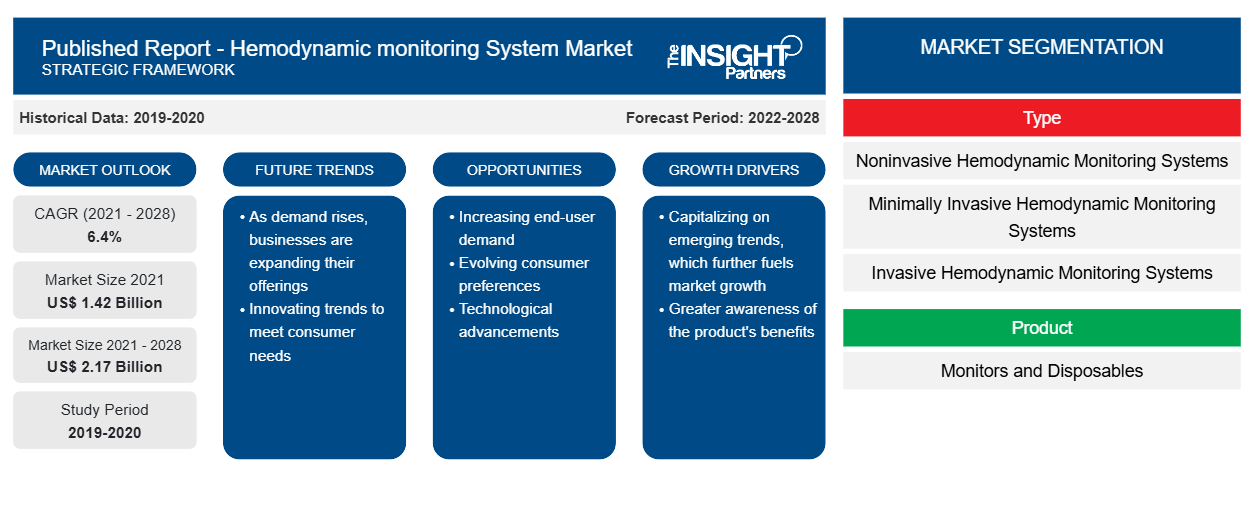
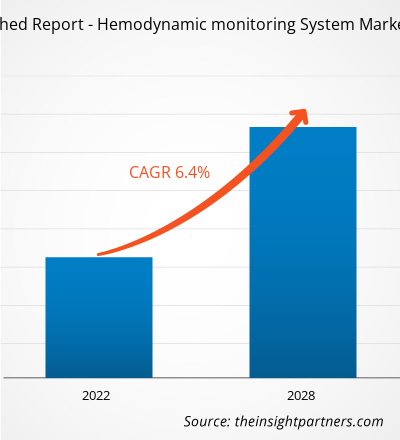
[Research Report] The hemodynamic monitoring system market is projected to reach US$ 2,173.15 million by 2028 from US$ 1,419.94 million in 2021; it is estimated to grow at a CAGR of 6.4% from 2022 to 2028.
The hemodynamics monitoring system measures the blood flow through the cardiovascular system, that is, the heart and blood vessels. The monitoring allows physicians to estimate the amount of oxygen distributed in tissues and organs of the human body. Further, it is used for measuring blood pressure from inside the veins, arteries, and heart. It is also used to measure the level of oxygen in the blood.
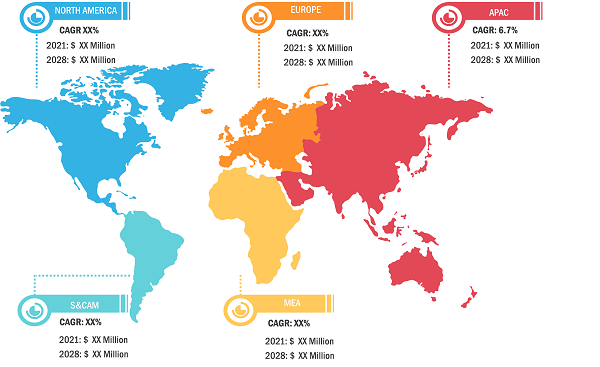
The hemodynamics monitoring system market is segmented based on type, product, end user, and geography. By geography, the market is broadly segmented into North America, Europe, Asia Pacific, the Middle East & Africa, and South & Central America. The report offers insights and in-depth analysis of the market, emphasizing on parameters such as market trends, technological advancements, and market dynamics, along with the analysis of the competitive landscape of the world's leading market players.
● REPORT CUSTOMIZATION
Tailor This Report To Align With Your Specific Business Requirements
This report can be customized to align precisely with your business objectives, scope, and target markets. Customization options include tailored segmentation, geography, competitive analysis, and strategic insights to support informed decision-making.
Customize This Report →WHAT YOU CAN ADJUST
- ● Segmentations
- ● Geography
- ● Competitive Analysis
- ● Language Preferences
Published Report - Hemodynamic monitoring System Market: Strategic Insights
-
Get Top Key Market Trends of this report.This FREE sample will include data analysis, ranging from market trends to estimates and forecasts.
Lucrative Regions for Hemodynamics Monitoring System Market
- This FREE sample will include data analysis, ranging from market trends to estimates and forecasts.
Market Insights
Increasing Geriatric Population
The prevalence of cardiovascular diseases is higher among geriatric people. Similar to Asian countries such as Japan, China, and India, the US is experiencing a significant shift in life expectancy. In 2019, the country recorded a significant demographic shift due to a huge baby boom. According to the Population Reference Bureau, the baby boomers belonged to the age group of 55–73. Thus, the baby boomers have brought various challenges and opportunities to the economy, especially in terms of infrastructure, institutions, and healthcare facilities. Similarly, as per the report published by the Population Reference Bureau in 2019, the geriatric population of the US will double by 2060. The number is expected to grow to 95 million by 2060 from 52 million, and the percentage of the geriatric population is anticipated to reach 23% of the total population from 16%. Additionally, as per the Eurostat, in 2021, over one-fifth (20.8%) of the European Union population was aged 65 or more. As per the report "The UK's ageing population" by the House of Commons (UK Parliament), the UK's population is witnessing a massive age shift. More than 12.3 million people are aged 65 years, and by 2043, ~24% (17.4 million people) of the population is expected to be 65 or more.
The rise in the geriatric population is expected to lead to various chronic health conditions such as high blood pressure, obesity, and diabetes, which are the primary causes of cardiovascular diseases. Monitoring services for the geriatric population are widely provided in home care settings. Therefore, the demand for hemodynamic monitoring systems in these settings is expected to grow, which would further foster the growth of the market during the forecast period.
Rising Prevalence of Cardiovascular Diseases
Cardiovascular diseases (CVDs) are the leading cause of death across the globe, causing millions of deaths every year. According to the 2022 heart disease & Stroke Statistical Update Fact Sheet, Global Burden of Disease, in 2020, approximately 119.1 million people died of cardiovascular diseases. It also stated that the global prevalence of stroke and ischemic stroke in 2020 was 89.1 million and 68.2 million, respectively. The major causes of cardiovascular diseases are hypertension, obesity, and diabetes.
The prevalence of cardiovascular diseases is also high in North America. As per the National Center for Chronic Disease Prevention and Health Promotion, Division for Heart Disease and Stroke Prevention, ~697,000 people the US died due to heart disease, which is one in every five deaths. Moreover, according to the American Heart Association, by 2035, over 130 million Americans, or 45.1% of people, are likely to have some form of cardiovascular disease. Additionally, cardiovascular diseases are the leading cause of mortality and a major cause of morbidity in Europe. CVD causes 45% of total deaths in Europe and 37% in the EU.
Furthermore, more than 75% of CVD deaths occur in low- and middle-income countries where high blood pressure is the most important risk factor for CVDs. As per the study “Global Burden of Disease Study 2019,” CVD was the leading cause of death in Asia in 2019, causing 10.8 million deaths (approximately 35% of the total deaths) in Asia. Thus, the rising prevalence of cardiovascular diseases is driving the hemodynamics monitoring market.
Type Insights
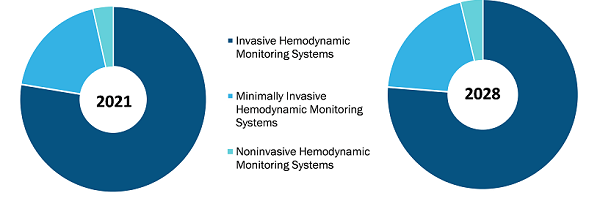
Based on type, the global hemodynamics monitoring system market is segmented into noninvasive hemodynamic monitoring system, minimally invasive hemodynamic monitoring system, and invasive hemodynamic monitoring system. In 2021, the invasive hemodynamic system segment held the largest share of the market. Moreover, the market for the noninvasive segment is expected to grow at the highest CAGR during 2022–2028. A noninvasive hemodynamic monitoring system includes an air-filled band that can analyze blood pressure manually and automatically. The benefit of this system is that it is fast and does not require a stethoscope.
Product insight
Based on product, the global hemodynamic monitoring system market is divided on basis of product into monitors and disposables. The disposables segment held the largest share of the market in 2021. However, the monitors segment is anticipated to register the highest CAGR in the market during the forecast period of 2022–2028. The factors responsible for the market growth are rising prevalence of CVD; technological improvements in monitoring systems; raising funding by government authorities for advancing patient-centered safety, care, and efficacy; and the capacity of hemodynamic monitors to enhance cath lab efficiency.
End User Insights
Based on end user, the hemodynamic monitoring system market is segmented into hospitals, cath labs, home care, and ambulatory surgical center. The hospital segment held the largest market share in 2021, and it is further expected to be the largest shareholder in the market by 2028. Hospitals are the most significant entities that have all the facilities available. Hospitals also provide various diagnostics and treatment facilities that can be reimbursed under insurance claims. Various hospitals offer facilities such as proper care, physiotherapy, and guidance that assist in the faster recovery of patients. Also, hospitals have modernized equipment and are installed with integrated information technologies.
Hospitals offer all the diagnostics and treatments associated with cardiovascular diseases. Cardiovascular diseases require continuous monitoring and better nursing services, which are largely provided by hospitals. Therefore, owing to all the factors mentioned above, the market for the hospitals segment is likely to grow in the coming years.
Hemodynamics Monitoring System Market, by Type – 2021 and 2028
- This FREE sample will include data analysis, ranging from market trends to estimates and forecasts.
- In May 2021, Philips introduced an integrated Interventional Hemodynamic System with Patient Monitor IntelliVue X3 to improve workflow and patient focus during image-guided procedures.
- In October 2020, Getinge launched NICCI, an advanced hemodynamic monitoring system. It provides continuous and noninvasive hemodynamic insights to reduce the risk of severe complications for patients with low blood pressure.
The COVID-19 pandemic is having the mixed impact on the hemodynamics monitoring system market. A hemodynamic monitoring system is an important device that are used in intensive care unit to monitor blood flow, blood pressure, vascular resistance, fluid, and oxygen level of critically ill patients. COVID-19 pandemic positively supported the market growth of hemodynamic monitoring system due to continuous measurement of the hemodynamic parameters among the COVID-19 patients. Further, patients who required hospitalization for COVID-19 are prone to conditions such as sepsis, acute lung injury, and acute respiratory syndrome. Hemodynamic instability is the major contributor for mortality and thus, hemodynamic monitoring systems are required to continuous monitoring of hemodynamic parameters. Thus, hemodynamic monitoring system supported the growth of the market during COVID-19 pandemic.
Hemodynamics monitoring system – Market Segmentation
Based on Type, the market is segmented into noninvasive hemodynamic monitoring system, minimally invasive hemodynamic monitoring system, and invasive hemodynamic monitoring system. The noninvasive hemodynamic monitoring system is further bifurcated into NICaS and others. Based on Product, the market is classified into monitors and disposables. Based on End User, the market is segmented into hospitals, cath labs, home care, and ambulatory surgical centers. Based on Geography, the market is divided into North America (US, Canada, Mexico), Europe (France, Germany, UK, Italy, Spain, and Rest of Europe), Asia Pacific (China, Japan, India, Australia, South Korea, and Rest of Asia Pacific), Middle East & Africa (Saudi Arabia, South Africa, UAE, and Rest of Middle East & Africa), South and Central America (Brazil, Argentina, and Rest of South and Central America)
Company Profiles
- Koninklijke Philips NV
- Osypka Medical GmbH
- General Electric Co
- Edwards Lifesciences Corporation
- Schwarzer Cardiotek
- Getinge Group
- Deltex Medical
- ICU Medical Inc
- Masimo
- Baxter International Inc
Published Report - Hemodynamic monitoring System Market Report Scope
| Report Attribute | Details |
|---|---|
| Market size in 2021 | US$ 1.42 Billion |
| Market Size by 2028 | US$ 2.17 Billion |
| Global CAGR (2021 - 2028) | 6.4% |
| Historical Data | 2019-2020 |
| Forecast period | 2022-2028 |
| Segments Covered |
By Type
|
| Regions and Countries Covered |
North America
|
| Market leaders and key company profiles |
|
Published Report - Hemodynamic monitoring System Market Players Density: Understanding Its Impact on Business Dynamics
The Published Report - Hemodynamic monitoring System Market is growing rapidly, driven by increasing end-user demand due to factors such as evolving consumer preferences, technological advancements, and greater awareness of the product's benefits. As demand rises, businesses are expanding their offerings, innovating to meet consumer needs, and capitalizing on emerging trends, which further fuels market growth.
Frequently Asked Questions

- Comprehensive Market Sizing and Forecast Analysis
- Detailed Segmentation Analysis
- In-Depth Market Dynamics Assessment
- Regional and Country-Level Insights
- Competitive Landscape and Company Benchmarking
- Strategic Business Intelligence
Recent Reports
Testimonials

The Insight Partners' SCADA System Market report is comprehensive, with valuable insights on current trends and future forecasts. The team was highly professional, responsive, and supportive throughout. We are very satisfied and highly recommend their services.
RAN KEDEM Partner, Reali Technologies LTDs
I requested a report on a very specific software market and the team produced the report in a few days. The information was very relevant and well presented. I then requested some changes and additions to the report. The team was again very responsive and I got the final report in less than a week.
JEAN-HERVE JENN Chairman, Future Analytica
We worked with The Insight Partners for an important market study and forecast. They gave us clear insights into opportunities and risks, which helped shape our plans. Their research was easy to use and based on solid data. It helped us make smart, confident decisions. We highly recommend them.
PIYUSH NAGPAL Sr. Vice President, High Beam Global
The Insight Partners delivered insightful, well-structured market research with strong domain expertise. Their team was professional and responsive throughout. The user-friendly website made accessing industry reports seamless. We highly recommend them for reliable, high-quality research services
YUKIHIKO ADACHI CEO, Deep Blue, LLC.
This is the first time I have purchased a market report from The Insight Partners.While I was unsure at first, I visited their web site and felt more comfortable to take the risk and purchase a market report.I am completely satisfied with the quality of the report and customer service. I had several questions and comments with the initial report, but after a couple of dialogs over email with their analyst I believe I have a report that I can use as input to our strategic planning process.Thank you so much for taking the extra time and making this a positive experience.I will definitely recommend your service to others and you will be my first call when we need further market data.
JOHN SUZUKI President and Chief Executive Officer, Board Director, BK Technologies
I wish to appreciate your support and the professionalism you displayed in the course of attending to my request for information regarding to infectious disease IVD market in Nigeria. I appreciate your patience, your guidance, and the fact that you were willing to offer a discount, which eventually made it possible for us to close a deal. I look forward to engaging The Insight Partners in the future, all thanks to the impression you have created in me as a result of this first encounter.
DR CHIJIOKE ONYIA MANAGING DIRECTOR, PineCrest Healthcare Ltd.Reason to Buy
- Informed Decision-Making
- Understanding Market Dynamics
- Competitive Analysis
- Identifying Emerging Markets
- Customer Insights
- Market Forecasts
- Risk Mitigation
- Boosting Operational Efficiency
- Strategic Planning
- Investment Justification
- Tracking Industry Innovations
- Aligning with Regulatory Trends





 Get Free Sample for