
Small Satellite Market Trends and Analysis by 2028
Published Report - Small Satellite Market Forecast to 2028 - COVID-19 Impact and Global Analysis By Type [Nanosatellite (1 to 10 Kg) and Microsatellite (10 to 150 Kg)], Application [Automatic Identification System (AIS), Transmitter, Imaging Devices, and Others], Payload (Earth Observation, Communication and Navigation, and Scientific Research), and Vertical (Government, Military, and Commercial)
- Status : Published
- Report Code : TIPAR00002266
- Category : Aerospace and Defense
- No. of Pages : 211
- Available Report Formats :


- Last update date : June 13, 2024


2022 Market Size
US$ 3.13 Bn
Base year value
2028 Forecast
US$ 11.78 Bn
Projected by 2028
CAGR 2023-2028
24.7 %
Growth rate
Addressable Market
US$ 43.62 Bn
(2023-2028)
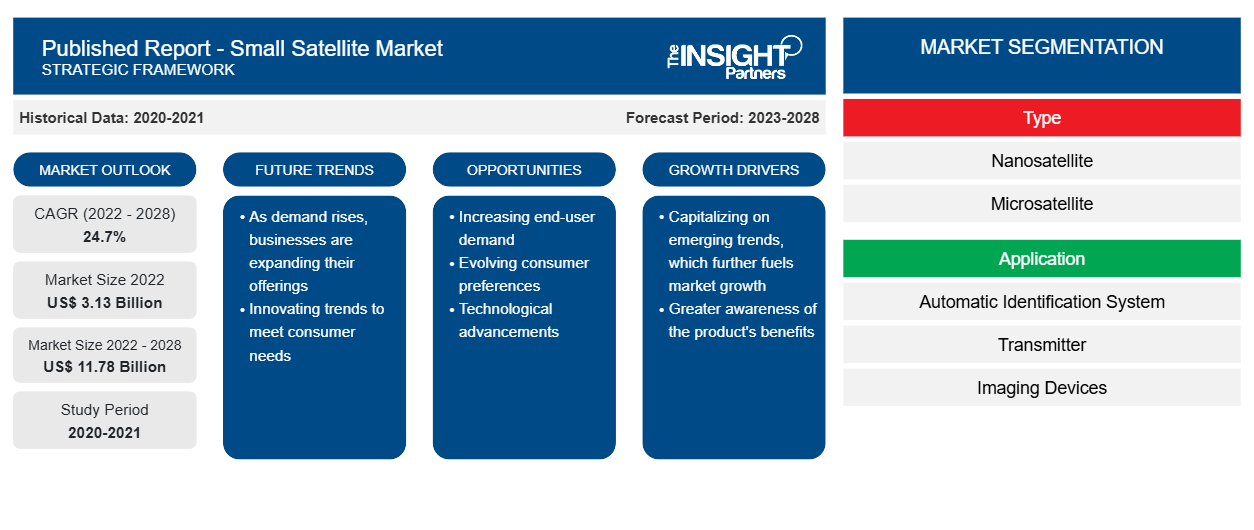
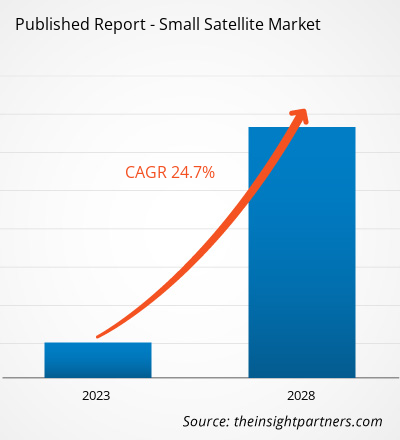
The small satellite market is expected to reach US$ 11,778.83 million by 2028; it is expected to grow at a compound annual growth rate of 24.7% from 2022 to 2028.
The use of small satellites helps government authorities monitor suspicious ships and serve other purposes such as communication & navigation, earth observation, and scientific research operations, as well as maintain national security and capture data regarding areas damaged by earthquakes or floods. In July 2021, Japan government announced to support the development of a small satellite constellation. Under the satellite constellation project, the government announced that they would support the companies for quick construction and domestic production of small satellites and thereby driving the small satellite market size in the region. In November 2021, Fleet Space Technologies raised US$ 26 million in funds to expand the nanosatellite IoT connectivity fleet. Also, in April 2022, the German parliament announced that it would invest US$ 10.51 million in the small satellite initiatives. Such investments and initiatives from governments for the development of small satellites are likely to fuel the small satellite market size.
The growing need for small satellites encourages market players to make strategic partnerships, collaborations, and contracts. A few strategies by the players are mentioned below:
- In July 2022, Vaya Space, Inc. announced the signing of an agreement with All2Space to launch its satellite constellation. All2Space is a developer of CubeSat and is also a launch aggregator with Brazilian Space Agency.
- In September 2021, the Indian Space Research Organisation (ISRO) announced the signing of a contract with Bhutan's telecom department to develop a small satellite.
Several companies are making contracts and partnerships to provide small satellites for applications such as communication, navigation, and earth observation. Therefore, the rising number of such initiatives bolsters the growth of the small satellite market.
● REPORT CUSTOMIZATION
Tailor This Report To Align With Your Specific Business Requirements
This report can be customized to align precisely with your business objectives, scope, and target markets. Customization options include tailored segmentation, geography, competitive analysis, and strategic insights to support informed decision-making.
Customize This Report →WHAT YOU CAN ADJUST
- ● Segmentations
- ● Geography
- ● Competitive Analysis
- ● Language Preferences
Published Report - Small Satellite Market: Strategic Insights
-
Get Top Key Market Trends of this report.This FREE sample will include data analysis, ranging from market trends to estimates and forecasts.
Internet access, machine-to-machine communication (M2M), and the Internet of Things (IoT) are among the most important applications of a small satellite. Space has become an ideal solution to improve the efficiency of current terrestrial communication networks. According to Alén Space, by 2025, more than 25.2 billion IoT connections are predicted to exist worldwide, and the IoT market will reach US$ 1,072.08 billion (€ 950 billion). Also, small satellite constellations can play an important role in various environmental conditions, especially in remote or hard-to-reach places, where real-time data is received from all types of sensors and linked devices for IoT-based business models. Thus, a small satellite helps receive, store, and transmit real-time information to any point.
The small satellite can also be effective for remote management. Sensors can help to control all devices, receive real-time information, and send commands for configurations remotely across the world. Satellite communications support land-based communications in Amazon basin, Antarctica, offshore platforms, critical infrastructure like nuclear power plants, and other hard-to-reach areas. Also, small satellites guarantee communication in any circumstances in virtually uncommunicated areas such as large rural areas, desert territories, frozen areas, jungle areas, and high seas.
For high internet access, several projects are being launched in various developed and developing regions where small satellites play a major role. According to Oberlo, in 2022, there are ~62.6% active internet users across the world. The growing internet access worldwide will propel the demand for small satellites during the forecast period. Thus, the rising demand for small satellites to provide internet access, M2M communication, and IoT will create a lucrative opportunity for market growth in the forecasted period.
Impact of COVID-19 Pandemic on Small Satellite Market Growth
With the onset of COVID-19 pandemic, manufacturing plants were forced to temporarily shut down their production facilities or slow down the production volume. The entire space or satellite manufacturing industry was hampered with the severe supply chain disruption. However, satellite manufacturers managed to produce handful of satellites despite supply chain disruption. Thus, the small satellite market witnessed marginal decline in terms of revenues.
Market Insights – Small Satellite Market
Based on region, the small satellite market is primarily segmented into North America, Europe, Asia Pacific, the Middle East & Africa, and South America. North America is expected to dominate the market in 2022 in terms of small satellite market share and is expected to retain its dominance during the forecast period, followed by Asia Pacific and Europe. Further, the small satellite market growth in Asia Pacific is attributed to the rising investments in the deployment of satellites across the commercial sectors of different countries, including China and India.
Vertical Insights – Small Satellite Market
Based on vertical, the small satellite market is segmented into government, military, and commercial. The commercial segment is expected to dominate the market in 2022 in terms of small satellite market share. Also, the segment is expected to retain its dominance during the forecast period. The small satellite market growth for the commercial segment is mainly attributed to rising investments in commercial satellite constellation programs and launch of new satellite constellation projects for commercial purposes.
Swarm Technologies, Thales SA, Airbus SAS, L3Harris Technologies Inc, and Sierra Nevada Corporation are among the prominent small satellite market players operating across the world. The market is moderately consolidated, as well-established small satellite market players and leaders in the market account for a larger share.
Players operating in the small satellite market are mainly focused on providing efficient small satellite products to customers. The small satellite market players are also witnessing a rise in demand for the procurement of small satellite across several commercial applications. Therefore, many companies are focusing to expand their product offerings to commercial, government, and military end users. For this, the vendors are also taking initiatives to partner with different companies to develop a sustainable solution for the commercial sector.
Small Satellite
Published Report - Small Satellite Market Report Scope
| Report Attribute | Details |
|---|---|
| Market size in 2022 | US$ 3.13 Billion |
| Market Size by 2028 | US$ 11.78 Billion |
| Global CAGR (2022 - 2028) | 24.7% |
| Historical Data | 2020-2021 |
| Forecast period | 2023-2028 |
| Segments Covered |
By Type
|
| Regions and Countries Covered |
North America
|
| Market leaders and key company profiles |
|
Published Report - Small Satellite Market Players Density: Understanding Its Impact on Business Dynamics
The Published Report - Small Satellite Market is growing rapidly, driven by increasing end-user demand due to factors such as evolving consumer preferences, technological advancements, and greater awareness of the product's benefits. As demand rises, businesses are expanding their offerings, innovating to meet consumer needs, and capitalizing on emerging trends, which further fuels market growth.
- In December 2020, Raytheon Technologies Corporation acquired a small satellite manufacturer and mission services provider, Blue Canyon Technologies. The acquisition allows Raytheon to strengthen its product line, including small satellite solutions such as microsatellites, nanosatellites, EELV Secondary Payload Adapter (ESPA)-class satellites, and associated technology.
- In March 2022, Spire Global signed a space service deal with Sierra Nevada Corporation (SNC) for the manufacturing of four 6U Lemur satellites for SNC to conduct radio frequency (R.F.) collection analysis.
Frequently Asked Questions
Increasing number of partnerships and contracts

- Comprehensive Market Sizing and Forecast Analysis
- Detailed Segmentation Analysis
- In-Depth Market Dynamics Assessment
- Regional and Country-Level Insights
- Competitive Landscape and Company Benchmarking
- Strategic Business Intelligence
Recent Reports
Testimonials

The Insight Partners' SCADA System Market report is comprehensive, with valuable insights on current trends and future forecasts. The team was highly professional, responsive, and supportive throughout. We are very satisfied and highly recommend their services.
RAN KEDEM Partner, Reali Technologies LTDs
I requested a report on a very specific software market and the team produced the report in a few days. The information was very relevant and well presented. I then requested some changes and additions to the report. The team was again very responsive and I got the final report in less than a week.
JEAN-HERVE JENN Chairman, Future Analytica
We worked with The Insight Partners for an important market study and forecast. They gave us clear insights into opportunities and risks, which helped shape our plans. Their research was easy to use and based on solid data. It helped us make smart, confident decisions. We highly recommend them.
PIYUSH NAGPAL Sr. Vice President, High Beam Global
The Insight Partners delivered insightful, well-structured market research with strong domain expertise. Their team was professional and responsive throughout. The user-friendly website made accessing industry reports seamless. We highly recommend them for reliable, high-quality research services
YUKIHIKO ADACHI CEO, Deep Blue, LLC.
This is the first time I have purchased a market report from The Insight Partners.While I was unsure at first, I visited their web site and felt more comfortable to take the risk and purchase a market report.I am completely satisfied with the quality of the report and customer service. I had several questions and comments with the initial report, but after a couple of dialogs over email with their analyst I believe I have a report that I can use as input to our strategic planning process.Thank you so much for taking the extra time and making this a positive experience.I will definitely recommend your service to others and you will be my first call when we need further market data.
JOHN SUZUKI President and Chief Executive Officer, Board Director, BK Technologies
I wish to appreciate your support and the professionalism you displayed in the course of attending to my request for information regarding to infectious disease IVD market in Nigeria. I appreciate your patience, your guidance, and the fact that you were willing to offer a discount, which eventually made it possible for us to close a deal. I look forward to engaging The Insight Partners in the future, all thanks to the impression you have created in me as a result of this first encounter.
DR CHIJIOKE ONYIA MANAGING DIRECTOR, PineCrest Healthcare Ltd.Reason to Buy
- Informed Decision-Making
- Understanding Market Dynamics
- Competitive Analysis
- Identifying Emerging Markets
- Customer Insights
- Market Forecasts
- Risk Mitigation
- Boosting Operational Efficiency
- Strategic Planning
- Investment Justification
- Tracking Industry Innovations
- Aligning with Regulatory Trends





 Get Free Sample for