
Markt für Aerosol Ventile: Größe, Marktanteil & Prognose 2034
Marktgröße und Prognosen für Aerosolventile (2021–2034), globaler und regionaler Marktanteil, Trends und Wachstumschancenanalyse. Berichtsabdeckung: nach Typ (kontinuierlich, dosiert); Endverbraucher (Körperpflege, Gesundheitswesen, häusliche Pflege, Automobilindustrie, Sonstige) und Geografie (Nordamerika, Europa, Asien-Pazifik sowie Süd- und Mittelamerika).
- Status : Veröffentlichte Daten
- Berichtscode : TIPRE00007928
- Kategorie : Fertigung und Bau
- Anzahl der Seiten : 150
- Verfügbare Berichtsformate :


- Datum der letzten Aktualisierung : July 13, 2026


2025 Market Size
US$ 2.08 Bn
Base year value
2034 Forecast
US$ 2.64 Bn
Projected by 2034
CAGR 2026-2034
2.71 %
Growth rate
Addressable Market
US$ 21.45 Bn
(2026-2034)
The aerosol valves market size is expected to grow from US$ 2.08 billion in 2025 to US$ 2.64 billion in 2034. It is anticipated to have a CAGR of 2.71% during 2026-2034. The market involves the use of continuous and metered valve systems for the personal care, healthcare, home care, and automotive segments, where dispensing accuracy, leakage prevention, and compatibility with emerging propellant systems are key considerations when purchasing valves.
According to the aerosol valves market report, North America is anticipated to witness a CAGR of 2.4-2.8% from 2026 to 2034, driven by high aerosol penetration across deodorants, disinfectants, inhalers, and automotive sprays. North America has developed its aerosol filling infrastructure, aluminum can recycling technology, and VOC compliance, which facilitates the adoption of low emission propellants, clean formulas, and dispensing parts.
Aerosol Valves Market Assessment and Insights
- North America: The region held 30–34% aerosol valves market share in 2025 and is expected to grow at a CAGR of 2.4–2.8% during 2026–2034, driven by personal care refills, disinfectant sprays, and regulated automotive maintenance formats.
- US: The US accounted for 76–80% of North America in 2025 and is projected to grow at a CAGR of 2.5–2.9% through 2034, supported by branded aerosol manufacturing and healthcare dispensing demand.
- Europe: Europe represented 28–32% share in 2025 and is forecast to grow at a CAGR of 2.1–2.5%, with Germany, the UK, France, Italy, and Spain leading sustainable aerosol packaging conversion.
- Asia Pacific: Asia Pacific held 22–26% share in 2025 and is expected to grow at a CAGR of 3.2–3.6%, led by China, Japan, India, South Korea, and Australia as consumer care manufacturing scales.
- Largest Segment: Continuous valves held 70–74% market share in 2025 and are expected to record a CAGR of 2.4–2.8%, reflecting wide use in deodorants, cleaners, lubricants, and paints.
- High Growth Segment: Healthcare held 12–15% market share in 2025 and is projected to grow at a CAGR of 3.4–3.8%, supported by respiratory delivery systems and hygienic topical sprays.
- Key companies analyzed in detail: AptarGroup, Inc.; Clayton Corporation; Coster Tecnologie Speciali S.p.A.; LINDAL Group Holding GmbH; Majesty Packaging Systems Limited; MITANI VALVE CO., LTD.; Newman-Green Inc.; Precision Valve Corporation; Salvalco Limited; Summit Packaging Systems Limited.
Source: The Insight Partners' analysis based on proprietary research, government publications, company annual reports, investor presentations, industry databases, and expert interviews.
The aerosol valves market forecast suggests that the market will shift from commodity parts used in aerosol valves to engineered dispensing systems driven by propellant transition, material compatibility, and filling line efficiency. Manufacturers continue to improve stem gaskets, mounting cups, dip tubes, and actuator interfaces to minimize leaks, ensure stable pressure, and maintain consistent spraying. Moreover, automation of assembly and quality control in the assembly process helps minimize defects, while customers demand more recyclable metals, less plastic, and valves suitable for compressed air or nitrogen.
The forecast period will be characterized by investments in Asia Pacific fill centers, North American specialized healthcare lines, and European eco-friendly packaging initiatives. Increasing regulation on VOC emissions, recycling initiatives, and drug safety is anticipated to benefit manufacturers possessing testing facilities, formulation capabilities, and brand-owner relationships. Thus, a wider scope of aerosol valves emerges.
Aerosol Valves Market Report Scope
| Report Attribute | Details |
|---|---|
| Market size in 2025 | US$ 2.08 Billion |
| Market Size by 2034 | US$ 2.64 Billion |
| Global CAGR (2026 - 2034) | 2.71% |
| Historical Data | 2021-2024 |
| Forecast period | 2026-2034 |
Aerosol Valves Market Analysis
Demand is driven by product categories where pressure-driven delivery provides an advantage in hygienic benefits, dosing accuracy, shelf-life preservation, and consumer ease of use. Personal care product lines continue to use fine-mist and foam-based products, whereas household care producers deploy aerosols for disinfectants, air fresheners, and surface cleaners. Healthcare applications demand greater accuracy because metered dosing affects repeat-dosing capability and patient safety.
The supply chain includes producers of metal/plastic components, gasket material suppliers, molders of precision components, valve assemblers, filling facilities, brand owners, and recyclers. Supply chain dynamics depend on the availability of aluminum, elastomer properties, and regional filling capabilities. According to the aerosol valves market analysis, buyers focus more on system performance than on the price of individual components, as leakage, clogging, or inaccurate spray may lead to recalls or consumer complaints.
The competitive environment is somewhat consolidated, with AptarGroup, Inc., Precision Valve Corporation, LINDAL Group Holding GmbH, Coster Tecnologie Speciali S.p.A., and Summit Packaging Systems Limited competing on application engineering, global delivery dependability, and development in partnership with fillers. Smaller specialist companies, such as Salvalco Limited and Newman-Green Inc., increase differentiation through sustainable or niche dispensing technologies.
Trends in investment include automated assembly lines, cleanroom manufacturing capabilities for health care, and valves designed for low-global-warming-potential propellants. MITANI VALVE CO., LTD., Majesty Packaging Systems Limited, and Clayton Corporation stay important where customers require local response, specialized designs or affordable deliveries. Positioning is becoming increasingly dependent on sustainability credentials, technical service, and multinational brand service without regional specification fragmentation.
● REPORT CUSTOMIZATION
Tailor This Report To Align With Your Specific Business Requirements
This report can be customized to align precisely with your business objectives, scope, and target markets. Customization options include tailored segmentation, geography, competitive analysis, and strategic insights to support informed decision-making.
Customize This Report →WHAT YOU CAN ADJUST
- ● Segmentations
- ● Geography
- ● Competitive Analysis
- ● Language Preferences
Aerosol Valves Market:
Passen Sie diesen Bericht Ihren Anforderungen an
Sie erhalten kostenlos Anpassungen an jedem Bericht, einschließlich Teilen dieses Berichts oder einer Analyse auf Länderebene, eines Excel-Datenpakets sowie tolle Angebote und Rabatte für Start-ups und Universitäten.
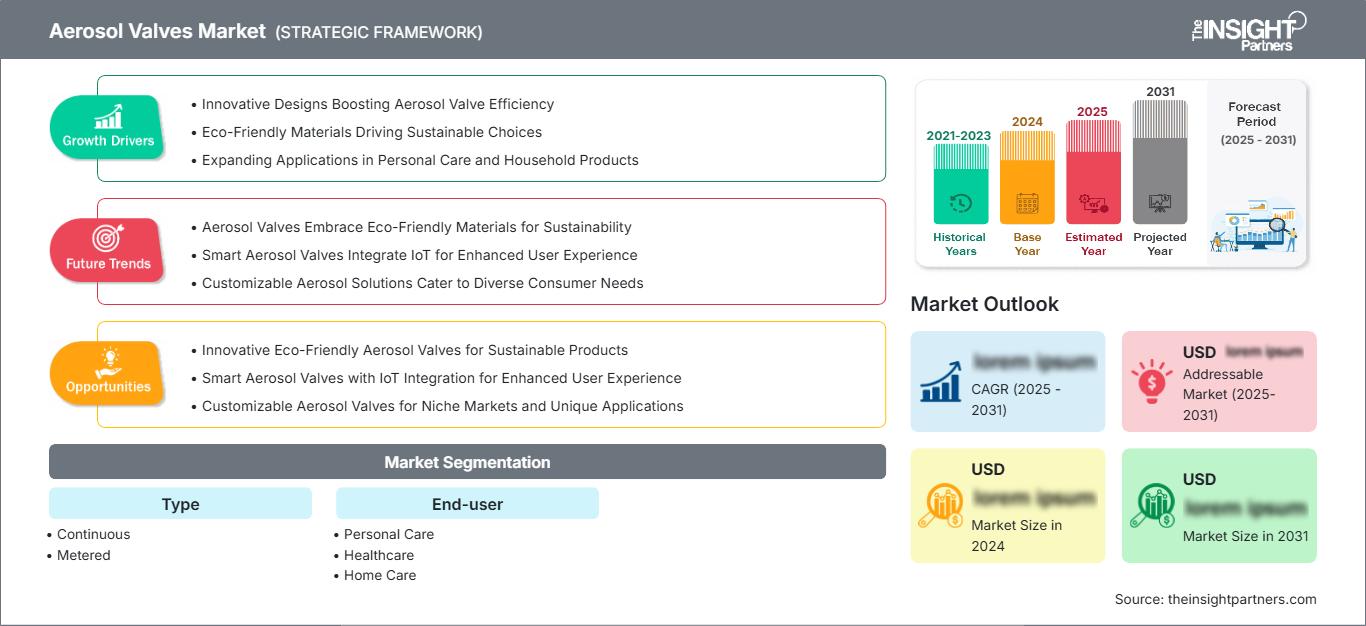
Markt für Aerosolventile: Strategische Einblicke
-
Holen Sie sich die wichtigsten Markttrends aus diesem Bericht.Dieses KOSTENLOSE Beispiel umfasst Datenanalysen, die von Markttrends bis hin zu Schätzungen und Prognosen reichen.
Regional Insights
North America aerosol valves
North America's share held steady between 30% and 34% in 2025 and is expected to grow at a CAGR of 2.4% to 2.8% from 2026 to 2034. The demand foundation in the region includes deodorants, dry shampoos, disinfectant sprays, automotive lubricants, and healthcare aerosols subject to regulatory norms. Well-established networks of filling in the US, Canada, and Mexico help maintain format localization and standardization of valves in products.
The structure of growth is influenced by VOC-compliant formulations, aluminum can recycling, and the increasing preference for controlled spray technologies in premium consumer goods. The aerosol valves market share in North America is also supported by robust aftermarket demand for automobiles and high-quality pharmaceutical packaging systems. Manufacturers with testing facilities, rapid sampling, and knowledge of compatibility have a better chance of defending contracts with multinationals.
U.S. aerosol valves Market
North America consists of the United States at 76-80%. The CAGR is estimated at 2.5-2.9%. Demand will prevail in personal care applications, respiratory treatments, disinfection sprays for households, insect control products, and maintenance garage products. Large fillers need valves that meet the requirements of repeatability, corrosion resistance, and fast crimping.
In the United States, vendors that provide valves to customers include AptarGroup, Inc., Precision Valve Corporation, Clayton Corporation, Newman-Green Inc., and Summit Packaging Systems Limited. Trends in the application of valves include more focus on metered healthcare valves, bags with dispensers, and premium mist fragrances.
Europe aerosol valves Market
In 2025, Europe accounted for 28–32% and is projected to register a CAGR of 2.1–2.5% for 2026–2034. The leading country is Germany, owing to its excellence in aerosol filling, automotive care, industrial maintenance, and technical packaging. German buyers prefer valves that are durable, recyclable, and compatible with the stringent requirements for handling propellants and chemicals.
The UK aerosol valves market is driven by personal care aerosols, air fresheners, pharmaceutical sprays, and private label products in the household segment. Specification improvements are more prevalent than aggressive demand in this market as retailers seek reduced packaging waste, recyclability, and better propellant systems. LINDAL Group Holding GmbH and Salvalco Limited are worth considering with regard to sustainability-driven innovations.
France, Italy, and Spain contribute through cosmetics, fragrances, home care, and regional filling clusters. Coster Tecnologie Speciali S.p.A. supports Italy’s technical capability, while French brands influence premium personal care valve requirements. One of the significant aerosol valves market trends includes Southern European producers adopting lighter components and lower-emission systems as retailer sustainability audits become more detailed.
APAC aerosol valves Market
APAC accounted for 22–26% share in 2025 and is projected to grow at a CAGR of 3.2–3.6%. China leads regional volume through personal care, household, industrial, and export-oriented aerosol filling.
Japan and South Korea emphasize precision, cosmetics, and healthcare quality, creating demand for reliable metered and fine-mist valve systems. MITANI VALVE CO., LTD. benefits from this engineering-led environment.
The aerosol valves market growth in India and Australia is driven through rising grooming, surface-care, and automotive maintenance consumption. Policy support for domestic manufacturing and packaging localization strengthens aerosol valves growth across regional supply chains.
Middle East & Africa aerosol valves Market
The aerosol valves market in Middle East & Africa is expected to grow at a CAGR of 2.8–3.2% through 2034. Saudi Arabia leads regional demand as industrial diversification supports local packaging, personal care, and maintenance aerosol production.
The UAE acts as a distribution and re-export hub for branded aerosols, supported by logistics infrastructure, retail expansion, and premium consumer goods imports. Demand favors reliable valves for hot-climate stability.
South Africa and Rest of MEA add demand from household, automotive, and industrial sprays. Energy-sector maintenance products also support specialized aerosol formats requiring corrosion-resistant valve components.
Segmentation Analysis
Type
The type segment in the aerosol valves market is expected to grow at a CAGR of 2.5–2.9% during 2026–2034 as manufacturers balance high-volume continuous dispensing with precision-oriented metered systems. Continuous valves dominate everyday aerosol formats because they are cost-efficient and adaptable, while metered valves are gaining strategic relevance in healthcare, fragrance, and controlled-dose applications where repeatability improves safety and consumer experience.
- Continuous valves remain the core platform for deodorants, air care, surface sprays, lubricants, and paints because they deliver uninterrupted flow, support high-speed filling, and offer proven compatibility across can formats.
- Metered valves serve applications requiring controlled release, including inhalation systems, fragrance sampling, and premium personal care sprays, where consistent dose volume and reduced product waste strengthen purchasing justification.
End-user
The end-user segment is projected to grow at a CAGR of 2.7–3.1% from 2026 to 2034, reflecting steady replacement demand in mature consumer categories and higher specification growth in healthcare. Personal care provides the largest commercial base, while healthcare offers higher technical value. Home care and automotive applications sustain volume through recurring maintenance, hygiene, and convenience-driven product use.
- Personal Care is the largest end-user, supported by deodorants, hair styling, shaving foams, sunscreens, and body mists that require fine spray control, consistent aesthetics, and compatibility with branded packaging.
- Healthcare is strategically important because respiratory, wound-care, and topical spray products demand reliable metering, clean manufacturing practices, and component validation that raise entry barriers for commodity suppliers.
- Home Care uses aerosol valves in disinfectants, air fresheners, surface cleaners, and insect-control sprays, where convenience, directional spraying, and shelf stability influence repeat purchases and private-label adoption.
- Automotive demand is tied to lubricants, cleaners, tire inflators, and maintenance sprays, with buyers prioritizing solvent resistance, clog prevention, corrosion protection, and performance under storage temperature variation.
Opportunity Snapshot
| End User |
Revenue Contribution |
Trend Tag |
Adoption Stage |
|
Personal Care |
High |
Fine Mist |
Mature |
|
Healthcare |
Medium |
Dose Control |
Scaling |
|
Home Care |
Medium |
Disinfection Spray |
Mature |
|
Automotive |
Low |
Maintenance Aerosols |
Scaling |
Aerosol Valves Market Growth Drivers and Impact Analysis
Expansion of Aerosol-Based Personal Care Formats
Personal care will continue to be the most noticeable catalyst due to aerosol containers' ability to package deodorants, hair sprays, dry shampoos, shaving foams, and body mists, enabling quick application and precise sensory behavior. Product marketers are moving beyond the functionality of a simple spray to reduced-noise valves, fine mists, and high-quality actuators. This makes the importance of precision components more pronounced even in established product categories. It is especially true for suppliers with the capacity to jointly design valves with formulators, since spray behavior depends on the fragrance load, viscosity, and propellant used.
Healthcare Demand for Controlled and Hygienic Dispensing
Medical use cases have added to the technical challenges, since the valve must dispense consistent dosages, reduce the risk of contamination, and be compatible with delicate formulations. Delivery systems for respiratory treatments, antiseptic sprays for topical application, and aerosols for wounds focus more on metering accuracy, material extractables, and proper assembly procedures. The importance of this driver in the market is significant despite the low volume compared to personal care applications, because regulated products offer better margins and a qualification process that takes a long time.
Sustainability Pressure on Propellants and Components
Increasing environmental concerns are shaping specifications as regulatory authorities, retailers, and brands strive for reductions in emissions, recyclable packages, and less material-intensive products. Valve designs must be reliable when working with compressed gases, hydrocarbon mixtures, and even novel propellants, with minimal environmental impact, while retaining effective spraying performance. It is not just about compliance; sustainable features are increasingly important in selecting suppliers, especially in Europe and North America. Proving compatibility with the aluminum recycling process, light-weighting, and leak-proof designs will enable clients to cut losses and emissions.
Aerosol Valves Market Future Trends
Growth of Low-Emission Dispensing Architectures
Valve systems will be developed in the future for their performance and low environmental impact throughout the packaging life cycle. Compressed air valves, nitrogen valves, and bag-separated valves are likely to undergo more testing, especially in household, personal care, and pharmaceutical products, where product quality is an issue. This will require ensuring that the pressure curve remains stable and that spray particle size and evacuation rate remain unchanged, without adding costs or complexity to the system. Suppliers with laboratory data, filling-line assistance, and compatibility tables will enjoy a business advantage.
Digital Quality Control in Valve Manufacturing
Manufacturing plants will have to use automated inspection and vision systems, as well as data analytics, during production to minimize leakage, dimensional drift, and assembly problems. This becomes especially important in light of tight tolerances being required by clients for metering valves and high-end spray systems. Digital quality control may improve traceability, enabling root cause analysis in the event of any filling problems. In the longer term, aerosol valves will see a trend towards factories combining high-speed assembly with continuous process control. For the buyer, this reduces supply risks and enables the qualification of valves for high-value product lines.
Aerosol Valves Market Opportunities
Localized Supply Partnerships in Asia Pacific
Asia Pacific offers an opportunity for valve suppliers to form localized partnerships with fillers, can makers, and consumer brands that are expanding regional aerosol production. China, India, Japan, and South Korea have different purchasing priorities, ranging from cost-efficient personal care valves to high-precision healthcare and cosmetics systems. Establishing technical service hubs can shorten qualification cycles and reduce dependence on imported components. Companies that localize tooling, sampling, and after-sales troubleshooting can capture programs before global specifications are finalized. This opportunity is especially relevant as multinational brands seek resilient supply chains and domestic producers move into higher-value aerosol formats.
Premium Metered Systems for Regulated Products
Metered systems create investment opportunity because they address applications where accurate dosing, safety, and product economy are commercially important. Healthcare sprays, dermatology products, fragrance samplers, and specialty household chemicals can justify higher valve costs when performance reduces waste or improves compliance. Suppliers can differentiate through dose repeatability testing, material compatibility databases, and co-development with formulation teams. The opportunity is action-oriented: build dedicated metered-valve portfolios, support regulatory documentation, and provide filling-line validation. This can move suppliers beyond commodity pricing and strengthen customer lock-in across products that require qualification, stability testing, and controlled release performance.
Recent Developments
- June 2026: AptarGroup, Inc. — Aptar Beauty expanded production of the AAT Vertical Slider Aerosol Valve in the U.S. for high-powder and shimmer formulations. Its 3.5 mm straight shank stem helps minimizes gasket flexing and wipes residual product build up to reduce clogging and prevent propellant leakage in particle-rich formulations.
- March 2025: Coster Group — Coster Group announced the opening of its new production facility in Cabreúva, São Paulo, Brazil. This strategic expansion further strengthens the Group’s presence in South America and supports its continued growth in the region. The new plant, operational since June 2024, marks a significant step in Coster Group’s strategy to expand its global operations. With the ability to manufacture aerosol valves, actuators, and pumps, the Cabreúva site is set to increase the capabilities of the Group in Brazil and South America, working together with the historic site in Pilar (BsAS), Argentina.
- August 2025— Summit Packaging Systems celebrated the inauguration of its state-of-the-art, 3,500-square-meter Toluca facility. The new site has two advanced high-speed valve assembly lines, offering annual capacity of approximately 250 million units.
Frequently Asked Questions

Nivedita ist eine versierte Forschungsexpertin mit über 9 Jahren Erfahrung in Marktforschung und Unternehmensberatung. Sie ist derzeit als Projektmanagerin im IKT-Bereich bei The Insight Partners tätig und verfügt über umfassende Fachkenntnisse in der Leitung und Durchführung von syndizierten, kundenspezifischen, abonnementbasierten und beratenden Forschungsaufträgen in unterschiedlichen Technologiesektoren.
Mit einer nachgewiesenen Erfolgsbilanz bei der Bereitstellung datengestützter Analysen und umsetzbarer Erkenntnisse war Nivedita maßgeblich an mehreren kritischen Projekten beteiligt. Ihre Arbeit umfasst die vollständige Projektabwicklung – vom Verständnis der Kundenziele über die Analyse von Markttrends bis hin zur Ableitung strategischer Empfehlungen. Sie hat umfassend mit führenden IKT-Unternehmen zusammengearbeitet und ihnen geholfen, Marktchancen zu erkennen und Branchenveränderungen zu meistern.
Nivedita hat einen MBA in Management vom IMS, Dehradun. Vor ihrem Eintritt bei The Insight Partners sammelte sie wertvolle Erfahrungen bei MarketsandMarkets und Future Market Insights in Pune, wo sie verschiedene Forschungspositionen innehatte und sich ein solides Fundament in Branchenanalyse und Kundenbindung erarbeitete.
- Umfassende Analyse der Marktgröße und Prognosen
- Detaillierte Segmentierungsanalyse
- Tiefgehende Bewertung der Marktdynamik
- Einblicke auf regionaler und nationaler Ebene
- Wettbewerbslandschaft und Unternehmens-Benchmarking
- Strategische Business Intelligence
Erfahrungsberichte

The Insight Partners lieferte wertvolle Marktinformationen, die unsere globale Markteintrittsstrategie unterstützten. Das Team arbeitete professionell, reagierte schnell und ging aufmerksam auf unser Feedback ein. Während des gesamten Projekts stellte es fundierte Analysen und hilfreiche methodische Erläuterungen bereit.
Junmo Kim Finanzvorstand (CFO), Enertech Co., Ltd.
Der SCADA-Systemmarktbericht von Insight Partners ist umfassend und bietet wertvolle Einblicke in aktuelle Trends und Zukunftsprognosen. Das Team war durchweg hochprofessionell, reaktionsschnell und hilfsbereit. Wir sind sehr zufrieden und können die Dienstleistungen wärmstens empfehlen.
RAN KEDEM Partner, Reali Technologies LTDs
Ich habe einen Bericht über einen sehr spezifischen Softwaremarkt angefordert, und das Team hat ihn innerhalb weniger Tage erstellt. Die Informationen waren sehr relevant und gut präsentiert. Anschließend habe ich einige Änderungen und Ergänzungen zum Bericht angefordert. Das Team reagierte erneut sehr schnell, und ich erhielt den Abschlussbericht in weniger als einer Woche.
JEAN-HERVE JENN Vorsitzende, Future Analytica
Wir haben mit The Insight Partners für eine wichtige Marktstudie und Prognose zusammengearbeitet. Sie gaben uns klare Einblicke in Chancen und Risiken, die uns bei der Gestaltung unserer Pläne halfen. Ihre Recherchen waren benutzerfreundlich und basierten auf soliden Daten. Sie halfen uns, kluge und sichere Entscheidungen zu treffen. Wir können sie wärmstens empfehlen.
PIYUSH NAGPAL Sr. Vizepräsident, Fernlicht Global
Die Insight Partners lieferten aufschlussreiche, gut strukturierte Marktforschung mit fundierter Fachkompetenz. Ihr Team war durchweg professionell und reaktionsschnell. Die benutzerfreundliche Website ermöglichte den Zugriff auf Branchenberichte. Wir empfehlen sie wärmstens für zuverlässige und hochwertige Forschungsdienstleistungen.
YUKIHIKO ADACHI Geschäftsführer, Deep Blue, LLC.
Dies ist das erste Mal, dass ich einen Marktbericht von The Insight Partners erworben habe. Obwohl ich zunächst unsicher war, besuchte ich die Website und fühlte mich dann sicherer, das Risiko einzugehen und einen Marktbericht zu kaufen. Ich bin mit der Qualität des Berichts und dem Kundenservice rundum zufrieden. Ich hatte einige Fragen und Anmerkungen zum ersten Bericht, aber nach einigen E-Mail-Gesprächen mit dem Analysten bin ich überzeugt, dass ich einen Bericht habe, den ich als Input für unseren strategischen Planungsprozess verwenden kann. Vielen Dank, dass Sie sich die Zeit genommen und dies zu einer positiven Erfahrung gemacht haben. Ich werde Ihren Service auf jeden Fall weiterempfehlen und Sie werden meine erste Anlaufstelle sein, wenn wir weitere Marktdaten benötigen.
JOHN SUZUKI Präsident und Chief Executive Officer, Vorstandsmitglied, BK Technologies
Ich möchte mich für Ihre Unterstützung und die Professionalität bedanken, die Sie bei der Bearbeitung meiner Informationsanfrage zum IVD-Markt für Infektionskrankheiten in Nigeria gezeigt haben. Ich schätze Ihre Geduld, Ihre Beratung und die Tatsache, dass Sie bereit waren, einen Rabatt anzubieten, der uns schließlich den Abschluss eines Geschäfts ermöglichte. Ich freue mich darauf, The Insight Partners in Zukunft wieder zu beauftragen, dank des Eindrucks, den Sie bei dieser ersten Begegnung bei mir hinterlassen haben.
DR. CHIJIOKE ONYIA GESCHÄFTSFÜHRERIN, PineCrest Healthcare Ltd.Grund zum Kauf
- Fundierte Entscheidungsfindung
- Marktdynamik verstehen
- Wettbewerbsanalyse
- Kundeneinblicke
- Marktprognosen
- Risikominimierung
- Strategische Planung
- Investitionsbegründung
- Identifizierung neuer Märkte
- Verbesserung von Marketingstrategien
- Steigerung der Betriebseffizienz
- Anpassung an regulatorische Trends




















 Kostenlose Probe anfordern für -