
Potenzial und Treiber des globalen Marktes für scharfe Saucen bis 2034
Abdeckung: nach Verpackungsart (Flaschen und Gläser, Beutel und Sachets, Sonstige); Vertriebskanal (Supermärkte und Verbrauchermärkte, Convenience-Stores, Online-Handel, Sonstige) und Geografie
- Status : Veröffentlichte Daten
- Berichtscode : TIPRE00011077
- Kategorie : Speisen und Getränke
- Anzahl der Seiten : 150
- Verfügbare Berichtsformate :


- Datum der letzten Aktualisierung : April 24, 2026


Marktgröße 2025
3,39 Mrd. US-Dollar
Basisjahrwert
Prognose für 2034
4,56 Mrd. US-Dollar
Prognose bis 2034
CAGR 2026-2034
3,35 %
Wachstumsrate
Adressierbarer Markt
36,10 Mrd. US-Dollar
(2026–2034)
Der globale Markt für scharfe Saucen wurde im Jahr 2025 auf 3,39 Milliarden US-Dollar geschätzt und soll bis 2034 auf 4,56 Milliarden US-Dollar anwachsen; für den Zeitraum 2026-2034 wird eine durchschnittliche jährliche Wachstumsrate (CAGR) von 3,35 % erwartet.
Marktanalyse für scharfe Saucen
Die meisten Verbraucher in Industrienationen haben sich an die wachsende Beliebtheit von Fast Food und Fertiggerichten gewöhnt, sei es als Genussmittel, Mahlzeit oder Mahlzeitenersatz. Dieser steigende Konsum von scharfen, verarbeiteten Fertiggerichten, insbesondere in Form von Nudeln, Pommes frites, Sandwiches, Burgern, Burritos, Tacos und Wraps, treibt den Markt für scharfe Saucen mit vielfältigen Geschmacksrichtungen an, um den dynamischen Verbraucherpräferenzen gerecht zu werden. Auch die Verwendung solcher Produkte in der gehobenen Gastronomie ist ein wichtiger Wachstumsfaktor. Das enthaltene Capsaicin trägt zudem zu gesundheitlichen Vorteilen wie Gewichtsverlust und Schmerzlinderung bei, was die Produkte wiederum verbraucherfreundlicher macht. Aufgrund des wachsenden Gesundheitsbewusstseins der Verbraucher bieten sich den Marktteilnehmern daher Chancen, in Forschung und Entwicklung zu investieren, um die damit verbundenen gesundheitlichen Vorteile zu nutzen und Produkte mit einem transparenten Etikett anzubieten.
Marktübersicht für scharfe Saucen
Nordamerika und Europa verzeichnen ein signifikantes Marktwachstum dank ihrer etablierten Fast-Food- und Fertiggerichtindustrie mit der starken Präsenz großer Anbieter wie Subway, Taco Bell, McDonald’s und KFC. Das Marktwachstum im asiatisch-pazifischen Raum wird durch die traditionelle Verwendung solcher Saucen in Form von Chiliöl und Gochujang, vorwiegend in der traditionellen scharfen chinesischen und koreanischen Küche, angetrieben. Auch die zunehmende Urbanisierung trägt maßgeblich zur steigenden Kaufkraft und den verbesserten Lebensbedingungen bei, was sich wiederum auf die Preise dieser Saucen auswirkt.
Highlights der Marktforschung
- Der globale Markt für scharfe Saucen wurde im Jahr 2025 auf 3,39 Milliarden US-Dollar geschätzt.
- Es wird erwartet, dass das jährliche Marktvolumen bis 2034 4,56 Milliarden US-Dollar erreichen wird.
- Der gesamte adressierbare Markt (TAM) wird im Zeitraum 2026-2034 voraussichtlich rund 36,10 Milliarden US-Dollar erreichen.
- Es wird erwartet, dass der Markt im Prognosezeitraum eine durchschnittliche jährliche Wachstumsrate (CAGR) von 3,35 % verzeichnen wird.
- Die Vereinigten Staaten stellen einen Schlüsselmarkt dar, gestützt durch das wachsende Interesse der Verbraucher an scharfen Aromen und kulinarischen Erlebnissen, die zunehmende Beliebtheit von scharfen Saucen in der globalen Küche und in Rezepten, die steigende Nachfrage nach einzigartigen und handwerklich hergestellten scharfen Saucensorten sowie die sich entwickelnde Branchendynamik.
- Die Marktanalyse umfasst Nordamerika, Europa, den asiatisch-pazifischen Raum, Süd- und Mittelamerika, den Nahen Osten und Afrika, wobei das Wachstum über den gesamten Prognosezeitraum bewertet wird.
- Marktchancen wie die Erforschung pflanzlicher Alternativen zu scharfen Saucen für gesundheitsbewusste Konsumenten, die Entwicklung von Gourmet-Saucen mit einzigartigen Geschmacksprofilen und Zutaten sowie der Ausbau von Online-Vertriebskanälen für Nischenmarken und -produkte im Bereich scharfer Saucen werden voraussichtlich die Marktdynamik und den adressierbaren Markt beeinflussen.
- Der Bericht stellt Branchenteilnehmer wie McIlhenny Company, McCormick & Company, Inc., Huy Fong Foods, Inc., Baumer Foods Inc., Garner Foods, B&G Foods, Inc., The Kraft Heinz Company, SALSA TAMAZULA SA DE CV., Bruce Foods und Schwarz vor und analysiert Wettbewerbsstrategien und Innovationsentwicklungen.
-
Quelle: Analyse von The Insight Partners auf Basis eigener Recherchen, Regierungsveröffentlichungen, Geschäftsberichten von Unternehmen, Investorenpräsentationen, Branchendatenbanken und Experteninterviews.
● BERICHTSANPASSUNG
Passen Sie diesen Bericht an Ihre spezifischen Geschäftsanforderungen an.
Dieser Bericht lässt sich präzise an Ihre Geschäftsziele, Ihren Umfang und Ihre Zielmärkte anpassen. Zu den Anpassungsoptionen gehören maßgeschneiderte Segmentierungen, geografische Analysen, Wettbewerbsanalysen und strategische Einblicke, die eine fundierte Entscheidungsfindung unterstützen.
Diesen Bericht anpassen →WAS SIE EINSTELLEN KÖNNEN
- ● Segmentierungen
- ● Geographie
- ● Wettbewerbsanalyse
- ● Sprachpräferenzen
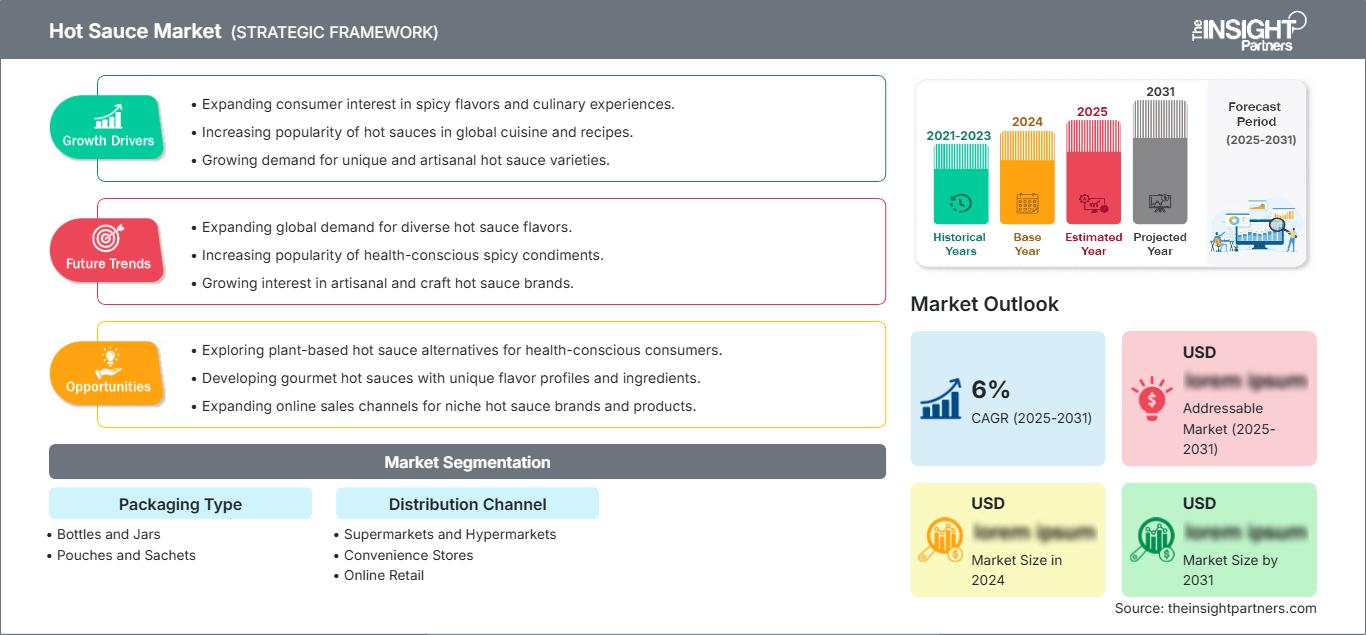
Markt für scharfe Saucen: Strategische Einblicke
-
Ermitteln Sie die wichtigsten Markttrends dieses Berichts.Diese kostenlose Probe beinhaltet eine Datenanalyse, die von Markttrends bis hin zu Schätzungen und Prognosen reicht.
Markttreiber und Chancen für scharfe Saucen
Wachsende Nachfrage nach verarbeiteten Lebensmitteln und Fertiggerichten
A key driver fueling the expansion of the hot sauce market is the rising disposable income among consumers globally, which has led to greater acceptance and consumption of premium convenience foods and fast food products. As lifestyles become more fast-paced, there is an increasing reliance on processed foods that offer quick preparation and enhanced flavor profiles, with hot sauces playing a pivotal role in elevating taste experiences. Additionally, the global popularity of ethnic cuisines, particularly those originating from China and Korea, is significantly boosting demand for hot sauces and condiments traditionally used in these culinary styles. These regional flavors are increasingly integrated into mainstream food products, further propelling market growth. Popular variants such as Louisiana-style Tabasco, Sriracha, Picante, and Harissa have gained widespread acceptance not only among consumers but also within the processed food industry, where they are used as key ingredients to enhance taste, aroma, and appeal. Moreover, evolving consumer preferences toward bold and diverse flavor profiles are encouraging manufacturers to innovate by introducing new blends and fusion sauces. The growing penetration of international cuisines and the expansion of global foodservice networks are expected to sustain the demand for hot sauces, making them an essential component in both home cooking and commercial food preparation. With urbanization and changing eating habits, the market is projected to maintain steady growth as hot sauces continue to gain prominence in culinary practices worldwide.
Rising Health-Conscious Consumer Segment
While hot sauce is widely appreciated as a flavorful addition to meals, concerns around the inclusion of additives, high sodium content, and preservatives often limit its appeal among health-conscious consumers. Recognizing this, market players are increasingly focusing on product innovation aimed at developing clean-label hot sauces that utilize natural ingredients such as fresh peppers, organic vinegar, and natural spices, while minimizing artificial additives and preservatives. This shift toward healthier formulations aligns with the growing demand for transparent labeling and products that support wellness goals without compromising on taste. New-generation consumers, particularly millennials and Gen Z, are more discerning about ingredient quality and actively seek products that align with their nutritional and lifestyle preferences. The emergence of “better-for-you” hot sauce variants provides a significant opportunity for brands to capture this expanding segment by offering guilt-free options that fit into balanced, health-focused diets. Additionally, the rise of plant-based and organic food trends complements this movement, driving innovation in hot sauce recipes that cater to diverse dietary needs, including vegan, gluten-free, and non-GMO certifications. Companies investing in natural and organic hot sauce lines are also capitalizing on the growing clean-eating movement and the increasing awareness of the impact of diet on long-term health. As consumer education and demand for healthier alternatives continue to rise, the market is expected to see accelerated growth driven by products that prioritize ingredient integrity, nutritional benefits, and sustainable sourcing.
Hot Sauce Market Report Segmentation Analysis
Key segments that contributed to the derivation of the hot sauce market analysis are packaging type and distribution channel.
- Based on packaging type, the hot sauce market is divided into bottles and jars, pouches and sachets, and others.
- By distribution channel, the market is divided into supermarkets and hypermarkets, convenience stores, online retail, and others.
Hot Sauce Market Share Analysis by Geography
The Hot Sauce Market Report comprises a detailed analysis of five major geographic regions: North America, Europe, Asia Pacific (APAC), Middle East and Africa (MEA), and South & Central America. Each region is further sub-segmented into respective countries. This report provides analysis and forecasts of 18+ countries, covering hot sauce market dynamics such as drivers, trends, and opportunities that are impacting the markets at the regional level. Also, the report covers PEST analysis, which involves the study of major factors that influence the hot sauce market in these regions.
Hot Sauce Market Report Scope
| Report Attribute | Details |
|---|---|
| Market size in 2025 | US$ 3.39 Billion |
| Market Size by 2034 | US$ 4.56 Billion |
| Global CAGR (2026 - 2034) | 3.35% |
| Historical Data | 2021-2024 |
| Forecast period | 2026-2034 |
| Segments Covered |
By Packaging Type
|
| Regions and Countries Covered |
North America
|
| Market leaders and key company profiles |
|
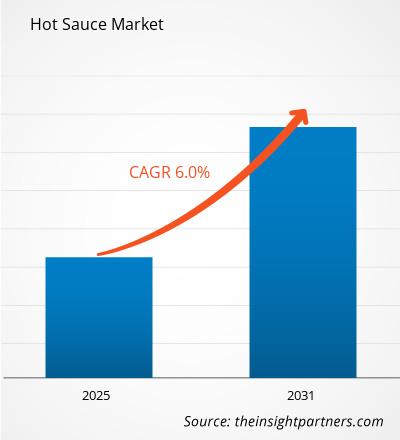
Hot Sauce Market Players Density: Understanding Its Impact on Business Dynamics
The Hot Sauce Market is growing rapidly, driven by increasing end-user demand due to factors such as evolving consumer preferences, technological advancements, and greater awareness of the product's benefits. As demand rises, businesses are expanding their offerings, innovating to meet consumer needs, and capitalizing on emerging trends, which further fuels market growth.
Hot Sauce Market News and Recent Developments
The hot sauce market is evaluated by gathering qualitative and quantitative data post primary and secondary research, which includes important corporate publications, association data, and databases. A few of the developments in the hot sauce market are listed below:
- Frank's Red-hot, among the most popular hot sauce in the world, is expanding its offerings with two new product lines: Frank's RedHot Dip'n Sauce and Frank's RedHot Squeeze Sauce. Available now at select retailers and coming soon to stores nationwide. The new Frank's Dip'n and Squeeze Sauces let fans add the perfect balance of flavor and heat in a new way by dipping or drizzling as much as they want on any food. (Source: Press Release, March 2024)
Hot Sauce Market Report Coverage and Deliverables
The “Hot Sauce Market Size and Forecast (2021–2034)” report provides a detailed analysis of the market covering below areas:
- Hot sauce market size and forecast at global, regional, and country levels for all the key market segments covered under the scope
- Hot sauce market trends as well as market dynamics such as drivers, restraints, and key opportunities
- Detailed PEST/Porter’s Five Forces and SWOT analysis
- Hot sauce market analysis covering key market trends, global and regional framework, major players, regulations, and recent market developments
- Industry landscape and competition analysis covering market concentration, heat map analysis, prominent players, and recent developments for the hot sauce market
- Detailed company profiles
Frequently Asked Questions

Vrushali ist eine erfahrene Senior Consultant mit über acht Jahren Berufserfahrung und umfassender Branchenexpertise im Bereich Chemie und Materialien (Chemicals & Materials), insbesondere auf dem Gebiet der Spezialchemikalien. Im Laufe ihrer Karriere hat sie mehr als 50 Beratungsprojekte in den Bereichen Chemie und Materialien, Lebensmittel und Getränke (Food & Beverage) sowie Konsumgüter (Consumer Goods) erfolgreich durchgeführt. Ihre Fachkenntnisse erstrecken sich über verschiedene Marktsegmente, darunter funktionelle Inhaltsstoffe, erneuerbare Chemikalien, Tierfuttermittel und Agrochemikalien. Durch ihre fundierten Branchenkenntnisse und ihre analytischen Fähigkeiten unterstützt sie Unternehmen bei der Bewertung von Marktpotenzialen und der Entwicklung strategischer Geschäftsmöglichkeiten.
Vrushali verfügt über einen Bachelorabschluss in Chemie sowie einen Masterabschluss in Management und verbindet damit fundiertes technisches Fachwissen mit einem ausgeprägten Verständnis für Unternehmensstrategien und wirtschaftliche Zusammenhänge. Sie hat zahlreiche Kunden bei der Bewertung von Marktexpansionsmöglichkeiten, der Entwicklung nachhaltiger Wachstumsstrategien sowie der Umsetzung operativer Transformationsinitiativen unterstützt. Ihre interdisziplinäre Expertise ermöglicht es ihr, komplexe Marktanforderungen zu analysieren und praxisorientierte strategische Lösungen zu entwickeln, die auf die jeweiligen Geschäftsziele ihrer Kunden abgestimmt sind.
Zu Vrushalis zentralen Kompetenzen gehören die Neukundengewinnung, das Stakeholder-Management sowie die Führung und Koordination von Teams. Durch einen strukturierten und systematischen Ansatz bei der Planung und Durchführung von Beratungsprojekten hat sie maßgeblich zur Verbesserung der betrieblichen Effizienz und Produktivität beigetragen. Ihre besondere Stärke liegt darin, technisches Fachwissen mit kommerziellen Prioritäten und strategischen Unternehmenszielen zu verknüpfen. Dadurch ist sie in der Lage, fundierte, praxisnahe und umsetzbare Handlungsempfehlungen zu entwickeln, die auf die individuellen geschäftlichen Anforderungen ihrer Kunden zugeschnitten sind und deren langfristige Wettbewerbsfähigkeit unterstützen.
- Umfassende Analyse der Marktgröße und Prognosen
- Detaillierte Segmentierungsanalyse
- Tiefgehende Bewertung der Marktdynamik
- Einblicke auf regionaler und nationaler Ebene
- Wettbewerbslandschaft und Unternehmens-Benchmarking
- Strategische Business Intelligence
Erfahrungsberichte

The Insight Partners lieferte wertvolle Marktinformationen, die unsere globale Markteintrittsstrategie unterstützten. Das Team arbeitete professionell, reagierte schnell und ging aufmerksam auf unser Feedback ein. Während des gesamten Projekts stellte es fundierte Analysen und hilfreiche methodische Erläuterungen bereit.
Junmo Kim Finanzvorstand (CFO), Enertech Co., Ltd.
Der SCADA-Systemmarktbericht von Insight Partners ist umfassend und bietet wertvolle Einblicke in aktuelle Trends und Zukunftsprognosen. Das Team war durchweg hochprofessionell, reaktionsschnell und hilfsbereit. Wir sind sehr zufrieden und können die Dienstleistungen wärmstens empfehlen.
RAN KEDEM Partner, Reali Technologies LTDs
Ich habe einen Bericht über einen sehr spezifischen Softwaremarkt angefordert, und das Team hat ihn innerhalb weniger Tage erstellt. Die Informationen waren sehr relevant und gut präsentiert. Anschließend habe ich einige Änderungen und Ergänzungen zum Bericht angefordert. Das Team reagierte erneut sehr schnell, und ich erhielt den Abschlussbericht in weniger als einer Woche.
JEAN-HERVE JENN Vorsitzende, Future Analytica
Wir haben mit The Insight Partners für eine wichtige Marktstudie und Prognose zusammengearbeitet. Sie gaben uns klare Einblicke in Chancen und Risiken, die uns bei der Gestaltung unserer Pläne halfen. Ihre Recherchen waren benutzerfreundlich und basierten auf soliden Daten. Sie halfen uns, kluge und sichere Entscheidungen zu treffen. Wir können sie wärmstens empfehlen.
PIYUSH NAGPAL Sr. Vizepräsident, Fernlicht Global
Die Insight Partners lieferten aufschlussreiche, gut strukturierte Marktforschung mit fundierter Fachkompetenz. Ihr Team war durchweg professionell und reaktionsschnell. Die benutzerfreundliche Website ermöglichte den Zugriff auf Branchenberichte. Wir empfehlen sie wärmstens für zuverlässige und hochwertige Forschungsdienstleistungen.
YUKIHIKO ADACHI Geschäftsführer, Deep Blue, LLC.
Dies ist das erste Mal, dass ich einen Marktbericht von The Insight Partners erworben habe. Obwohl ich zunächst unsicher war, besuchte ich die Website und fühlte mich dann sicherer, das Risiko einzugehen und einen Marktbericht zu kaufen. Ich bin mit der Qualität des Berichts und dem Kundenservice rundum zufrieden. Ich hatte einige Fragen und Anmerkungen zum ersten Bericht, aber nach einigen E-Mail-Gesprächen mit dem Analysten bin ich überzeugt, dass ich einen Bericht habe, den ich als Input für unseren strategischen Planungsprozess verwenden kann. Vielen Dank, dass Sie sich die Zeit genommen und dies zu einer positiven Erfahrung gemacht haben. Ich werde Ihren Service auf jeden Fall weiterempfehlen und Sie werden meine erste Anlaufstelle sein, wenn wir weitere Marktdaten benötigen.
JOHN SUZUKI Präsident und Chief Executive Officer, Vorstandsmitglied, BK Technologies
Ich möchte mich für Ihre Unterstützung und die Professionalität bedanken, die Sie bei der Bearbeitung meiner Informationsanfrage zum IVD-Markt für Infektionskrankheiten in Nigeria gezeigt haben. Ich schätze Ihre Geduld, Ihre Beratung und die Tatsache, dass Sie bereit waren, einen Rabatt anzubieten, der uns schließlich den Abschluss eines Geschäfts ermöglichte. Ich freue mich darauf, The Insight Partners in Zukunft wieder zu beauftragen, dank des Eindrucks, den Sie bei dieser ersten Begegnung bei mir hinterlassen haben.
DR. CHIJIOKE ONYIA GESCHÄFTSFÜHRERIN, PineCrest Healthcare Ltd.Grund zum Kauf
- Fundierte Entscheidungsfindung
- Marktdynamik verstehen
- Wettbewerbsanalyse
- Kundeneinblicke
- Marktprognosen
- Risikominimierung
- Strategische Planung
- Investitionsbegründung
- Identifizierung neuer Märkte
- Verbesserung von Marketingstrategien
- Steigerung der Betriebseffizienz
- Anpassung an regulatorische Trends




















 Kostenlose Probe anfordern für -