
Markt für Mill Auskleidung: Größe, Marktanteil & Prognose 2034
Marktgröße und Prognosen für Mühlenauskleidungen (2021–2034), globaler und regionaler Marktanteil, Trends und Wachstumschancenanalyse. Berichtsabdeckung: Nach Material (Stahl, Gummi, Verbundwerkstoff); Mühlentyp (Kugelmühle, Stabmühle, SAG-Mühle, AG-Mühle, Sonstige); Branche (Bergbau, Zement, Kraftwerke, Sonstige) und Geografie (Nordamerika, Europa, Asien-Pazifik sowie Süd- und Mittelamerika).
- Status : Veröffentlichte Daten
- Berichtscode : TIPRE00014740
- Kategorie : Fertigung und Bau
- Anzahl der Seiten : 150
- Verfügbare Berichtsformate :


- Datum der letzten Aktualisierung : July 20, 2026


2025 Market Size
US$ 3.48 Bn
Base year value
2034 Forecast
US$ 7.26 Bn
Projected by 2034
CAGR 2026-2034
8.50 %
Growth rate
Addressable Market
US$ 48.15 Bn
(2026-2034)
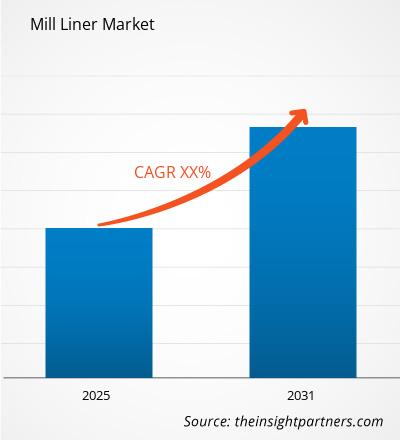
The Mill Liner Market is projected to expand from US$ 3.48 Billion in 2025 to US$ 7.26 Billion by 2034, registering a CAGR of 8.50% during 2026–2034. Demand is shaped by wear-intensive grinding circuits, rising mineral processing throughput, and the need for liners that extend operating campaigns while reducing reline frequency across mining, cement, and power generation mills.
Across North America, the Mill Liner Market size is supported by mature copper, gold, aggregates, and cement assets, with estimated regional expansion in the 7.8–8.3% CAGR range. Replacement-led procurement, safety-led liner handling improvements, and composite adoption in large SAG and ball mills are strengthening demand as operators prioritize uptime and predictable maintenance windows.
Mill Liner Market Assessment and Insights
- North America held 24–26% share in 2025 and is growing at a CAGR of 7.8–8.3% during 2026–2034, driven by mine modernization, cement plant relining, and aftermarket service intensity.
- US accounted for 70–74% of North America in 2025 and is growing at a CAGR of 7.9–8.4% during 2026–2034, led by copper, gold, and cement mills.
- Europe represented 18–20% share in 2025 and is growing at a CAGR of 7.2–7.8% during 2026–2034, with Germany, Sweden, Finland, Spain, and the UK supporting demand.
- Asia Pacific captured 34–37% share in 2025 and is growing at a CAGR of 9.0–9.6% during 2026–2034, led by China, India, Australia, Japan, and South Korea.
- Largest Segment Mining held 55–58% market share in 2025 and is growing at a CAGR of 8.7–9.2% during 2026–2034 due to recurring liner replacement.
- High Growth Segment Composite held 18–21% market share in 2025 and is growing at a CAGR of 9.5–10.2% during 2026–2034 as lightweight hybrid designs gain acceptance.
- Key companies analyzed in detail: Bradken Pty Limited, Eriez Manufacturing Co., FLSmidth & Co. A/S, Magotteaux International S.A., Metso Corporation, Multotec Group, Polycorp Ltd., thyssenkrupp AG, Trelleborg AB, and The Weir Group PLC.
Source: The Insight Partners' analysis based on proprietary research, government publications, company annual reports, investor presentations, industry databases, and expert interviews.
Grinding liners have evolved from standard steel castings into complex engineered solutions that involve metallurgy, geometrical design, safe installation, and inspection through technology. The Mill Liner Market has been positively impacted by increased adoption of optimized lifter shapes, rubber-steel composites, and wear prediction based on site-specific conditions. There is a change occurring in production as well due to the localization of foundries, reduced production periods, and integration of liner design based on ore strength, mill speed, ball movement, and time needed for relining.
In terms of future development, newly emerging mining regions, expansions of existing concentrators, and increasing safety requirements will facilitate a more widespread adoption of advanced liners. Funding will be geared towards recyclable materials, lighter components, and performance-based agreements that ensure liner lifetime directly correlates with mill availability. Regulations for waste management and high energy intensity will make these liners even more attractive.
Mill Liner Market Report Scope
| Report Attribute | Details |
|---|---|
| Market size in 2025 | US$ 3.48 Billion |
| Market Size by 2034 | US$ 7.26 Billion |
| Global CAGR (2026 - 2034) | 8.50% |
| Historical Data | 2021-2024 |
| Forecast period | 2026-2034 |
Mill Liner Market Analysis
Mill Liner Market growth is closely tied to recurring aftermarket replacement, because liners are consumed continuously in abrasive and impact-heavy grinding environments. Mining remains the primary demand anchor, while cement and power plants contribute stable replacement volumes. Line selections are being made to minimize downtime, enhance charging accuracy, and keep throughput high despite the mining of more challenging ores, increasing mill loading, and shortened maintenance windows.
The ecosystem consists of foundries, rubber compounders, mill equipment manufacturers, engineering firms, reliners, and mine maintenance crews. The supply dynamics are impacted by alloy steel supplies, rubber costs, logistics, and local casting capabilities. More and more buyers are favoring suppliers who offer material science, wear analysis, installation, and lifecycle analysis along with the liners themselves.
Mill Liner Market analysis indicates a competitive landscape led by firms that can integrate design, manufacturing, and service coverage across multiple regions. Metso Corporation and FLSmidth & Co. A/S are focusing on circular liner services. At the same time, Bradken Pty Limited, The Weir Group PLC, Magotteaux International S.A., and Multotec Group differentiate themselves using application engineering and proximity services. Polycorp Ltd., Trelleborg AB, thyssenkrupp AG, and Eriez Manufacturing Co. enhance specialization in rubber, wear parts, and process equipment.
The investment trend is towards recycling capacity, digital wear monitoring, and manufacturing in proximity to mining clusters. Competitive advantage becomes more focused on lowering total cost per tonne treated rather than just liner cost alone. Companies that respond quickly to relining requests, provide performance data, and have flexible materials will find themselves in a position to enter into long-term service agreements.
● REPORT CUSTOMIZATION
Tailor This Report To Align With Your Specific Business Requirements
This report can be customized to align precisely with your business objectives, scope, and target markets. Customization options include tailored segmentation, geography, competitive analysis, and strategic insights to support informed decision-making.
Customize This Report →WHAT YOU CAN ADJUST
- ● Segmentations
- ● Geography
- ● Competitive Analysis
- ● Language Preferences
Mill Liner Market:
Passen Sie diesen Bericht Ihren Anforderungen an
Sie erhalten kostenlos Anpassungen an jedem Bericht, einschließlich Teilen dieses Berichts oder einer Analyse auf Länderebene, eines Excel-Datenpakets sowie tolle Angebote und Rabatte für Start-ups und Universitäten.
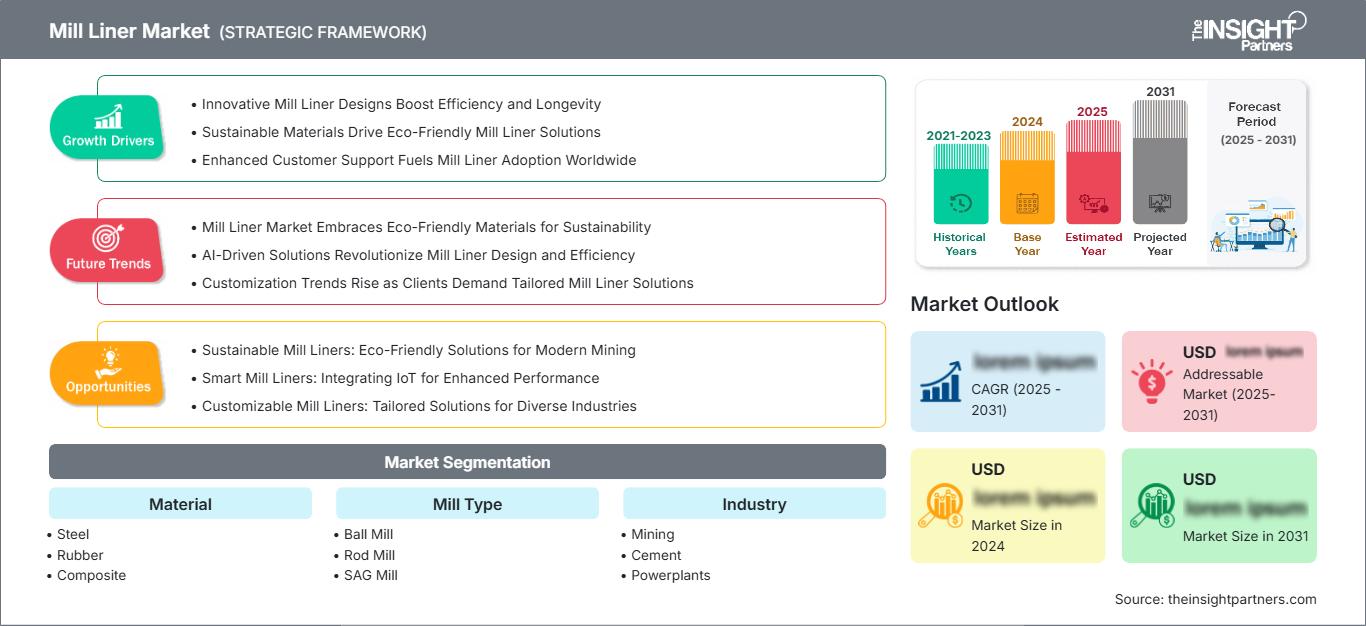
Markt für Mühlenauskleidungen: Strategische Einblicke
-
Holen Sie sich die wichtigsten Markttrends aus diesem Bericht.Dieses KOSTENLOSE Beispiel umfasst Datenanalysen, die von Markttrends bis hin zu Schätzungen und Prognosen reichen.
Regional Insights
North America Mill Liner Market
North America accounted for 24–26% of global demand in 2025 and is expected to grow at a CAGR of 7.8–8.3% during 2026–2034. The region benefits from copper, gold, iron ore, aggregates, and cement operations that rely on large ball, SAG, and rod mills. Its Mill Liner Market share is reinforced by replacement-led purchases, strict safety programs, and demand for lighter liners that reduce reline exposure. Structural growth is supported by mine life extension projects, higher ore hardness, and investment in grinding circuit optimization. Canada contributes through base metals and gold assets, while Mexico adds cement and precious metals activity. Procurement increasingly favors suppliers offering wear scans, design simulations, and recycling pathways for rubber and composite liners.
U.S. Mill Liner Market
The U.S. represented 70–74% of North American demand in 2025 and is growing at a CAGR of 7.9–8.4% during 2026–2034. Copper and gold concentrators in the western states, cement plants in key industrial belts, and power applications related to grinding all contribute to a sizable and well-established installed base for mill liner systems. Application trends point toward greater demand for composite liners and rubber liners due to their ability to deliver reduced noise levels, safer handling conditions for personnel, shorter maintenance periods, and faster installation of the liners in the mills. Additionally, the country is blessed with a good number of foreign and local manufacturers and distributors who offer assistance in inspecting the liners, scheduling mill shutdowns, and replacing the liners. There are further reasons for high demand in the form of investments made in infrastructure, new mining projects, and increased focus on mineral security within the country, which leads to better utilization and maintenance of equipment. Moreover, the market is showing interest in the newer mill liner packages incorporating inspection services, better fasteners, wear monitoring systems, and better liners.
Europe Mill Liner Market
Europe held 18–20% share in 2025 and is expanding at a CAGR of 7.2–7.8% during 2026–2034. Germany is one of the top countries because of cement, industrial minerals, and equipment engineering requirements. The United Kingdom contributes because of aggregates, cement, and quarries, where liners are chosen based on their wear life predictability and according to workplace safety requirements. The market of Germany has its advantages due to process engineering experience and requirements regarding efficient grinding of cement and minerals. Sweden and Finland help with consumption via mining clusters and supplier innovation, and France, Italy, and Spain contribute because of cement, aggregates, and industrial mineral usage.
APAC Mill Liner Market
APAC accounted for 34–37% of the global market in 2025 and is projected to grow at a CAGR of 9.0–9.6% during 2026–2034, making it the fastest-growing regional market. China is leading the market on account of its massive mining, cement production, and electricity generation industries. These industries make use of grinding plants, which need to replace their linings periodically in order to ensure optimal performance and equipment functioning. India is also becoming an important growth region because of the ongoing expansion of cement production capacities, infrastructure construction, and mineral processing plant construction, all of which contribute to constant needs for mill linings. Australia is still an important player in this market because of its active participation in iron ore, gold, lithium, and copper mining operations, which involve high-tonnage processing and require quality liner products. Moreover, Japan and South Korea add to this market because of their expertise in advanced materials and industrial efficiency. In the region, the support from the governments in terms of infrastructure development, domestic mineral resources security, and energy transition metals will be conducive to investments into mining and processing activities, thereby facilitating the development of advanced steel, rubber, and composite mill linings.
Middle East & Africa Mill Liner Market
The Middle East & Africa are projected to grow at a CAGR of 8.1–8.7% during 2026–2034, supported by expanding mining activities, increasing cement production capacity, and ongoing investments in energy and industrial infrastructure. South Africa continues to be the most important market in the region because of the significant gold, platinum group metal, coal, and cement milling operations in the country, which need liner replacement to keep the processes running effectively. On the other hand, Saudi Arabia and the UAE have been making their contribution towards market growth through investments in the industrial minerals sector, construction materials, and major developments that increase the need for reliable solutions in the milling process. In the remaining countries of the MEA region, the demand is based on gold, copper, phosphate, and cement projects, which are being carried out as part of economic diversification programs and industrial development based on the use of resources. The purchasers in the region place much attention on the reliability of liners that can cope with various ore properties and adverse conditions, remoteness of locations, and limited periods available for shutting down the milling processes.
Segmentation Analysis
Material
Material is expected to grow at a CAGR of 8.4–8.9% during 2026–2034 as operators choose liners based on ore abrasiveness, impact intensity, installation safety, and lifecycle cost. The Mill Liner Market scope within materials is widening from conventional steel toward rubber and composite solutions that combine wear resistance with lower mass and improved handling.
- Steel remains essential for high-impact SAG and AG mills where toughness, load-bearing capacity, and proven metallurgy are critical for severe ore conditions.
- Rubber is favored in lower-impact grinding where noise reduction, corrosion resistance, and safer manual handling improve operating conditions and reliability and efficiency.
- Composite is strategically important as hybrid metal-rubber designs reduce weight while maintaining wear performance, supporting faster installation and longer campaigns.
Mill Type
Mill Type is projected to grow at a CAGR of 8.3–8.8% during 2026–2034 as liner designs become more application-specific. Ball mills generate broad replacement demand in cement and minerals, while SAG and AG mills require advanced profiles that manage high-energy impacts, charge motion, and throughput stability.
- Ball Mill applications dominate cement and secondary grinding, where predictable liner wear, grinding efficiency, and high installed base create consistent replacement demand.
- Rod Mill demand is more specialized, serving applications needing coarse grinding control and durable liners that withstand sliding and rolling media contact.
- SAG Mill liners command strong strategic importance due to large mill sizes, high impact loads, and direct influence on concentrator throughput.
- AG Mill liners are used where ore acts as grinding media, requiring designs that balance impact resistance, charge movement, and shell protection.
Industry
Industry is forecast to grow at a CAGR of 8.6–9.1% during 2026–2034, with mining as the largest revenue contributor. Cement and power plants maintain steady demand because grinding equipment remains central to clinker processing, coal pulverization, and industrial material preparation, creating recurring opportunities for engineered liner replacement.
- Mining leads consumption because abrasive ores, large mill fleets, and continuous operations require recurring liner replacement to preserve throughput and availability.
- Cement uses liners in raw and finish grinding mills, where wear life, energy efficiency, and stable particle size distribution influence plant economics.
- Power plants rely on liners in coal and material grinding circuits, prioritizing reliability, heat tolerance, and maintenance planning for uninterrupted operation.
Opportunity Snapshot
|
Industry |
Revenue Contribution |
Trend Tag |
Adoption Stage |
|
Mining |
High |
Ore Hardness |
Mature |
|
Cement |
Medium |
Clinker Grinding |
Scaling |
|
Powerplants |
Low |
Coal Milling |
Mature |
Mill Liner Market Growth Drivers and Impact Analysis
Rising Ore Hardness and Concentrator Uptime Requirements
The falling grades and increasing hardness of ores mean that there will be a need to handle larger quantities of materials to produce one unit of metal. As a result, there will be an increase in abrasion, impact load, and energy consumption. The choice of liners becomes a way to increase efficiency through proper liner design. Users have started choosing liners that improve the movement of the charge and campaign duration over cost-effectiveness.
Expansion of Cement and Infrastructure Grinding Capacity
Cement manufacturers are focusing on ensuring grinding reliability as the construction industry demands more clinker and blended cement. Liners have an effect on energy consumption, particle size and the number of plant shutdowns during both raw and finish grinding operations. As plants strive for increased production capacity, durable liners that are easy to maintain are becoming key in terms of maintenance planning. This is increasing the market for mill liners outside of the mining industry.
Safety and Sustainability Pressure on Reline Operations
Relining continues to be an arduous task that requires careful attention and strict adherence to safety standards in larger SAG and ball mills. The use of lighter rubber and composite parts will help prevent injuries during manual handling, while well-designed fastening systems will cut downtime. Moreover, sustainability concerns are affecting sourcing due to the waste, transportation, and storage issues associated with the disposal of worn-out liners.
Mill Liner Market Future Trends
Smart Wear Monitoring Becomes Embedded in Liner Programs
Mill Liner Market trends will increasingly center on digital wear intelligence rather than periodic visual inspection. Embedded sensors, laser scanning, and charge monitoring will help maintenance teams predict liner life, schedule shutdowns, and avoid overuse that risks shell damage. As mines integrate plant data with maintenance systems, liner suppliers will be expected to provide analytics-backed recommendations. The shift should convert liners into monitored assets and strengthen long-term service relationships.
Circular Liner Services Move from Pilot to Procurement Standard
Rubber, composite, and steel liner recycling programs have started appearing on purchasing scorecards as mining companies keep tabs on their waste production, emissions, and ESG reporting. Supply chain partners are working on ways to separate these items from other materials, recycle locally, and return used liners to minimize landfill use. Circular economy capabilities are expected to be a key tender qualifier during the forecast period in Europe, Chile, Australia, and North America.
Mill Liner Market Opportunities
Localized Foundry and Service Hubs Near Mining Basins
Regional manufacturing offers a clear investment opening because heavy liners are costly to ship and vulnerable to port, customs, and shutdown timing risks. Mill Liner Market Forecasts point to stronger demand near copper, gold, lithium, and iron ore basins, creating scope for foundry capacity, inventory hubs, and reline service centers. Companies that localize alloy development, quality control, and field engineering can reduce lead times while tailoring designs to ore-specific wear patterns.
Performance-Based Contracts for High-Throughput Mills
Large concentrators increasingly want measurable improvements in availability, throughput, and cost per tonne. This creates opportunities for contracts that bundle liners, wear monitoring, installation support, and performance reviews. Suppliers can capture more value by linking compensation to campaign life, changeout efficiency, and grinding stability. Such models require strong data governance and technical credibility, but they can deepen customer retention and reduce price-only competition in mature aftermarket channels.
Recent Developments
- June 2026: Bradken Pty Limited inaugurated a dedicated mill liner foundry in Peru, strengthening localized supply for Latin American copper and gold operations that support faster technical response for SAG and ball mill relines.
- July 2025: Metso Corporation acquired TL Solution’s recycling operations and induction heating technology development capabilities to enhance its Poly-Met mill liner recycling services by expanding its presence in the Nordic region, Chile, and North America.
- April 2025: FLSmidth & Co. A/S launched mill liner recycling services in Chile for composite and rubber grinding mill liners. This underscores its commitment to sustainability and to supporting customers with productivity-enhancing mill liner solutions. The comprehensive recycling solution is launched to serve customers across South America with plans for global expansion at a later stage.
Frequently Asked Questions

Nivedita ist eine versierte Forschungsexpertin mit über 9 Jahren Erfahrung in Marktforschung und Unternehmensberatung. Sie ist derzeit als Projektmanagerin im IKT-Bereich bei The Insight Partners tätig und verfügt über umfassende Fachkenntnisse in der Leitung und Durchführung von syndizierten, kundenspezifischen, abonnementbasierten und beratenden Forschungsaufträgen in unterschiedlichen Technologiesektoren.
Mit einer nachgewiesenen Erfolgsbilanz bei der Bereitstellung datengestützter Analysen und umsetzbarer Erkenntnisse war Nivedita maßgeblich an mehreren kritischen Projekten beteiligt. Ihre Arbeit umfasst die vollständige Projektabwicklung – vom Verständnis der Kundenziele über die Analyse von Markttrends bis hin zur Ableitung strategischer Empfehlungen. Sie hat umfassend mit führenden IKT-Unternehmen zusammengearbeitet und ihnen geholfen, Marktchancen zu erkennen und Branchenveränderungen zu meistern.
Nivedita hat einen MBA in Management vom IMS, Dehradun. Vor ihrem Eintritt bei The Insight Partners sammelte sie wertvolle Erfahrungen bei MarketsandMarkets und Future Market Insights in Pune, wo sie verschiedene Forschungspositionen innehatte und sich ein solides Fundament in Branchenanalyse und Kundenbindung erarbeitete.
- Umfassende Analyse der Marktgröße und Prognosen
- Detaillierte Segmentierungsanalyse
- Tiefgehende Bewertung der Marktdynamik
- Einblicke auf regionaler und nationaler Ebene
- Wettbewerbslandschaft und Unternehmens-Benchmarking
- Strategische Business Intelligence
Erfahrungsberichte

The Insight Partners lieferte wertvolle Marktinformationen, die unsere globale Markteintrittsstrategie unterstützten. Das Team arbeitete professionell, reagierte schnell und ging aufmerksam auf unser Feedback ein. Während des gesamten Projekts stellte es fundierte Analysen und hilfreiche methodische Erläuterungen bereit.
Junmo Kim Finanzvorstand (CFO), Enertech Co., Ltd.
Der SCADA-Systemmarktbericht von Insight Partners ist umfassend und bietet wertvolle Einblicke in aktuelle Trends und Zukunftsprognosen. Das Team war durchweg hochprofessionell, reaktionsschnell und hilfsbereit. Wir sind sehr zufrieden und können die Dienstleistungen wärmstens empfehlen.
RAN KEDEM Partner, Reali Technologies LTDs
Ich habe einen Bericht über einen sehr spezifischen Softwaremarkt angefordert, und das Team hat ihn innerhalb weniger Tage erstellt. Die Informationen waren sehr relevant und gut präsentiert. Anschließend habe ich einige Änderungen und Ergänzungen zum Bericht angefordert. Das Team reagierte erneut sehr schnell, und ich erhielt den Abschlussbericht in weniger als einer Woche.
JEAN-HERVE JENN Vorsitzende, Future Analytica
Wir haben mit The Insight Partners für eine wichtige Marktstudie und Prognose zusammengearbeitet. Sie gaben uns klare Einblicke in Chancen und Risiken, die uns bei der Gestaltung unserer Pläne halfen. Ihre Recherchen waren benutzerfreundlich und basierten auf soliden Daten. Sie halfen uns, kluge und sichere Entscheidungen zu treffen. Wir können sie wärmstens empfehlen.
PIYUSH NAGPAL Sr. Vizepräsident, Fernlicht Global
Die Insight Partners lieferten aufschlussreiche, gut strukturierte Marktforschung mit fundierter Fachkompetenz. Ihr Team war durchweg professionell und reaktionsschnell. Die benutzerfreundliche Website ermöglichte den Zugriff auf Branchenberichte. Wir empfehlen sie wärmstens für zuverlässige und hochwertige Forschungsdienstleistungen.
YUKIHIKO ADACHI Geschäftsführer, Deep Blue, LLC.
Dies ist das erste Mal, dass ich einen Marktbericht von The Insight Partners erworben habe. Obwohl ich zunächst unsicher war, besuchte ich die Website und fühlte mich dann sicherer, das Risiko einzugehen und einen Marktbericht zu kaufen. Ich bin mit der Qualität des Berichts und dem Kundenservice rundum zufrieden. Ich hatte einige Fragen und Anmerkungen zum ersten Bericht, aber nach einigen E-Mail-Gesprächen mit dem Analysten bin ich überzeugt, dass ich einen Bericht habe, den ich als Input für unseren strategischen Planungsprozess verwenden kann. Vielen Dank, dass Sie sich die Zeit genommen und dies zu einer positiven Erfahrung gemacht haben. Ich werde Ihren Service auf jeden Fall weiterempfehlen und Sie werden meine erste Anlaufstelle sein, wenn wir weitere Marktdaten benötigen.
JOHN SUZUKI Präsident und Chief Executive Officer, Vorstandsmitglied, BK Technologies
Ich möchte mich für Ihre Unterstützung und die Professionalität bedanken, die Sie bei der Bearbeitung meiner Informationsanfrage zum IVD-Markt für Infektionskrankheiten in Nigeria gezeigt haben. Ich schätze Ihre Geduld, Ihre Beratung und die Tatsache, dass Sie bereit waren, einen Rabatt anzubieten, der uns schließlich den Abschluss eines Geschäfts ermöglichte. Ich freue mich darauf, The Insight Partners in Zukunft wieder zu beauftragen, dank des Eindrucks, den Sie bei dieser ersten Begegnung bei mir hinterlassen haben.
DR. CHIJIOKE ONYIA GESCHÄFTSFÜHRERIN, PineCrest Healthcare Ltd.Grund zum Kauf
- Fundierte Entscheidungsfindung
- Marktdynamik verstehen
- Wettbewerbsanalyse
- Kundeneinblicke
- Marktprognosen
- Risikominimierung
- Strategische Planung
- Investitionsbegründung
- Identifizierung neuer Märkte
- Verbesserung von Marketingstrategien
- Steigerung der Betriebseffizienz
- Anpassung an regulatorische Trends



















 Kostenlose Probe anfordern für -