
Mercado de dispositivos de cifrado de datos biométricos: tamaño, crecimiento y previsiones 2034
Tamaño del mercado y previsiones (2021-2034), cuota global y regional, tendencias y análisis de oportunidades de crecimiento. Cobertura del informe: por tipo de autenticación (reconocimiento de huellas dactilares, reconocimiento facial, reconocimiento de iris, reconocimiento de voz, otros); sector vertical (servicios financieros y seguros, atención médica, gobierno, comercio minorista, TI y telecomunicaciones, educación, manufactura, otros) y geografía (América del Norte, Europa, Asia Pacífico y América del Sur y Central).
- Estado : Datos publicados
- Código de informe : TIPRE00019776
- Categoría : Electrónica y semiconductores
- Número de páginas : 150
- Formatos de informe disponibles :


- Fecha de última actualización : July 21, 2026


2025 Market Size
US$ 1.4 Bn
Base year value
2034 Forecast
US$ 4.14 Bn
Projected by 2034
CAGR 2026-2034
12.79 %
Growth rate
Addressable Market
US$ 24.13 Bn
(2026-2034)
The Biometric Data Encryption Device Market size in 2025 was estimated to be worth US$ 1.4 Billion and is anticipated to reach US$ 4.14 Billion by 2034, recording a CAGR of 12.79% in the 2026-2034 period. Driving demand is the increasing use of biometric authentication in regulated industries, increased need for end-device encryption, and corporate transitions from password authentication processes to hardware-based identity solutions.
North American adoption is likely to progress at a 12.1-12.8% CAGR as companies across the banking sector, hospitals, airports, and government institutions increase their investment in endpoint-based encrypted identity verification systems. The Biometric Data Encryption Device Market in North America is driven by zero-trust cybersecurity strategies, HIPAA-compliant access control of healthcare, and governmental upgrades of border control and citizen service authentication infrastructure.
Biometric Data Encryption Device Market Assessment and Insights
- North America: The region holds 32–36% Biometric Data Encryption Device Market share in 2025 and grows at a CAGR range of 12.1–12.8% during 2026–2034, driven by BFSI authentication, healthcare privacy controls, and public-sector identity programs.
- US: The country represents 76–80% of North America in 2025 and grows at a CAGR range of 12.2–12.9% during 2026–2034, led by enterprise security budgets.
- Europe: The region accounts for 23–27% share in 2025 and grows at a CAGR range of 11.4–12.1% during 2026–2034, with Germany, the UK, France, Italy, and Spain leading adoption.
- Asia Pacific: The region holds 28–32% share in 2025 and grows at a CAGR range of 13.6–14.4% during 2026–2034, led by China, Japan, South Korea, India, and Australia.
- Largest Segment: Fingerprint Recognition holds 36–40% market share in 2025 and grows at a CAGR range of 11.8–12.5% during 2026–2034 due to cost efficiency.
- High Growth Segment: Face Recognition holds 24–28% market share in 2025 and grows at a CAGR range of 14.1–14.9% during 2026–2034 through contactless access.
- Key companies analyzed in detail: Fujitsu Limited; Samsung Electronics Co., Ltd.; Dataram Corporation; SecuGen Corporation; Integrated Biometrics, LLC; HID Global Corporation; NITGEN Co., Ltd.; Suprema Inc.; Crossmatch Technologies, Inc.; NEXT Biometrics Group ASA.
Source: The Insight Partners' analysis based on proprietary research, government publications, company annual reports, investor presentations, industry databases, and expert interviews.
The development of biometric encryption technology has moved on from the simple use of fingerprint scanners to endpoint devices that collect, process, encrypt, and send biometric identity templates with minimized exposure of raw biometric information. The Biometric Data Encryption Device Market includes secure hardware, liveness detection, secure firmware, and edge processing in small readers. Future production dynamics are moving towards certified sensors, secure trusted execution environment, and interoperable device software that can interface with enterprise identity systems, physical access controls, and national identification platforms.
Further developments in the adoption of biometric data encryption devices are expected to be guided by applications such as digital identity initiatives in the public sector, healthcare record protection, fintech fraud prevention, and contactless workforce access. Asia Pacific has an advantage of having national identification programs and device manufacturing capabilities while North America and Europe focus more on privacy frameworks and enterprise compliance. The area of investment is AI-enabled matching, template protection, and encryption at the device level.
Biometric Data Encryption Device Market Report Scope
| Report Attribute | Details |
|---|---|
| Market size in 2025 | US$ 1.4 Billion |
| Market Size by 2034 | US$ 4.14 Billion |
| Global CAGR (2026 - 2034) | 12.79% |
| Historical Data | 2021-2024 |
| Forecast period | 2026-2034 |
Biometric Data Encryption Device Market Analysis
Biometric Data Encryption Devices Market growth is fueled by the convergence of cybersecurity, the proliferation of digital identities, and heightened endpoint security needs. BFSI organizations replace password and token-based authentication with biometric encryption devices to prevent account hijacking, branch crime, and privileged access. The healthcare industry employs these technologies to protect patient records, pharmacy access, and clinical workstations, and government agencies adopt biometrics for their citizen services and secure facilities.
The ecosystem consists of sensor companies, secure microcontroller makers, assembly firms, algorithms creators, system integrators, and digital identity platforms. Favorable supply chain dynamics favor vendors that can integrate capture capability, liveness detection, tampering resistance, firmware signing, and encrypted templates. According to the analysis of Biometric Data Encryption Device Market, the decision-making process now increasingly takes into account compliance, certifications, interoperability, and patches
The competitive balance lies between electronics specialists, biometric specialists, and access control vendors. Among the electronics vendors, Fujitsu Limited and Samsung Electronics Co., Ltd. provide device design and security features, whereas among the biometric companies are SecuGen Corporation, Integrated Biometrics, LLC, Suprema Inc., NITGEN Co., Ltd., and NEXT Biometrics Group ASA, who compete in fingerprint and access control depth. Enterprise and governmental identity solutions have been enhanced by HID Global Corporation and Crossmatch Technologies, Inc., and secure memory technologies are provided by Dataram Corporation.
Current investment trends focus on the development of edge encryption, multimodal authentication, privacy-aware template storage, and cloud-based device management. The company's positioning should be based on the capacity to handle large volumes of enrollment, compliance with biometric privacy requirements, and low rejection rates in real-world environments. Among the criteria for choosing a vendor is its capability to handle physical and logical access applications.
● REPORT CUSTOMIZATION
Tailor This Report To Align With Your Specific Business Requirements
This report can be customized to align precisely with your business objectives, scope, and target markets. Customization options include tailored segmentation, geography, competitive analysis, and strategic insights to support informed decision-making.
Customize This Report →WHAT YOU CAN ADJUST
- ● Segmentations
- ● Geography
- ● Competitive Analysis
- ● Language Preferences
Biometric Data Encryption Device Market:
Personalice este informe según sus necesidades
Disfrutará de la personalización gratuita de cualquier informe, incluyendo partes del mismo, análisis por país y un paquete de datos de Excel. Además, podrá aprovechar excelentes ofertas y descuentos para startups y universidades.
Mercado de dispositivos de cifrado de datos biométricos: Perspectivas estratégicas
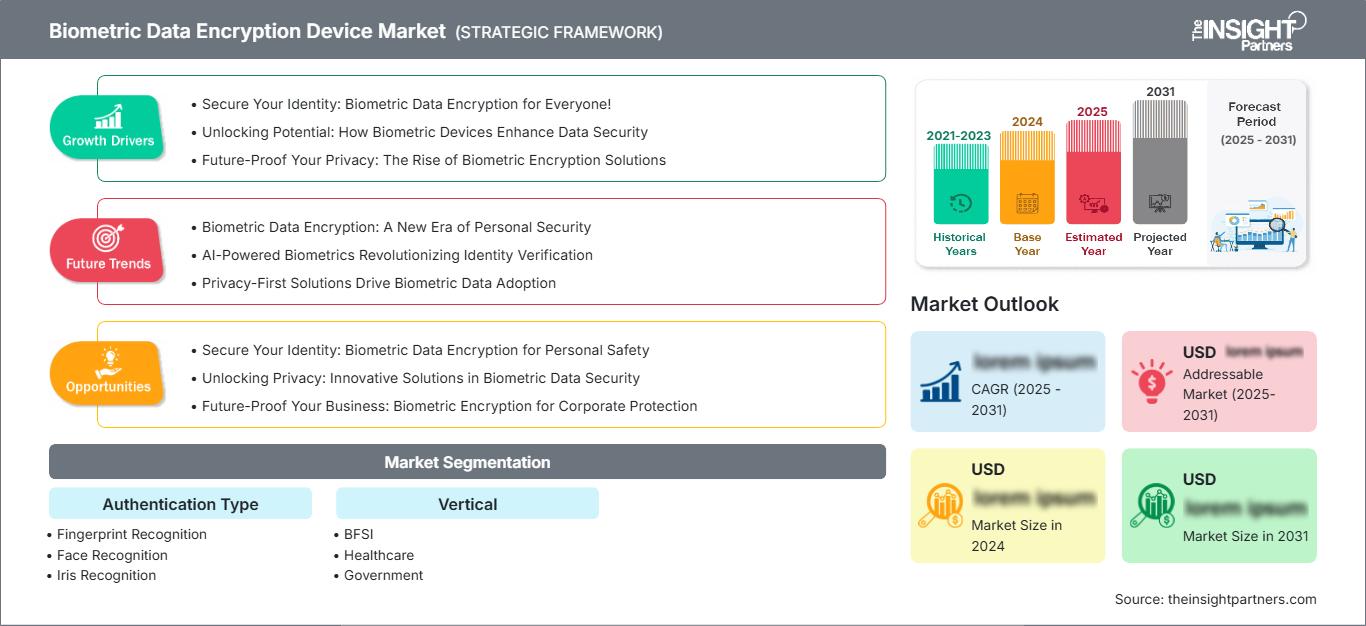
-
Obtenga las principales tendencias clave del mercado de este informe.Esta muestra GRATUITA incluye análisis de datos, desde tendencias del mercado hasta estimaciones y pronósticos.
Regional Insights
North America Biometric Data Encryption Device Market
North America represents a market share of 32–36% in 2025 and is expected to register a CAGR of 12.1–12.8% from 2026–2034. The Biometric Data Encryption Device Market's growth drivers are mature cybersecurity budgets, healthcare data privacy regulations, and the adoption of multifactor authentication in banking, insurance, airports, and government buildings. Enterprises will increasingly demand encrypted biometric templates at the device level due to heightened security risks during capture, matching, and transfer.
The demands from Canada and Mexico will include financial inclusion, border management, industrial parks, and common supply chains across North America. The regional drivers will include state biometric privacy regulations, federal cybersecurity guidelines, and insurance after identity theft attacks. Device providers who provide proof of liveness detection, auditability, and secure firmware update capability will be more likely to win enterprise contracts.
U.S. Biometric Data Encryption Device Market
The United States forms 76–80% of North America by 2025 and exhibits a CAGR of 12.2–12.9% for the years between 2026 and 2034. Demands exist in BFSI, federal institutions, healthcare network, educational institutes, retail logistics, and critical infrastructures. Suprema Inc., SecuGen Corporation, Integrated Biometrics, LLC, HID Global Corporation, and Crossmatch Technologies, Inc. continue their relevance due to their product portfolio, identity management, and biometric deployment experience within the government.
Applications show a trend towards encrypted fingerprint readers, face recognition terminals, and multimodal access control systems. Hospitals use biometric devices for security purposes because of risks of shared passwords, whereas banks give importance to authentication of their tellers and customers along with preventing fraud. Consumer electronic and semiconductor competencies of Samsung Electronics Co., Ltd. also affect expectations.
Europe Biometric Data Encryption Device Market
The region represents 23% to 27% market share by 2025 and experiences a growth rate of CAGR between 11.4% and 12.1% from 2026 to 2034. Germany emerges as the most dominant country, owing to the need for identity verification due to industry access controls, automotive campus settings, and a controlled enterprise environment. The UK invests in financial services and border solutions, whereas France relies on public administration, transportation, and defense-based identity security.
Demand is created in the countries like Italy and Spain through banking transformation, health care digitization, airport solutions, and smart cities. The enforcement of GDPR legislation drives purchase decisions, requiring vendors to provide template security, consent processes, and data minimization. European customers usually prefer devices capable of explaining encryption algorithms, supporting data residency policies, and integration with existing access control solutions without revealing biometrics.
APAC Biometric Data Encryption Device Market
APAC is forecast to have 28-32% market share in 2025 and is anticipated to expand with a CAGR of 13.6-14.4% during 2026-2034. China leads the market, followed by Japan, South Korea, India, and Australia. Programs for national identity, mobile-first banking, and electronics manufacturing help promote the technology.
Government industrial policy, digital payments, and e-governance are important in terms of adoption economics. The identity systems of India, the enterprise security approach of Japan, and biometrics devices expertise of South Korea enhance the depth of the region. End users look for encryption, spoofing prevention, and local certification due to population sizes and volumes of transactions.
Middle East & Africa Biometric Data Encryption Device Market
The forecasted CAGR for the Middle East & Africa region ranges from 10.8% to 11.6% for 2026–2034. The UAE ranks highest because of the significant use of the latest identity technology in airports, smart city initiatives, banking organizations, and high-end commercial buildings. Saudi Arabia drives demand due to modernization in the government, energy, and secure access to workforce sectors.
Rest of MEA is an opportunity-driven market where the adoption depends on the banking sector’s inclusion, telecommunications registrations, border controls, and critical infrastructure. Operating in harsh environments and wide networks requires durable biometrics technology equipped with encrypted memory, remote management, and matching capability in varying lighting and dusty environments.

Segmentation Analysis
Authentication Type
Authentication Type is projected to grow at a CAGR range of 12.4–13.2% during 2026–2034. Biometric Data Encryption Device Market scope is strongest where enterprises need reliable identity proofing without exposing raw templates. Fingerprint remains cost-efficient and widely certified, while face, iris, and voice recognition expand through contactless access, high-assurance environments, and remote authentication workflows.
- Fingerprint Recognition: Fingerprint recognition remains the largest modality because devices are compact, affordable, familiar to users, and suitable for banking, workforce access, national ID, and healthcare authentication.
- Face Recognition: Face recognition is scaling rapidly as contactless access, airport processing, retail loss prevention, and smart-building systems require fast authentication with improved liveness detection.
- Iris Recognition: Iris recognition serves high-security applications where accuracy and uniqueness matter, including border control, defense facilities, critical infrastructure, and healthcare zones requiring strict access assurance.
- Voice Recognition: Voice recognition supports remote and call-center authentication, adding value where customer service, telecom, and banking channels need friction-light identity checks.
Vertical
Vertical is expected to grow at a CAGR range of 12.2–13.0% during 2026–2034. Adoption varies by risk exposure, compliance burden, and transaction volume. BFSI leads due to fraud prevention and privileged access needs, while healthcare and government deploy encrypted biometric devices to protect sensitive records, facilities, and citizen-service workflows. Retail, IT and telecom, education, and manufacturing add scale through distributed sites.
- BFSI: BFSI generates high revenue contribution because banks, insurers, and payment providers use encrypted biometric devices for onboarding, branch controls, teller access, and fraud prevention.
- Healthcare: Healthcare demand is rising as hospitals secure clinical workstations, patient records, drug cabinets, and staff authentication while reducing dependence on shared passwords.
- Government: Government adoption is strategically important for national ID, border management, law enforcement, citizen services, and secure employee access across public facilities.
- Retail: Retail uses biometric encryption for loss prevention, workforce attendance, payment security, warehouse access, and customer verification in higher-risk transaction environments.
- IT and Telecom: IT and telecom buyers prioritize privileged-access management, data-center entry, subscriber identity controls, and secure remote workflows across distributed digital infrastructure.
- Education: Education adoption centers on campus access, examination integrity, library services, attendance systems, and secure administration of student and staff records.
- Manufacturing: Manufacturing uses encrypted biometric devices for plant access, time attendance, tool rooms, clean areas, and operational technology zones requiring accountable identity.
Opportunity Snapshot
|
Vertical |
Revenue Contribution |
Trend Tag |
Adoption Stage |
|
BFSI |
High |
Fraud Shield |
Mature |
|
Healthcare |
High |
Record Access |
Scaling |
|
Government |
High |
Digital ID |
Scaling |
|
Retail |
Medium |
Checkout Trust |
Scaling |
|
IT and Telecom |
Medium |
Privileged Access |
Scaling |
|
Education |
Low |
Campus Entry |
Emerging |
|
Manufacturing |
Medium |
Plant Security |
Scaling |
Biometric Data Encryption Device Market Growth Drivers and Impact Analysis
Rising Identity Fraud and Endpoint-Centric Security
The need to prevent identity fraud has led organizations to implement stronger security measures during biometrics acquisition. Passwords, cards, and one-time codes still suffer from phishing attacks, theft, and account takeover whereas encrypted biometrics make the link between the user and the credential stronger. In terms of the market impact, we can observe the following effects in BFSI, IT, healthcare, and governmental sectors where compromised access may result in financial loss, fines, or disruption of services. Biometric devices that use encryption for sending templates minimize risks in terms of both networks and database exposure.
Digital Identity Programs and Public-Sector Modernization
Demand is growing for biometrics solutions capable of enrolling, authenticating, and securing citizens for use in border control, social welfare provision, licensing, law enforcement operations, and restricted site access via government digital identity systems. Such large-scale deployments call for robust systems that are able to handle high volume capacity, low error rates, interoperability, and secure encryption, since the same identity system may serve millions of individuals. The market for Biometric Data Encryption Devices stands to gain as public institutions move away from using paper-based credentials and disparate databases to build their identity ecosystems. In addition, there will be demand for durable biometric equipment that can function under field conditions.
Healthcare and Financial Compliance Pressure
Organizations in the healthcare industry, as well as those in finance, have stricter requirements for protecting sensitive information, transactions, and privileged systems. Healthcare organizations are required to control access to information about patients, medications, and application processes, whereas financial institutions require authentication of employees, customers, and certain transactions. The use of biometric encryption devices will enable avoiding common credentials, ensuring accountability, and providing necessary documentation in case of audits. The effect on reality will be increased expenditure on biometric devices that are efficient and also provide privacy features in fast-paced conditions. A nurse, a teller, or a claims adjuster has to go through authentication fast and without compromising security.
Biometric Data Encryption Device Market Future Trends
Multimodal Authentication with Edge AI
The Biometric Data Encryption Device Market trend will increasingly be geared towards multimodal devices that utilize fingerprinting, facial recognition, iris scanning, or voice, in combination with edge-based AI matching. This is beneficial since the system will be resilient to changes due to any adverse conditions affecting a single modality such as lighting, injuries, mask-wearing, noise, and even individual preferences. The deployment of edge-based AI technology will also minimize dependency on centralized server systems since there will be more decisions made on the device before encryption and sending of the results.
Privacy-Preserving Template Protection
Template protection will become a defining product differentiator as regulators, enterprises, and consumers scrutinize biometric data handling. Future devices will increasingly store encrypted templates on secure elements, mobile credentials, or distributed architectures rather than centralized repositories. Vendors will emphasize cancellable biometrics, secure enclaves, firmware attestation, and consent-aware enrollment tools. The shift will reduce breach impact because stolen templates cannot be reused like passwords. It will also help buyers meet privacy-by-design expectations in jurisdictions with strict biometric governance. Devices that document encryption paths and deletion controls will gain preference in regulated procurement.
Biometric Data Encryption Device Market Opportunities
BFSI Authentication Modernization
Biometric Data Encryption Device Market Forecasts point to a strong opportunity in BFSI modernization as banks replace legacy authentication across branches, ATMs, call centers, and employee systems. Investment can target encrypted fingerprint and face terminals that support customer onboarding, teller approvals, vault access, and privileged IT functions. The opportunity is attractive because fraud prevention, auditability, and customer convenience align with measurable business outcomes. Vendors should prioritize integration with core banking systems, identity platforms, and risk engines. Financial institutions will favor suppliers that can deliver scalable device management, rapid enrollment, and strong anti-spoofing controls without slowing customer service.
Secure Healthcare Workflows
Healthcare offers an actionable opportunity because identity errors, shared passwords, and unauthorized record access create operational and compliance risk. Encrypted biometric devices can support clinician sign-on, medication cabinet access, patient matching, laboratory controls, and restricted-area entry. Investment should focus on devices that work with gloves, variable lighting, and high-use clinical stations while maintaining fast authentication. Hospitals and health networks also need integration with electronic health records, workforce management, and physical access systems. Suppliers that combine hygienic design, privacy controls, and high uptime can address a recurring replacement opportunity as providers modernize security without adding workflow friction.
Recent Developments
- July 2026: Parsons Corporation launched AresNXT, a next-generation biometrics platform designed for secure and scalable identity management across critical infrastructure, national security operations, and large-scale events. The platform enables the collection, processing, and verification of biometric and biographic data, including fingerprints, facial recognition, and iris scans, while providing near real-time identity verification through integration with secure back-end repositories. AresNXT supports iOS, Android, and Windows devices, combines AI-driven biometric workflows with advanced security features, and enables deployment without requiring specialized hardware, helping organizations improve operational efficiency and mission readiness.
- May 2026: Suprema unveiled BioStation 3 Max, a flagship AI-powered biometric terminal designed to enhance identity-based security and access control. The device combines advanced facial recognition, fingerprint authentication, RFID, QR code, and mobile credential support in a single platform, enabling secure multi-factor authentication for enterprises and high-security environments. BioStation 3 Max is built on Suprema’s AI security technology and provides improved accuracy, faster authentication, and flexible deployment options for modern access control systems.
- March 2026: Precise Biometrics launched Palm Access Pro, a next-generation biometric solution for physical access control that combines touchless palm recognition, anti-spoofing technology, and a flexible multi-factor authentication (MFA) platform. The solution enables organizations to combine palm biometrics with mobile credentials, providing secure and seamless access while maintaining a privacy-first architecture with encrypted biometric templates stored on users’ mobile devices. Palm Access Pro is designed for access control providers, system integrators, and technology partners seeking scalable biometric authentication solutions for modern security environments.
Frequently Asked Questions

Naveen es un experimentado profesional en investigación de mercados y consultoría con más de 9 años de experiencia en proyectos personalizados, sindicados y de consultoría. Actualmente se desempeña como Vicepresidente Asociado, donde ha gestionado con éxito a las partes interesadas en toda la cadena de valor del proyecto y ha redactado más de 100 informes de investigación y más de 30 proyectos de consultoría. Su trabajo abarca proyectos industriales y gubernamentales, contribuyendo significativamente al éxito de los clientes y a la toma de decisiones basada en datos.
Naveen es licenciado en Ingeniería Electrónica y Comunicaciones por la VTU (Karnataka) y tiene un MBA en Marketing y Operaciones por la Universidad de Manipal. Ha sido miembro activo del IEEE durante 9 años, participando en conferencias, simposios técnicos y realizando voluntariado tanto a nivel de sección como regional. Antes de su puesto actual, trabajó como Consultor Estratégico Asociado en IndustryARC y como Consultor de Servidores Industriales en Hewlett Packard (HP Global).
- Análisis exhaustivo del tamaño del mercado y previsiones
- Análisis detallado de la segmentación
- Evaluación en profundidad de la dinámica del mercado
- Información a nivel regional y nacional
- Panorama competitivo y análisis comparativo de empresas
- Inteligencia empresarial estratégica
Testimonios

El informe de mercado de sistemas SCADA de Insight Partners es completo y ofrece información valiosa sobre las tendencias actuales y las previsiones futuras. El equipo fue altamente profesional, receptivo y me brindó un gran apoyo en todo momento. Estamos muy satisfechos y recomendamos ampliamente sus servicios.
RAN KEDEM Socio, Reali Technologies LTDs
Solicité un informe sobre un mercado de software muy específico y el equipo lo elaboró en pocos días. La información era muy relevante y estaba bien presentada. Posteriormente, solicité algunos cambios y adiciones al informe. El equipo fue muy receptivo y recibí el informe final en menos de una semana.
JEAN-HERVE JENN Presidente, Future Analytica
Trabajamos con The Insight Partners para un importante estudio y pronóstico de mercado. Nos brindaron una visión clara de las oportunidades y los riesgos, lo que nos ayudó a definir nuestros planes. Su investigación fue fácil de usar y se basó en datos sólidos. Nos ayudó a tomar decisiones inteligentes y seguras. Los recomendamos ampliamente.
PIYUSH NAGPAL Vicepresidente Sénior, , High Beam Global
The Insight Partners realizó una investigación de mercado profunda y bien estructurada con una sólida experiencia en el sector. Su equipo fue profesional y receptivo en todo momento. El sitio web, fácil de usar, facilitó el acceso a los informes del sector. Los recomendamos ampliamente por sus servicios de investigación confiables y de alta calidad.
YUKIHIKO ADACHI Director Ejecutivo, , Deep Blue, LLC
Esta es la primera vez que compro un informe de mercado de The Insight Partners. Aunque al principio tenía dudas, visité su sitio web y me sentí más cómodo al arriesgarme y comprarlo. Estoy completamente satisfecho con la calidad del informe y el servicio al cliente. Tenía varias preguntas y comentarios sobre el informe inicial, pero después de un par de conversaciones por correo electrónico con su analista, creo que tengo un informe que puedo usar como base para nuestro proceso de planificación estratégica. Muchas gracias por tomarse el tiempo y hacer de esta una experiencia positiva. Sin duda, recomendaré sus servicios y serán mi primera opción cuando necesitemos más datos de mercado.
JOHN SUZUKI Presidente y Director Ejecutivo, Director de la Junta Directiva, BK Technologies
Agradezco su apoyo y la profesionalidad que demostraron al atender mi solicitud de información sobre el mercado de diagnóstico in vitro (IVD) para enfermedades infecciosas en Nigeria. Agradezco su paciencia, su orientación y su disposición a ofrecerme un descuento, lo que finalmente nos permitió cerrar un trato. Espero poder colaborar con The Insight Partners en el futuro, gracias a la impresión que me causó este primer encuentro.
DRA. CHIJIOKE ONYIA, DIRECTORA GENERAL, PineCrest Healthcare Ltd.Razón para comprar
- Toma de decisiones informada
- Comprensión de la dinámica del mercado
- Análisis competitivo
- Información sobre clientes
- Pronósticos del mercado
- Mitigación de riesgos
- Planificación estratégica
- Justificación de la inversión
- Identificación de mercados emergentes
- Mejora de las estrategias de marketing
- Impulso de la eficiencia operativa
- Alineación con las tendencias regulatorias



















 Obtenga una muestra gratuita para -