
Mercado de silicona para acristalamiento estructural: tamaño, cuota de mercado y previsiones 2034
Tamaño del mercado y pronósticos del acristalamiento estructural de silicona (2021-2034), participación global y regional, tendencias y análisis de oportunidades de crecimiento. Cobertura del informe: Por tipo (acristalamiento estructural de cuatro lados, acristalamiento estructural de dos lados, acristalamiento inclinado, acristalamiento escalonado, acristalamiento en forma de U, acristalamiento de sistemas de visión total, otros); material (paneles de vidrio, marcos estructurales de aluminio, selladores de silicona, EPDM); uso final (comercial, público, residencial) y geografía (América del Norte, Europa, Asia Pacífico y América del Sur y Central).
- Estado : Datos publicados
- Código de informe : TIPRE00005494
- Categoría : Fabricación y construcción
- Número de páginas : 150
- Formatos de informe disponibles :


- Fecha de última actualización : July 22, 2026


2025 Market Size
US$ 52.26 Bn
Base year value
2034 Forecast
US$ 115.64 Bn
Projected by 2034
CAGR 2026-2034
9.23 %
Growth rate
Addressable Market
US$ 750.49 Bn
(2026-2034)
The Silicone Structural Glazing Market is projected to grow from US$ 52.26 Billion in 2025 to US$ 115.64 Billion by 2034, registering a CAGR of 9.23% during 2026–2034. Demand is shaped by high-performance facade systems, curtain-wall modernization, and wider use of silicone sealants that support structural bonding, weather resistance, and design flexibility in commercial, public, and residential buildings.
Across North America, the Silicone Structural Glazing Market size is expected to advance at a 8.4–9.0% CAGR, supported by energy-code compliance, retrofit activity, and demand for resilient facades in dense urban corridors. Developers are prioritizing systems that improve daylighting, reduce envelope maintenance, and meet green building requirements while preserving architectural transparency in offices, healthcare facilities, airports, and mixed-use towers.
Silicone Structural Glazing Market Assessment and Insights
- North America accounted for 28–31% share in 2025 and is projected to grow at a CAGR of 8.4–9.0% between 2026–2034, led by code-driven facade upgrades and commercial renovations.
- US represented 78–82% of North America in 2025 and is expected to expand at 8.5–9.1% CAGR between 2026–2034, supported by high-rise and institutional projects.
- Europe held 23–26% share in 2025 and is forecast to grow at 7.8–8.5% CAGR between 2026–2034, with Germany, the UK, France, Italy, and Spain leading demand.
- Asia Pacific captured 32–35% share in 2025 and is expected to record 10.0–10.8% CAGR between 2026–2034, driven by China, India, Japan, South Korea, and Australia.
- Largest Segment Four-Sided Structural Glazing held 40–44% market share in 2025 and is projected to expand at 8.7–9.4% CAGR during 2026–2034.
- High Growth Segment Residential end use held 18–22% market share in 2025 and is expected to grow at 10.2–11.0% CAGR during 2026–2034.
- Key companies analyzed in detail: 3M Company, Arkema S.A., AGC Inc., Central Glass Co., Ltd., Nippon Sheet Glass Co., Ltd., Permasteelisa S.p.A., Compagnie de Saint-Gobain S.A., Sika AG, Dow Inc., YKK Corporation.
Source: The Insight Partners' analysis based on proprietary research, government publications, company annual reports, investor presentations, industry databases, and expert interviews.
Adoption of technology has evolved from traditional mechanically attached curtain walls to pre-fabricated modularized facades that decrease on-site assembly time and achieve consistent dimensions. Silicone chemistry is evolving to prioritize increased movement properties, UV resistance, and compatibility with coated glass. The industry is undergoing a shift in production processes by incorporating facade contractors' use of digitalization, modularized fabrication, and specific project sealant testing to minimize risks associated with complex tower installation.
Demand in the future will increasingly be driven by public infrastructure, transit-oriented development projects, and premium residential projects in urbanizing cities. Energy-efficient envelope designs, fire safety considerations, and life cycle considerations will provide demand for specification activity. Tailwinds through building performance standards and carbon reduction programs will drive specifications for facades that balance transparency, strength, thermal properties, and proven durability.
Silicone Structural Glazing Market Report Scope
| Report Attribute | Details |
|---|---|
| Market size in 2025 | US$ 52.26 Billion |
| Market Size by 2034 | US$ 115.64 Billion |
| Global CAGR (2026 - 2034) | 9.23% |
| Historical Data | 2021-2024 |
| Forecast period | 2026-2034 |
Silicone Structural Glazing Market Analysis
Silicone Structural Glazing Market growth is being driven by commercial real estate modernization, higher facade performance requirements, and the shift toward glass-intensive building envelopes. Demand moves through the ecosystem of glass processors, sealant manufacturers, aluminum system manufacturers, facade consultants, contractors, and laboratories performing certification tests. In this value chain, there is recognition for suppliers who can assure adhesion, weathering resistance, movement capability, and compatibility with low-e coatings.
Supply continues to be vulnerable to silicone intermediates, aluminum extrusion capabilities, and coated glass supply. Bigger projects have become more dependent on design cooperation, mock-up trials, and logistics management because facade solutions impact crucial construction timelines. Embodied carbon, warranty provisions, and installation efficiency have started to enter into the decision-making of structural glazing systems.
Competitive positioning in the Silicone Structural Glazing Market analysis centers on technical support, global project references, and product compliance. Dow, Sika, 3M, and Compagnie de Saint-Gobain compete using sealant technology, glass solutions, and facade engineering knowledge, while Permasteelisa and YKK use engineered envelope solutions to improve market accessibility.
There is an increasing trend towards investment in automation of the sealant dispensing process, unitized facade assembly, and regional service centers that reduce the time needed to deliver a project. Differentiation relies upon certification services, design assist services, and the provision of landmark commercial, aviation, healthcare, and civic buildings where envelope system failure cannot be tolerated.
● REPORT CUSTOMIZATION
Tailor This Report To Align With Your Specific Business Requirements
This report can be customized to align precisely with your business objectives, scope, and target markets. Customization options include tailored segmentation, geography, competitive analysis, and strategic insights to support informed decision-making.
Customize This Report →WHAT YOU CAN ADJUST
- ● Segmentations
- ● Geography
- ● Competitive Analysis
- ● Language Preferences
Silicone Structural Glazing Market:
Personalice este informe según sus necesidades
Disfrutará de la personalización gratuita de cualquier informe, incluyendo partes del mismo, análisis por país y un paquete de datos de Excel. Además, podrá aprovechar excelentes ofertas y descuentos para startups y universidades.
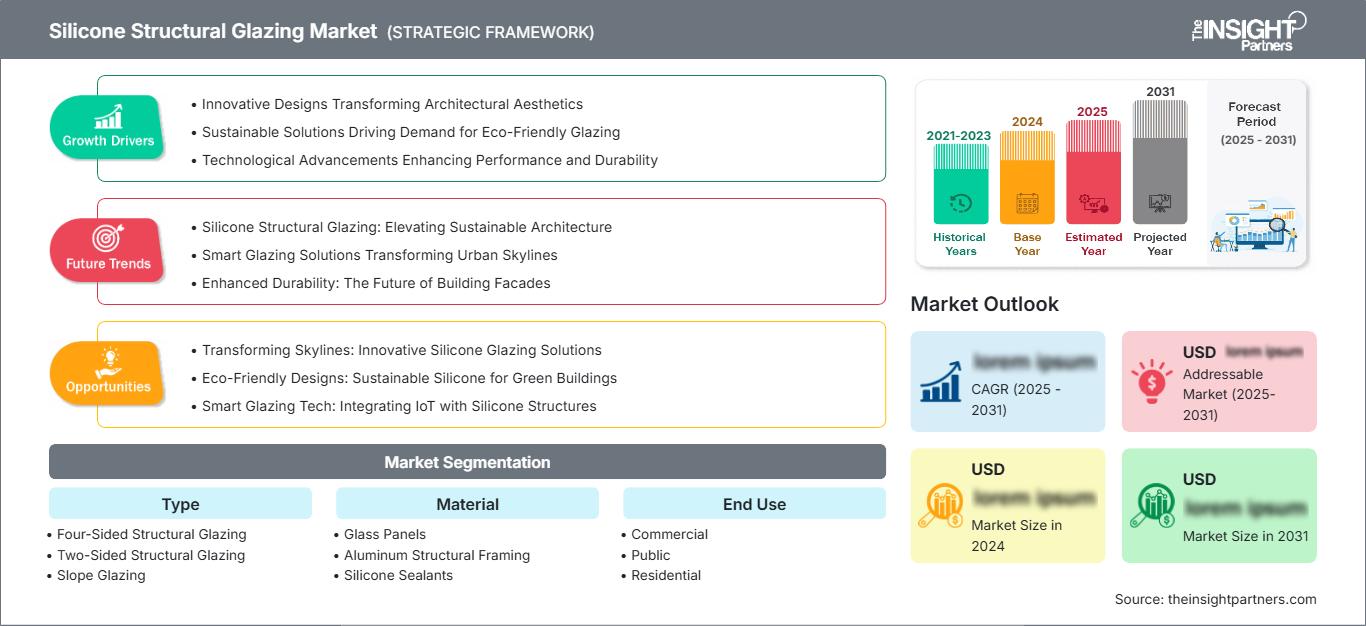
Mercado de acristalamiento estructural de silicona: Perspectivas estratégicas
-
Obtenga las principales tendencias clave del mercado de este informe.Esta muestra GRATUITA incluye análisis de datos, desde tendencias del mercado hasta estimaciones y pronósticos.
Regional Insights
North America Silicone Structural Glazing Market
North America held 28–31% of global revenue in 2025, with the Silicone Structural Glazing Market share supported by commercial retrofits, institutional construction, and stricter energy codes. Regional CAGR is estimated at 8.4–9.0% during 2026–2034, reflecting demand for low-maintenance curtain walls and durable weather-sealing systems.
Growth is strongest in office redevelopment, airports, hospitals, laboratories, and mixed-use towers where transparency and envelope performance are both procurement priorities. Manufacturers benefit from established testing standards, contractor specialization, and owner preference for warranty-backed silicone systems that can manage thermal movement, wind load, and severe weather exposure.
U.S. Silicone Structural Glazing Market
The U.S. accounted for 78–82% of North America revenue in 2025 and is projected to grow at an 8.5–9.1% CAGR through 2034. Demand is concentrated in major metropolitan redevelopment, university campuses, healthcare complexes, airports, and corporate headquarters that prioritize daylighting, facade resilience, and energy performance.
Company presence is reinforced by Dow Inc., 3M Company, Sika AG, and major glass and facade specialists serving specification-led projects. Application trends include unitized curtain walls, four-sided systems in premium offices, and retrofit glazing for older commercial assets seeking better air leakage control and occupant comfort.
Europe Silicone Structural Glazing Market
Europe represented 23–26% of global revenue in 2025 and is expected to expand at a 7.8–8.5% CAGR during 2026–2034. Germany continues to be the leading nation due to the high level of facade renovations, stringent energy efficiency standards and a robust production base of architectural glasses. The UK continues to get aided by modernization projects for offices and urban redevelopment efforts in transportation, which are helping to drive the demand for architectural glasses.
France, Italy, and Spain will help in driving the market through investments in the public sector, hotel projects and urban redevelopment initiatives with emphasis on natural light, durability and energy standards. The clients in Europe are becoming more concerned about low-carbon content products, traceability and lifecycle performance.
APAC Silicone Structural Glazing Market
APAC held 32–35% share in 2025 and is projected to grow at a 10.0–10.8% CAGR, making it the fastest-expanding regional market. China leads demand due to large-scale commercial, residential, and infrastructure construction activity. At the same time, India, Japan, South Korea, and Australia contribute through investments in commercial towers, transit hubs, airports, and institutional buildings.
Rapid urbanization, industrial development, and smart-city initiatives are driving the adoption of advanced facade systems across the region. Demand is increasingly shifting toward unitized and structurally bonded glazing systems that offer improved installation efficiency, energy performance, and architectural flexibility. At the same time, local facade fabricators are expanding manufacturing capacity, while international suppliers are strengthening technical support and engineering capabilities to meet stringent requirements related to wind loads, seismic resilience, humidity resistance, and thermal insulation across APAC's diverse climatic conditions.
Middle East & Africa Silicone Structural Glazing Market
The Middle East and Africa are expected to grow at an 8.8–9.6% CAGR, supported by strong construction activity and investments in landmark developments across the Gulf region. UAE continues to dominate regional specifications due to its emphasis on high performance envelopes, while Saudi Arabia is rapidly increasing demand through giga projects, airports, hospitality schemes, mixed-use facilities, and infrastructure developments. Other MEA countries like South Africa, are more discriminating but placing increasing emphasis on facade performance, energy efficiency, and building performance.
The hot climate of the region influences the development of demand for facade systems, which offer optimal levels of solar heat gain control and daylight transmission. Structural Silicone Glazing Systems have proven themselves ideal for use in tall structures, shopping centers, hotels, and public buildings as they enable clean lines of architecture while enabling thermal movement, withstand heavy wind loads, and enable large glass facades without any mechanical fixings.
Segmentation Analysis
Type
The Type segment is projected to grow at an 8.8–9.6% CAGR during 2026–2034. Silicone Structural Glazing Market scope is broadening as architects choose system types according to visibility, load transfer, fabrication complexity, and facade geometry. Four-sided systems dominate premium projects, while two-sided, slope, stepped, U-shaped, and total vision systems address specialized design and installation requirements.
- Four-Sided Structural Glazing leads premium curtain-wall use because it conceals framing, delivers clean glass planes, and supports landmark commercial buildings requiring high transparency and tested structural bonding.
- Two-Sided Structural Glazing remains attractive where partial mechanical support reduces risk and cost while preserving a contemporary facade appearance for offices, schools, hospitals, and mid-rise buildings.
- Slope Glazing supports atriums, skylights, canopies, and transit structures where drainage, sealant durability, and thermal movement control are critical for overhead glass performance.
- Stepped Glass Glazing serves projects requiring layered facade depth, shadow effects, or drainage control, making it strategically relevant in complex commercial and civic architectural envelopes.
- U-Shaped Glazing is used in daylighting walls and public facilities where diffused light, privacy, and vertical design continuity matter more than fully transparent views.
- Total Vision Systems Glazing targets high-end retail, lobbies, and showpiece buildings where unobstructed views, minimal framing, and premium visual continuity influence specification decisions.
Material
The Material segment is projected to grow at an 8.9–9.7% CAGR during 2026–2034. Material selection is shaped by bonding compatibility, load-bearing performance, thermal expansion, and facade lifecycle expectations. Glass panels and aluminum framing define structural geometry, while silicone sealants and EPDM support sealing continuity, movement accommodation, and long-term weather performance.
- Glass Panels remain the largest material component because facade aesthetics, daylighting, thermal coatings, and safety performance depend on engineered glass specifications across commercial and public buildings.
- Aluminum Structural Framing provides lightweight support, corrosion resistance, and fabrication precision, making it essential for unitized systems, mullion design, and complex high-rise envelope assemblies.
- Silicone Sealants are strategically critical because adhesion strength, elasticity, ultraviolet resistance, and weatherproofing determine structural glazing durability and compliance with project-specific performance testing.
- EPDM supports gasket, spacer, and secondary sealing requirements, helping facade systems manage water infiltration, air leakage, and movement between glass, frame, and building structure.
End Use
The End Use segment is projected to grow at a 9.1–9.9% CAGR during 2026–2034. Commercial buildings account for the strongest demand base, public projects add specification rigor, and residential towers are moving faster as developers pursue premium facades. Adoption depends on project budgets, safety standards, facade warranties, and energy-efficiency targets.
- Commercial leads demand through offices, retail centers, hotels, and mixed-use projects where architectural visibility, daylight, lease value, and facade performance directly influence investment decisions.
- Public applications include airports, hospitals, universities, museums, and government buildings, where lifecycle durability, safety documentation, and energy performance create disciplined procurement requirements.
- Residential is scaling in premium apartments and urban towers as buyers value panoramic views, quieter interiors, improved daylight, and facades aligned with modern lifestyle positioning.
Opportunity Snapshot
|
End Use |
Revenue Contribution |
Trend Tag |
Adoption Stage |
|
Commercial |
High |
Office Retrofits |
Mature |
|
Public |
Medium |
Civic Envelopes |
Scaling |
|
Residential |
Medium |
Luxury Towers |
Scaling |
Silicone Structural Glazing Market Growth Drivers and Impact Analysis
Energy Codes Push High-Performance Building Envelopes
Building owners are under pressure to reduce operating energy use, and facade performance has become a measurable compliance issue rather than an aesthetic choice. Silicone structural glazing supports larger glass areas while enabling insulated units, low-emissivity coatings, and controlled air and water infiltration. The impact is strongest in offices, hospitals, campuses, and airports, where HVAC costs and comfort standards are closely monitored. As energy codes tighten, suppliers that provide tested sealant compatibility, thermal modeling support, and long-term warranties gain specification advantage across the Silicone Structural Glazing Market.
Urban High-Rise Construction Raises Façade Complexity
A city needs vertical structures for dense building, and the building facades will have challenging wind, movement, and installation requirements. Structural silicone glazing allows lightweight and clean facade systems to be constructed in a controlled factory environment and installed in panel form. It helps in reducing on-site activity and optimizing construction scheduling on the limited city site. Its commercial benefit is not only seen in terms of new buildings but is also seen with old office buildings that are refaced for better performance.
Durability Requirements Shift Procurement Toward Certified Systems
Failure of a facade is expensive to remedy, poses health hazards, and brings about reputational risks, which makes customers more interested in getting the results of tests before committing themselves to any structural glazing systems. Specific adhesion test, weathering test, movement test, and standard-compliance test will become critical issues when purchasing products and services. This is because it will be an advantage to those companies that have a laboratory to conduct these tests and engineers to apply the results.
Silicone Structural Glazing Market Future Trends
Digital Facade Engineering and Automated Sealant Application
Silicone Structural Glazing Market trends point toward digitally coordinated facade engineering, where building information modeling, structural simulation, and automated sealant dispensing reduce tolerance errors. Manufacturers will tend to use production lines under controlled conditions to apply silicone with consistent bead geometry, curing process, and records. This change will enhance productivity as well as assist contractors in demonstrating compliance with regulations in complex building projects. Manufacturers that embed technical information into design software and factory operations will be able to influence specifications.
Low-Carbon and Solar-Control Façade Packages
Specifications going forward will be composed of silicone bonding structure, low-carbon-content glass, recycled aluminum, warm-edge spacers, and state-of-the-art solar control coating technology. Consumers are already comparing the carbon footprint with operating savings, particularly in office spaces, civic structures, and campus buildings, pursuing green certification. This development offers possibilities of facade systems packages rather than individual materials sales. Technical information will be important since the consumer is going to demand environmental declarations, durability verification, and maintenance expectations before making expensive envelope purchases.
Silicone Structural Glazing Market Opportunities
Retrofit Programs for Aging Commercial Buildings
A major opportunity lies in replacing outdated curtain walls and poorly sealed facades in older office, hotel, and institutional buildings. Owners can improve energy performance, comfort, asset value, and tenant perception without full demolition. Silicone Structural Glazing Market Forecasts indicate retrofit demand will expand where building-performance rules make inefficient envelopes financially costly. Suppliers should position tested systems, field-applied repair solutions, and design-assist services for phased renovations that minimize disruption while extending building service life.
Premium Residential Towers in Emerging Cities
The residential facades in developing urban areas use transparent facade systems as a means of differentiation between the expensive apartments, serviced apartments, and mixed-use towers. It is not just about having the materials, but also having the expertise when it comes to structural wind loads, acoustic performance, safety glazing, and installation sequence. The companies that can offer residential facade systems in standard modules, along with the regional training and warranty packages for the developer’s risk profile, are those that have an edge.
Recent Developments
- October 2025: New Advancement in Silicone Sealant- SV-888 silicone weatherproof sealant is a one-part, elastomeric and neutral cure silicone sealant, designed for glass curtain wall, aluminum curtain wall and building exterior design, has excellent weathering properties, and can form durable and most building materials, waterproof and flexible interface.
- May 2024: Signaling a shared commitment towards carbon neutrality, Dow Chemical International Private Limitedopens in a new tab (Dow India), and Glass Wall Systems Indiaopens in a new tab signed an agreement for Dow to supply DOWSIL Facade Sealants from Dow's Decarbia opens in a new tab portfolio of reduced-carbon solutions, for Glass Wall System's curtain wall system. Glass Wall Systems can achieve carbon neutrality through the use of DOWSIL 983 Structural Glazing Sealant and DOWSIL 791 Weatherproofing Sealant. The carbon neutrality, following PAS 2060, was achieved by the responsible sourcing of low-carbon feedstocks, Dow's actions to reduce carbon emissions in the manufacturing process, the use of renewable energy sources, and compensation of the remaining emissions.
Frequently Asked Questions

Nivedita es una investigadora con más de 9 años de experiencia en Investigación de Mercados y Consultoría de Negocios. Actualmente se desempeña como Gerente de Proyectos en el área de TIC en The Insight Partners, y aporta una amplia experiencia en la gestión y ejecución de proyectos de investigación sindicados, personalizados, por suscripción y de consultoría en diversos sectores tecnológicos.
Con una trayectoria comprobada en la entrega de análisis basados en datos e información práctica, Nivedita ha sido una colaboradora clave en varios proyectos cruciales. Su trabajo abarca la ejecución integral de proyectos, desde la comprensión de los objetivos del cliente y el análisis de las tendencias del mercado hasta la formulación de recomendaciones estratégicas. Ha colaborado extensamente con empresas líderes en TIC, ayudándolas a identificar oportunidades de mercado y a adaptarse a los cambios del sector.
Nivedita posee un MBA en Administración de Empresas por IMS, Dehradun. Antes de unirse a The Insight Partners, adquirió una valiosa experiencia en MarketsandMarkets y Future Market Insights en Pune, donde ocupó diversos puestos de investigación y desarrolló una sólida base en análisis del sector y la interacción con el cliente.
- Análisis exhaustivo del tamaño del mercado y previsiones
- Análisis detallado de la segmentación
- Evaluación en profundidad de la dinámica del mercado
- Información a nivel regional y nacional
- Panorama competitivo y análisis comparativo de empresas
- Inteligencia empresarial estratégica
Testimonios

The Insight Partners proporcionó información de mercado valiosa que respaldó nuestra estrategia global de entrada en el mercado. Su equipo fue profesional, respondió con rapidez y prestó atención a nuestros comentarios. A lo largo del proyecto, ofreció análisis bien fundamentados y aclaraciones metodológicas útiles.
Junmo Kim Director financiero (CFO), Enertech Co., Ltd.
El informe de mercado de sistemas SCADA de Insight Partners es completo y ofrece información valiosa sobre las tendencias actuales y las previsiones futuras. El equipo fue altamente profesional, receptivo y me brindó un gran apoyo en todo momento. Estamos muy satisfechos y recomendamos ampliamente sus servicios.
RAN KEDEM Socio, Reali Technologies LTDs
Solicité un informe sobre un mercado de software muy específico y el equipo lo elaboró en pocos días. La información era muy relevante y estaba bien presentada. Posteriormente, solicité algunos cambios y adiciones al informe. El equipo fue muy receptivo y recibí el informe final en menos de una semana.
JEAN-HERVE JENN Presidente, Future Analytica
Trabajamos con The Insight Partners para un importante estudio y pronóstico de mercado. Nos brindaron una visión clara de las oportunidades y los riesgos, lo que nos ayudó a definir nuestros planes. Su investigación fue fácil de usar y se basó en datos sólidos. Nos ayudó a tomar decisiones inteligentes y seguras. Los recomendamos ampliamente.
PIYUSH NAGPAL Vicepresidente Sénior, , High Beam Global
The Insight Partners realizó una investigación de mercado profunda y bien estructurada con una sólida experiencia en el sector. Su equipo fue profesional y receptivo en todo momento. El sitio web, fácil de usar, facilitó el acceso a los informes del sector. Los recomendamos ampliamente por sus servicios de investigación confiables y de alta calidad.
YUKIHIKO ADACHI Director Ejecutivo, , Deep Blue, LLC
Esta es la primera vez que compro un informe de mercado de The Insight Partners. Aunque al principio tenía dudas, visité su sitio web y me sentí más cómodo al arriesgarme y comprarlo. Estoy completamente satisfecho con la calidad del informe y el servicio al cliente. Tenía varias preguntas y comentarios sobre el informe inicial, pero después de un par de conversaciones por correo electrónico con su analista, creo que tengo un informe que puedo usar como base para nuestro proceso de planificación estratégica. Muchas gracias por tomarse el tiempo y hacer de esta una experiencia positiva. Sin duda, recomendaré sus servicios y serán mi primera opción cuando necesitemos más datos de mercado.
JOHN SUZUKI Presidente y Director Ejecutivo, Director de la Junta Directiva, BK Technologies
Agradezco su apoyo y la profesionalidad que demostraron al atender mi solicitud de información sobre el mercado de diagnóstico in vitro (IVD) para enfermedades infecciosas en Nigeria. Agradezco su paciencia, su orientación y su disposición a ofrecerme un descuento, lo que finalmente nos permitió cerrar un trato. Espero poder colaborar con The Insight Partners en el futuro, gracias a la impresión que me causó este primer encuentro.
DRA. CHIJIOKE ONYIA, DIRECTORA GENERAL, PineCrest Healthcare Ltd.Razón para comprar
- Toma de decisiones informada
- Comprensión de la dinámica del mercado
- Análisis competitivo
- Información sobre clientes
- Pronósticos del mercado
- Mitigación de riesgos
- Planificación estratégica
- Justificación de la inversión
- Identificación de mercados emergentes
- Mejora de las estrategias de marketing
- Impulso de la eficiencia operativa
- Alineación con las tendencias regulatorias

















 Obtenga una muestra gratuita para -