
Descripción general de los ingresos, las tendencias y los factores clave del mercado de sistemas de gestión de servicios públicos.
Cobertura: por Gestión Inteligente del Agua (Dispositivo, Solución, Servicios); Gestión Inteligente del Gas (Dispositivo, Solución, Servicios); Gestión Inteligente de la Red Eléctrica (Dispositivo, Solución, Servicios) y Geografía (América del Norte, Europa, Asia Pacífico y América del Sur y Central).
- Estado : Datos publicados
- Código de informe : TIPRE00012393
- Categoría : Electrónica y semiconductores
- Número de páginas : 150
- Formatos de informe disponibles :


- Fecha de última actualización : September 15, 2026


2025 Market Size
US$ 14.91 Bn
Base year value
2034 Forecast
US$ 25.67 Bn
Projected by 2034
CAGR 2026-2034
6.22 %
Growth rate
Addressable Market
US$ 183.66 Bn
(2026-2034)
The global Utility Management System market was valued at US$ 14.91 billion in 2025 and is expected to reach US$ 25.67 billion by 2034; it is estimated to record a CAGR of 6.22% during 2026-2034.
Utility Management System Market Assessment and Insights
- North America accounted for an estimated 32–34% share in 2025 and is projected to grow at a 6.8–7.6% CAGR between 2026–2034.
- US represented 22–24% globally in 2025 and is projected to expand at a 6.9–7.7% CAGR between 2026–2034.
- Europe held 25–27% share in 2025 and is forecast to grow at a 6.5–7.3% CAGR between 2026–2034.
- Asia Pacific represented 28–31% share in 2025 and is expected to expand at an 8.0–8.8% CAGR between 2026–2034.
- Largest Segment: Smart Grid Management held an estimated 48–52% market share in 2025 and is projected to grow at a 7.0–7.8% CAGR between 2026–2034.
- High Growth Segment: Smart Water Management held an estimated 26–29% market share in 2025 and is expected to grow at an 8.2–9.0% CAGR between 2026–2034.
- Key companies analyzed in detail: Atos SE, Cisco Systems, Inc., General Electric Company, Honeywell International Inc., IBM Corporation, Itron Inc., Landis+Gyr Group AG, Oracle Corporation, Schneider Electric SE, Siemens AG.
Source: The Insight Partners' analysis based on proprietary research, government publications, company annual reports, investor presentations, industry databases, and expert interviews.
The utility management system market is evolving from isolated meter-reading and control applications toward connected operating environments that combine field devices, communications, analytics, and enterprise workflows. Communication between smart meters, sensors, supervisory control systems, and cloud platforms becomes more frequent, while edge computing cuts down delays for local actions. Consequently, utility transformation leads to an increased allocation of costs not to stand-alone equipment but to integration solutions providing better transparency, utilization of assets, and availability of services.
The future perspective is defined by the following aspects: electrification in emerging markets, water scarcity, distributed generation, and regulatory demand for measurable efficiency gains. Investments are now being assessed, taking into account the total lifecycle costs of assets, not only initial equipment costs. Multi-network digital platforms enable the distribution of integration expenses among electricity, gas, and water businesses, while open interfaces minimize the use of proprietary data silos.
Utility Management System Market Report Scope
| Report Attribute | Details |
|---|---|
| Market size in 2025 | US$ 14.91 Billion |
| Market Size by 2034 | US$ 25.67 Billion |
| Global CAGR (2026 - 2034) | 6.22% |
| Historical Data | 2021-2024 |
| Forecast period | 2026-2034 |
Utility Management System Market Analysis
Demand is being driven by aging infrastructure, rising electricity loads, non-revenue water concerns, and the operational complexity created by distributed resources. Suppliers compete on interoperability because utilities increasingly need data to move across operational technology and information technology environments.
Supply dynamics remain technology-intensive, with hardware availability, communications standards, software integration, and long-term maintenance shaping procurement decisions. Large utilities often favor phased deployments that protect existing investments while adding new functionality. The utility management system market growth is therefore influenced by replacement cycles as much as greenfield projects, particularly where utilities can demonstrate lower losses, faster outage restoration, better forecasting, or improved customer service.
In the utility management system market analysis, competitive positioning increasingly depends on the ability to connect field intelligence with enterprise decision-making. The Honeywell International Inc. company integrates its grid management with utility analytics solutions, whereas Itron Inc. is still strong in metering and distributed intelligence. Siemens AG and Schneider Electric SE are more concerned with grid automation and digital infrastructure, but Oracle Corporation and IBM Corporation are improving the software and analytics stack.
Moreover, other vendors have unique offerings in terms of communication technologies, cybersecurity, and integration of solutions. Cisco Systems, Inc. specializes in networking solutions, Atos SE – in digital transformation services, and General Electric Company is known for its utility technology and automation solutions. Landis+Gyr Group AG is significant in the sphere of advanced metering.
● REPORT CUSTOMIZATION
Tailor This Report To Align With Your Specific Business Requirements
This report can be customized to align precisely with your business objectives, scope, and target markets. Customization options include tailored segmentation, geography, competitive analysis, and strategic insights to support informed decision-making.
Customize This Report →WHAT YOU CAN ADJUST
- ● Segmentations
- ● Geography
- ● Competitive Analysis
- ● Language Preferences
Utility Management System Market:
Personalice este informe según sus necesidades
Disfrutará de la personalización gratuita de cualquier informe, incluyendo partes del mismo, análisis por país y un paquete de datos de Excel. Además, podrá aprovechar excelentes ofertas y descuentos para startups y universidades.
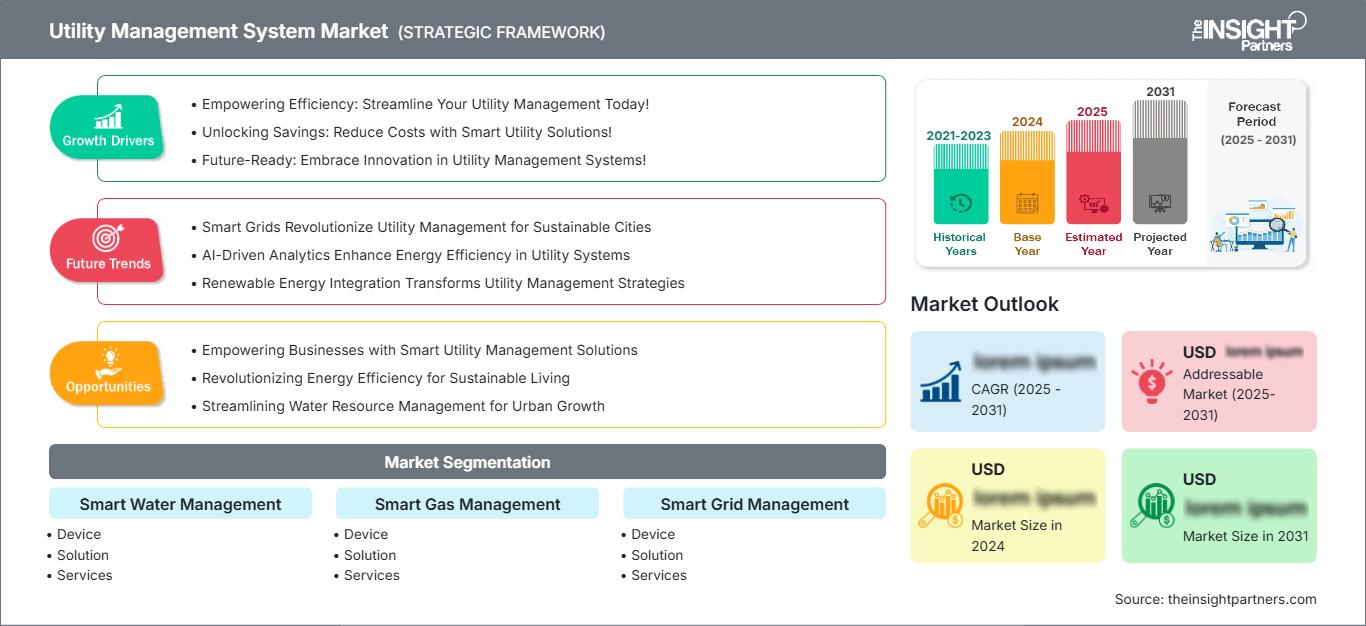
Mercado de sistemas de gestión de servicios públicos: Perspectivas estratégicas
-
Obtenga las principales tendencias clave del mercado de este informe.Esta muestra GRATUITA incluye análisis de datos, desde tendencias del mercado hasta estimaciones y pronósticos.
Regional Insights
North America Utility management system market
North America is estimated to hold a 32–34% share in 2025 and grow at a 6.8–7.6% CAGR through 2034. The region benefits from aging grid assets, rising peak demand, advanced metering penetration, and sustained investment in transmission and distribution modernization. The United States' utility companies are likewise considering the visibility of their distributed energy resources, substations, feeders, and customer points. The United States' water utilities are likewise under pressure to detect water leaks, manage their pumping cost, and plan their assets efficiently. These needs encourage the adoption of platforms encompassing devices, communication, operations software, and analytics in lieu of meter deployment alone.
Canada makes its contribution in the form of smart-grid transformation, digital water initiatives, and reliability initiatives, while the United States is the market player within the region. Policy developments have helped increase the investments into these systems: the U.S. Department of Energy released an estimated $1.9 billion dollar funding opportunity in March 2026 for transmission enhancements.
U.S. Utility management system Market
The U.S. represented an estimated 22–24% of global revenue and about 68–72% of North American revenue in 2025, with a 6.9–7.7% CAGR expected through 2034. Utilities are expanding advanced metering, outage management, distribution automation, and analytics as electricity demand rises.
The company coverage is widespread in the various utility modernization initiatives, which include Honeywell International Inc., Itron Inc., Oracle Corporation, IBM Corporation, Cisco Systems, Inc., and General Electric Company. The applications have come to rely on smart metering in connection with demand forecast, asset condition, consumer engagement and distributed energy management. Regional initiatives vary from state to state; however, the common denominator here is the need for a robust digital layer that would link the field assets with control room applications and consumers’ applications without having to replace existing infrastructure completely.
Europe Utility management system Market
Europe held 25–27% share in 2025, supporting the utility management system market share and is growing at a 6.5–7.3% CAGR through 2034. Germany leads grid modernization and industry digitization, while the UK, France, Italy, and Spain are expanding smart programs.
Interoperable platforms are needed due to the integration of smart metering, flexibility, and network modernization in the UK. The focus in Germany is on the digitalization of the distribution grid in the face of increasing levels of electrification and renewable energy production alongside rising industrial loads. In addition to advancing in the area of smart metering, the countries of France, Italy, and Spain have become leaders in water efficiency and distribution automation, and are therefore mature but developing environments in Europe.
APAC Utility management system Market
Asia Pacific held an estimated 28–31% share in 2025 and is forecast to grow at an 8.0–8.8% CAGR through 2034. China leads regional deployment, followed by Japan, South Korea, India, and Australia, where modernization priorities differ by utility structure and infrastructure maturity.
Industrial expansion, electrification, smart-city programs, and policy-led metering are strengthening demand across utility networks. India had installed 4.76 crore smart meters under various schemes by December 2025, while 20.33 crore had been sanctioned under the national distribution modernization program.
Middle East & Africa Utility management system Market
The Middle East and Africa are expected to grow at a 6.2–7.0% CAGR through 2034, led by Saudi Arabia and the UAE. Smart metering, desalination, water-loss management, and network reliability are central priorities as utilities manage resource constraints and rapidly expanding urban infrastructure.
South Africa and the rest of MEA present opportunities through grid rehabilitation, municipal digitization, and utility efficiency programs. Gulf markets emphasize automated electricity and water networks, while African markets increasingly favor modular solutions that can address reliability and revenue collection.
Segmentation Analysis
Smart Water Management
Smart Water Management is estimated to account for 26–29% of 2025 revenue and grow at an 8.2–9.0% CAGR through 2034. The utility management system market scope includes metering accuracy, leakage detection, pressure optimization, and asset visibility. Utilities are prioritizing metering accuracy, leak detection, pressure optimization, water-quality monitoring, and asset visibility. Climate-related water stress strengthens the economic case for digital monitoring, while connected devices allow utilities to identify anomalies before losses become systemic.
- Device: Connected water meters, sensors, and monitoring hardware provide the field-level data required for consumption measurement, leakage detection, pressure management, and targeted infrastructure maintenance.
- Solution: Analytics, meter data management, and operational applications convert field measurements into actionable intelligence, supporting conservation, billing accuracy, network optimization, and faster response to anomalies.
- Services: Implementation, integration, maintenance, and managed services reduce deployment complexity and help utilities sustain performance after installation, especially where internal digital capabilities remain constrained.
Smart Gas Management
Smart Gas Management is estimated to represent 20–23% of 2025 revenue and grow at a 6.4–7.2% CAGR through 2034. Utilities are upgrading metering, pressure monitoring, network surveillance, and customer data systems to improve safety and operational efficiency. Digitalization also supports better demand planning and faster identification of abnormal consumption or network conditions.
- Device: Smart gas meters, pressure sensors, and communications equipment provide granular network information, improving measurement, remote monitoring, safety management, and field-service prioritization.
- Solution: Network analytics, meter data management, and operational software help utilities forecast demand, identify anomalies, optimize field activities, and connect consumption information with enterprise systems.
- Services: Deployment, connectivity management, cybersecurity, maintenance, and integration services support long-lived gas infrastructure and enable utilities to modernize systems without replacing every legacy component.
Smart Grid Management
Smart Grid Management is the largest segment, estimated at 48–52% of 2025 revenue, with a 7.0–7.8% CAGR through 2034. Distributed generation, electric vehicles, data centers, and weather-related reliability risks are increasing the value of real-time grid visibility, automation, and coordinated asset control.
- Device: Smart meters, grid sensors, intelligent switches, and substation equipment create the measurement and control layer required for feeder visibility, outage response, distributed-resource integration, and reliability improvement.
- Solution: Distribution management, outage management, DER orchestration, and analytics coordinate increasingly complex networks, helping utilities optimize capacity, restore service, and integrate variable generation.
- Services: Systems integration, modernization, cybersecurity, consulting, and managed operations enable utilities to connect new grid technologies with established control-room and enterprise environments.
Opportunity Snapshot
|
Smart Grid Management |
Revenue Contribution (High/Medium/Low) |
Trend Tag (MAX 2 words) |
Adoption Stage (Emerging/Scaling/Mature) |
|
Device |
High |
Edge Sensing |
Scaling |
|
Solution |
High |
Grid Analytics |
Scaling |
|
Services |
Medium |
Managed Operations |
Scaling |
Utility Management System Market Growth Drivers and Impact Analysis
Grid complexity is increasing the value of real-time operational intelligence
Rising penetration of distributed generation, electric vehicles, flexible loads, and data centers is making distribution networks more dynamic. Utilities need continuous information from feeders, substations, meters, and customer assets to identify constraints before they become service problems. Digital management systems provide the common data environment required for forecasting, switching, outage restoration, and distributed-resource coordination. Suppliers that connect field devices with control applications can help utilities defer selected infrastructure upgrades by improving the utilization of existing capacity. As grid complexity rises, software, communications, and analytics become increasingly important components of infrastructure investment. Utilities can also use these capabilities to improve feeder-level visibility, coordinate flexible loads, and reduce manual investigation. The resulting value proposition extends across reliability, planning, and customer service rather than being limited to operational control.
Water scarcity is accelerating digital measurement and loss reduction
Water utilities are under pressure to increase resource efficiency without compromising on the quality of their service and keeping a check on their operational cost. With digital meters and network sensors, water utilities have the ability to track consumption trends, identify abnormal water flow rates, conduct field investigations, and monitor pressure. This is even more beneficial for water utilities when there are aged pipelines in their water systems or in case of seasonal changes that generate huge operational variations in water systems. The consequences of these technological developments go far beyond just metering since improved measurement helps utilities to plan capital expenditures more effectively and differentiate real losses from apparent losses. In addition, connected water technologies also facilitate remote service operations, which reduces manual meter reading and the duration between detecting anomalies and taking action.
Interoperability requirements are reshaping procurement and supplier positioning
Replacing every component simultaneously is usually impractical, so procurement increasingly favors open interfaces, modular architectures, and integration capabilities. The result is greater emphasis on lifecycle compatibility rather than initial hardware specifications. Suppliers able to connect operational technology with enterprise systems can participate in broader modernization programs, while specialized vendors can remain relevant through standards-based integration. Cybersecurity is becoming part of this purchasing decision because more connected endpoints expand the potential attack surface. Utilities therefore, evaluate identity management, network segmentation, software updates, data governance, and resilience alongside functionality. This changes competitive economics by rewarding vendors that can demonstrate long-term interoperability and secure operations across heterogeneous environments instead of optimizing a single application. Procurement teams increasingly reward lifecycle compatibility and measurable resilience outcomes.
Utility Management System Market Future Trends
AI-enabled utility operations will move from analytics toward autonomous recommendations
The utility management system market trends are shifting toward AI that does more than report historical performance. Over the next decade, utilities are likely to use machine learning and agentic software to recommend switching actions, prioritize maintenance, forecast localized demand, identify abnormal water flows, and coordinate flexible resources. Adoption will remain controlled because operators must understand model outputs and retain authority over safety-critical decisions. Edge processing will also expand where low latency or communications resilience is important. Vendors that can embed explainable AI into established operational workflows may gain stronger adoption than providers offering standalone models. Governance frameworks, model validation, and controlled deployment will remain important because utility decisions affect essential services and public safety across critical infrastructure networks globally.
Multi-utility digital platforms will support shared data and operating models
Utilities are likely to consolidate selected data, identity, asset, and analytics functions across electricity, gas, and water operations. Shared digital foundations can reduce duplicated integration work and create consistent governance for devices, users, locations, and asset records. This approach is particularly attractive for municipal or diversified utility groups that manage several networks but operate separate legacy applications. Cloud architectures can support common analytics while edge systems continue handling time-sensitive control functions locally. The utility management system market is therefore positioned to evolve toward platform architectures that coordinate multiple operational domains without requiring identical technology stacks. Security, interoperability, and data ownership will determine which consolidation models scale successfully. Utilities will favor architectures that allow domain teams to retain specialized applications while sharing common data services, reducing duplication without forcing premature replacement of proven operational systems.
Utility Management System Market Opportunities
Modernization-as-a-service can lower the barrier to utility digitization
Modernization-as-a-service offers utilities a way to adopt connected metering, analytics, and operational software without bearing the full upfront burden of technology ownership. Suppliers and infrastructure partners can combine equipment, implementation, communications, software, maintenance, and performance management into multiyear contracts. This model is particularly relevant for smaller municipalities and utilities with constrained technical teams. Investors and vendors can target programs where recurring service revenue aligns with measurable operational outcomes such as reduced losses, faster outage restoration, or lower field costs. They also create opportunities for specialized providers to partner with larger technology companies rather than competing for complete platform contracts. Such arrangements can improve local implementation capacity while giving utilities clearer accountability for outcomes, support, and technology refreshes over time consistently.
Water-network intelligence creates investable niches beyond smart metering
A significant opportunity in the market exists in software and services that turn water-network data into infrastructure decisions. Utilities increasingly need tools that combine consumption information with pressure, flow, asset condition, weather, and maintenance records. Providers can develop targeted offerings for leak localization, pump optimization, demand forecasting, pressure management, and capital prioritization rather than selling metering hardware alone. Utility management system market forecasts should track where the strongest opportunities will be in markets where water scarcity or non-revenue water creates a clear financial incentive for measurable intervention. Providers can also package analytics with field services, creating a practical bridge between software recommendations and physical maintenance decisions at scale. Utility management system Forecasts should therefore consider water intelligence as a distinct avenue for technology-led value creation.
Frequently Asked Questions

Naveen es un profesional experimentado en investigación de mercados y consultoría de gestión empresarial, con más de 12 años de experiencia en el desarrollo de investigaciones estratégicas, inteligencia de mercado (Market Intelligence) y soluciones de asesoramiento empresarial en diversos sectores industriales. Sus principales áreas de especialización incluyen electrónica, tecnología, automatización industrial, banca, servicios financieros y seguros (BFSI), industria automotriz y sector aeroespacial. Está especializado en la evaluación de mercados, el análisis de la competencia (Competitive Intelligence), la evaluación comparativa sectorial (Benchmarking), el desarrollo de estrategias de crecimiento, el análisis de entrada a nuevos mercados y la evaluación de oportunidades de negocio. Gracias a sus amplios conocimientos sectoriales y su experiencia en consultoría estratégica, ayuda a las organizaciones a identificar oportunidades de mercado y tomar decisiones empresariales fundamentadas.
En su función como vicepresidente asociado (Associate Vice President), Naveen lidera proyectos complejos de investigación de mercados y consultoría estratégica, gestiona las relaciones con las principales partes interesadas (stakeholders) y supervisa el ciclo completo de ejecución de los proyectos, desde la planificación inicial hasta la entrega de los resultados. A lo largo de su trayectoria profesional, ha llevado a cabo con éxito numerosos proyectos de investigación de mercados y consultoría para clientes de diferentes sectores industriales y regiones geográficas. Su trabajo ha permitido a las organizaciones identificar oportunidades emergentes, comprender las dinámicas competitivas, evaluar el potencial de inversión y adoptar decisiones estratégicas informadas. Su enfoque analítico y orientado a resultados contribuye al desarrollo de estrategias empresariales eficaces y al fortalecimiento de la competitividad de sus clientes.
Naveen cuenta con una licenciatura en Ingeniería Electrónica y de Comunicaciones por la Visvesvaraya Technological University (VTU), ubicada en el estado de Karnataka, India, y una maestría en Administración de Empresas (MBA), con especialización en Marketing y Gestión de Operaciones, por la Manipal University. La combinación de sus sólidos conocimientos técnicos, su amplia experiencia en múltiples sectores industriales y su trayectoria en consultoría estratégica le permite transformar datos de mercado complejos en información estratégica relevante y recomendaciones prácticas y aplicables. Gracias a estas capacidades, apoya a las empresas en la identificación de oportunidades de crecimiento, la mejora de su posicionamiento competitivo y el desarrollo de planes estratégicos a largo plazo, contribuyendo al cumplimiento de sus objetivos comerciales y al crecimiento sostenible de sus negocios.
- Análisis exhaustivo del tamaño del mercado y previsiones
- Análisis detallado de la segmentación
- Evaluación en profundidad de la dinámica del mercado
- Información a nivel regional y nacional
- Panorama competitivo y análisis comparativo de empresas
- Inteligencia empresarial estratégica
Testimonios

The Insight Partners proporcionó información de mercado valiosa que respaldó nuestra estrategia global de entrada en el mercado. Su equipo fue profesional, respondió con rapidez y prestó atención a nuestros comentarios. A lo largo del proyecto, ofreció análisis bien fundamentados y aclaraciones metodológicas útiles.
Junmo Kim Director financiero (CFO), Enertech Co., Ltd.
El informe de mercado de sistemas SCADA de Insight Partners es completo y ofrece información valiosa sobre las tendencias actuales y las previsiones futuras. El equipo fue altamente profesional, receptivo y me brindó un gran apoyo en todo momento. Estamos muy satisfechos y recomendamos ampliamente sus servicios.
RAN KEDEM Socio, Reali Technologies LTDs
Solicité un informe sobre un mercado de software muy específico y el equipo lo elaboró en pocos días. La información era muy relevante y estaba bien presentada. Posteriormente, solicité algunos cambios y adiciones al informe. El equipo fue muy receptivo y recibí el informe final en menos de una semana.
JEAN-HERVE JENN Presidente, Future Analytica
Trabajamos con The Insight Partners para un importante estudio y pronóstico de mercado. Nos brindaron una visión clara de las oportunidades y los riesgos, lo que nos ayudó a definir nuestros planes. Su investigación fue fácil de usar y se basó en datos sólidos. Nos ayudó a tomar decisiones inteligentes y seguras. Los recomendamos ampliamente.
PIYUSH NAGPAL Vicepresidente Sénior, , High Beam Global
The Insight Partners realizó una investigación de mercado profunda y bien estructurada con una sólida experiencia en el sector. Su equipo fue profesional y receptivo en todo momento. El sitio web, fácil de usar, facilitó el acceso a los informes del sector. Los recomendamos ampliamente por sus servicios de investigación confiables y de alta calidad.
YUKIHIKO ADACHI Director Ejecutivo, , Deep Blue, LLC
Esta es la primera vez que compro un informe de mercado de The Insight Partners. Aunque al principio tenía dudas, visité su sitio web y me sentí más cómodo al arriesgarme y comprarlo. Estoy completamente satisfecho con la calidad del informe y el servicio al cliente. Tenía varias preguntas y comentarios sobre el informe inicial, pero después de un par de conversaciones por correo electrónico con su analista, creo que tengo un informe que puedo usar como base para nuestro proceso de planificación estratégica. Muchas gracias por tomarse el tiempo y hacer de esta una experiencia positiva. Sin duda, recomendaré sus servicios y serán mi primera opción cuando necesitemos más datos de mercado.
JOHN SUZUKI Presidente y Director Ejecutivo, Director de la Junta Directiva, BK Technologies
Agradezco su apoyo y la profesionalidad que demostraron al atender mi solicitud de información sobre el mercado de diagnóstico in vitro (IVD) para enfermedades infecciosas en Nigeria. Agradezco su paciencia, su orientación y su disposición a ofrecerme un descuento, lo que finalmente nos permitió cerrar un trato. Espero poder colaborar con The Insight Partners en el futuro, gracias a la impresión que me causó este primer encuentro.
DRA. CHIJIOKE ONYIA, DIRECTORA GENERAL, PineCrest Healthcare Ltd.Razón para comprar
- Toma de decisiones informada
- Comprensión de la dinámica del mercado
- Análisis competitivo
- Información sobre clientes
- Pronósticos del mercado
- Mitigación de riesgos
- Planificación estratégica
- Justificación de la inversión
- Identificación de mercados emergentes
- Mejora de las estrategias de marketing
- Impulso de la eficiencia operativa
- Alineación con las tendencias regulatorias



















 Obtenga una muestra gratuita para -