
Panorama general de los ingresos, la demanda y las tendencias del mercado de redes de sensores inalámbricos
Tamaño del mercado y pronósticos de redes de sensores inalámbricos (2021-2034), participación global y regional, tendencias y análisis de oportunidades de crecimiento. Cobertura del informe: por oferta (hardware, software, servicios), tipo de sensor (sensores de luz ambiental, sensores de temperatura, sensores de presión, sensores de movimiento y posición, IMU, sensores de flujo, sensores químicos, otros), tipo de conectividad (ANT+, Bluetooth/BLE, Zigbee, Wi-Fi, red celular, NFC, otros), uso final (automatización de edificios, dispositivos portátiles, atención médica, automoción y transporte, industria, petróleo y gas, comercio minorista, agricultura, aeroespacial y defensa, energía y electricidad, otros).
- Estado : Datos publicados
- Código de informe : TIPRE00039680
- Categoría : Electrónica y semiconductores
- Número de páginas : 150
- Formatos de informe disponibles :


- Fecha de última actualización : September 28, 2026


2025 Market Size
US$ 106.75 Bn
Base year value
2034 Forecast
US$ 334.09 Bn
Projected by 2034
CAGR 2026-2034
13.52 %
Growth rate
Addressable Market
US$ 1,909.86 Bn
(2026-2034)
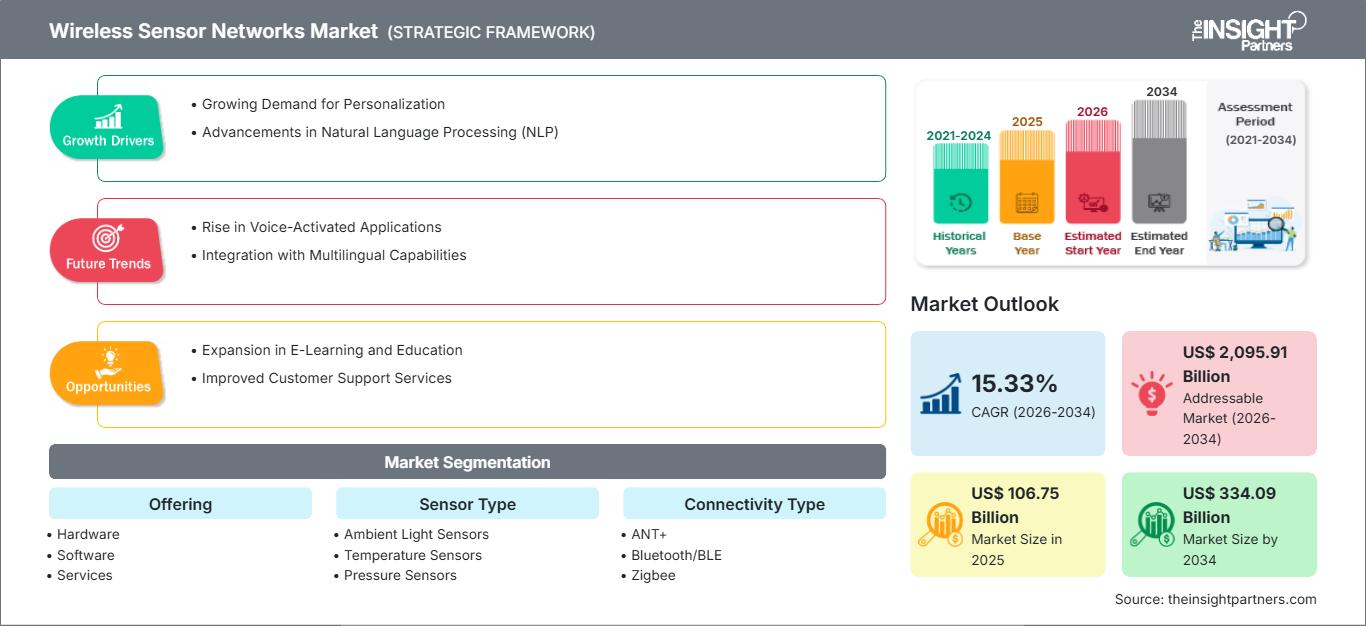
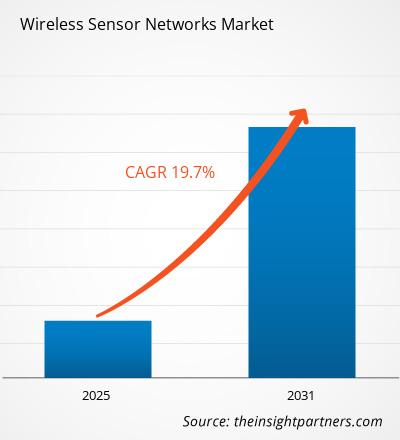
The Wireless Sensor Networks market was valued at US$ 106.75 billion in 2025 and is expected to reach US$ 334.09 billion by 2034; it is estimated to record a CAGR of 13.52% during 2026-2034.
Wireless Sensor Networks Market Assessment and Insights
- North America is estimated to hold 29–33% wireless sensor networks market share in 2025 and grow at a CAGR of 14.5–16.0% between 2026–2034, supported by industrial IoT, building automation, healthcare monitoring, and connected infrastructure.
- US is estimated to represent 72–76% of North American demand in 2025 and expand at a CAGR of 14.7–16.2% during 2026–2034, led by connected infrastructure and industrial automation.
- Europe is estimated at 23–27% share in 2025 and projected to grow at 13.5–15.0% CAGR between 2026–2034, with Germany, the UK, France, Italy, and Spain supporting industrial and energy deployments.
- Asia Pacific is estimated at 30–34% share in 2025 and expected to expand at 16.0–17.5% CAGR during 2026–2034, led by China, Japan, South Korea, India, and Australia.
- Largest Segment is estimated to hold 38–42% market share in 2025 and grow at 14.0–15.5% CAGR between 2026–2034, reflecting the scale of hardware-led node and gateway deployments.
- High Growth Segment is estimated to hold 18–22% market share in 2025 and grow at 17.0–18.5% CAGR during 2026–2034, supported by services, integration, monitoring, and lifecycle management.
- Key companies analyzed in detail: Intel Corporation, Dell Inc., Texas Instruments Incorporated, Cisco Systems, Inc., NXP Semiconductors N.V., TE Connectivity Ltd., ABB Ltd., Honeywell International Inc., Broadcom Inc., Infineon Technologies AG, Analog Devices, Inc.
Source: The Insight Partners' analysis based on proprietary research, government publications, company annual reports, investor presentations, industry databases, and expert interviews.
The market for wireless sensor networks will evolve away from single sensors towards integrated solutions that include sensing capabilities, edge computing, gateways, and cloud infrastructures. More flexible deployment will be enabled by lower-power microcontrollers, smaller radio transceivers, mesh networking technology, and multi-protocol designs. Industrial buyers are turning towards wireless designs for their retrofits where wiring is difficult and costly, and semiconductor design is making nodes smaller and less power-hungry.
Over the forecast period, adoption of wireless sensor networks will gain further traction in emerging industrial economies, smart infrastructures and distributed energy sources. Regulatory concerns regarding energy efficiency, cyber security, functional safety and interoperability of connected devices will impact buying decisions. Capital expenditure will be directed at edge computing and security for device management in order for companies to leverage value without data transfer and save battery-operated operation time.
Wireless Sensor Networks Market Report Scope
| Report Attribute | Details |
|---|---|
| Market size in 2025 | US$ 106.75 Billion |
| Market Size by 2034 | US$ 334.09 Billion |
| Global CAGR (2026 - 2034) | 13.52% |
| Historical Data | 2021-2024 |
| Forecast period | 2026-2034 |
Wireless Sensor Networks Market Analysis
The growth drivers for the wireless sensor network market are related to the need for real-time visibility, monitoring, tracking, sensing, flexible automation, and predictive maintenance. The value chain includes the manufacturers of sensors, semiconductors, connectivity solutions, gateways, software, systems integration and end-users from industry. Interoperability among devices, protocols and analytics layer is the source of new value.
In the supply dynamics of the wireless sensor network market, the trend towards reducing bill of material by integrating multiple functions into single components is observed. This increases the speed of installation and reduces costs, while niche players will be able to specialize in development of robust sensors and radios. The demand is strongest in areas where wired solutions can’t be used due to installation constraints – manufacturing facilities, utilities, buildings, logistics facilities, agricultural areas and remote sites.
Market competition in the wireless sensor networks market is growing as players in the semiconductor, networking, automation, and connectivity segments align themselves around the IoT architecture. Intel Corporation and Dell Inc. are focused on computing and infrastructure layers, while Texas Instruments Incorporated, NXP Semiconductors N.V., Infineon Technologies AG, and Analog Devices, Inc. provide sensing, processing, and connectivity capabilities. Cisco Systems, Inc. combines wireless infrastructures and IoT management, while ABB Ltd. and Honeywell International Inc. provide industrial automation and building solutions.
Wireless Sensor Networks Market report is indicative of efforts towards integration of platforms, developer ecosystems, and software-as-a-service. TE Connectivity Ltd. integrates sensing and connectivity capabilities, while Broadcom Inc. provides wireless and semiconductor solutions. Investments are being made in low power architectures, multi-protocol radios, edge processing, and secure device provisioning. Alliances with system integrators and industrial software vendors can help reduce deployment time and increase presence in difficult enterprise deals.
● REPORT CUSTOMIZATION
Tailor This Report To Align With Your Specific Business Requirements
This report can be customized to align precisely with your business objectives, scope, and target markets. Customization options include tailored segmentation, geography, competitive analysis, and strategic insights to support informed decision-making.
Customize This Report →WHAT YOU CAN ADJUST
- ● Segmentations
- ● Geography
- ● Competitive Analysis
- ● Language Preferences
Wireless Sensor Networks Market:
Personalice este informe según sus necesidades
Disfrutará de la personalización gratuita de cualquier informe, incluyendo partes del mismo, análisis por país y un paquete de datos de Excel. Además, podrá aprovechar excelentes ofertas y descuentos para startups y universidades.
Mercado de redes de sensores inalámbricos: Perspectivas estratégicas
-
Obtenga las principales tendencias clave del mercado de este informe.Esta muestra GRATUITA incluye análisis de datos, desde tendencias del mercado hasta estimaciones y pronósticos.
Regional Insights
North America wireless sensor networks market
North America is estimated to account for 29–33% share in 2025 and expand at a CAGR of 14.5–16.0% through 2034. The United States is the region leader in adoption, whereas Canada adds value by way of its participation in mining, utilities, manufacturing, and smart buildings. Industrial retrofitting, monitoring of data centers, healthcare digitalization, and infrastructural connections will generate a demand for efficient sensors and secure wireless connectivity.
More and more regional purchasing will require solutions that possess good interoperability, cybersecurity, and cost-efficiency during the whole lifecycle of the products. Wireless nodes will be able to minimize interference with ongoing processes and monitor assets where cabling may prove difficult. Investments in manufacturing, energy, and infrastructural digitalization are expected to stimulate further adoption.
U.S. wireless sensor networks market
The U.S. represents an estimated 72–76% of North American demand in 2025 and is projected to grow at a CAGR of 14.7–16.2% through 2034. Adoption is prevalent within manufacturing, construction, healthcare, logistics, energy and transport. The companies like Intel Corporation, Cisco Systems, Inc., Honeywell International Inc., Texas Instruments Incorporated, and Analog Devices, Inc. are contributing in computing, networking, automation, and sensing domains respectively.
Application focus is shifting towards areas such as predictive maintenance, occupancy awareness, asset tracking and automated control. The larger buildings prefer wireless systems since sensors may be installed without undertaking major construction projects. Healthcare and wearable applications also get benefited with the compact and power-efficient system designs. Network security has become a major consideration in network design.
Europe wireless sensor networks market
Europe is estimated to hold 23–27% share in 2025 and grow at 13.5–15.0% CAGR through 2034, with Germany leading regional industrial demand. The United Kingdom favors the development of intelligence and healthcare solutions, while France, Italy, and Spain favor applications in energy, manufacturing, transport, and infrastructure. Factory automation and digitalization help Germany gain in-demand use cases for reliable wireless monitoring systems.
Consumers in Europe tend to pay more attention to the energy efficiency, cybersecurity, interoperability, and durability of products in addition to their price. The industrial upgrades and intelligent buildings drive the adoption of retrofittable sensors, and the utilities leverage distributed monitoring to enhance asset visibility. The manufacturing and transport sectors are promising in France and Italy, and Spain gains from renewable energy and infrastructure applications.
APAC wireless sensor networks market
APAC is estimated to represent 30–34% share in 2025 and grow at 16.0–17.5% CAGR through 2034, making it the fastest major regional growth center. China leads, followed by Japan, South Korea, India, and Australia. Manufacturing automation, electronics production, smart cities, and industrial energy management are major demand sources.
While China gains advantages of industrial digitalization, Japan and South Korea stress advanced manufacturing and robotics technologies. India develops initiatives for the development of connected infrastructures, utilities, and industrial automation systems, whereas Australia has possibilities in the mining industry, agriculture, and remote asset monitoring. The role of government-driven programs for digitalization and energy efficiency grows stronger.
Middle East & Africa wireless sensor networks market
The wireless sensor networks market report shows that Middle East and Africa is expected to expand at 12.5–14.0% CAGR through 2034, with Saudi Arabia leading regional opportunity. Smart-city, building, logistics, and energy applications are supported by the UAE, while the South African side contributes with industry, mining, and utilities usage. The remote monitoring solution is especially useful in case the infrastructure is spread and not easily accessible.
Among other application segments, energy, water, transportation, and industrial infrastructures continue to be among those most important for the market. Saudi Arabia and the UAE will have connected buildings and digital infrastructure, while South Africa will see the growth in mining and utilities usage. Rest of MEA is dependent on telecom availability, funding, and harsh environment.
Segmentation Analysis
Offering
Offering segment in the wireless sensor networks market is expected to grow at a CAGR of 14.0–15.5% during 2026–2034. Hardware remains central because deployments require sensor nodes, radios, gateways, and power components. Software is gaining importance for device management, analytics, security, and integration, while services support installation, calibration, network design, and lifecycle optimization.
- Hardware remains foundational for node, gateway, antenna, processor, and power architectures. Demand favors compact, low-power components supporting diverse sensing functions and industrial reliability requirements.
- Software supports provisioning, telemetry management, analytics, security, and interoperability. Buyers favor platforms that reduce fragmented operations and provide centralized visibility across distributed sensor estates.
- Services cover site assessment, deployment, integration, calibration, maintenance, and optimization. Their value rises when networks span large facilities, remote assets, multiple protocols, or regulated environments.
Sensor Type
Sensor Type segment in the wireless sensor networks market is projected to grow at a CAGR of 14.5–16.0% during 2026–2034. Temperature, pressure, motion, and environmental sensing remain widely deployed, while integrated inertial and chemical sensing expands use in mobility, healthcare, industrial safety, and process monitoring. Multi-sensor nodes improve data density without proportionally increasing installation complexity.
- Ambient Light Sensors support lighting automation, displays, occupancy-aware environments, and energy optimization. Low power requirements make them suitable for distributed building and consumer-device applications.
- Temperature Sensors support equipment health, HVAC control, cold-chain monitoring, and process supervision. Wireless deployment is valuable where assets are distributed or cable installation is disruptive.
- Pressure Sensors serve fluid systems, industrial equipment, medical devices, and process control. Demand benefits from predictive maintenance and remote monitoring in challenging locations.
- Motion & Position Sensors enable asset tracking, machine-state monitoring, security, and automation. Their importance rises as enterprises seek real-time location and movement information.
- IMUs combine motion measurements for wearables, vehicles, robotics, and industrial equipment. Integration with edge processing enables responsive control and richer contextual data.
- Flow Sensors monitor water, gas, chemicals, and process fluids. Wireless connectivity improves visibility across distributed metering points while reducing cabling requirements.
- Chemical Sensors address air quality, process chemistry, environmental monitoring, and safety. Their importance increases as connected facilities demand continuous detection instead of manual sampling.
Connectivity Type
Connectivity Type is projected to grow at a CAGR of 15.0–16.5% during 2026–2034. No single protocol serves every application. BLE and Wi-Fi support local deployments, Zigbee enables low-power mesh networks, cellular extends geographic reach, and NFC supports commissioning. Multi-protocol architectures are increasingly favored for interoperability.
- ANT+ remains relevant for ultra-low-power sports, wellness, and specialized monitoring devices where modest data rates and efficient battery use are priorities.
- Bluetooth/BLE supports wearables, healthcare, building sensing, asset tracking, and consumer devices. Low power consumption and broad availability make it attractive for short-range connectivity.
- Zigbee provides low-power mesh networking for buildings, lighting, automation, and connected devices. Its mesh structure extends coverage while supporting distributed nodes.
- Wi-Fi serves applications requiring higher throughput and broad local coverage. Newer generations improve capacity and efficiency for increasingly dense connected environments.
- Cellular Network enables wide-area monitoring of vehicles, utilities, agriculture, logistics, and remote industrial assets. It reduces dependence on local gateways where geographic coverage exists.
- NFCs support commissioning, identification, configuration, and short-range exchange. Their role is strongest where devices require simple contact-based setup or secure interaction.
End Use
End Use is expected to grow at a CAGR of 15.5–17.0% during 2026–2034, with industrial and building applications providing substantial deployment volume. Healthcare, automotive, energy, agriculture, and logistics broaden opportunities by requiring continuous monitoring across distributed assets and operating environments.
- Building Automation uses sensors for HVAC, lighting, occupancy, security, and environmental quality. Wireless architectures are particularly useful in retrofit buildings because installation minimizes disruption.
- Wearable Devices rely on compact sensing and low-power connectivity for activity, wellness, location, and physiological monitoring. Miniaturization supports greater functionality in battery-constrained products.
- Healthcare applications include remote monitoring, connected equipment, assisted care, and facility management. Wireless sensing improves data availability while supporting flexible placement around patients.
- Automotive & Transportation uses sensors for vehicle condition, location, safety, fleet monitoring, and infrastructure. Wireless architectures complement embedded systems requiring distributed measurements.
- Industrial deployments emphasize predictive maintenance, process monitoring, machine health, worker safety, and asset visibility. Rugged wireless nodes are valuable where wired installation is costly.
- Oil & Gas applications include pressure, vibration, flow, corrosion, and environmental monitoring. Wireless sensing improves access to remote equipment while reducing cabling exposure.
- Retail uses sensing for inventory visibility, environmental control, security, occupancy, and asset tracking. Connected data improves store operations and facility management.
- Agriculture applications monitor soil, weather, irrigation, livestock, and equipment. Wireless networks cover large areas where cabling is impractical.
- Aerospace & Defense applications require reliable sensing for equipment condition, logistics, facilities, and mission support. Secure, rugged, low-power architectures remain important.
- Energy & Power uses distributed sensing across generation, transmission, distribution, storage, and facilities. Wireless monitoring improves asset visibility across geographically dispersed infrastructure.
Opportunity Snapshot
|
End Use |
Revenue Contribution (High/Medium/Low) |
Trend Tag |
Adoption Stage |
|
Building Automation |
High |
HVAC Intelligence |
Scaling |
|
Wearable Devices |
Medium |
Health Tracking |
Scaling |
|
Healthcare |
High |
Remote Monitoring |
Scaling |
|
Automotive & Transportation |
High |
Fleet Telemetry |
Scaling |
|
Industrial |
High |
Predictive Maintenance |
Mature |
|
Oil & Gas |
Medium |
Asset Monitoring |
Scaling |
|
Retail |
Medium |
Smart Inventory |
Scaling |
|
Agriculture |
Medium |
Precision Irrigation |
Scaling |
|
Aerospace & Defense |
Medium |
Secure Telemetry |
Emerging |
|
Energy & Power |
High |
Grid Monitoring |
Scaling |
Wireless Sensor Networks Market Growth Drivers and Impact Analysis
Industrial Retrofit Economics Favor Wireless Deployment
Wireless sensing can reduce disruption associated with monitoring existing factories, warehouses, utilities, and commercial facilities. In brownfield environments, routing cables may require shutdowns, civil work, hazardous-area procedures, or specialized labor. Wireless nodes can instead be installed around operating assets and connected through gateways or mesh architectures. The commercial impact is strongest when customers need incremental coverage rather than complete control-system replacement. This changes purchasing decisions toward phased deployments, allowing customers to prioritize high-value equipment first. Installed sensor bases can then expand as maintenance or efficiency benefits are demonstrated. The result is a broader addressable pool across facilities where wired monitoring was technically possible but economically unattractive, strengthening demand for rugged nodes, gateways, software, and integration services.
Edge Intelligence Raises the Value of Distributed Sensing
More processing is moving toward gateways and sensor endpoints as organizations seek faster decisions and lower communications overhead. Local filtering can identify abnormal vibration, temperature changes, occupancy events, or equipment states before transmitting selected information. This improves responsiveness while reducing unnecessary network traffic. The impact extends beyond hardware because customers increasingly require software, analytics, security, and lifecycle services around the sensing layer. Semiconductor suppliers that combine processing, connectivity, and sensing can capture more system value, while integrators can differentiate through application-specific analytics. Edge intelligence also supports battery-constrained devices by allowing selective communication rather than continuous transmission. As data volumes rise, this architecture can become essential for scalable deployments across dense industrial and commercial environments.
Interoperability Requirements Expand Multi-Protocol Architectures
Connected facilities increasingly contain equipment from multiple generations and vendors, creating pressure for networks that accommodate different wireless standards. Enterprises may combine BLE for nearby devices, Wi-Fi for higher throughput, Zigbee for low-power mesh connectivity, and cellular links for remote assets. The commercial impact is a shift toward gateways, software abstraction layers, and multi-radio chips that manage heterogeneous environments. Vendors able to support interoperability can reduce replacement requirements and simplify deployment across mixed estates. Procurement criteria therefore increasingly include ecosystem compatibility, security updates, management tools, and long-term support alongside radio performance. Standards-based architectures can lower integration risk and encourage wider adoption by allowing enterprises to preserve existing assets while progressively adding new sensing capabilities.
Wireless Sensor Networks Market Future Trends
AI-Assisted Sensor Nodes and Adaptive Sampling
The wireless sensor networks market trends are likely to move toward adaptive sensing in which devices dynamically adjust sampling frequency, local processing, and transmission behavior according to operating conditions. Instead of sending every measurement, intelligent nodes can identify meaningful changes and transmit selected events. This approach can extend battery life, reduce network congestion, and improve responsiveness in predictive maintenance and environmental monitoring. Future platforms are likely to combine small AI accelerators with inertial, acoustic, thermal, or chemical inputs, enabling contextual decisions at the edge. Such architectures can support autonomous operation in remote locations where frequent battery replacement is impractical. The opportunity will favor vendors combining sensing accuracy, low-power computing, secure software, and efficient wireless communication in compact platforms.
Energy Harvesting and Maintenance-Light Sensor Networks
Energy harvesting is expected to become more practical for selected deployments as enterprises seek to reduce recurring maintenance associated with battery replacement. Sensors may draw small amounts of energy from vibration, light, temperature gradients, or electromagnetic sources, depending on operating conditions. This can support monitoring of equipment located in difficult-to-access areas such as industrial machinery, pipelines, bridges, and remote infrastructure. The trend will not eliminate batteries across all applications because harvested energy varies by location. Instead, hybrid architectures combining harvesting, energy-efficient electronics, and storage are likely to emerge. Vendors that optimize sensing duty cycles, radio activity, and local processing around available energy profiles can improve network longevity. This creates new value for system designers focused on lifecycle cost rather than initial device price.
Wireless Sensor Networks Market Opportunities
Connected Infrastructure for Distributed Energy Assets
The wireless sensor networks market Forecasts indicate an expanding opportunity in distributed energy infrastructure, including solar installations, battery storage, substations, microgrids, and commercial energy systems. These assets require measurements for temperature, pressure, current, vibration, environmental conditions, and equipment status. Wireless sensing can provide incremental visibility without extensive cabling, particularly during capacity additions or retrofit programs. Suppliers can target utility operators, renewable developers, industrial energy users, and facility managers with modular monitoring architectures. The strongest opportunities are likely to combine rugged sensing, secure communications, edge analytics, and centralized asset management. Partnerships with electrical equipment manufacturers and energy software providers can reduce integration barriers. Investment should prioritize platforms supporting multiple protocols and reliable operation under variable environmental and electromagnetic conditions.
Industrial Safety and Remote Asset Monitoring
A second opportunity in the wireless sensor networks market lies in safety-critical monitoring of remote industrial assets where manual inspection is expensive, infrequent, or hazardous. Oil and gas facilities, mining operations, chemical plants, water infrastructure, and large manufacturing sites can use wireless sensors to monitor equipment condition and environmental parameters. Opportunity is strongest where a limited number of high-value assets justify specialized ruggedized nodes and managed connectivity. Vendors can differentiate through hazardous-environment certifications, long battery life, secure provisioning, and analytics that convert measurements into maintenance actions. System integrators can package these capabilities into application-specific solutions rather than selling individual sensors. Customers can extend networks from pilot assets to broader operating areas once reliability and maintenance savings are demonstrated, creating recurring demand for hardware, software, and lifecycle services.
Frequently Asked Questions

Naveen es un profesional experimentado en investigación de mercados y consultoría de gestión empresarial, con más de 12 años de experiencia en el desarrollo de investigaciones estratégicas, inteligencia de mercado (Market Intelligence) y soluciones de asesoramiento empresarial en diversos sectores industriales. Sus principales áreas de especialización incluyen electrónica, tecnología, automatización industrial, banca, servicios financieros y seguros (BFSI), industria automotriz y sector aeroespacial. Está especializado en la evaluación de mercados, el análisis de la competencia (Competitive Intelligence), la evaluación comparativa sectorial (Benchmarking), el desarrollo de estrategias de crecimiento, el análisis de entrada a nuevos mercados y la evaluación de oportunidades de negocio. Gracias a sus amplios conocimientos sectoriales y su experiencia en consultoría estratégica, ayuda a las organizaciones a identificar oportunidades de mercado y tomar decisiones empresariales fundamentadas.
En su función como vicepresidente asociado (Associate Vice President), Naveen lidera proyectos complejos de investigación de mercados y consultoría estratégica, gestiona las relaciones con las principales partes interesadas (stakeholders) y supervisa el ciclo completo de ejecución de los proyectos, desde la planificación inicial hasta la entrega de los resultados. A lo largo de su trayectoria profesional, ha llevado a cabo con éxito numerosos proyectos de investigación de mercados y consultoría para clientes de diferentes sectores industriales y regiones geográficas. Su trabajo ha permitido a las organizaciones identificar oportunidades emergentes, comprender las dinámicas competitivas, evaluar el potencial de inversión y adoptar decisiones estratégicas informadas. Su enfoque analítico y orientado a resultados contribuye al desarrollo de estrategias empresariales eficaces y al fortalecimiento de la competitividad de sus clientes.
Naveen cuenta con una licenciatura en Ingeniería Electrónica y de Comunicaciones por la Visvesvaraya Technological University (VTU), ubicada en el estado de Karnataka, India, y una maestría en Administración de Empresas (MBA), con especialización en Marketing y Gestión de Operaciones, por la Manipal University. La combinación de sus sólidos conocimientos técnicos, su amplia experiencia en múltiples sectores industriales y su trayectoria en consultoría estratégica le permite transformar datos de mercado complejos en información estratégica relevante y recomendaciones prácticas y aplicables. Gracias a estas capacidades, apoya a las empresas en la identificación de oportunidades de crecimiento, la mejora de su posicionamiento competitivo y el desarrollo de planes estratégicos a largo plazo, contribuyendo al cumplimiento de sus objetivos comerciales y al crecimiento sostenible de sus negocios.
- Análisis exhaustivo del tamaño del mercado y previsiones
- Análisis detallado de la segmentación
- Evaluación en profundidad de la dinámica del mercado
- Información a nivel regional y nacional
- Panorama competitivo y análisis comparativo de empresas
- Inteligencia empresarial estratégica
Testimonios

The Insight Partners proporcionó información de mercado valiosa que respaldó nuestra estrategia global de entrada en el mercado. Su equipo fue profesional, respondió con rapidez y prestó atención a nuestros comentarios. A lo largo del proyecto, ofreció análisis bien fundamentados y aclaraciones metodológicas útiles.
Junmo Kim Director financiero (CFO), Enertech Co., Ltd.
El informe de mercado de sistemas SCADA de Insight Partners es completo y ofrece información valiosa sobre las tendencias actuales y las previsiones futuras. El equipo fue altamente profesional, receptivo y me brindó un gran apoyo en todo momento. Estamos muy satisfechos y recomendamos ampliamente sus servicios.
RAN KEDEM Socio, Reali Technologies LTDs
Solicité un informe sobre un mercado de software muy específico y el equipo lo elaboró en pocos días. La información era muy relevante y estaba bien presentada. Posteriormente, solicité algunos cambios y adiciones al informe. El equipo fue muy receptivo y recibí el informe final en menos de una semana.
JEAN-HERVE JENN Presidente, Future Analytica
Trabajamos con The Insight Partners para un importante estudio y pronóstico de mercado. Nos brindaron una visión clara de las oportunidades y los riesgos, lo que nos ayudó a definir nuestros planes. Su investigación fue fácil de usar y se basó en datos sólidos. Nos ayudó a tomar decisiones inteligentes y seguras. Los recomendamos ampliamente.
PIYUSH NAGPAL Vicepresidente Sénior, , High Beam Global
The Insight Partners realizó una investigación de mercado profunda y bien estructurada con una sólida experiencia en el sector. Su equipo fue profesional y receptivo en todo momento. El sitio web, fácil de usar, facilitó el acceso a los informes del sector. Los recomendamos ampliamente por sus servicios de investigación confiables y de alta calidad.
YUKIHIKO ADACHI Director Ejecutivo, , Deep Blue, LLC
Esta es la primera vez que compro un informe de mercado de The Insight Partners. Aunque al principio tenía dudas, visité su sitio web y me sentí más cómodo al arriesgarme y comprarlo. Estoy completamente satisfecho con la calidad del informe y el servicio al cliente. Tenía varias preguntas y comentarios sobre el informe inicial, pero después de un par de conversaciones por correo electrónico con su analista, creo que tengo un informe que puedo usar como base para nuestro proceso de planificación estratégica. Muchas gracias por tomarse el tiempo y hacer de esta una experiencia positiva. Sin duda, recomendaré sus servicios y serán mi primera opción cuando necesitemos más datos de mercado.
JOHN SUZUKI Presidente y Director Ejecutivo, Director de la Junta Directiva, BK Technologies
Agradezco su apoyo y la profesionalidad que demostraron al atender mi solicitud de información sobre el mercado de diagnóstico in vitro (IVD) para enfermedades infecciosas en Nigeria. Agradezco su paciencia, su orientación y su disposición a ofrecerme un descuento, lo que finalmente nos permitió cerrar un trato. Espero poder colaborar con The Insight Partners en el futuro, gracias a la impresión que me causó este primer encuentro.
DRA. CHIJIOKE ONYIA, DIRECTORA GENERAL, PineCrest Healthcare Ltd.Razón para comprar
- Toma de decisiones informada
- Comprensión de la dinámica del mercado
- Análisis competitivo
- Información sobre clientes
- Pronósticos del mercado
- Mitigación de riesgos
- Planificación estratégica
- Justificación de la inversión
- Identificación de mercados emergentes
- Mejora de las estrategias de marketing
- Impulso de la eficiencia operativa
- Alineación con las tendencias regulatorias




















 Obtenga una muestra gratuita para -