
Taille et demande du marché de l'acide caprique en 2034
Taille et prévisions du marché de l'acide caprique (2021-2034), parts de marché mondiales et régionales, tendances et analyse des opportunités de croissance : par sources (animales, végétales) ; applications (cosmétiques et soins personnels, alimentation et boissons, produits pharmaceutiques, produits chimiques industriels, autres) et zones géographiques (Amérique du Nord, Europe, Asie-Pacifique, Amérique du Sud et centrale).
- Statut : Données publiées
- Code du rapport : TIPRE00005621
- Catégorie : Produits chimiques et matériaux
- Nombre de pages : 150
- Formats de rapport disponibles :


- Date de dernière mise à jour : July 22, 2026


2025 Market Size
US$ 274.7 Mn
Base year value
2034 Forecast
US$ 330.15 Mn
Projected by 2034
CAGR 2026-2034
2.06 %
Growth rate
Addressable Market
US$ 2,741.45 Mn
(2026-2034)
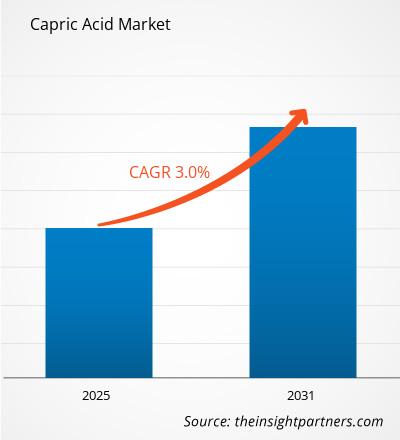
The global Capric Acid market was valued at US$ 274.7 million in 2025 and is expected to reach US$ 330.15 million by 2034; it is estimated to record a CAGR of 2.06% during 2026-2034.
Capric Acid Market Assessment and Insights
- North America: Accounted for a 24–28% share in 2025 and is projected to grow at a CAGR of 2.1%–2.5% during 2026–2034, supported by demand from pharmaceutical excipients, premium personal care ingredients, and food processing industries.
- U.S.: Represented 72–76% of the North American market in 2025 and is anticipated to expand at a CAGR of 2.2%–2.6%, driven by specialty chemical production and increasing demand for medium-chain fatty acid derivatives.
- Europe: Held 23–27% share in 2025 and is forecast to register a CAGR of 2.0%–2.4%, with Germany, France, Italy, and the United Kingdom remaining leading consumers owing to advanced cosmetics, food, and pharmaceutical manufacturing.
- Asia Pacific: Accounted for a 40–44% share in 2025 while recording the fastest regional expansion with a CAGR of 2.6%–3.1%, led by China, Malaysia, Indonesia, India, and Japan through integrated oleochemical production and rising downstream demand.
- Largest Segment: Natural accounted for 66–70% market share in 2025 and is expected to grow at a CAGR of 2.4%–2.8%, benefiting from abundant coconut and palm kernel oil feedstocks and increasing sustainability preferences.
- High Growth Segment: Personal Care and Cosmetics represented 28–32% market share in 2025 and is projected to record a CAGR of 2.8%–3.3% through growing demand for bio-based emollients, surfactants, and cosmetic intermediates.
- Key companies analyzed in detail: Acme-Hardesty Company, Ecogreen Oleochemicals Pte. Ltd., Hangzhou Oleochemicals Co., Ltd., IOI Oleo GmbH, KLK OLEO, Majorhub Oleochemicals Pvt. Ltd., The Procter & Gamble Company, Temix Oleo S.r.l., Univar Solutions Inc., VVF (Illinois Services) LLC.
Source: The Insight Partners' analysis based on proprietary research, government publications, company annual reports, investor presentations, industry databases, and expert interviews.
There is an increasing trend of dynamics in the process of production towards vertical integration of oleochemical producers that can secure supplies of raw materials, fatty acid fractioning, refining, and production of special chemicals. Expansion of chains of certified sustainable palm kernel and coconut oil sources, along with technological advancements in purification, has increased product consistency that is needed by the pharmaceutical and premium cosmetic markets.
The future growth will occur due to South East Asia, India, and some Middle Eastern manufacturing centers as more money is invested in the development of integrated oleochemical facilities and production of specialty fatty acids. There will be more incentive to invest due to government regulations in favor of using renewable raw materials, growing demand for biodegradable chemical intermediates, and sustainability measures.
Capric Acid Market Report Scope
| Report Attribute | Details |
|---|---|
| Market size in 2025 | US$ 274.7 Million |
| Market Size by 2034 | US$ 330.15 Million |
| Global CAGR (2026 - 2034) | 2.06% |
| Historical Data | 2021-2024 |
| Forecast period | 2026-2034 |
Capric Acid Market Analysis
Growing consumer preference for naturally derived ingredients continues to stimulate Capric Acid Market growth across food, cosmetics, and pharmaceutical applications. Natural capric acid obtained from coconut and palm kernel oils remains the preferred raw material because it supports clean-label product development and aligns with sustainability initiatives implemented by multinational consumer goods manufacturers. Demand is also reinforced by expanding applications in medium-chain triglycerides, antimicrobial formulations, emulsifiers, and specialty esters.
The market ecosystem begins with vegetable oil cultivation, followed by oil extraction, fatty acid splitting, fractionation, purification, formulation, and distribution to downstream manufacturers. Vertically integrated producers in Malaysia and Indonesia maintain a competitive advantage through secure feedstock availability, efficient production infrastructure, and established export networks. Distribution partners further enhance market accessibility by supplying customized grades to food processors, pharmaceutical formulators, and industrial chemical manufacturers worldwide.
Competitive intensity within the Capric Acid Market analysis remains moderate because production requires specialized oleochemical processing capabilities, consistent feedstock access, and compliance with international quality standards. Leading companies like KLK OLEO, IOI Oleo GmbH, Ecogreen Oleochemicals Pte. Ltd., Temix Oleo S.r.l., Acme-Hardesty Company, and The Procter & Gamble Company are continually working on increasing their portfolios in order to increase their share in the high-end pharmaceutical and cosmetic applications.
Growing investments focus on sustainability, RSPO certified raw materials, efficient processes, and production of high purity fatty acids. Companies are now upgrading their refinery plants and adding capacities in specialty fatty acids. They are also increasing supply chain visibility in order to meet the demands of the regulations and multinational sourcing requirements. Leading distribution companies like Univar Solutions Inc. are also increasing regional supply capabilities by offering technical assistance and customized sourcing solutions to industries operating in different end-use markets.
● REPORT CUSTOMIZATION
Tailor This Report To Align With Your Specific Business Requirements
This report can be customized to align precisely with your business objectives, scope, and target markets. Customization options include tailored segmentation, geography, competitive analysis, and strategic insights to support informed decision-making.
Customize This Report →WHAT YOU CAN ADJUST
- ● Segmentations
- ● Geography
- ● Competitive Analysis
- ● Language Preferences
Capric Acid Market:
Personnalisez ce rapport en fonction de vos besoins
Vous bénéficierez d’une personnalisation sur n’importe quel rapport - gratuitement - y compris des parties de ce rapport, ou une analyse au niveau du pays, un pack de données Excel, ainsi que de profiter d’offres exceptionnelles et de réductions pour les start-ups et les universités
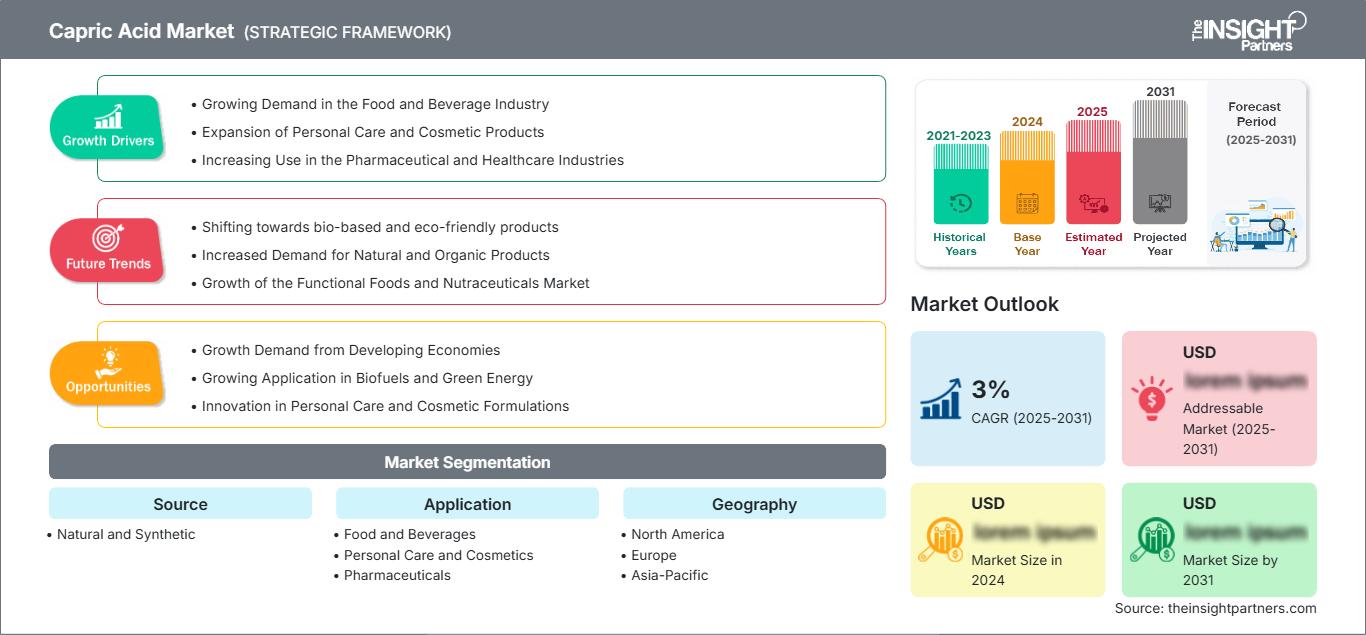
Marché de l'acide caprique: Perspectives stratégiques
-
Obtenez les principales tendances clés du marché de ce rapport.Cet échantillon GRATUIT comprendra une analyse de données, allant des tendances du marché aux estimations et prévisions.
Regional Insights
North America Capric Acid market
North America accounted for 24–28% of the Capric Acid Market share in 2025 and is projected to register a CAGR of 2.1%–2.5% during 2026–2034. Demand in the region is driven by a high level of pharmaceutical production, superior personal care ingredients, functional food ingredients, and specialty chemicals. The US and Canada are continuing to add more bio-based fatty acids into formulations due to consumer demand for sustainable ingredients and stringent environmental legislation in the chemical industry.
Capric acid obtained from natural sources such as coconut and palm kernel oil is gaining importance due to the need to meet the sustainability goals and formulate clean-label products. Investments in nutraceuticals, medium-chain triglycerides, and cosmetics based on biodegradable emollients are boosting demand in the region. Reliable supply arrangements with oleochemical producers from Southeast Asia are bolstering demand in the region.
U.S. Capric Acid Market
The United States represented 72–76% of the North American Capric Acid Market in 2025 and is anticipated to expand at a CAGR of 2.2%–2.6% through 2034. The country remains the region's largest consumer due to its advanced pharmaceutical sector, extensive cosmetics manufacturing, and mature specialty chemical industry. Increasing demand for medium-chain triglycerides, food preservatives, and pharmaceutical excipients continues to support steady consumption across multiple industrial applications.
Leading distributors and manufacturers, including Univar Solutions Inc., Acme-Hardesty Company, and The Procter & Gamble Company, maintain strong commercial networks that ensure reliable supply to food, healthcare, and personal care manufacturers. Rising investment in sustainable ingredient sourcing, together with innovation in bio-based formulations, is expected to reinforce domestic demand while encouraging higher adoption of certified renewable oleochemical feedstocks across manufacturing industries.
Europe Capric Acid Market
Europe held a 23–27% of the Capric Acid Market share in 2025 and is expected to register a CAGR of 2.0%–2.4% during 2026–2034. Germany remains the leading regional market due to its strong specialty chemicals, pharmaceuticals, and cosmetics industries, while increasing sustainability regulations continue encouraging the replacement of petrochemical ingredients with renewable oleochemicals across numerous industrial applications.
The United Kingdom continues experiencing steady demand driven by premium cosmetics, nutraceutical products, and functional food manufacturing. Growing consumer awareness regarding naturally derived ingredients has encouraged manufacturers to incorporate bio-based fatty acids into skincare products and dietary supplements. Investments in sustainable chemical sourcing further support long-term market development.
Germany leads European consumption through its advanced chemical manufacturing infrastructure and extensive pharmaceutical production capabilities. Integrated supply chains, continuous research activities, and the adoption of environmentally responsible production processes strengthen domestic demand. Manufacturers also benefit from close collaboration between chemical producers, research institutions, and downstream industrial users.
France, Italy, and Spain collectively contribute a significant portion of regional consumption through expanding personal care, food processing, and pharmaceutical industries. Premium cosmetic exports from France and Italy, together with Spain's growing specialty chemicals sector, continue increasing the utilization of medium-chain fatty acids in high-value consumer formulations while supporting moderate market expansion.
APAC Capric Acid Market
Asia Pacific accounted for 40–44% of the Capric Acid Market share in 2025 and is forecast to expand at a CAGR of 2.6%–3.1% through 2034, making it the fastest-growing regional market. China remains the largest consumer, while Malaysia and Indonesia dominate global feedstock availability through extensive palm kernel oil production. Japan, South Korea, India, and Australia continue to increase demand across pharmaceuticals, cosmetics, and industrial chemicals.
Government initiatives supporting bio-based industries, integrated oleochemical manufacturing, and export-oriented production continue to strengthen regional competitiveness. Expansion of downstream specialty chemical manufacturing and increasing investment in sustainable feedstock certification are expected to reinforce Asia Pacific's leadership throughout the forecast period.
Middle East & Africa Capric Acid Market
The Middle East & Africa Capric Acid Market is projected to register a CAGR of 2.0%–2.3% during 2026–2034. Saudi Arabia and the United Arab Emirates continue investing in specialty chemical diversification beyond traditional petrochemical production. At the same time, South Africa maintains steady demand through food processing, pharmaceutical manufacturing, and industrial chemical applications.
Increasing infrastructure investment, expanding industrial diversification programs, and improving regional distribution networks continue to support specialty chemical imports and downstream manufacturing. Although regional production remains comparatively limited, growing consumption of premium cosmetics, healthcare products, and processed foods is expected to create additional opportunities for international oleochemical suppliers.
Segmentation Analysis
Source
The Source segment is expected to expand at a CAGR of 2.3%–2.7% during 2026–2034. The Capric Acid Market scope continues to broaden as manufacturers increasingly prioritize renewable feedstocks and sustainable production methods. Growing preference for naturally derived fatty acids in food, cosmetics, and pharmaceutical applications supports long-term demand. At the same time, synthetic production remains important for industrial applications requiring highly consistent quality, controlled purity, and reliable year-round supply.
- Natural: Derived primarily from coconut oil and palm kernel oil, this sub-segment dominates global demand owing to renewable sourcing, broad regulatory acceptance, and increasing adoption in clean-label foods, personal care formulations, nutraceutical ingredients, and pharmaceutical products.
- Synthetic: Produced through petrochemical or chemical synthesis routes, this sub-segment serves industrial chemicals, specialty esters, lubricants, and applications requiring consistent composition, dependable availability, and controlled manufacturing specifications irrespective of agricultural feedstock fluctuations.
Application
The Application segment is anticipated to record a CAGR of 2.5%–2.9% during 2026–2034. Expanding use across multiple downstream industries continues to support stable demand for capric acid. Increasing consumption of bio-based ingredients, specialty surfactants, pharmaceutical intermediates, preservatives, and industrial esters is encouraging manufacturers to develop higher-purity grades tailored to industry-specific performance and regulatory requirements.
- Food and Beverages: Capric acid is utilized in flavor carriers, emulsifiers, preservatives, and medium-chain triglyceride formulations, supporting clean-label product development and functional food innovation while maintaining product stability and extended shelf life.
- Personal Care and Cosmetics: Widely incorporated into skincare products, soaps, shampoos, emulsifiers, and emollients, this sub-segment benefits from rising consumer preference for naturally sourced ingredients and biodegradable cosmetic formulations with improved sensory performance.
- Pharmaceuticals: Pharmaceutical manufacturers employ capric acid in excipients, drug delivery systems, antimicrobial formulations, and specialty intermediates because of its compatibility, formulation stability, and established safety profile across numerous therapeutic applications.
- Industrial Chemicals: Industrial demand includes lubricants, specialty esters, surfactants, plastic additives, corrosion inhibitors, and chemical intermediates, where consistent purity, processing efficiency, and chemical performance remain essential for downstream manufacturing operations.
Opportunity Snapshot
|
Application |
Revenue Contribution |
Trend Tag |
Adoption Stage |
|
Food and Beverages |
High |
Clean Label |
Mature |
|
Personal Care and Cosmetics |
High |
Bio Cosmetics |
Scaling |
|
Pharmaceuticals |
Medium |
Drug Delivery |
Scaling |
|
Industrial Chemicals |
Medium |
Green Esters |
Mature |
|
Others |
Low |
Specialty Uses |
Emerging |
Capric Acid Market Growth Drivers and Impact Analysis
Increasing Demand for Bio-based Oleochemicals Across Consumer Industries
Increasing awareness about the environment and government support for the use of renewable sources of materials are leading to rising demand for oleochemicals globally. Caprylic acid, obtained through coconut oil and palm kernel oil, has emerged as a promising option for replacing petroleum-based chemicals as it exhibits qualities like biodegradation and sustainability, along with applications in different industrial sectors. Consumer goods companies are using more renewable content in their personal care, food, and household products to fulfill their environmental commitments and meet changing consumer demands. This move towards sustainability is providing impetus to invest in certification of feedstocks and specialty fatty acids production.
Expansion of Personal Care and Cosmetic Manufacturing
The international cosmetics industry is expected to witness growth due to increasing disposable incomes, the use of premium skin care products, and the growing inclination towards natural ingredients. Capric acid is used as an essential ingredient for emollients, surfactants, cleansers, and esters utilized in cosmetics such as hair care and skin care products. Companies are continuously innovating and reformulating their products based on environmentally friendly and naturally derived products. Innovations in terms of clean label formulations, vegan cosmetics, and natural ingredients are expected to maintain the demand for capric acid in the foreseeable future. Expansion of the manufacturing facilities in the Asia Pacific region is also expected to increase the demand for specialty fatty acids.
Growing Pharmaceutical and Nutraceutical Applications
The demand for medium-chain fatty acids is expected to grow due to the growing use of medium-chain fatty acids in pharmaceutical applications, as excipients, antimicrobial agents, and MCT oils. Capric acid plays an important role in formulating stable drugs and ensuring compatibility of active ingredients in advanced drug delivery systems. Growing health care spending and aging populations, along with dietary supplement consumption, will drive innovations within the pharmaceutical value chain. High-purity production and regulatory compliance will add more competitiveness to the market.
Capric Acid Market Future Trends
Growing Preference for Certified Sustainable Feedstocks
The Capric Acid Market trends are increasingly influenced by sustainability commitments across the global chemical and consumer goods industries. Manufacturers are expanding the procurement of RSPO-certified palm kernel oil and responsibly sourced coconut oil to improve supply-chain transparency and meet environmental, social, and governance (ESG) objectives. Brand owners are also demanding traceable raw materials that comply with international sustainability standards while supporting carbon reduction goals. Digital traceability systems, supplier certification programs, and lifecycle assessment tools are becoming integral to procurement strategies. These developments are expected to enhance product differentiation, strengthen customer confidence, and encourage long-term investment in renewable oleochemical production throughout the forecast period.
Advancements in High-Purity Specialty Fatty Acid Manufacturing
With continuous advancements being made in refinement and fractionation, the producers will be able to manufacture high-purity grades of capric acid. With the help of process automation and efficient production techniques, there will be improved efficiency of manufacturing along with reduced waste creation. Manufacturers are now showing an inclination towards the use of specialty grades with strict quality standards due to their assured performance and compliance with regulations. As downstream users will be requiring customized products in future, there is an anticipation that the producers will make more specialty offerings.
Capric Acid Market Opportunities
Expansion of High-Value Pharmaceutical Ingredient Manufacturing
Growing investments in pharmaceutical manufacturing present a significant opportunity for specialty fatty acid producers. The increasing use of capric acid in excipients, lipid-based drug delivery systems, antimicrobial formulations, and nutraceutical ingredients is encouraging manufacturers to develop pharmaceutical-grade production capabilities. Capric Acid Market Forecasts indicate that demand from healthcare applications will remain resilient because of rising pharmaceutical production in the Asia Pacific, North America, and Europe. Companies investing in high-purity manufacturing facilities, regulatory certifications, and advanced quality management systems are expected to secure stronger positions in premium healthcare markets while expanding partnerships with global pharmaceutical manufacturers.
Increasing Adoption of Renewable Ingredients in Premium Consumer Products
Consumer preference for environmentally responsible products continues to create investment opportunities across cosmetics, food ingredients, and specialty chemicals. Manufacturers that expand production of naturally sourced capric acid derived from certified renewable feedstocks can benefit from growing demand for clean-label formulations and sustainable consumer products. Investments in integrated oleochemical complexes, supply-chain traceability, and specialty ingredient innovation are expected to improve profitability while reducing dependence on petroleum-derived alternatives. Strategic collaboration with multinational consumer goods manufacturers and distributors can further strengthen market access and support long-term revenue diversification across emerging and developed economies.
Recent Developments
- June 2025 VVF Group highlighted the expanded application of its Capric Acid (C10) portfolio for personal care, pharmaceutical, food, industrial, and animal nutrition applications. The company emphasized sustainable manufacturing from coconut and palm kernel oil and promoted formulation support for customers developing medium-chain fatty acid-based products.
- August 2025 Tradeasia International reported increasing investments in high-value oleochemicals, identifying capric triglycerides and medium-chain fatty acid derivatives as key growth areas driven by demand from personal care, pharmaceutical, and nutrition industries. The company highlighted sustainable palm-based feedstocks and secure supply chains as major competitive advantages.
Frequently Asked Questions

Vrushali est une consultante senior possédant plus de huit ans d’expérience professionnelle et une expertise approfondie dans le secteur de la chimie et des matériaux (Chemicals & Materials), notamment dans le domaine des produits chimiques de spécialité. Au cours de sa carrière, elle a mené à bien plus de 50 projets de conseil dans divers secteurs, notamment la chimie et les matériaux, l’agroalimentaire et les boissons (Food & Beverage), ainsi que les biens de consommation (Consumer Goods). Ses domaines de compétence couvrent un large éventail de segments, tels que les ingrédients fonctionnels, les produits chimiques issus de ressources renouvelables, l’alimentation animale et les produits agrochimiques. Grâce à sa connaissance approfondie des marchés et à ses solides capacités d’analyse, elle accompagne les entreprises dans l’identification des opportunités commerciales et le développement de stratégies de croissance.
Vrushali est titulaire d’une licence en chimie et d’un master en management, ce qui lui permet d’associer de solides connaissances techniques à une compréhension approfondie des stratégies commerciales et des enjeux économiques. Elle a accompagné de nombreux clients dans l’évaluation des possibilités d’expansion sur de nouveaux marchés, l’élaboration de stratégies de croissance et la mise en œuvre d’initiatives de transformation opérationnelle. Son expertise multidisciplinaire lui permet d’analyser les dynamiques sectorielles et de formuler des recommandations stratégiques adaptées aux objectifs commerciaux et aux besoins spécifiques de chaque organisation.
Les principales compétences professionnelles de Vrushali comprennent l’acquisition de nouveaux clients, la gestion des relations avec les parties prenantes (stakeholders) et le leadership d’équipes. Grâce à une approche structurée et méthodique de la planification, de la gestion et de l’exécution des projets de conseil, elle a contribué à améliorer l’efficacité opérationnelle et la productivité des entreprises clientes. Sa capacité à intégrer une expertise technique approfondie aux priorités commerciales et aux objectifs stratégiques lui permet de proposer des recommandations concrètes, des solutions personnalisées et des stratégies opérationnelles adaptées aux besoins de ses clients, contribuant ainsi à renforcer leur compétitivité et à soutenir leur croissance à long terme.
- Analyse complète de la taille du marché et prévisions
- Analyse détaillée de la segmentation
- Évaluation approfondie de la dynamique du marché
- Aperçus par région et par pays
- Paysage concurrentiel et analyse comparative des entreprises
- Intelligence économique stratégique
Témoignages

The Insight Partners nous a fourni des informations précieuses sur le marché qui ont soutenu notre stratégie mondiale de commercialisation. Son équipe s’est montrée professionnelle, réactive et attentive à nos commentaires, en proposant tout au long du projet des analyses approfondies et des éclaircissements méthodologiques utiles.
Junmo Kim Directeur financier (CFO), Enertech Co., Ltd.
Le rapport sur le marché des systèmes SCADA d'Insight Partners est complet et fournit des informations précieuses sur les tendances actuelles et les prévisions. L'équipe a fait preuve d'un grand professionnalisme, d'une grande réactivité et d'un grand soutien tout au long du projet. Nous sommes très satisfaits et recommandons vivement leurs services.
RAN KEDEM Partenaire, Reali Technologies LTD
J'ai demandé un rapport sur un marché logiciel très spécifique et l'équipe l'a produit en quelques jours. Les informations étaient très pertinentes et bien présentées. J'ai ensuite demandé des modifications et des ajouts au rapport. L'équipe a de nouveau été très réactive et j'ai reçu le rapport final en moins d'une semaine.
JEAN-HERVÉ JENN Président, Future Analytica
Nous avons collaboré avec The Insight Partners pour une importante étude de marché et des prévisions. Ils nous ont fourni une vision claire des opportunités et des risques, ce qui nous a aidés à élaborer nos plans. Leurs recherches étaient faciles à utiliser et basées sur des données solides. Elles nous ont permis de prendre des décisions éclairées et en toute confiance. Nous les recommandons vivement.
PIYUSH NAGPAL Vice-président principal, Feux de route mondiaux
Insight Partners a réalisé une étude de marché pertinente et bien structurée, avec une solide expertise du domaine. Son équipe a fait preuve de professionnalisme et de réactivité tout au long du projet. Son site web convivial a facilité l'accès aux rapports sectoriels. Nous recommandons vivement ses services d'études fiables et de haute qualité.
YUKIHIKO ADACHI PDG, Bleu profond, LLC.
C'est la première fois que j'achète une étude de marché auprès de The Insight Partners. J'étais un peu hésitant au début, mais j'ai consulté leur site web et me suis senti plus à l'aise pour prendre le risque d'acheter une étude de marché. Je suis entièrement satisfait de la qualité du rapport et du service client. J'avais plusieurs questions et commentaires concernant le rapport initial, mais après quelques échanges par e-mail avec leur analyste, je pense avoir obtenu un rapport qui pourra alimenter notre processus de planification stratégique. Merci beaucoup pour votre temps et pour avoir rendu cette expérience positive. Je recommanderai sans hésiter vos services et vous serez mon premier contact lorsque nous aurons besoin de données de marché supplémentaires.
JOHN SUZUKI Président-directeur général, administrateur du conseil d'administration, BK Technologies
Je tiens à vous remercier pour votre soutien et le professionnalisme dont vous avez fait preuve lors du traitement de ma demande d'informations concernant le marché des dispositifs de diagnostic in vitro (DIV) pour les maladies infectieuses au Nigéria. J'apprécie votre patience, vos conseils et votre volonté d'offrir une réduction, ce qui nous a finalement permis de conclure un accord. Je me réjouis de collaborer à nouveau avec The Insight Partners, grâce à l'impression que vous m'avez laissée suite à cette première rencontre.
DR CHIJIOKE DIRECTEUR GÉNÉRAL D'ONYIA, PineCrest Healthcare Ltd.Raison d'acheter
- Prise de décision éclairée
- Compréhension de la dynamique du marché
- Analyse concurrentielle
- Connaissances clients
- Prévisions de marché
- Atténuation des risques
- Planification stratégique
- Justification des investissements
- Identification des marchés émergents
- Amélioration des stratégies marketing
- Amélioration de l'efficacité opérationnelle
- Alignement sur les tendances réglementaires




















 Obtenez un échantillon gratuit pour -