
Previsioni e quote di mercato dei sistemi di controllo delle microreti fino al 2034
Dimensioni e previsioni del mercato dei sistemi di controllo delle microreti (2021-2034), quota di mercato globale e regionale, tendenze e analisi delle opportunità di crescita. Copertura del rapporto: per componente (hardware, software); tipo di rete (off-grid, on-grid); utenti finali (industriali, commerciali, servizi di pubblica utilità, campus e istituzioni) e area geografica (Nord America, Europa, Asia Pacifico e Sud e Centro America).
- Stato : Dati rilasciati
- Codice del report : TIPRE00003651
- Categoria : Elettronica e semiconduttori
- Numero di pagine : 150
- Formati di report disponibili :


- Data dell'ultimo aggiornamento : October 13, 2026


Dimensioni del mercato nel 2025
4,82 miliardi di dollari USA
Valore dell'anno base
Previsioni per il 2034
8,89 miliardi di dollari USA
Previsione entro il 2034
CAGR 2026-2034
7,95 %
Tasso di crescita
Mercato di riferimento
64,84 miliardi di dollari USA
(2026-2034)
Il mercato dei sistemi di controllo delle microreti ha un valore di 4,82 miliardi di dollari nel 2025 e si prevede che raggiungerà gli 8,89 miliardi di dollari entro il 2034 , registrando un tasso di crescita annuo composto (CAGR) del 7,95% nel periodo 2026-2034 . Tale espansione è influenzata dalla crescente adozione di energie distribuite, dalle iniziative di modernizzazione della rete, dai requisiti di integrazione delle energie rinnovabili e dalla crescente necessità di soluzioni di gestione energetica resilienti per aziende di servizi pubblici, industrie e infrastrutture critiche.
Il mercato dei sistemi di controllo delle microreti sta acquisendo sempre maggiore importanza in Nord America grazie ai crescenti investimenti nelle infrastrutture energetiche decentralizzate e nell'integrazione delle energie pulite. Si prevede che la regione registrerà un tasso di crescita annuo composto (CAGR) stimato tra il 7% e il 9% nel periodo 2026-2034, sostenuto dai programmi di modernizzazione delle utility, dalle applicazioni per la difesa e dalla crescente diffusione di piattaforme intelligenti per la gestione dell'energia.
Analisi e approfondimenti sul mercato dei sistemi di controllo delle microreti
- Nord America: Si prevede che la regione manterrà una posizione di rilievo con una quota del 30-35% nel 2025 e un tasso di crescita annuo composto (CAGR) compreso tra il 7% e il 9% tra il 2026 e il 2034. Gli investimenti nell'integrazione delle energie rinnovabili, nelle reti resilienti e nelle risorse energetiche distribuite favoriscono l'adozione di queste tecnologie.
- USA Il Paese rappresenta una quota di mercato pari a circa il 22-27% nel 2025 e si prevede che crescerà a un tasso annuo composto (CAGR) compreso tra il 7% e l'8% nel periodo 2026-2034. La domanda è trainata da ammodernamenti delle infrastrutture, installazioni militari e implementazioni commerciali.
- L' Europa detiene una quota del 25-30% nel 2025 e si prevede che crescerà a un tasso annuo composto (CAGR) compreso tra l'8% e il 10% nel periodo 2026-2034. Germania, Regno Unito, Francia e Italia stanno promuovendo la diffusione delle energie rinnovabili attraverso programmi di transizione energetica.
- La regione Asia- Pacifico detiene una quota di mercato pari a circa il 25-30% nel 2025 e si prevede che registrerà un tasso di crescita annuo composto (CAGR) compreso tra il 9% e l'11% nel periodo 2026-2034. Cina, Giappone, India, Corea del Sud e Australia sostengono la crescita attraverso iniziative di elettrificazione.
- Il segmento più ampio è rappresentato dai sistemi connessi alla rete, con una quota di mercato del 45-50% nel 2025 e un tasso di crescita annuo composto (CAGR) compreso tra il 7% e il 9% tra il 2026 e il 2034, grazie all'integrazione con le reti di distribuzione.
- Segmento ad alta crescita: i sistemi ibridi dimostrano un forte potenziale, con una quota di mercato del 25-30% nel 2025 e un tasso di crescita annuo composto (CAGR) compreso tra il 9% e l'11% grazie alle combinazioni di sistemi di accumulo rinnovabili.
- Key companies analyzed in detail: ABB Ltd., Eaton Corporation, Emerson Electric Co., ETAP, General Electric Company, Ontech Electric Corporation, PowerSecure Inc., Schneider Electric, Spirae, LLC, S&C Electric Company, Siemens AG, and Honeywell International Inc.
Source: The Insight Partners' analysis based on proprietary research, government publications, company annual reports, investor presentations, industry databases, and expert interviews.
Development of microgrid control systems market is impacted by automation, artificial intelligence-based monitoring, digital energy solutions, and communication technologies. Previously, such control systems had limited functionalities related to energy balancing, but now there are solutions that incorporate predictive analytics, security features, and management of renewable energy. The growth of solar, wind, battery, and distributed generation capacity has changed the architecture of control systems. Energy companies and industrial customers are opting for flexible control systems that will enable them to use various energy sources without compromising their efficiency and decreasing their dependence on the grid.
Further adoption is going to be fueled by rising adoption of these control solutions in the economies of countries where electrification and renewable infrastructure development programs are being implemented. Governments in various nations are promoting the adoption of resilient power networks through their policies and private organizations are looking into ways of ensuring energy independence. Military installations, remote locations, and industrial campuses are considering advanced control solutions to ensure energy continuity and manage energy costs.
Microgrid Control System Market Report Scope
| Report Attribute | Details |
|---|---|
| Market size in 2025 | US$ 4.82 Billion |
| Market Size by 2034 | US$ 8.89 Billion |
| Global CAGR (2026 - 2034) | 7.95% |
| Historical Data | 2021-2024 |
| Forecast period | 2026-2034 |
Microgrid Control System Market Analysis
The growing need for electricity management, incorporation of renewable energy, and flexibility of distributed power generation are driving the development of microgrid control system market. In the ecosystem, there are hardware manufacturers, software companies, system integrators, utilities, energy storage companies, and end users. Microgrid control platforms facilitate connections between the generators, storage systems, and loads by means of monitoring and automation capabilities. Factors that influence supply dynamics include semiconductor availability, advancements in communication technology, and increasing cooperation between energy technology firms and infrastructure operators.
In the wake of energy transition programs, many opportunities emerge in the value chain. Intelligent control systems are utilized by utilities to increase the reliability of power grid, and microgrid systems are adopted by industrial companies to minimize any possible disruption. Software architecture, cloud computing, and cybersecurity become crucial parts of the new systems.
The microgrid control system market report for microgrid control system reveals that there is increased competition in this industry between the electrical equipment manufacturing firms and specialized technology vendors. Firms are trying to position themselves through partnerships, technological developments, and energy management solutions. The examples include ABB Ltd., Schneider Electric, Eaton Corporation, Emerson Electric Co., General Electric Company, and Siemens AG, which are investing in digitization, while other firms like ETAP, Spirae, LLC, and S&C Electric Company are concentrating on special control systems.
The investments in this market are targeted towards the integration of renewables, battery storage, and resiliency applications. Positioning of vendors is becoming increasingly dependent on interoperability, cybersecurity, and capability of supporting various energy assets.
● REPORT CUSTOMIZATION
Tailor This Report To Align With Your Specific Business Requirements
This report can be customized to align precisely with your business objectives, scope, and target markets. Customization options include tailored segmentation, geography, competitive analysis, and strategic insights to support informed decision-making.
Customize This Report →WHAT YOU CAN ADJUST
- ● Segmentations
- ● Geography
- ● Competitive Analysis
- ● Language Preferences
Microgrid Control System Market:
Personalizza questo rapporto in base alle tue esigenze
Potrai personalizzare gratuitamente qualsiasi rapporto, comprese parti di questo rapporto, o analisi a livello di paese, pacchetto dati Excel, oltre a usufruire di grandi offerte e sconti per start-up e università
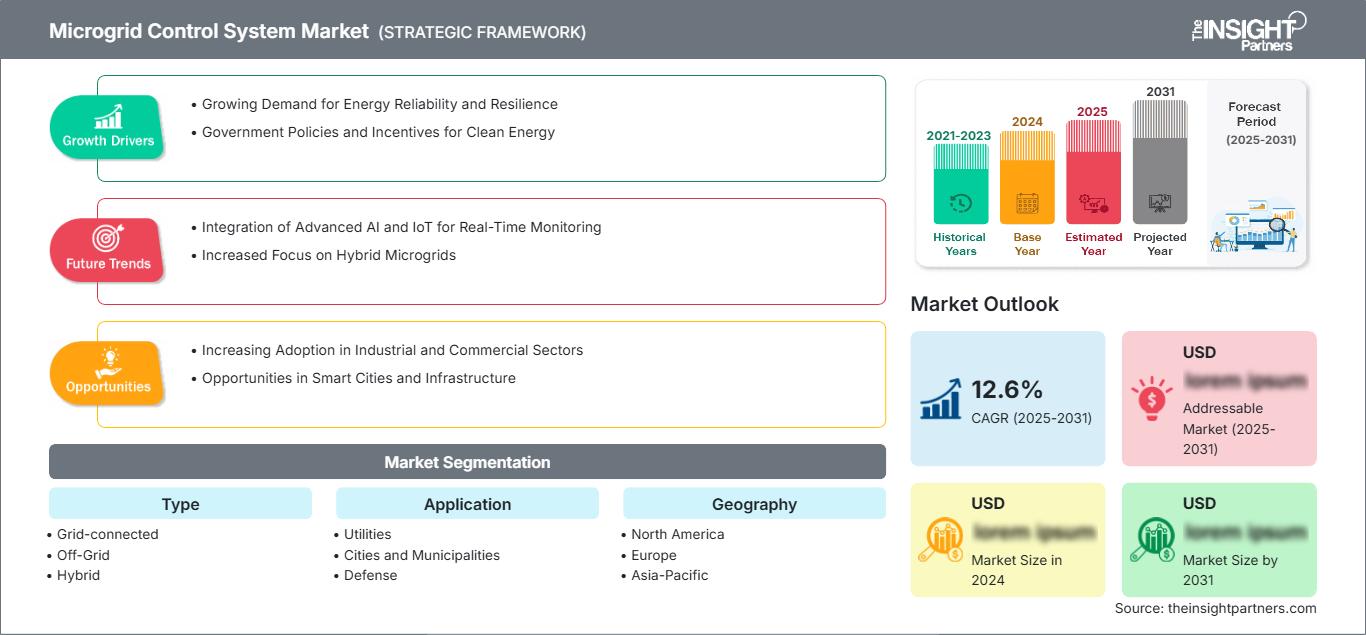
Mercato dei sistemi di controllo delle microreti: Approfondimenti strategici
-
Ottieni le principali tendenze chiave del mercato di questo rapporto.Questo campione GRATUITO includerà l'analisi dei dati, che vanno dalle tendenze di mercato alle stime e alle previsioni.
Regional Insights
North America microgrid control system market
North America holds a 30–35% microgrid control system market share in 2025 and is expected to register a CAGR range of 7–9% during 2026–2034. The region benefits from advanced grid infrastructure, renewable energy investments, and increasing demand for reliable power systems.
The US and Canada are leading adoption through utility modernization, defense applications, and commercial energy projects. Government support for clean energy deployment and resilience programs continues to encourage investments. The presence of major technology providers further strengthens regional capabilities and accelerates innovation.
U.S. microgrid control system Market
The U.S. accounts for 70–75% of North America’s share in 2025 and is projected to grow at a CAGR range of 7–8% during the forecast period. Utilities, military facilities, universities, and industrial users are major adopters.
Companies including ABB Ltd., Eaton Corporation, Schneider Electric, and General Electric Company maintain strong application presence across energy infrastructure projects. Increasing integration of renewable sources, storage systems, and advanced monitoring platforms supports market expansion.
Europe microgrid control system Market
Europe represents a 25–30% share in 2025 and is estimated to grow at a CAGR range of 8–10%. The region benefits from ambitious renewable energy targets and smart grid development programs.
The UK is adopting advanced systems for distributed energy management and renewable integration. Germany demonstrates strong industrial demand due to energy transition initiatives. France, Italy, and Spain are expanding deployments through clean energy projects and grid modernization programs. Germany remains a leading country because of industrial applications and renewable infrastructure investments.
APAC microgrid control system Market
APAC accounts for a 25–30% share in 2025 and is expected to achieve a CAGR range of 9–11% during 2026–2034. China leads regional adoption through renewable energy expansion and grid modernization.
Japan, South Korea, India, and Australia are investing in decentralized energy systems for industrial, commercial, and remote applications. Policy support, electrification programs, and increasing renewable capacity additions are strengthening regional opportunities.
Middle East & Africa microgrid control system Market
Middle East & Africa represents a developing opportunity with a projected CAGR range of 6–8% during 2026–2034. Saudi Arabia and the UAE are investing in energy diversification and infrastructure modernization.
South Africa and other MEA countries are exploring decentralized systems to improve electricity reliability. Energy security priorities, renewable projects, and infrastructure development programs support adoption across the region.
Segmentation Analysis
Type
The Type segment is divided into Grid-connected, Off-Grid, and Hybrid solutions. The segment is expected to grow at a CAGR range of 7–10% during 2026–2034 as organizations seek flexible energy management solutions. Grid-connected systems remain widely deployed, while hybrid architectures gain importance through renewable and storage integration.
- Grid-connected systems represent the dominant approach because they enable coordination between microgrids and utility networks. These systems support reliability, demand management, and renewable energy optimization across commercial and industrial applications.
- Off-Grid solutions address remote locations and areas with limited grid access. They provide autonomous energy management capabilities for communities, defense facilities, and isolated industrial operations requiring dependable power availability.
- Hybrid solutions combine multiple energy resources and storage technologies. They are gaining strategic importance as organizations pursue energy resilience, lower emissions, and improved operational flexibility.
Application
The Application segment includes Utilities, Cities and Municipalities, Defense, Industrial, and Other. The segment is projected to expand at a CAGR range of 8–10% during 2026–2034. Increasing infrastructure modernization and energy resilience requirements support adoption across diverse users.
- Utilities deploy advanced controls to improve grid stability, integrate distributed resources, and manage renewable energy variability. Utility-led projects remain important contributors due to increasing smart grid investments.
- Cities and Municipalities use microgrid platforms for public infrastructure, emergency power planning, and sustainable energy initiatives. Urban electrification programs encourage adoption of intelligent energy solutions.
- Defense applications prioritize secure and resilient power systems. Military facilities increasingly implement microgrid technologies to maintain continuity during disruptions and reduce dependency on external grids.
- Industrial users adopt systems to optimize energy costs, improve reliability, and support sustainability targets. Manufacturing facilities and processing plants are major contributors to deployment.
Opportunity Snapshot
|
Application |
Revenue Contribution |
Trend Tag |
Adoption Stage |
|---|---|---|---|
|
Utilities |
High |
Grid Modernization |
Mature |
|
Cities and Municipalities |
Medium |
Urban Energy |
Scaling |
|
Defense |
Medium |
Secure Power |
Scaling |
|
Industrial |
High |
Energy Optimization |
Mature |
|
Other |
Low |
Remote Systems |
Emerging |
Microgrid Control System Market Growth Drivers and Impact Analysis
Rising integration of renewable energy resources
The increasing deployment of renewables is driving companies to develop sophisticated control technologies that can help in managing power sources with fluctuating outputs. In the case of solar and wind farms, intelligent integration is required with respect to the storage and consumption patterns in order to ensure system stability. Microgrid controllers help in providing such balancing and improve efficiency while minimizing the curtailment of renewable energy. Increasing investment in these technologies is being observed with an increase in renewable penetration by utilities and industrial consumers.
Increasing demand for resilient electricity infrastructure
Issues regarding power reliability are making it necessary for governments, organizations, and enterprises to adopt energy systems that are resilient. Weather emergencies, power outages, and increased reliance on power are driving the adoption of systems that are capable of managing power independently. These systems feature advanced controls that provide automatic switching and load management. Hospitals, military bases, and data centers benefit immensely from the enhanced continuity. This development is making it necessary to have intelligent systems that provide security in the operations.
Advancement of digital energy management technologies
Through the digital transformation, energy control platforms are being improved using artificial intelligence, analytics, automation, and remote monitoring. Current platforms offer predictive analysis, asset optimization, and better decision making. The organizations are moving towards solutions which will be able to connect with the current energy management systems and communications networks. This will increase the efficiency and minimize the maintenance cost. The use of cloud based monitoring and cybersecurity makes advanced controllers more attractive. With the advancement of digital technologies, energy providers will need smart platforms which can operate distributed energy systems.
Microgrid Control System Market Future Trends
Artificial intelligence enabled energy optimization
Artificial intelligence integration will become a significant future direction as operators seek improved forecasting and automated decision-making. AI-based systems can analyze energy patterns, predict demand fluctuations, and optimize resource allocation. Future platforms are expected to combine machine learning with distributed energy management to improve efficiency. This evolution will support more autonomous microgrid operations and enhance coordination between renewable generation, storage, and consumption assets. The trend will encourage technology providers to develop advanced analytics capabilities and adaptive control solutions.
Expansion of blockchain based energy transactions
Blockchain-enabled energy management may influence future decentralized power networks by improving transparency and enabling peer-to-peer energy exchange models. As distributed generation increases, communities and organizations may explore secure transaction frameworks for energy sharing. Future control systems could integrate blockchain capabilities to support automated settlement and improved asset coordination. This trend represents a shift toward more flexible energy ecosystems where users actively participate in power management. Technology providers are expected to evaluate these capabilities as decentralized energy structures evolve.
Microgrid Control System Market Opportunities
Growth opportunities in developing economies
Le economie emergenti offrono opportunità grazie all'espansione dei programmi di elettrificazione, agli investimenti nelle energie rinnovabili e alla modernizzazione delle infrastrutture. I Paesi che cercano un accesso affidabile all'elettricità stanno valutando soluzioni decentralizzate per affrontare i limiti della rete. I fornitori possono rafforzare la propria presenza sviluppando piattaforme scalabili ed economicamente vantaggiose, adatte alle esigenze regionali. Le partnership strategiche con aziende di servizi pubblici, governi e integratori locali possono migliorare le capacità di implementazione. Le previsioni del mercato dei sistemi di controllo delle microreti indicano una crescente attenzione verso le regioni in cui l'affidabilità energetica e l'integrazione delle energie rinnovabili rimangono priorità chiave. Gli investimenti in soluzioni localizzate possono supportare l'espansione a lungo termine.
Integrazione con le tecnologie di accumulo energetico
L'integrazione dei sistemi di accumulo energetico crea opportunità per le aziende che sviluppano piattaforme di controllo avanzate. I sistemi a batteria richiedono un coordinamento intelligente per massimizzare le prestazioni e supportare la disponibilità di energia rinnovabile. I fornitori specializzati in compatibilità con i sistemi di accumulo, funzionalità di monitoraggio e software di ottimizzazione possono intercettare la domanda emergente. Gli utenti industriali e le aziende di servizi pubblici stanno valutando sempre più soluzioni integrate di energia rinnovabile e accumulo in termini di resilienza ed efficienza. È probabile che gli investimenti futuri privilegino le piattaforme in grado di gestire ecosistemi energetici complessi. Le aziende che sviluppano soluzioni integrate potrebbero beneficiare della crescente domanda di infrastrutture flessibili e sostenibili.
Domande frequenti

Naveen è un esperto professionista nel campo delle ricerche di mercato e della consulenza direzionale, con oltre 12 anni di esperienza nella realizzazione di ricerche strategiche, analisi di mercato (Market Intelligence) e soluzioni di consulenza aziendale in diversi settori industriali. Le sue principali aree di competenza comprendono l'elettronica, la tecnologia, l'automazione industriale, il settore bancario, i servizi finanziari e assicurativi (BFSI), l'industria automobilistica e il settore aerospaziale. È specializzato nella valutazione dei mercati, nell'analisi della concorrenza (Competitive Intelligence), nel benchmarking settoriale, nello sviluppo di strategie di crescita, nell'analisi delle opportunità di ingresso in nuovi mercati e nella valutazione delle opportunità commerciali.
Nel ruolo di Vicepresidente Associato (Associate Vice President), Naveen guida complessi progetti di ricerca di mercato e consulenza strategica, gestisce le relazioni con i principali stakeholder e supervisiona l'intero ciclo di vita dei progetti, dalla pianificazione iniziale fino alla consegna dei risultati. Nel corso della sua carriera, ha portato a termine con successo numerosi progetti di ricerca e consulenza per clienti appartenenti a diversi settori e aree geografiche, aiutando le organizzazioni a individuare nuove opportunità di mercato, comprendere le dinamiche competitive, valutare il potenziale degli investimenti e prendere decisioni strategiche informate. Grazie al suo approccio analitico e orientato ai risultati, contribuisce a supportare le aziende nell'elaborazione di strategie efficaci e nel rafforzamento della loro competitività.
Naveen ha conseguito una laurea in Ingegneria Elettronica e delle Telecomunicazioni presso la Visvesvaraya Technological University (VTU), nello Stato del Karnataka, in India, e un Master in Business Administration (MBA) con specializzazione in Marketing e Gestione delle Operazioni presso la Manipal University. La combinazione di solide competenze tecniche, una vasta conoscenza interdisciplinare e una significativa esperienza nella consulenza strategica gli consente di trasformare dati di mercato complessi in informazioni strategiche concrete e indicazioni operative. Attraverso questa capacità, supporta le imprese nell'individuazione delle opportunità di crescita, nel miglioramento della competitività e nella definizione di piani strategici a lungo termine, contribuendo al raggiungimento degli obiettivi aziendali e a uno sviluppo sostenibile del business.
- Analisi completa delle dimensioni e delle previsioni di mercato
- Analisi dettagliata della segmentazione
- Valutazione approfondita delle dinamiche di mercato
- Approfondimenti a livello regionale e nazionale
- Analisi del panorama competitivo e benchmarking aziendale
- Business intelligence strategica
Testimonianze

The Insight Partners ha fornito preziose informazioni di mercato che hanno supportato la nostra strategia globale di ingresso sul mercato. Il suo team si è dimostrato professionale, tempestivo e attento ai nostri commenti, offrendo durante tutto il progetto analisi approfondite e utili chiarimenti metodologici.
Junmo Kim Direttore finanziario (CFO), Enertech Co., Ltd.
Il report di mercato sui sistemi SCADA di Insight Partners è completo, con preziosi spunti sulle tendenze attuali e sulle previsioni future. Il team si è dimostrato altamente professionale, reattivo e disponibile in ogni fase del progetto. Siamo molto soddisfatti e consigliamo vivamente i loro servizi.
RAN KEDEM Partner, Reali Technologies LTDs
Ho richiesto un report su un mercato software molto specifico e il team lo ha prodotto in pochi giorni. Le informazioni erano molto pertinenti e ben presentate. Ho quindi richiesto alcune modifiche e aggiunte al report. Il team è stato ancora una volta molto reattivo e ho ricevuto il report finale in meno di una settimana.
JEAN-HERVE JENN Presidente, Future Analytica
Abbiamo collaborato con The Insight Partners per un importante studio di mercato e una previsione. Ci hanno fornito informazioni chiare su opportunità e rischi, che ci hanno aiutato a definire i nostri piani. La loro ricerca è stata facile da usare e basata su dati solidi. Ci ha aiutato a prendere decisioni intelligenti e consapevoli. Li consigliamo vivamente.
PIYUSH NAGPAL Vicepresidente senior, Abbaglianti globali
Insight Partners ha fornito ricerche di mercato approfondite e ben strutturate, con una solida competenza nel settore. Il loro team si è dimostrato professionale e reattivo in ogni fase. Il sito web intuitivo ha reso l'accesso ai report di settore semplice e immediato. Li consigliamo vivamente per servizi di ricerca affidabili e di alta qualità.
YUKIHIKO ADACHI Amministratore delegato, Deep Blue, LLC.
Questa è la prima volta che acquisto un report di mercato da The Insight Partners. Sebbene inizialmente fossi indeciso, ho visitato il loro sito web e mi sono sentito più a mio agio nell'acquistare un report di mercato. Sono completamente soddisfatto della qualità del report e del servizio clienti. Avevo diverse domande e commenti sul report iniziale, ma dopo un paio di conversazioni via email con il loro analista credo di avere un report che posso utilizzare come input per il nostro processo di pianificazione strategica. Grazie mille per aver dedicato del tempo extra e aver reso questa esperienza positiva. Consiglierò sicuramente il vostro servizio ad altri e sarete la mia prima persona a cui rivolgermi quando avremo bisogno di ulteriori dati di mercato.
GIOVANNI SUZUKI Presidente e Amministratore Delegato, Consigliere di Amministrazione, Tecnologie BK
Desidero esprimere la mia gratitudine per il supporto e la professionalità dimostrati nel rispondere alla mia richiesta di informazioni sul mercato dei dispositivi medici in vitro per malattie infettive in Nigeria. Apprezzo la vostra pazienza, la vostra guida e la vostra disponibilità a offrirmi uno sconto, che alla fine ci ha permesso di concludere l'affare. Non vedo l'ora di collaborare con The Insight Partners in futuro, grazie anche all'impressione che mi avete lasciato dopo questo primo incontro.
Dott. Chijioke AMMINISTRATORE DELEGATO DI ONYIA, PineCrest Healthcare Ltd.Motivo dell'acquisto
- Processo decisionale informato
- Comprensione delle dinamiche di mercato
- Analisi competitiva
- Analisi dei clienti
- Previsioni di mercato
- Mitigazione del rischio
- Pianificazione strategica
- Giustificazione degli investimenti
- Identificazione dei mercati emergenti
- Miglioramento delle strategie di marketing
- Aumento dell'efficienza operativa
- Allineamento alle tendenze normative




















 Ottieni un campione gratuito per -