
3D 레이저 스캐너 시장: 잠재력, 성장 및 동향 (2034년까지)
3D 레이저 스캐너 시장 규모 및 전망(2021~2034), 글로벌 및 지역별 점유율, 트렌드 및 성장 기회 분석 보고서 범위: 구성 요소별(하드웨어, 소프트웨어/서비스), 측정 범위별(단거리, 중거리, 장거리), 기술별(레이저 삼각측량, 구조광 기술, 패턴 간섭무늬 삼각측량, 펄스 기반, 위상 편이, 기타), 산업 분야별(항공우주 및 방위, 자동차, 건설 및 인프라, 전자 및 반도체, 유물 및 문화재 보존, 기타)
- 상태 : 데이터 공개
- 보고서 코드 : TIPRE00039689
- 범주 : 전자 및 반도체
- 페이지 수 : 150
- 사용 가능한 보고서 형식 :


- 최종 업데이트 일자 : July 09, 2026


2025년 시장 규모
15억 8 천만 달러
기준연도 값
2034년 전망
45 억 3 천만 달러
2034년까지 예상됨
2026-2034년 연평균 성장률
12.42 %
성장률
공략 가능 시장
267 억 2 천만 달러
(2026-2034)
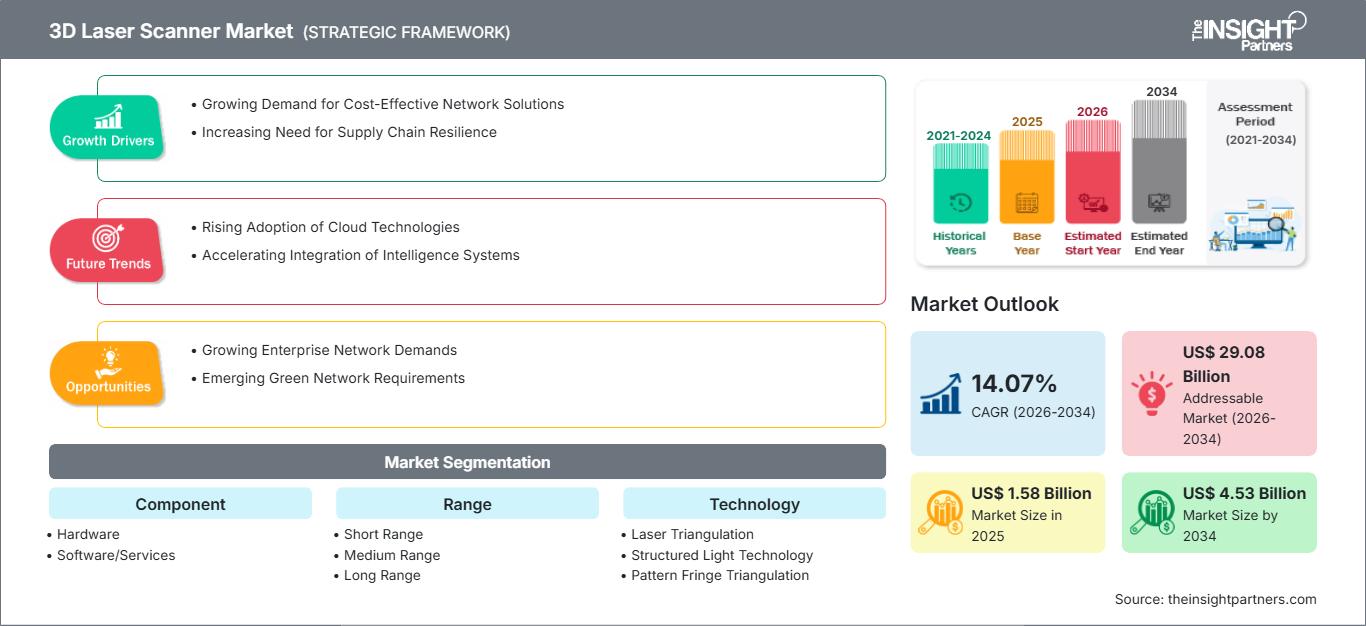
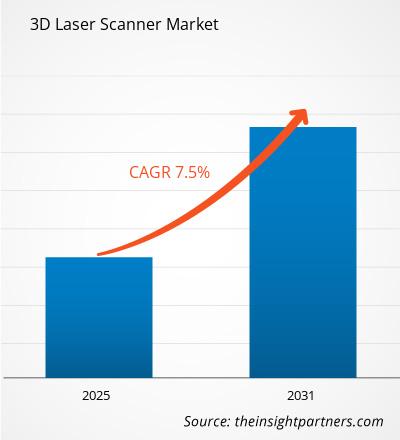
3D 레이저 스캐너 시장은 2025년 15억 8천만 달러 규모였으며, 2034년에는 45억 3천만 달러에 이를 것으로 예상됩니다. 2026년부터 2034년까지 연평균 성장률(CAGR)은 12.42%로 추정됩니다.
3D 레이저 스캐너 시장 평가 및 분석
- 북미: 이 지역은 2025년에 3D 레이저 스캐너 시장 점유율의 32%~36%를 차지할 것으로 예상되며, 항공우주 검사, 국방 프로그램, 인프라 재건 및 스캔 기반 BIM 활용에 힘입어 2026년부터 2034년까지 연평균 12.5%~14.5%의 성장률을 보일 것으로 전망됩니다.
- 미국: 미국은 2025년에 북미 시장의 75%~82%를 차지할 것으로 예상되며, 계측, 건설 및 법의학 워크플로우를 중심으로 2026년에서 2034년 사이에 연평균 13%~15%의 성장률을 보일 것으로 전망됩니다.
- 유럽: 유럽은 2025년에 24%~29%의 시장 점유율을 차지할 것으로 예상되며, 2026년부터 2034년까지 연평균 11.5%~13.5%의 성장률을 보일 것으로 전망됩니다. 독일, 영국, 프랑스, 이탈리아, 스페인이 도입을 주도할 것으로 보입니다.
- 아시아 태평양 지역: 아시아 태평양 지역은 2025년에 28%~34%의 시장 점유율을 차지할 것으로 예상되며, 중국, 일본, 한국, 인도, 호주를 중심으로 2026년부터 2034년까지 연평균 15%~17%의 성장률을 보일 것으로 전망됩니다.
- 가장 큰 부문인 하드웨어는 2025년에 시장 점유율 56%~62%를 차지하며, 스캐너 교체 주기가 지속됨에 따라 2026년부터 2034년까지 연평균 12.5%~14.5%의 성장률을 보일 것으로 예상됩니다.
- 고성장 부문: 소프트웨어/서비스는 2025년에 38%~44%의 시장 점유율을 차지하며, 등록, 분석 및 스캔-투-CAD 수요 증가에 힘입어 2026년부터 2034년까지 연평균 16%~18%의 성장률을 보일 것으로 예상됩니다.
- 상세분석대상 주요기업: AMETEK, Inc.; FARO CREAFORM; 파로 인사이트; 육각형 AB; 트림블 주식회사; 탑콘 주식회사; 니콘 메트롤로지 NV; 크레온 기술; 퍼셉트론, Inc.; 조스캔, Inc.; 3D 디지털 코퍼레이션; 베이직 소프트웨어 주식회사
출처: Insight Partners의 자체 조사, 정부 간행물, 기업 연례 보고서, 투자자 발표 자료, 산업 데이터베이스 및 전문가 인터뷰를 기반으로 한 분석.
시장은 전문 계측실과 삼각대 기반 측량에서 연결된 현장 및 공장 워크플로우로 전환되고 있습니다. 하드웨어 정확도는 여전히 중요하지만, 경쟁력 차별화는 자동 정합, 포인트 클라우드 정리, 스캔-CAD 변환, 검사 보고서 작성, BIM 통합 등에서 점점 더 중요해지고 있습니다. 이제 생산 환경은 휴대용 캡처 장치, 견고한 광학 장치, 직관적인 소프트웨어, 교정 서비스 및 교육을 결합한 솔루션을 제공하는 업체에 유리합니다. 구매자는 스캐너 사양뿐만 아니라 전체 워크플로우 소요 시간으로 가치를 평가하기 때문입니다.
향후 수요는 아시아 태평양, 걸프 지역 및 산업 인프라 시장 전반에 걸쳐 확대될 것으로 예상됩니다. 소유주들이 공장, 운송 자산, 공공시설 및 문화 유적지를 디지털화함에 따라 디지털 트윈, 탄력적인 인프라, 품질 추적성 및 자동화된 검사에 대한 투자는 일회성 하드웨어 판매를 넘어 지속적인 수요를 창출하여 3D 레이저 스캐너 시장의 장기적인 전망을 뒷받침할 것입니다. 안전 문서 및 자산 기록에 대한 규제 요건 또한 시장 성장을 촉진하며, 반복적인 스캔 작업이 프로젝트 및 유지 관리 주기에 필수적인 요소가 될 것입니다.
3D 레이저 스캐너 시장 보고서 범위
| 보고서 속성 | 세부 |
|---|---|
| 2025년 시장 규모 | 15억 8천만 달러 |
| 2034년 시장 규모 | 45억 3천만 달러 |
| 글로벌 연평균 성장률(2026년~2034년) | 12.42% |
| 역사적 데이터 | 2021-2024 |
| 예측 기간 | 2026-2034 |
3D 레이저 스캐너 시장 분석
The demand stems from the need for quicker physical geometry measurements than manual measurements permit. In aerospace, automotive, electronics, building and preservation industries, the scanning system is used to assure dimensions, reverse engineer, as-built documentation, and create asset records. The 3D Laser Scanner Market analysis shows rising value in workflows that reduce site revisits, improve tolerance validation, and convert physical objects into trusted digital datasets.
Ecosystem encompasses optics, lasers, controllers, batteries, calibrators, registration software, inspection devices, cloud viewers, service bureaus, and training partners. Favorable supply trends for firms whose hardware and software reduce interpretation time. While hardware is still the biggest source of the 3D Laser Scanner Market size, software and services become more important for profits and customer loyalty.
The competitive landscape is led by diversified industrial technology groups and specialized scanning vendors. AMETEK, Inc., FARO CREAFORM, FARO INSIGHT, Hexagon AB, Trimble Inc., Topcon Corporation, and Nikon Metrology NV compete through range, accuracy, software integration, and service coverage. Kreon Technologies, Perceptron, Inc., JoeScan, Inc., 3D Digital Corporation, and Basic Software Inc. address targeted industrial, forestry, and imaging needs.
The key focus areas for investment include lightweight handheld systems, wireless operation, artificial intelligence-driven processing, robotic scanning, and platform compatibility. The share of vendors in the 3D Laser Scanner Market is measured through their ability to provide implementations, software capabilities, distribution channels, and life cycle services. The strategic positioning in such a scenario shifts from selling products to providing solutions to integrate different departments.
● REPORT CUSTOMIZATION
Tailor This Report To Align With Your Specific Business Requirements
This report can be customized to align precisely with your business objectives, scope, and target markets. Customization options include tailored segmentation, geography, competitive analysis, and strategic insights to support informed decision-making.
Customize This Report →WHAT YOU CAN ADJUST
- ● Segmentations
- ● Geography
- ● Competitive Analysis
- ● Language Preferences
3D Laser Scanner Market:
요구 사항에 맞게 이 보고서를 사용자 정의하십시오.
이 보고서의 일부, 국가 수준 분석, Excel 데이터 팩을 포함하여 모든 보고서에 대한 사용자 정의를 무료로 받을 수 있을 뿐만 아니라 스타트업 및 대학을 위한 훌륭한 제안 및 할인을 이용할 수 있습니다
3D 레이저 스캐너 시장: 전략적 통찰력
-
이 보고서의 주요 주요 시장 동향을 확인하세요.이 무료 샘플에는 시장 동향부터 추정 및 예측에 이르기까지 데이터 분석이 포함됩니다.
Regional Insights
North America 3D Laser Scanner Market
North America holds a 32%–36% share in 2025 and is expected to grow at a 12.5%–14.5% CAGR. Demands revolve around tooling qualification in aerospace, defense QA, automotive testing, forensic engineering, and documentation of infrastructures. Established service providers can assist organizations in transforming point clouds to CAD, BIM, and inspection formats.
Structural factors include a shortage of surveying personnel, increased demand for digital twins, and greater documentation requirements for industrial assets. The market in the region is supported by rentals, resellers, calibrations, and training services, reducing adoption hurdles. 3D Laser Scanner Market trends in North America are becoming portable, cloud-based, and software-driven.
U.S. 3D Laser Scanner Market
The U.S. accounts for 75%–82% of North American demand in 2025 and is projected to grow at a 13%–15% CAGR. Aerospace, shipbuilding, automotive engineering, public safety, and construction documentation sustain adoption. Vendor presence from AMETEK, Inc., FARO CREAFORM, FARO INSIGHT, Hexagon AB, Trimble Inc., and Nikon Metrology NV strengthens access.
Application patterns show handheld scanners moving deeper into shop-floor inspection, while terrestrial and mobile systems support construction, utilities, and large facility capture. Buyers value direct links to CAD, BIM, and reporting software. The U.S. also benefits from established service bureaus that support users before full equipment ownership.
Europe 3D Laser Scanner Market
Europe holds a 24%–29% share in 2025 and grows at an 11.5%–13.5% CAGR. The UK uses scanners in rail modernization, commercial construction, aerospace inspection, and heritage documentation. Survey firms deploy terrestrial and mobile systems to reduce site visits, improve records, and support safer planning in dense urban locations.
Germany remains the leading country in Europe because customers in the automotive, machinery, and factory automation sectors need precise dimensional control. The manufacturers use scanners to prove tooling, compare parts against CAD models, and enable fast engineering changes. Culture of quality and suppliers’ involvement emphasize Germany's strategic role in the European 3D Laser Scanner Market.
France helps through its aerospace, military, transportation, and heritage preservation initiatives. Italy offers its support based on the demands of its machinery, automobiles, and heritage initiatives, while Spain applies its scanning technologies in construction, rail, and industrial maintenance. In Europe, interoperability, accuracy, and serviceability play a greater role in purchasing decision-making than cost alone.
APAC 3D Laser Scanner Market
APAC holds a 28%–34% share in 2025 and grows at a 15%–17% CAGR, making it the fastest-growing region. China leads through manufacturing scale, infrastructure expansion, and industrial digitization.
Demand in Japan and South Korea is driven by robotics, semiconductors, shipbuilding, automotive design, and precision manufacturing. The movement is enhanced in India and Australia through transportation infrastructure, mining, power generation, utilities, and intelligent construction programs.
Government support for manufacturing, electronics, railways, and infrastructure makes adoption easier. Service-driven implementation remains critical, as many customers require project delivery, training, and modeling before making a purchase decision.
Middle East & Africa 3D Laser Scanner Market
Middle East & Africa is expected to grow at a 10.5%–12.5% CAGR. The UAE leads in smart cities, airports, real estate, and digital construction, while Saudi Arabia applies scanning to giga-projects, energy sites, and industrial facilities.
Scanners are used by oil and gas producers for site documentation, shutdown preparations, and brownfield modification activities. South Africa promotes usage in the mining, utility, transportation, and cultural heritage documentation sectors.
Financial challenges prevent direct purchase in certain areas of the region, but rental options and scanning services increase access to the technology. Aging infrastructure and lifecycle management programs generate regular demand.
Segmentation Analysis
Component
Component demand is projected to grow at a 13%–15% CAGR as buyers combine scanners with software, calibration, training, and specialist services. Hardware defines capture accuracy and durability, while software/services expand the 3D Laser Scanner Market scope by converting scans into inspection reports, CAD models, BIM-ready data, cloud views, and repeatable workflows.
- Hardware remains the largest contributor because scanners, optics, controllers, batteries, calibration tools, mounts, and accessories determine capture performance, user confidence, and equipment suitability in field and industrial environments.
- Software/Services are strategically important because users need registration, scan-to-CAD conversion, inspection reporting, cloud collaboration, training, calibration, and outsourced deliverables to shorten the path from capture to decision.
Range
Range is expected to grow at a 12%–14% CAGR, with selection guided by object size, working distance, accuracy requirements, and site conditions. Short-range scanners support detailed parts and artifacts, medium-range systems balance portability with reach, and long-range scanners address infrastructure, mining, energy, terrain, and large facility documentation.
- Short Range systems support detailed object scanning, reverse engineering, and fragile artifact documentation where high surface resolution and close-proximity capture are more important than wide-area coverage.
- Medium Range scanners serve manufacturing cells, interiors, plant rooms, and facility documentation where users need balanced reach, portability, productivity, and accuracy in industrial or construction settings.
- Long Range systems support bridges, mines, energy assets, airports, rail corridors, and outdoor construction sites where remote measurement improves safety, planning, and broad spatial coverage.
Technology
Technology demand is projected to grow at a 13%–15% CAGR because each method addresses different accuracy, speed, surface, and distance requirements. Laser triangulation and structured light serve shorter-range precision work, pulse-based and phase shift methods support larger spaces, and pattern fringe triangulation improves dense surface capture for complex geometries.
- Laser Triangulation fits close-range dimensioning and reverse engineering because it captures fine surface detail on industrial parts, tooling, and components requiring high local accuracy.
- Structured Light Technology supports faster surface acquisition in controlled environments where geometry density, scanning speed, and repeatability matter for design, inspection, and modeling tasks.
- Pattern Fringe Triangulation assists complex surface capture and quality inspection because projected patterns generate dense point data from contoured shapes and detailed geometry.
- Pulse Based systems serve longer-distance infrastructure, terrain, mining, energy, and facility applications by measuring laser travel time and enabling remote capture across broad areas.
- Phase Shift systems support rapid medium-range scanning in interiors, construction documentation, industrial plants, and as-built surveys where dense point clouds are required quickly.
Industry Verrtical
Industry Verrtical demand is expected to grow at a 14%–16% CAGR as scanning becomes central to quality control, design verification, field documentation, and asset lifecycle management. Aerospace and automotive users prioritize traceable accuracy, construction users require as-built fidelity, electronics users need alignment precision, and heritage users depend on non-contact preservation methods.
- Aerospace and Defense users apply scanning to tooling validation, MRO inspection, assembly verification, and traceable documentation for complex components where dimensional error can disrupt safety and delivery schedules.
- Automotive users deploy scanning for body-in-white inspection, prototype validation, reverse engineering, supplier quality checks, and faster digitization of legacy parts into CAD environments.
- Construction and Infrastructure users rely on scanning for as-built capture, BIM coordination, progress verification, deformation monitoring, claims documentation, and rework reduction on complex sites.
- Electronics and Semiconductors users apply scanning for equipment alignment, small component inspection, cleanroom documentation, and quality assurance in dense, high-precision manufacturing environments.
- Artifact and Heritage Preservation users adopt non-contact scanning to document fragile objects, monuments, and historic sites for conservation, restoration, digital archives, and public education.
Opportunity Snapshot
|
Industry Verrtical |
Revenue Contribution |
Trend Tag |
Adoption Stage |
|
Aerospace and Defense |
High |
MRO Accuracy |
Mature |
|
Automotive |
High |
Quality Automation |
Mature |
|
Construction and Infrastructure |
High |
Digital Twins |
Scaling |
|
Electronics and Semiconductors |
Medium |
Micro Inspection |
Scaling |
|
Artifact and Heritage Preservation |
Low |
Digital Archives |
Emerging |
3D Laser Scanner Market Growth Drivers and Impact Analysis
Precision Inspection and Reverse Engineering Demand
Manufacturers face pressure to shorten their development cycle time and improve dimensional precision in the design of complex parts. 3D laser scanners measure geometry non-invasively; therefore, engineers can compare the actual part with its CAD model, spot any discrepancies, and modify old parts. This effect is felt strongly in the aerospace, automotive, mechanical, and electronic industries, since inaccurate measurements may lead to scrapping items, conflicts between suppliers, delays in certification, or even warranty issues.
Construction Digitization and As-Built Documentation
On-the-ground data needs to be confirmed before making any modifications to construction, infrastructure, or facility management. Laser scanners provide point cloud data from buildings, bridges, industrial facilities, tunnels, and utilities, which professionals can use to compare actual data with models. Market implications include reduced site visits, better clash detection, more accurate progress verification, and claims documentation. Adoption is also supported by digital twin programs because owners want accurate baseline records that can be refreshed throughout the asset lifecycle, reinforcing the positive 3D Laser Scanner Market Forecast.
Portable, Automated, and Software-Led Workflows
Portable scanning technology, wireless capability, and assisted software are extending users' reach beyond just metrology experts. Parts can be scanned in the factory, in the buildings, or even at remote locations, saving the trouble of moving assets. Registration, color mapping, reports creation, and the scan-to-CAD process are all becoming more efficient after scanning. This means the buyer is concerned about time-to-result, which is now a key factor in purchasing decisions.
3D Laser Scanner Market Future Trends
AI-Assisted Point Cloud Processing
Future differentiation will depend on how quickly raw point clouds become engineering intelligence. AI-driven processing could help with segmentation, feature extraction, defect finding, classification, and even comparison with reference models. For construction, it may enhance progress monitoring and deviation detection; for manufacturing, it can expedite inspections and identify geometric risks early. Companies integrating secure, verifiable automation into their processes would be at an advantage, since in enterprises, consistent, verifiable results are more important than bigger data.
Digital Twin and Robotics Convergence
Scanning will also become integrated with digital twins, autonomous inspection vehicles, mobile mapping systems, and industrial robotics. Rather than taking snapshots of space, scanning will provide regular spatial data for operational modeling in manufacturing facilities, energy plants, transportation networks, and commercial real estate. The future belongs to technologies that can regularly traverse routes, perform automatic change detection, and feed CAD, BIM, simulation, and analytics software. This convergence will expand scanner value from documentation toward continuous asset intelligence and operational risk reduction, reflecting evolving 3D Laser Scanner Market Trends.
3D Laser Scanner Market Opportunities
Service-Based Scanning for Mid-Market Users
Mid-sized manufacturers, contractors, preservation bodies, and infrastructure managers often recognize scanning value but lack recurring workloads or trained operators to justify ownership. Rentals, scanning-as-a-service, inspection packages, and modeling services can reduce adoption barriers by delivering usable outputs such as CAD files, deviation reports, BIM-ready point clouds, and archive datasets. Suppliers and service bureaus can build recurring revenue while exposing customers to advanced hardware and software before capital purchase decisions, supporting the long-term 3D Laser Scanner Market Size.
Heritage and Infrastructure Lifecycle Programs
Public authorities, utilities, museums, and infrastructure owners are digitizing assets to support maintenance, renovation, emergency recovery, and cultural documentation. Bridges, tunnels, monuments, industrial plants, and historic buildings benefit from repeatable spatial records that preserve current condition and enable comparison over time. Partnerships with engineering consultancies, conservation organizations, and asset owners can generate opportunities in equipment sales, software subscriptions, archival services, and scheduled inspection programs.
Recent Developments
- 2026년 1월: AMETEK, Inc.의 사업부인 FARO Technologies와 Creaform은 계측 및 현실 캡처 분야에 새로운 지평을 열게 될 중요한 변화를 발표했습니다. 오늘부로 FARO의 3D 측정 사업 부문은 Creaform과 통합되어 FARO CREAFORM이라는 새로운 사업부로 재탄생합니다. FARO CREAFORM은 제조 및 유지보수 팀이 신속하게 대응할 수 있도록 실질적인 정확성을 제공하는 정밀한 치수 측정 솔루션을 제공합니다. 동시에 FARO의 현실 캡처 사업 부문은 FARO INSIGHT로 명칭을 변경하여, 물리적 세계를 팀이 신뢰할 수 있는 실행 가능한 인사이트로 변환하는 세계 최고 수준의 현실 캡처 솔루션 제공에 집중할 것입니다. 이번 조직 개편은 고객에게 더 큰 가치를 제공하고, 혁신을 가속화하며, 성장과 장기적인 발전을 뒷받침하는 시너지를 창출하기 위해 설계되었습니다.
- 2025년 10월: 헥사곤의 제조 인텔리전스 사업부는 모든 산업 분야의 초보 사용자도 전문가급 레이저 스캐닝을 활용할 수 있도록 설계된 새로운 휴대용 3D 스캐너인 ATLASCAN Pro를 출시합니다. 여러 개의 레이저 라인과 독자적인 처리 알고리즘을 사용하는 ATLASCAN Pro는 합리적인 가격과 간편한 사용법으로 누구나 쉽게 사용할 수 있는 기기에서 빠른 스캔 속도와 고품질 데이터 캡처를 구현합니다.
- 2025년 7월: 아메텍(AMETEK, Inc., 뉴욕증권거래소: AME)은 파로 테크놀로지스(FARO Technologies, Inc.)를 주당 44달러, 총 약 9억 2천만 달러(현금 인수 제외)에 인수하는 절차를 완료했다고 발표했습니다. 이번 거래는 파로 주주들의 승인과 모든 규제 당국의 승인을 거쳐 완료되었습니다. 합병 완료에 따라 파로의 보통주는 더 이상 나스닥에서 거래되지 않습니다.
자주 묻는 질문

나빈은 맞춤형, 신디케이트 및 컨설팅 프로젝트 전반에 걸쳐 9년 이상의 전문 지식을 보유한 시장 조사 및 컨설팅 전문가입니다. 현재 부사장으로 재직 중이며, 프로젝트 가치 사슬 전반의 이해관계자들을 성공적으로 관리해 왔으며, 100편 이상의 연구 보고서와 30건 이상의 컨설팅 업무를 수행했습니다. 그는 산업 및 정부 프로젝트 전반에 걸쳐 다양한 업무를 수행하며 고객 성공과 데이터 기반 의사 결정에 크게 기여하고 있습니다.
나빈은 카르나타카주 VTU에서 전자통신 공학 학위를, 마니팔 대학교에서 마케팅 및 운영 MBA를 취득했습니다. 그는 9년 동안 IEEE 회원으로 활발하게 활동하며 컨퍼런스, 기술 심포지엄에 참여하고 지역 및 지역 차원에서 자원봉사 활동을 해왔습니다. 현재 직책을 맡기 전에는 IndustryARC에서 준전략 컨설턴트로, 휴렛팩커드(HP Global)에서 산업용 서버 컨설턴트로 근무했습니다.
- 포괄적인 시장 규모 산정 및 전망 분석
- 상세 시장 세분화 분석
- 심층적인 시장 동향 및 요인 분석
- 지역 및 국가별 인사이트
- 경쟁 구도 및 기업 벤치마킹
- 전략적 비즈니스 인텔리전스
사용 후기

The Insight Partners는 당사의 글로벌 시장 진출 전략을 뒷받침하는 가치 있는 시장 정보를 제공했습니다. 담당 팀은 전문적이고 신속하게 대응했으며 당사의 의견을 세심하게 반영했습니다. 또한 프로젝트 전반에 걸쳐 깊이 있는 분석과 유용한 방법론적 설명을 제공했습니다.
Junmo Kim 최고재무책임자(CFO), Enertech Co., Ltd.
Insight Partners의 SCADA 시스템 시장 보고서는 포괄적이며, 현재 동향과 미래 전망에 대한 귀중한 통찰력을 제공합니다. 팀은 매우 전문적이고, 신속하게 대응하며, 처음부터 끝까지 지원해 주었습니다. 저희는 매우 만족하며 Insight Partners의 서비스를 적극 추천합니다.
란 케뎀 파트너, Reali Technologies LTDs
아주 구체적인 소프트웨어 시장에 대한 보고서를 요청했는데, 팀에서 며칠 만에 보고서를 작성해 주셨습니다. 정보는 매우 관련성이 높고 잘 정리되어 있었습니다. 그 후 보고서에 몇 가지 수정과 추가 사항을 요청했습니다. 팀원들의 응답도 매우 빨랐고, 일주일도 채 되지 않아 최종 보고서를 받았습니다.
장-에르브 젠 의장, 퓨처 애널리티카
The Insight Partners와 함께 중요한 시장 조사 및 예측 작업을 진행했습니다. Insight Partners는 기회와 위험에 대한 명확한 통찰력을 제공하여 계획을 세우는 데 큰 도움이 되었습니다. The Insight Partners의 조사는 사용하기 쉬웠고, 탄탄한 데이터를 기반으로 했습니다. 덕분에 현명하고 자신 있는 결정을 내릴 수 있었습니다. The Insight Partners를 강력 추천합니다.
피유시 나그팔 수석 부사장, 하이빔 글로벌
Insight Partners는 탄탄한 분야 전문성을 바탕으로 통찰력 있고 체계적인 시장 조사를 제공했습니다. Insight Partners 팀은 처음부터 끝까지 전문적이고 신속하게 대응했습니다. 사용자 친화적인 웹사이트 덕분에 업계 보고서에 쉽게 접근할 수 있었습니다. 신뢰할 수 있고 고품질의 조사 서비스를 원하신다면 Insight Partners를 강력 추천합니다.
아다치 유키히코 대표이사, 딥블루 주식회사
The Insight Partners에서 시장 보고서를 구매한 것은 이번이 처음입니다. 처음에는 확신이 없었지만, 웹사이트를 방문하고 나서 위험을 감수하고 시장 보고서를 구매하는 것이 더 편하다는 것을 알게 되었습니다. 보고서의 품질과 고객 서비스에 매우 만족합니다. 처음 보고서를 보고 몇 가지 질문과 의견이 있었지만, 분석가와 이메일로 몇 차례 대화를 나눈 후, 전략 기획 과정에 참고할 수 있는 보고서를 확보했다고 생각합니다. 시간을 내어 긍정적인 경험을 선사해 주셔서 정말 감사합니다. 다른 사람들에게도 귀사의 서비스를 적극 추천할 것이며, 추가적인 시장 데이터가 필요할 때면 가장 먼저 귀사에 연락하겠습니다.
존 스즈키 사장 겸 최고 경영자, 이사회 이사, BK 테크놀로지스
나이지리아 감염성 질환 IVD 시장 관련 정보 요청에 응해 주신 귀사의 지원과 전문성에 감사드립니다. 귀사의 인내심과 지도, 그리고 할인 혜택을 기꺼이 제공해 주셔서 결국 계약을 성사시킬 수 있었습니다. 첫 만남을 통해 귀사가 저에게 심어주신 좋은 인상을 바탕으로 앞으로도 The Insight Partners와 함께할 수 있기를 기대합니다.
치지오케 박사 오니아 전무이사, 파인크레스트 헬스케어 유한회사구매 이유
- 정보에 기반한 의사 결정
- 시장 역학 이해
- 경쟁 분석
- 고객 인사이트
- 시장 예측
- 위험 완화
- 전략 기획
- 투자 타당성 분석
- 신흥 시장 파악
- 마케팅 전략 강화
- 운영 효율성 향상
- 규제 동향에 발맞춰 대응




















 무료 샘플 받기 -