
5G 코어 시장: 시장 점유율·성장·수요·전망 2034
5G 코어 시장 규모 및 전망(2021~2034), 글로벌 및 지역별 점유율, 트렌드 및 성장 기회 분석 보고서 범위: 구성 요소별(솔루션, 서비스), 기능별(AMF, SMF, UPF, PCF, NEF, NRF, 기타), 최종 사용자별(통신 사업자, 기업), 구축 모델별(클라우드, 온프레미스), 지역별(북미, 유럽, 아시아 태평양, 남미 및 중미)
- 상태 : 데이터 공개
- 보고서 코드 : TIPRE00019481
- 범주 : 기술, 미디어 및 통신
- 페이지 수 : 150
- 사용 가능한 보고서 형식 :


- 최종 업데이트 일자 : August 04, 2026


2025년 시장 규모
64억 8 천만 달러
기준연도 값
2034년 전망
863 억 2천만 달러
2034년까지 예상됨
2026-2034년 연평균 성장률
33.34 %
성장률
공략 가능 시장
3,194 억 달러
(2026-2034)
5G 코어 시장은 2025년 64억 8천만 달러 규모였으며 , 2034년까지 863억 2천만 달러 에 달할 것으로 예상되며 , 2026년부터 2034년까지 연평균 33.34%의 성장률을 기록할 전망 입니다. 이러한 시장 성장은 주로 독립형 5G 네트워크 구축 가속화, 통신 인프라 가상화 증가, 그리고 클라우드 네이티브 아키텍처 도입 확대에 기인합니다. 이러한 아키텍처를 통해 통신 사업자는 다양한 산업 분야에서 고급 연결 서비스, 네트워크 슬라이싱 기능, 저지연 애플리케이션을 제공할 수 있게 됩니다.
성숙한 통신 인프라와 독립형 5G 서비스의 초기 상용화에 힘입어 북미는 선도적인 지역 시장으로 자리매김하고 있습니다. 이 지역의 5G 코어 시장 규모는 기업의 사설 무선 네트워크 도입 확대, 통신 사업자의 클라우드 네이티브 전환 투자 지속, 그리고 엣지 컴퓨팅 기반 애플리케이션에 대한 수요 증가에 힘입어 성장하고 있습니다. 광범위한 디지털 인프라 투자와 통신 사업자와 클라우드 서비스 제공업체 간의 융합 증대에 힘입어 북미 지역의 연평균 성장률은 약 30~34% 에 달할 것으로 예상됩니다 .
5G 코어 시장 평가 및 분석
- 북미 지역: 2025년 시장 점유율: 34~38% . 2026~2034년 연평균 성장률: 30~34% . 이러한 지역적 선도세는 선진 통신 인프라, 신속한 독립형 구축, 그리고 네트워크 자동화, 기업 연결성 및 엣지 컴퓨팅 환경에 대한 대규모 투자에 힘입은 것입니다.
- 미국: 2025년 시장 점유율: 북미 지역 72~76% . 2026~2034년 연평균 성장률: 29~33% . 통신 사업자의 강력한 투자, 증가하는 사설 네트워크 구축, 그리고 확장되는 클라우드 파트너십이 시장 성장을 지속적으로 견인하고 있습니다.
- 유럽: 2025년 시장 점유율: 24~28% . 2026~2034년 연평균 성장률: 31~35% . 독일, 영국, 프랑스는 산업 디지털화 정책, 민간 5G 프로젝트, 그리고 지원적인 규제 체계 덕분에 주요 성장 동력으로 꼽힌다.
- 아시아 태평양 지역: 2025년 시장 점유율: 30~34% . 2026~2034년 연평균 성장률: 35~39% . 중국, 일본, 한국, 인도가 광범위한 네트워크 구축 프로그램과 스마트 제조 투자로 지역 확장을 주도하고 있다.
- Largest Segment: Solutions. Market share in 2025: 68–72%. CAGR between 2026–2034: 32–36%. Demand remains concentrated in cloud-native core platforms, orchestration software, and subscriber management solutions.
- High Growth Segment: Cloud Deployment Model. Market share in 2025: 58–62%. CAGR between 2026–2034: 36–40%. Operators increasingly prefer cloud-based deployments to enhance scalability, automation, and operational efficiency.
- Key companies analyzed in detail: Nokia Corporation, Telefonaktiebolaget LM Ericsson, Huawei Technologies Co., Ltd., ZTE Corporation, Samsung Electronics Co., Ltd., Affirmed Networks, Inc., Mavenir Systems, Inc., NEC Corporation, Cisco Systems, Inc., Hewlett Packard Enterprise Company.
Source: The Insight Partners' analysis based on proprietary research, government publications, company annual reports, investor presentations, industry databases, and expert interviews.
5G core market transition toward service-based architecture is reshaping telecom network operations worldwide. Operators are steadily replacing legacy packet core environments with cloud-native platforms capable of delivering greater flexibility, automation, and scalability. Advancements in virtualization, containerization, orchestration, and network automation technologies have significantly reduced operational complexity while enabling faster deployment of new services. In addition, increasing adoption of private 5G networks across industrial facilities, logistics hubs, transportation corridors, and utilities is creating sustained demand for advanced core network functionality.
Over the coming decade, 5G core market investments are expected to extend beyond traditional telecommunications providers into enterprise-led deployment environments. Government-backed digital transformation programs, expanding edge computing infrastructure, and increasing monetization opportunities through network APIs are expected to strengthen investment activity. Emerging markets in Asia Pacific, the Middle East, and parts of Europe are anticipated to witness accelerated implementation as regulators and operators prioritize next-generation digital connectivity infrastructure to support broader economic development objectives.
5G Core Market Report Scope
| Report Attribute | Details |
|---|---|
| Market size in 2025 | US$ 6.48 Billion |
| Market Size by 2034 | US$ 86.32 Billion |
| Global CAGR (2026 - 2034) | 33.34% |
| Historical Data | 2021-2024 |
| Forecast period | 2026-2034 |
5G Core Market Analysis
The 5G core market growth momentum reflects a broader shift toward fully standalone network architectures capable of supporting advanced services and diversified revenue streams. Operators increasingly require flexible core infrastructures that can efficiently manage massive device connectivity, low-latency applications, and differentiated quality-of-service requirements. Growing adoption of industrial IoT, autonomous systems, augmented reality, and mission-critical communication solutions further reinforces demand for scalable and intelligent core network platforms.
Supply-side dynamics continue to evolve as equipment vendors, software providers, hyperscale cloud organizations, and systems integrators collaborate to accelerate network modernization initiatives. Cloud-native development approaches have become central to product strategies, enabling shorter deployment cycles and improved lifecycle management. Vendors are also investing heavily in automation capabilities to reduce operational costs and improve service delivery performance across increasingly complex network environments.
The 5G core market analysis indicates intensifying competition among established telecommunications technology providers and specialized software-centric vendors. Nokia Corporation and Telefonaktiebolaget LM Ericsson continue strengthening cloud-native core portfolios through automation, orchestration, and multi-cloud compatibility initiatives. Huawei Technologies Co., Ltd., ZTE Corporation, Samsung Electronics Co., Ltd., and NEC Corporation are leveraging large-scale deployment expertise to support both operator and enterprise modernization programs, particularly within high-growth Asia Pacific markets.
Meanwhile, Cisco Systems, Inc., Hewlett Packard Enterprise Company, Mavenir Systems, Inc., and Affirmed Networks, Inc. continue focusing on software-defined networking, virtualized architectures, and enterprise-oriented connectivity solutions. Strategic partnerships, platform interoperability, and AI-enabled operational capabilities increasingly serve as key differentiators. Market participants are also prioritizing investment in network exposure functions, policy management systems, and edge-integrated architectures to capitalize on emerging digital service opportunities and strengthen long-term competitive positioning.
● REPORT CUSTOMIZATION
Tailor This Report To Align With Your Specific Business Requirements
This report can be customized to align precisely with your business objectives, scope, and target markets. Customization options include tailored segmentation, geography, competitive analysis, and strategic insights to support informed decision-making.
Customize This Report →WHAT YOU CAN ADJUST
- ● Segmentations
- ● Geography
- ● Competitive Analysis
- ● Language Preferences
5G Core Market:
요구 사항에 맞게 이 보고서를 사용자 정의하십시오.
이 보고서의 일부, 국가 수준 분석, Excel 데이터 팩을 포함하여 모든 보고서에 대한 사용자 정의를 무료로 받을 수 있을 뿐만 아니라 스타트업 및 대학을 위한 훌륭한 제안 및 할인을 이용할 수 있습니다
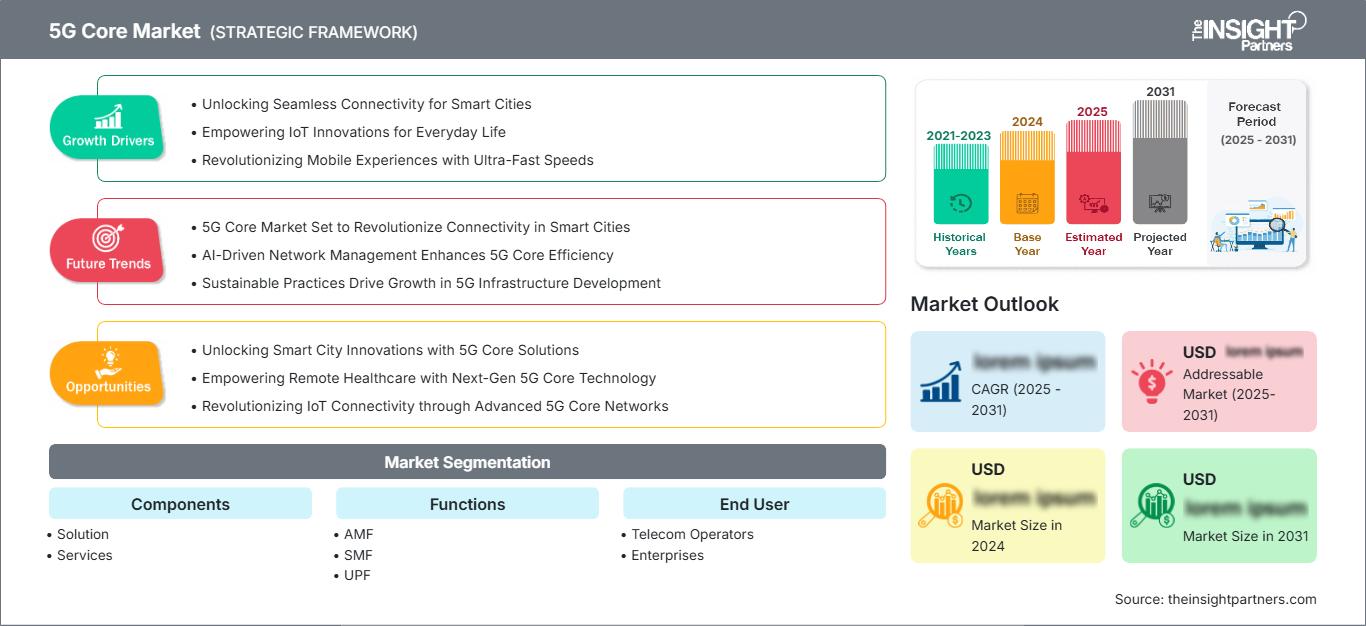
5G 코어 시장: 전략적 통찰력
-
이 보고서의 주요 주요 시장 동향을 확인하세요.이 무료 샘플에는 시장 동향부터 추정 및 예측에 이르기까지 데이터 분석이 포함됩니다.
Regional Insights
North America 5G core market
North America accounted for approximately 34–38% 5G core market share in 2025, maintaining its position as the largest regional contributor. Adoption is supported by widespread commercialization of standalone 5G services, extensive cloud infrastructure availability, and growing enterprise demand for advanced wireless connectivity solutions. The region is projected to expand at a 30–34% CAGR through 2034 as telecom operators accelerate modernization of legacy infrastructure and strengthen service monetization strategies.
In addition to telecommunications investments, demand is increasingly supported by industrial sectors implementing automation, predictive maintenance, and data-intensive operational systems. Manufacturing, healthcare, logistics, and public safety organizations are deploying advanced connectivity platforms to improve operational performance and enable real-time decision-making. Growing collaboration between telecom carriers, hyperscale cloud service providers, and systems integrators further reinforces regional leadership by improving deployment flexibility, reducing implementation timelines, and supporting scalable network architectures capable of meeting evolving enterprise requirements.
U.S. 5G core market
The United States represented approximately 72–76% of the North American market in 2025 and remains the primary driver of regional technology investment. Growth is expected to remain strong at a 29–33% CAGR through 2034, supported by extensive standalone network deployment strategies among major national carriers. Investments continue focusing on virtualization, automation, and cloud-based service delivery capabilities that enhance operational efficiency while supporting enterprise-focused monetization initiatives.
A robust ecosystem of technology providers, telecommunications operators, and cloud infrastructure companies contributes to market development. Cisco Systems, Inc., Hewlett Packard Enterprise Company, Mavenir Systems, Inc., Nokia Corporation, and Samsung Electronics Co., Ltd. maintain significant operational presence within the country. Demand is increasingly generated by private wireless deployments, mission-critical enterprise communications, smart infrastructure initiatives, and industrial automation projects. As organizations pursue digital transformation strategies, modern core network platforms remain essential for supporting secure, scalable, and highly reliable connectivity frameworks across multiple sectors.
Europe 5G core market
Europe held approximately a 24–28% share of the global market in 2025 and is expected to grow at a 31–35% CAGR during the 5G core market forecast period 2034. Regional expansion is supported by strong regulatory encouragement for digital infrastructure modernization, increasing standalone network implementation, and growing private wireless deployments. Germany remains the leading country due to its substantial manufacturing base, advanced industrial automation initiatives, and broad adoption of Industry 4.0 technologies that depend heavily on reliable, low-latency communication infrastructure.
The United Kingdom continues investing in nationwide standalone deployment programs while encouraging enterprise and public-sector digitalization. France is witnessing increasing commercialization of advanced connectivity services across transportation, healthcare, and industrial environments. Meanwhile, Italy and Spain benefit from ongoing smart city projects, digital infrastructure investments, and growing adoption of enterprise network solutions. Collectively, these developments support regional demand for cloud-native core platforms, orchestration technologies, and network automation solutions capable of enabling scalable and future-ready telecommunications ecosystems.
APAC 5G core market
Asia Pacific represented approximately a 30–34% share in 2025 and is expected to register the fastest expansion, with a projected 35–39% CAGR through 2034. China remains the dominant national market because of extensive standalone deployment programs and strong participation from domestic telecommunications equipment providers.
Japan, South Korea, India, and Australia continue strengthening digital infrastructure through nationwide connectivity initiatives, industrial modernization programs, and smart manufacturing investments. Government support for digital transformation and advanced telecommunications infrastructure remains a key factor supporting long-term regional growth.
Middle East & Africa 5G core market
The Middle East and Africa region is forecast to expand at a 32–36% CAGR through 2034, supported by rising investment in next-generation telecommunications infrastructure. Saudi Arabia and the United Arab Emirates remain leading markets owing to large-scale digital transformation initiatives and smart city development programs.
South Africa and other emerging economies are gradually expanding advanced connectivity infrastructure to support industrial diversification and public-sector modernization. Increasing adoption of digital technologies within energy, transportation, and infrastructure sectors is expected to sustain long-term demand for modern core network solutions.
Segmentation Analysis
Components
The Components segment is projected to grow at a 31–35% CAGR between 2026 and 2034. Investments within this segment are primarily directed toward cloud-native core deployment, network orchestration, lifecycle automation, and integration capabilities. As operators move toward service-based architectures, spending on software platforms remains significantly higher than support-related expenditures. Demand is also influenced by increasing enterprise adoption of private wireless infrastructure and the growing need for network modernization across developed and emerging telecommunications markets.
- Solution – Represents the largest share of component spending, driven by deployment of cloud-native packet core platforms, orchestration software, subscriber data management systems, analytics engines, charging platforms, and network exposure solutions that enable advanced standalone capabilities.
- Services – Includes consulting, implementation, migration, system integration, optimization, support, and managed services. Demand remains strong as operators seek external expertise to accelerate deployment timelines, reduce operational risks, and improve network performance.
Functions
The Functions segment is expected to register a 33–37% CAGR through 2034. Growth reflects increasing deployment of service-based architectures where multiple network functions operate in a cloud-native environment. Operators are placing greater emphasis on modular network design, dynamic resource allocation, and intelligent traffic management to support a wide range of consumer and enterprise applications. The rising complexity of standalone networks continues to increase the strategic importance of specialized network functions.
- AMF – Access and Mobility Management Function remains essential for subscriber registration, authentication procedures, mobility control, and seamless connectivity management across multiple network environments and service scenarios.
- SMF – Session Management Function supports establishment, modification, and maintenance of data sessions while ensuring efficient allocation of network resources and policy enforcement throughout the communication lifecycle.
- UPF – User Plane Function plays a critical role in traffic forwarding and low-latency communication, making it highly relevant for edge computing environments and enterprise applications requiring real-time responsiveness.
- PCF – Policy Control Function enables dynamic policy creation and enforcement, supporting differentiated service offerings, traffic prioritization, quality management, and revenue monetization strategies.
- NEF – Network Exposure Function facilitates secure access to network capabilities through application programming interfaces, encouraging innovation and enabling integration with external business applications.
- NRF – Network Repository Function provides service discovery and registration capabilities, ensuring efficient communication among cloud-native network elements and improving overall system flexibility.
End User
The End User segment is forecast to expand at a 34–38% CAGR during the assessment period. Market demand originates from both traditional telecommunications providers and enterprise organizations pursuing advanced connectivity strategies. As standalone network capabilities mature, organizations are increasingly leveraging modern core architectures to support operational efficiency, digital transformation, and new business service models that require flexible and highly reliable communications infrastructure.
- Telecom Operators – Continue representing the dominant customer category because national and regional carriers remain responsible for large-scale network deployment, modernization projects, spectrum utilization, and commercialization of next-generation connectivity services.
- Enterprises – Adoption is accelerating across manufacturing, logistics, healthcare, mining, utilities, ports, and transportation sectors where organizations require secure, low-latency, and highly scalable wireless communication environments.
Deployment Model
The Deployment Model segment is projected to grow at a 35–39% CAGR through 2034. Organizations increasingly favor deployment strategies that enable application agility, infrastructure flexibility, and operational scalability. Cloud-native implementation approaches are becoming central to market development as operators focus on reducing complexity and improving service deployment speeds. At the same time, specific industries continue maintaining local infrastructure to satisfy regulatory and operational requirements.
- Cloud – The leading and fastest-growing deployment approach because it supports elastic scalability, automated lifecycle management, multi-cloud compatibility, and efficient resource utilization while reducing infrastructure constraints.
- On-Premises – Maintains relevance among organizations requiring enhanced data governance, regulatory compliance, network customization, and direct operational oversight for mission-critical communications infrastructure.
Opportunity Snapshot
|
End User |
Revenue Contribution |
Trend Tag |
Adoption Stage |
|
Telecom Operators |
High |
Network Slicing |
Mature |
|
Enterprises |
Medium |
Private 5G |
Scaling |
5G Core Market Growth Drivers and Impact Analysis
Expansion of Standalone 5G Network Deployments Worldwide
The transition from non-standalone architectures toward fully standalone networks remains one of the most significant growth catalysts. Telecom operators increasingly require modern core platforms that enable them to deploy network slicing, ultra-reliable low-latency communications, and enhanced mobile broadband use cases. The standalone approach gives them the agility required to generate revenue from enterprise services, as well as efficiencies associated with automation and virtualization. With national telecoms moving their legacy infrastructure to cloud-native environments, there is a growing need for investment in software platforms, integration services, orchestration tools, and subscriber management tools. Such modernization efforts also promote better working relationships between telecom vendors, cloud service providers, and enterprise technology providers.
Increasing Enterprise Adoption of Private Wireless Infrastructure
A growing number of enterprises are implementing dedicated wireless networks to improve productivity, operational visibility, and process automation. There is a growing reliance on connectivity among manufacturing plants, logistics hubs, airports, seaports, mines, and utility services to support mission-critical applications. The advanced functions provided by core networks enable enterprises to control large numbers of devices in a secure environment with minimal communication delays. With the increasing sophistication of digital transformation efforts, there is a need for a platform that can provide capabilities for analysis, automation, robotics, and industrial IoT. This creates great business opportunities for network solutions vendors.
Growing Demand for Cloud-Native Network Operations
Cloud-enabled operational methodologies are changing how telecommunications infrastructure is designed and managed. The operators strive to develop approaches that help them reduce the complexity of lifecycle management, upgrade their software quickly, automatically provision their services, and increase infrastructure utilization. A containerized approach helps telecommunication companies run network functions effectively and flexibly. This helps reduce operational costs and improve scalability compared with traditional networks. Vendors continue to invest in orchestration systems, automation, and intelligent management to help them handle increasingly complex communication environments.
5G Core Market Future Trends
Artificial Intelligence Integration Across Core Network Operations
5G 코어 시장 동향은 네트워크 계획, 최적화 및 운영 관리에서 인공지능(AI)의 역할이 점점 더 중요해지고 있음을 보여줍니다. 향후 구축될 시스템은 이상 징후를 감지하고, 트래픽 혼잡을 예측하며, 이를 해결하기 위한 조치를 자동으로 수행하는 고급 분석 기능을 통합할 것으로 예상됩니다. 네트워크 사업자들의 AI 기반 시스템 활용은 꾸준히 증가하는 추세입니다. 기업 네트워크 구축 확대와 엣지 컴퓨팅으로 네트워크 복잡성이 증가함에 따라 자동화 기반 운영은 효율성 향상은 물론 신뢰성, 보안 및 성능 개선을 가져올 것으로 전망됩니다. 따라서 AI 기반 관리 시스템은 미래 코어 네트워크의 핵심 요소가 될 가능성이 높습니다.
네트워크 노출 확대 및 API 기반 비즈니스 모델
향후 시장 발전은 타사 애플리케이션이 통신 인프라와 안전하게 상호 작용할 수 있도록 하는 네트워크 노출 기술에 의해 크게 좌우될 것으로 예상됩니다. 표준화된 API를 사용하면 기업과 소프트웨어 개발자는 인증, 위치 서비스, QoD 기능 및 분석을 포함한 네트워크 기능에 접근할 수 있습니다. 이를 통해 특정 비즈니스 요구 사항을 충족하고 통신 사업자에게 새로운 수익원을 창출하는 혁신적인 솔루션을 개발할 수 있습니다. 애플리케이션 생태계가 성숙하고 디지털 서비스에 대한 수요가 증가함에 따라 API 기반 비즈니스 모델은 통신 사업자, 소프트웨어 개발자 및 기업 간의 비즈니스 관계를 더욱 강화할 것입니다.
5G 코어 시장 기회
산업별 기업 연결 솔루션으로의 확장
산업 기업들은 자동화, 원격 운영, 예측 유지보수, 디지털 트윈, 실시간 분석을 지원할 수 있는 무선 인프라에 대한 필요성이 점점 커지고 있습니다. 이러한 추세는 제조, 에너지, 의료, 물류, 광업, 운송 산업의 요구에 맞춘 비즈니스 특화 솔루션을 제공할 수 있는 벤더들에게 많은 기회를 창출하고 있습니다. 클라우드 네이티브 아키텍처와 탄탄한 통합 경험을 바탕으로 벤더들은 향후 기업 프로젝트에서 경쟁 우위를 확보할 수 있을 것으로 기대됩니다. 또한, 통신 사업자, 시스템 통합업체, 애플리케이션 개발자 간의 협력 강화는 솔루션 도입을 가속화하고 고객 만족도를 높이는 데 기여할 수 있습니다.
멀티 클라우드 및 엣지 통합 배포 생태계
멀티 클라우드 전략으로의 전환은 차별화를 모색하는 기업들에게 상당한 잠재력을 제공합니다. 퍼블릭 클라우드, 프라이빗 클라우드, 엣지 클라우드 등 다양한 환경에서 네트워크 서비스를 실행할 수 있는 유연한 접근 방식에 대한 필요성이 증가하고 있습니다. 이러한 분산 시스템에서 상호 운용성, 오케스트레이션, 보안 관리를 간소화할 수 있는 기업은 이러한 변화의 혜택을 누릴 수 있습니다. 지연 시간에 민감한 서비스, 데이터 분석, 분산 처리 등에 대한 수요 증가로 엣지 기반 솔루션의 비즈니스 가치가 더욱 높아지고 있습니다. 분산형 배포 모델이 더욱 확산됨에 따라 통합 관리 도구를 제공하는 기업은 지속적인 수익 창출 기회를 더욱 많이 확보할 수 있을 것입니다.
자주 묻는 질문

Ankita는 9년 이상의 경력을 보유한 시장조사 및 경영 컨설팅 전문가로, 기술(Technology), 미디어(Media), 통신(Telecommunications), 전자 및 반도체(Electronics & Semiconductors), 은행·금융서비스·보험(BFSI) 등 다양한 산업 분야에서 풍부한 전문 지식과 실무 경험을 갖추고 있습니다. 지금까지 Microsoft, Oracle, NEC Corporation, SAP, KPMG, Expeditors International 등 세계적인 기업들을 대상으로 100건 이상의 시장조사 및 컨설팅 프로젝트를 성공적으로 이끌고 수행해 왔습니다. 주요 전문 분야는 시장 평가(Market Assessment), 데이터 분석(Data Analysis), 시장 예측(Forecasting), 전략 수립(Strategy Formulation), 경쟁 정보 분석(Competitive Intelligence), 시장조사 보고서 작성(Report Writing) 등으로 폭넓게 구성되어 있습니다. 이러한 산업별 전문성과 뛰어난 분석 역량을 바탕으로 고객사가 시장 동향을 정확하게 파악하고, 새로운 사업 기회를 발굴하며, 효과적인 비즈니스 전략을 수립할 수 있도록 지원하고 있습니다.
Ankita는 영업 제안 단계에서의 프로젝트 제안서 작성과 고객 협의부터 시장조사 기획 및 실행, 분석 결과 도출, 실질적이고 실행 가능한 전략적 인사이트 제공에 이르기까지 프로젝트의 전체 생애주기를 체계적으로 관리하고 있습니다. 또한 다양한 전문 분야의 인력으로 구성된 부서 간 협업팀(Cross-functional Teams)을 이끌고, 복잡한 시장조사 프로젝트를 체계적으로 설계하고 수행하며, 고객사의 비즈니스 목표에 부합하는 전략적 권고안을 개발하는 데 풍부한 경험을 보유하고 있습니다. 뛰어난 커뮤니케이션 능력, 리더십, 프레젠테이션 역량을 바탕으로 복잡한 시장조사 결과를 명확하고 이해하기 쉬운 전략적 인사이트로 전환하여 고객사가 신뢰할 수 있는 데이터를 기반으로 합리적인 경영 의사결정을 내릴 수 있도록 지원합니다. 이를 통해 기업의 시장 경쟁력 강화와 지속 가능한 성장 전략 수립, 장기적인 비즈니스 목표 달성에 기여하고 있습니다.
- 포괄적인 시장 규모 산정 및 전망 분석
- 상세 시장 세분화 분석
- 심층적인 시장 동향 및 요인 분석
- 지역 및 국가별 인사이트
- 경쟁 구도 및 기업 벤치마킹
- 전략적 비즈니스 인텔리전스
사용 후기

The Insight Partners는 당사의 글로벌 시장 진출 전략을 뒷받침하는 가치 있는 시장 정보를 제공했습니다. 담당 팀은 전문적이고 신속하게 대응했으며 당사의 의견을 세심하게 반영했습니다. 또한 프로젝트 전반에 걸쳐 깊이 있는 분석과 유용한 방법론적 설명을 제공했습니다.
Junmo Kim 최고재무책임자(CFO), Enertech Co., Ltd.
Insight Partners의 SCADA 시스템 시장 보고서는 포괄적이며, 현재 동향과 미래 전망에 대한 귀중한 통찰력을 제공합니다. 팀은 매우 전문적이고, 신속하게 대응하며, 처음부터 끝까지 지원해 주었습니다. 저희는 매우 만족하며 Insight Partners의 서비스를 적극 추천합니다.
란 케뎀 파트너, Reali Technologies LTDs
아주 구체적인 소프트웨어 시장에 대한 보고서를 요청했는데, 팀에서 며칠 만에 보고서를 작성해 주셨습니다. 정보는 매우 관련성이 높고 잘 정리되어 있었습니다. 그 후 보고서에 몇 가지 수정과 추가 사항을 요청했습니다. 팀원들의 응답도 매우 빨랐고, 일주일도 채 되지 않아 최종 보고서를 받았습니다.
장-에르브 젠 의장, 퓨처 애널리티카
The Insight Partners와 함께 중요한 시장 조사 및 예측 작업을 진행했습니다. Insight Partners는 기회와 위험에 대한 명확한 통찰력을 제공하여 계획을 세우는 데 큰 도움이 되었습니다. The Insight Partners의 조사는 사용하기 쉬웠고, 탄탄한 데이터를 기반으로 했습니다. 덕분에 현명하고 자신 있는 결정을 내릴 수 있었습니다. The Insight Partners를 강력 추천합니다.
피유시 나그팔 수석 부사장, 하이빔 글로벌
Insight Partners는 탄탄한 분야 전문성을 바탕으로 통찰력 있고 체계적인 시장 조사를 제공했습니다. Insight Partners 팀은 처음부터 끝까지 전문적이고 신속하게 대응했습니다. 사용자 친화적인 웹사이트 덕분에 업계 보고서에 쉽게 접근할 수 있었습니다. 신뢰할 수 있고 고품질의 조사 서비스를 원하신다면 Insight Partners를 강력 추천합니다.
아다치 유키히코 대표이사, 딥블루 주식회사
The Insight Partners에서 시장 보고서를 구매한 것은 이번이 처음입니다. 처음에는 확신이 없었지만, 웹사이트를 방문하고 나서 위험을 감수하고 시장 보고서를 구매하는 것이 더 편하다는 것을 알게 되었습니다. 보고서의 품질과 고객 서비스에 매우 만족합니다. 처음 보고서를 보고 몇 가지 질문과 의견이 있었지만, 분석가와 이메일로 몇 차례 대화를 나눈 후, 전략 기획 과정에 참고할 수 있는 보고서를 확보했다고 생각합니다. 시간을 내어 긍정적인 경험을 선사해 주셔서 정말 감사합니다. 다른 사람들에게도 귀사의 서비스를 적극 추천할 것이며, 추가적인 시장 데이터가 필요할 때면 가장 먼저 귀사에 연락하겠습니다.
존 스즈키 사장 겸 최고 경영자, 이사회 이사, BK 테크놀로지스
나이지리아 감염성 질환 IVD 시장 관련 정보 요청에 응해 주신 귀사의 지원과 전문성에 감사드립니다. 귀사의 인내심과 지도, 그리고 할인 혜택을 기꺼이 제공해 주셔서 결국 계약을 성사시킬 수 있었습니다. 첫 만남을 통해 귀사가 저에게 심어주신 좋은 인상을 바탕으로 앞으로도 The Insight Partners와 함께할 수 있기를 기대합니다.
치지오케 박사 오니아 전무이사, 파인크레스트 헬스케어 유한회사구매 이유
- 정보에 기반한 의사 결정
- 시장 역학 이해
- 경쟁 분석
- 고객 인사이트
- 시장 예측
- 위험 완화
- 전략 기획
- 투자 타당성 분석
- 신흥 시장 파악
- 마케팅 전략 강화
- 운영 효율성 향상
- 규제 동향에 발맞춰 대응




















 무료 샘플 받기 -