Increasing Integration of JTAG-Compatible Devices Across Semiconductor Ecosystems Fuels the Boundary Scan Hardware Market Growth
According to our latest study, "Boundary Scan Hardware Market Size and Forecast (2021–2034), Global and Regional Share, Trend, and Growth Opportunity Analysis – by Component, Industry, and Geography," the market was valued at US$ 728.57 million in 2025 and is expected to reach US$ 1,512.75 million by 2034; it is estimated to record a CAGR of 8.5% during 2026–2034. The report includes growth prospects owing to current boundary scan hardware market trends and their foreseeable impact during the forecast period.
JTAG-compliant devices are incorporated into semiconductors due to the increased complexity of contemporary electronic systems. Modern semiconductor devices are being produced with JTAG and IEEE 1149.x interfaces to facilitate standardized testing, debugging, programming, and diagnostics of electronic circuits. Furthermore, the development of miniaturized semiconductor packages and multilayer printed circuit board (PCB) designs has made physical probing less convenient, thus necessitating the use of boundary-scan hardware facilitated by the JTAG interface to detect errors in these complex devices. JTAG-based components are also used in the automotive, aerospace, telecom, healthcare, industrial automation, and consumer electronics industries. This technology allows synchronization between debugger software and hardware for validation, firmware verification, interconnect testing, and real-time diagnostics. Standardization of JTAG interfaces in semiconductor devices from different manufacturers enhances compatibility and helps automate test procedures in the context of Industry 4.0 smart manufacturing environments.
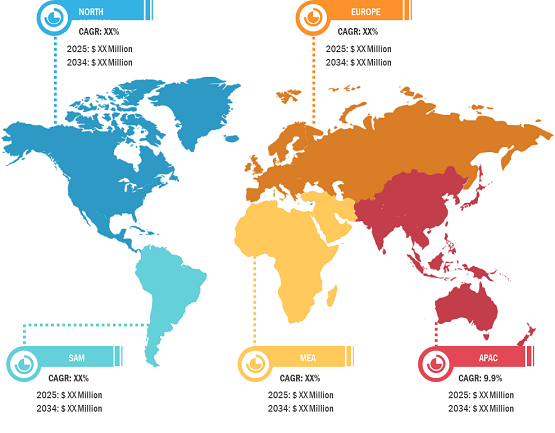
Boundary Scan Hardware Market Analysis — by Geography
Boundary Scan Hardware Market Demand, Size & Forecast by 2034
Download Free Sample
Boundary Scan Hardware Market Size and Forecast (2021 - 2034), Global and Regional Share, Trend, and Growth Opportunity Analysis Report Coverage: By Component (Controllers, I/O Modules, Accessories, and Other), Industry (Consumer Electronics, Automotive, IT and Telecom, Aerospace and Defense, Healthcare, and Others), and Geography (North America, Europe, Asia Pacific, Middle East & Africa, and South & Central America)
Boundary Scan Hardware Market Demand, Size & Forecast by 2034
Download Free SampleBoundary Scan Hardware Market Size and Forecast (2021 - 2034), Global and Regional Share, Trend, and Growth Opportunity Analysis Report Coverage: By Component (Controllers, I/O Modules, Accessories, and Other), Industry (Consumer Electronics, Automotive, IT and Telecom, Aerospace and Defense, Healthcare, and Others), and Geography (North America, Europe, Asia Pacific, Middle East & Africa, and South & Central America)
Source: The Insight Partners Analysis
One example that illustrates this trend in practice comes from the industry. Thus, Microchip Technology stressed the rising strategic significance of secure JTAG integration in embedded semiconductor solutions via its 2025 discussion of layered JTAG security in PolarFire FPGAs and PolarFire SoC FPGAs. According to the company, the JTAG interface utilized for debugging and boundary scan was one of the most vulnerable entry points for physical attacks in embedded electronics since hackers could easily misuse it to steal firmware, reverse-engineer software or generally compromise the system. Therefore, Microchip developed a multi-layered security system comprised of static JTAG locks and a dynamic JTAG security monitor capable of stopping unauthorized access and detecting any attempts of tampering in various applications, including industrial, automotive, aerospace, and defense. Hence, this case study shows that JTAG features are being incorporated into modern semiconductor solutions not only because of the diagnostic function but also for more comprehensive system security and management. With the rise in advanced JTAG capabilities in next-generation semiconductor components, it seems reasonable to expect that demand for more sophisticated boundary scan hardware will rise significantly.
Corelis Inc., Teradyne Inc, Keysight Technologies Inc, Acculogic Inc, GÖPEL electronic GmbH, JTAG Technologies, XJTAG Limited, Qmax Test Technologies, and Konrad GmbH are among the key players profiled in the boundary scan hardware market report. Other major players were also studied and analyzed during the market study to get a holistic view of the market and its ecosystem.
The report includes the boundary scan hardware market forecast by component, industry, and geography. Based on component, the market is segmented into controllers, I/O modules, accessories, and others. Based on industry, the market is segmented into healthcare, IT and telecom, consumer electronics, automotive, aerospace and defense, and others. Geographically, the market is segmented into North America, Europe, Asia Pacific, and South & Central America.
The scope of the boundary scan hardware market report focuses on North America (the US, Canada, and Mexico), Europe (Russia, the UK, Germany, France, Italy, and the Rest of Europe), Asia Pacific (South Korea, China, India, Japan, Australia, and the Rest of Asia Pacific), Middle East & Africa (UAE, Saudi Arabia, South Africa, and Rest of Middle East & Africa), and South and Central America (Brazil, Argentina, and the Rest of South and Central America). Asia Pacific dominated the market in 2025, followed by North America and Europe.
The boundary scan hardware market in Asia Pacific is segmented into Australia, China, Japan, India, South Korea, and the Rest of Asia Pacific. In terms of revenue, China held the largest boundary scan hardware market share in Asia Pacific. The boundary scan hardware market growth in China is driven by its dominant position in global electronics manufacturing, semiconductor packaging, and high-volume PCB assembly. China serves as a major production hub for consumer electronics, telecommunications equipment, automotive electronics, and industrial systems, all of which require highly efficient testing solutions to manage increasing design complexity and production scale. The rapid rollout of 5G infrastructure, AI hardware ecosystems, and data center expansion is significantly increasing demand for advanced PCB testing and debugging technologies. In addition, government-led initiatives such as "Made in China 2025" are accelerating the adoption of smart manufacturing, automation, and domestic semiconductor development, which directly supports the integration of boundary scan hardware into production lines.
In Asia Pacific, market growth is driven by the rapidly expanding electronics manufacturing sector, high semiconductor production, and increasing demand for advanced PCB testing solutions. Due to the growing demand for electronics manufacturing services in Asia, there is an increasing focus on incorporating JTAG technology to improve production efficiency and ensure reliable testing of increasingly sophisticated electronic assemblies. One of the prominent companies operating in this market is Corelis, a provider of JTAG-based boundary-scan testing and debugging solutions for the electronics industry. The company has established a strong presence across Asia Pacific through its sales channels and JTAG support services in countries such as Japan, China, South Korea, Singapore, Taiwan, India, Malaysia, and Australia. Thousands of clients worldwide use Corelis products across various stages of business operations, including product development, prototyping, volume production, and field service operations.
Corelis' JTAG boundary-scan tests are compatible with multiple in-circuit testers, flying probers, and functional testing platforms. In addition, the company's involvement in highly sophisticated custom test and simulation projects enables it to keep pace with the latest technological advancements and support manufacturers developing next-generation electronic systems.
Contact Us
Phone: +1-646-491-9876
Email Id: sales@theinsightpartners.com