The rapid Expansion Of Offshore Energy Activities is driving the Electrical Underwater Connector Market Growth.
According to our latest study, “Electrical Underwater Connector Market Size and Forecast (2021–2034), Global and Regional Share, Trend, and Growth Opportunity Analysis – by Type, Application, and Geography," the market was valued at US$ 0.87 billion in 2025 and is expected to reach US$ 1.51 billion by 2034; it is estimated to register a CAGR of 6.3% during 2026–2034. The report includes prospects owing to the electrical underwater connector market trends and their foreseeable impact during the forecast period.
The expansion of offshore energy projects and submarine communication networks drives the electrical underwater connector market growth. The rapid expansion of offshore energy activities drives the electrical underwater connector market, as it increases the demand for reliable and durable subsea connectivity solutions. Offshore oil and gas exploration, with the growing development of offshore renewable energy projects such as wind and tidal power, requires advanced infrastructure capable of operating in highly challenging marine environments. Electrical underwater connectors ensure uninterrupted power transmission, signal integrity, and data exchange between underwater equipment and surface control systems.
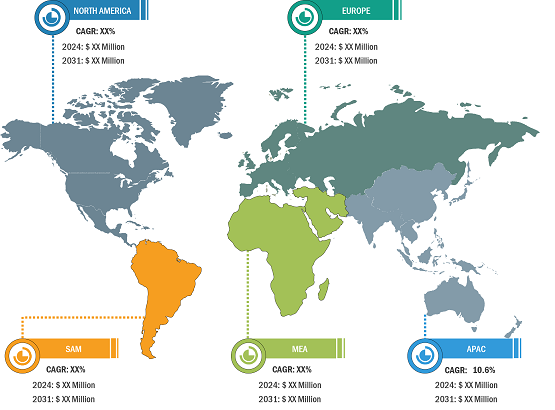
Electrical Underwater Connector Market Analysis — by Geography
Electrical Underwater Connector Market Size, Demand & Growth by 2034
Download Free Sample
Electrical Underwater Connector Market Size and Forecast (2021 - 2034), Global and Regional Share, Trend, and Growth Opportunity Analysis Report Coverage: By Type (Rubber Molded, Inductive Coupling, Fluid-filled Underwater Mateable Connector, and Rigid-shell/Bulk-headed), Application (Military & Defense, Oil and Gas, Telecommunications, Oceanography, ROVs/AUVs, and Others), and Geography (North America, Europe, Asia Pacific, Middle East and Africa, and South and Central America)
Electrical Underwater Connector Market Size, Demand & Growth by 2034
Download Free SampleElectrical Underwater Connector Market Size and Forecast (2021 - 2034), Global and Regional Share, Trend, and Growth Opportunity Analysis Report Coverage: By Type (Rubber Molded, Inductive Coupling, Fluid-filled Underwater Mateable Connector, and Rigid-shell/Bulk-headed), Application (Military & Defense, Oil and Gas, Telecommunications, Oceanography, ROVs/AUVs, and Others), and Geography (North America, Europe, Asia Pacific, Middle East and Africa, and South and Central America)
Source: The Insight Partners Analysis
As energy projects move into deeper waters and more remote locations, the complexity of subsea operations increases. This creates a need for connectors that can withstand high pressure, corrosion from saltwater, and mechanical stress while maintaining long-term performance. These connectors are essential for linking subsea production systems, monitoring equipment, and control modules that operate continuously in harsh conditions.
Offshore energy expansion encourages the integration of automation and digital technologies in subsea operations. This increases the reliance on connectors that can support both power and high-speed data transmission for real-time monitoring and operational control. Reliable connectivity ensures safety, efficiency, and productivity in offshore installations. The shift toward cleaner energy sources is also contributing to new offshore wind farms and hybrid energy systems, increasing the installation of underwater electrical networks. As a result, manufacturers are focusing on developing advanced connector solutions with improved sealing, durability, and modular designs to meet evolving industry requirements.
BIRNS Aquamate LLC; Hydro Group; Glenair, Inc.; Fischer Connectors SA; GISMA Steckverbinder GmbH; Eaton Corporation plc; TE Connectivity Ltd; AK Industries; Amphenol Corporation; and Teledyne Technologies Inc. are among the key players profiled in the electrical underwater connector market report. Other players were also studied and analyzed during the market study to get a holistic view of the market and its ecosystem.
The report includes the electrical underwater connector market forecast by type and application. Based on type, the global electrical underwater connector market is segmented into rubber molded, inductive coupling, fluid-filled underwater mateable connector, and rigid-shell/bulk-headed. The rubber molded segment plays an important role in the electrical underwater connector market due to its strong sealing capability, flexibility, and resistance to harsh marine conditions. These connectors are used in underwater applications where protection against water ingress, pressure, and corrosion is essential. The rubber molding process ensures that electrical components are tightly encapsulated, providing a reliable barrier against saltwater exposure and mechanical stress. This segment is valued in offshore energy systems, underwater robotics, and marine monitoring equipment, where consistent performance and durability are critical. Rubber molded connectors offer excellent vibration resistance and maintain stable electrical connections even under dynamic underwater conditions. Their flexible design also allows for easier installation and adaptation in complex subsea layouts.
These connectors are known for their long operational life and reduced maintenance requirements, making them suitable for deep-sea and remote applications. Manufacturers are focusing on enhancing material quality and insulation properties to improve performance in extreme environments. As underwater operations become more advanced and widespread, the demand for rubber molded connectors continues to grow steadily across marine and offshore industries. This segment held the largest electrical underwater connector market share in 2025.
The scope of the electrical underwater connector market report focuses on North America (the US, Canada, and Mexico), Europe (Spain, the UK, Germany, France, Italy, and the Rest of Europe), Asia Pacific (South Korea, China, India, Japan, Australia, and the Rest of Asia Pacific), the Middle East & Africa (South Africa, Saudi Arabia, the UAE, and the Rest of the Middle East & Africa), and South & Central America (Brazil, Argentina, and the Rest of South & Central America). North America dominated the market in 2025, followed by Europe and Asia Pacific.
The electrical underwater connector market in Asia Pacific is segmented into Australia, China, Japan, India, South Korea, and the Rest of Asia Pacific. In terms of revenue, China held the largest electrical underwater connector market share in APAC. China holds a significant position in the electrical underwater connector market, supported by its strong focus on offshore energy development, marine engineering, and technological advancement. The country’s expanding offshore oil and gas exploration activities are a key driver, as they require reliable subsea connectivity solutions to ensure efficient power transmission and data communication between underwater equipment and surface systems. China’s rapid development of offshore wind energy projects is increasing the demand for durable and high-performance underwater connectors capable of operating in harsh marine environments. The country is also investing heavily in marine research, deep-sea exploration, and underwater robotics. These applications rely on advanced electrical connectors to maintain stable communication and power supply in complex subsea operations. The growing deployment of autonomous underwater vehicles and remotely operated systems is strengthening market demand. China’s focus on strengthening its naval defense capabilities is also contributing to market growth. Subsea connectors are widely used in surveillance, communication, and underwater defense systems, where reliability and durability are critical.
China’s manufacturing strength supports the production of cost-effective and technologically advanced connector solutions, making it a key global supplier. Continuous innovation in materials, sealing technologies, and miniaturized designs is enhancing product performance. China’s combination of industrial growth, offshore expansion, and technological investment positions it as a major contributor to the global electrical underwater connector market.
Contact Us
Phone: +1-646-491-9876
Email Id: sales@theinsightpartners.com