Global Generative AI Market Forecast to 2031: Key Insights
According to our latest study on "Global Generative AI Market – Global and Regional Share, Trend, and Growth Opportunity Analysis – by Component, Technology, Model, Application, End User, and Geography," the market was valued at US$40.2 billion in 2024 and is projected to reach US$652.02 billion by 2031; it is expected to register a CAGR of 49.1% during 2025–2031. The gradual expansion of the generative AI global market size is to a considerable extent owing to the growing need for automation, the rising acceptance of data-based decision-making, and the demand for content and software generation that can be scaled up across different sectors. Technological advancements, including large language models, multimodal AI systems, cloud-based deployment, and responsible AI frameworks, are expected to emerge as key generative AI market trends in the future.
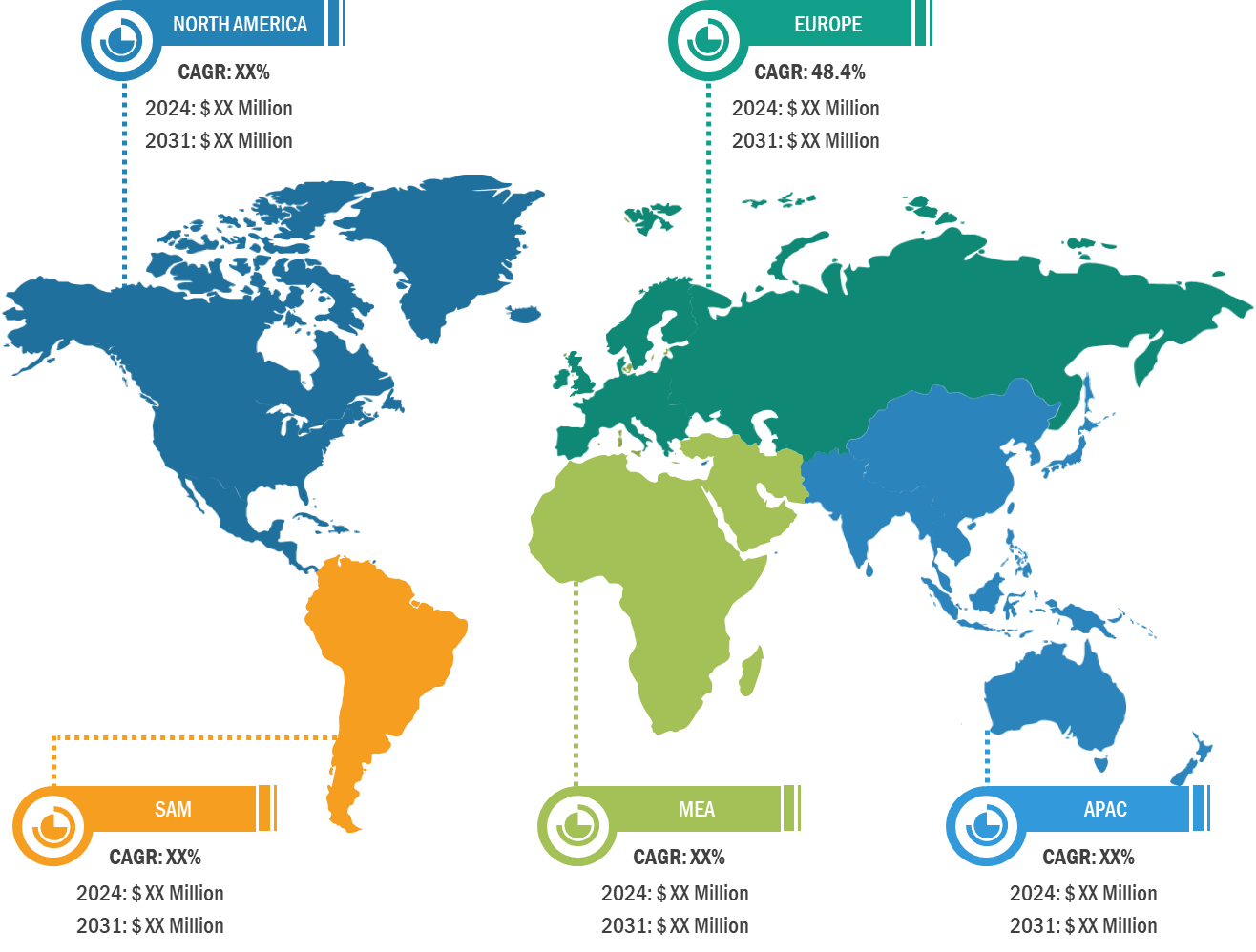
The generative AI market in Europe is not only developing but also evolving at the same time, although a characteristic mix of challenges and limitations is restraining the market. Businesses in the UK, Germany, France, Italy, Russia, and the Nordics have moved from the stage of pilot projects to incorporating generative AI in creating new content, automating processes intelligently, and supporting art and design. Moreover, Europe is establishing a unique position as the region that responsibly, humanely, and transparently adopts this technology. In October 2023, Eviden (Atos Group) rolled out a Generative AI Acceleration Program targeted at European organizations. The program includes AI value segments (infrastructure, model-factory, data orchestration, trust layer) and is intended for firms to get the most out of their generative AI use cases.
Generative AI Market
Generative AI Market Size, Share & Demand Insights by 2031
Download Free SampleGenerative AI Market Size and Forecast (2021 - 2031), Global and Regional Share, Trend, and Growth Opportunity Analysis Report Coverage: By Component (Software, Services), Technology [(Transformers, Diffusion Networks, Generative Adversarial Networks (GANs), and Variational Auto‑encoders (VAEs)], Model (Large Language Models, Image & Video Generative Models, and Multimodal Generative Models Others), Application (NLP, Content Generation, Computer Vision, Robotics and Automation, Predictive Analytics, and Others), End User (Media and Entertainment, BFSI, IT and Telecom Healthcare, Automotive, and Others), and Geography (North America, Europe, Asia Pacific, Middle East & Africa, and South & Central America)
Europe's generative AI ecosystem growth is affected by several factors. The demand for the automation of digital processes, personalization, and scalability is very high: industries such as manufacturing, finance, media, and healthcare are using AI that can create text, images, audio, or even mixed media content instead of data analyzing. AI applications have always been attractive to Europe because of its technological expertise in engineering, design, and the creative industries.
Rapid Growth in Data Availability and Computing Power Drives Global Generative AI Market Growth
The rapid growth of the generative AI market has been driven by the sheer increase in both data availability and computing power, which creates a cycle of capability, demand, and deployment that feeds upon itself. Data-wise, the models of generative AI require large and diverse corpora, and currently, modern companies and organizations possess data in vast amounts, if not more than they had ever had before, which is of three types: unstructured data (text, images, audio, video), well-governed internal datasets, and synthetic data. This change has been marked by the transition from model-centric to data-centric AI, where the availability and quality of data better AI outcomes. For instance, research highlights that high-quality, richly labelled data is a must for the successful deployment of generative AI systems. In July 2024, HPE revealed that the next-generation supercomputer (ABCI 3.0), powered by NVIDIA H200 GPUs, the development of which will be focused on a large-scale generative AI model and will be available as a cloud service to enterprise/government/academia, will be hosted by the National Institute of Advanced Industrial Science and Technology (AIST) in Japan.
Computing power, which was once a limiting factor, has multiplied many times over, allowing the training and inference of large foundation models and generative networks. The Organisation for Economic Co-operation and Development (OECD) conducted an analysis which stated that modern machine-learning systems have seen the doubling of training compute every ~3.4 months in recent years, far faster than the pace of Moore’s Law.
Global Generative AI Market: Segmental Overview
By component, the market is bifurcated into software and services. The software segment held a larger generative AI market share in 2024. The basic software products that are offered, such as large language models, generative frameworks, APIs, and AI development platforms, support the content generation, automation of intelligent processes, and advanced analytics in large companies right from the start. By automating the most complex cognitive tasks, these solutions eliminate human labor, increase the rate of work done, and make the right decisions more accurately. The presence of cloud computing, model orchestration tools, and enterprise-level security is changing the way businesses implement and control generative AI in great numbers. Firms are more and more putting their money on software designs that are both modular and customizable, which allows for the tweaking, changing of the area of application, and smooth connection with the already in place IT systems. Besides this, the rising requirement for ethical AI, governance tools, and performance enhancement is propelling the software segment's innovation cycle, keeping its market strength for generative AI intact.
Global Generative AI Market Analysis: Competitive Landscape and Key Developments
The global generative AI market report emphasizes prominent players' developments. Capgemini SE, International Business Machines Corp (IBM), Microsoft Corp, NVIDIA Corp, Adobe Inc, Advanced Micro Devices Inc (AMD), Google LLC, Meta Platforms Inc, Accenture Plc, and Oracle Corp are among the prominent players profiled in the generative AI market report. Market players focus on new product launches, expansion, diversification, and acquisition strategies to capitalize on prevailing business opportunities.
- In July 2025, Capgemini unveiled its Resonance AI Framework to help organizations unlock the full potential of AI at scale, reimagining their business from operations to innovation. With the vast majority of organizations planning to implement agentic AI in the next 2 years, there is a strong need to reinforce organizations’ AI readiness, while creating the right “human-AI chemistry” to ensure long-lasting adoption. Supported by a suite of AI transformation offers and RAISE, a comprehensive gallery of generative AI and AI agents, the framework enables organizations to turn strategy into action across the enterprise.
- In June 2025, IBM introduced Gen AI Assistant. Maximo 9.1 users can strategically manage assets, facilities, and investment planning in a single experience; they can also leverage a new generative AI assistant built with watsonx.ai for increased workforce productivity.
Contact Us
Phone: +1-646-491-9876
Email Id: sales@theinsightpartners.com