Surging Demand from Semiconductor and Electronics Fabrication Fuels the Thermal Mass Flow Controller Market Growth
According to our latest study, “Thermal Mass Flow Controller Market Size and Forecast (2021–2031), Global and Regional Share, Trend, and Growth Opportunity Analysis – by Flow Rate, Application, and Geography," the market was valued at US$ 719.86 million in 2024 and is expected to reach US$ 1058.96 million by 2031; it is estimated to record a CAGR of 5.9% during 2025–2031. The report includes growth prospects owing to current Thermal mass flow controller market trends and their foreseeable impact during the forecast period.
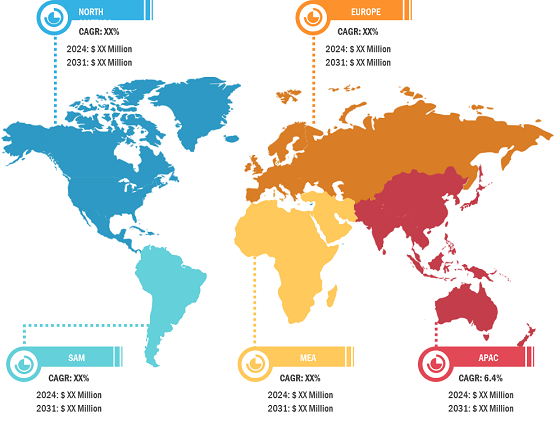
Thermal Mass Flow Controller Market Analysis — by Geography
Thermal Mass Flow Controller Market Share & Demand Insights 2031
Download Free SampleThermal Mass Flow Controller Market Size and Forecast (2021 - 2031), Global and Regional Share, Trend, and Growth Opportunity Analysis Report Coverage: By Flow Rate (Low, Medium, and High), Application (Semiconductors, Food and Beverages Industry, Chemicals, Pharmaceutical and Healthcare Industry, Oil and Gas, and Others), and Geography (North America, Europe, Asia Pacific, Middle East and Africa, and South and Central America)
Source: The Insight Partners Analysis
- The demand for semiconductors and electronics fabrication is increasing significantly. The entire semiconductor industry is being revolutionized by the following: AI, IoT, 5G, self-driving cars, and clean energy systems are a few examples of technologies that require microchips and electronic components to function. To ensure that thin films have the correct thickness, purity, and uniformity on wafers, semiconductor fabrication processes such as chemical vapor deposition (CVD), physical vapor deposition (PVD), etching, oxidation, and doping require very precise and repeatable gas flow rates. Directly measuring and controlling gas flow in mass units, without conversion for temperature or pressure changes, is what thermal mass flow controllers do, owing to which they provide the level of accuracy, stability, and responsiveness required. Accuracy such as this leads to fewer defects, higher process efficiency, and guarantees the best yield rates, which are important parameters in chip production, where very small inconsistencies can cause product failure or performance degradation.
- As semiconductor gadgets become tinier and more complex, requiring nanoscale precision, the use of top-quality thermal mass flow controllers is increasing. Cutting-edge fabs at sub-7nm and 5nm technology nodes are outfitting their plants with the new generation flow controllers, which are capable of extremely low flow rates and rapid response times. These advancements drive this expansion of the market.
- The shift of the electronics industry toward advanced packaging, MEMS (Micro-Electro-Mechanical Systems), and flexible electronics is unfolding new avenues of applications for thermal mass flow controllers. These manufacturing setups require multi-gas handling, contamination control, and dynamic flow profiling, which are areas where thermal mass flow controllers perform better than traditional volumetric or pressure-based controllers.
- The worldwide semiconductor foundry expansions in Asia Pacific (mainly Taiwan, South Korea, China, and Japan), combined with the revival of local chip production in North America and Europe due to government-supported projects such as the US CHIPS Act and the European Chips Act, are significantly increasing the adoption of process automation and instrumentation such as thermal mass flow controllers.
- The Industry 4.0 technology integration at fabs, such as smart sensors, IoT-based control systems, and predictive maintenance analytics, has boosted the capabilities of modern thermal mass flow controllers, which are equipped with digital communication protocols (e.g., EtherCAT, PROFINET) and self-diagnostic features. These technological innovations facilitate not only operational excellence but also reduce the time the machine is offline, minimize calibration errors, and minimize gas wastage.
- The thermal mass flow controller market growth will be closely linked to and grow steadily with the semiconductor and electronics industries, thus resuscitating the position of thermal mass flow controllers as the most essential instruments in the global chip manufacturing ecosystems' quest for precision, efficiency, and innovation.
Horiba Ltd., Sensirion Holding AG, Teledyne Technologies Inc., Brooks Instrument, Parker Hannifin Corp., Azbil Corp., Axetris AG, Dwyer Instruments, Inc., Avantor Inc., and MKS Instruments Inc. are among the key players profiled in the thermal mass flow controller market report. Other major players were also studied and analyzed during the market study to get a holistic view of the market and its ecosystem.
The report includes the thermal mass flow controller market forecast by flow rate, application, and geography. Based on type, the market is divided into low, medium, and high. Low segment held the largest thermal mass flow controllers market share in 2024. By application, the market is segmented into semiconductor, oil & gas, chemical, pharmaceutical & healthcare, food & beverages, and others. Geographically, the thermal mass flow controller market is segmented into North America, Europe, Asia Pacific, the Middle East & Africa, and South & Central America.
The scope of the thermal mass flow controller market report focuses on North America (the US, Canada, and Mexico), Europe (Russia, the UK, Germany, France, Italy, and the Rest of Europe), Asia Pacific (South Korea, China, India, Japan, Australia, and the Rest of Asia Pacific), the Middle East & Africa (South Africa, Saudi Arabia, the UAE, and the Rest of the Middle East & Africa), and South & Central America (Brazil, Argentina, and the Rest of South & Central America). Asia Pacific dominated the market in 2024, followed by North America and Europe.
The thermal mass flow controller market in Asia Pacific is segmented into Australia, China, Japan, India, South Korea, and the Rest of the Asia Pacific. In terms of revenue, China held the largest thermal mass flow controllers market share in Asia Pacific.
The market for thermal mass flow controllers in China is among the top global markets in terms of size and growth rate. Rapid industrialization, a significant technological leap, and the widespread adoption of high-tech manufacturing primarily influence it. China is a leader in semiconductor fabrication, solar panel production, and chemical processing; these industries require precise control of the flow of gases and liquids. The demand for precision flow instruments in research and industrial applications is being accelerated by various government initiatives, including the "Made in China 2025" strategy, investments in renewable energy, and hydrogen.
The rate of adoption of automation and digital manufacturing is increasing; thus, factories in China are integrating mass flow controllers into smart, IoT-enabled production lines. Additionally, the pharmaceutical and biotechnology sectors are thriving, which increases the demand for precise flow control in laboratory processes and pilot-scale manufacturing. The market in China for thermal mass flow controllers is like a melting pot of huge domestic demand, technological upgrading, and government incentives for the clean and high-tech sectors, making it a global growth hub for these instruments.
Contact Us
Phone: +1-646-491-9876
Email Id: sales@theinsightpartners.com