
3D Pens Market Size, Share & Growth by 2034
Coverage: By Category (Adults, Kids); Distribution Channel (Supermarkets and Hypermarkets, Specialty Stores, Online Retail, Others) , and Geography (North America, Europe, Asia Pacific, and South and Central America)
- Status : Data Released
- Report Code : TIPRE00027357
- Category : Consumer Goods
- No. of Pages : 150
- Available Report Formats :


- Last update date : August 04, 2026


2025 Market Size
US$ 87.43 Mn
Base year value
2034 Forecast
US$ 364.40 Mn
Projected by 2034
CAGR 2026-2034
17.19 %
Growth rate
Addressable Market
US$ 1,888.75 Mn
(2026-2034)
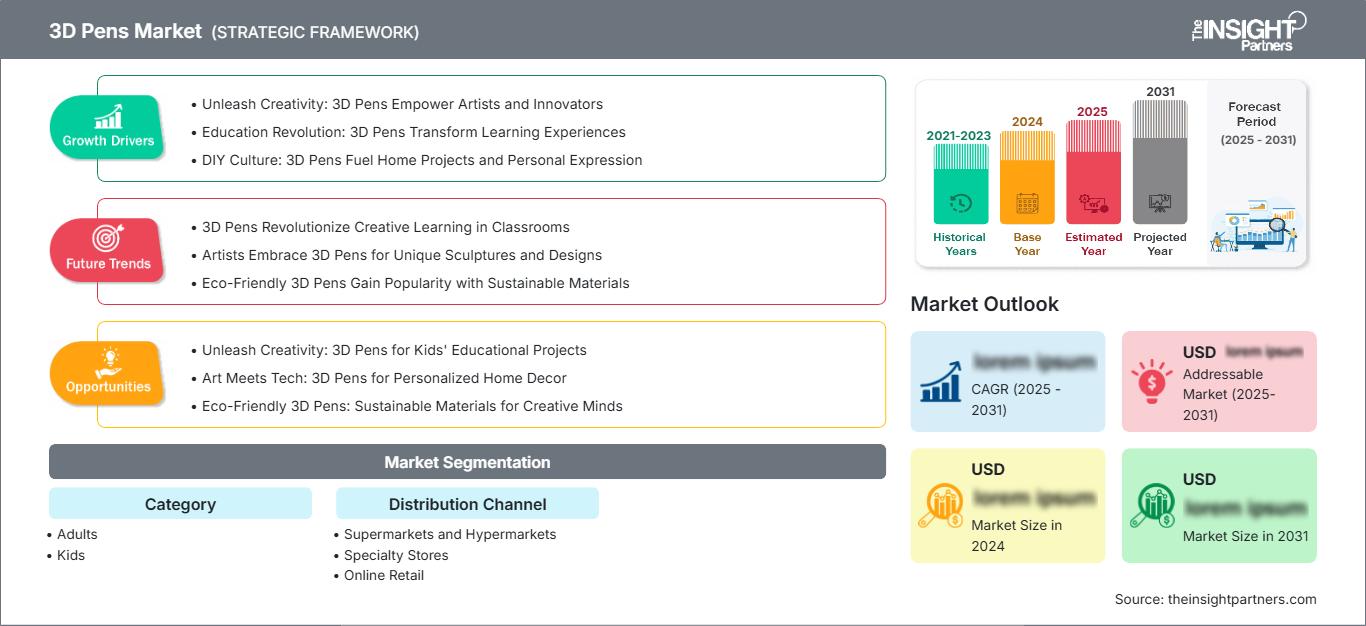
The 3D pens market was valued at US$ 87.43 Million in 2025 and is projected to reach US$ 364.40 Million by 2034, registering a CAGR of 17.19% during 2026–2034. The market continues to gain traction across educational, creative, and prototyping applications as consumers and institutions increasingly adopt accessible fabrication tools. Product innovation, wider filament compatibility, and increasing awareness of additive manufacturing concepts support long-term adoption across both developed and emerging economies.
Across North America, institutional investment in STEM education, maker spaces, and technology-enabled learning environments continues to create favorable demand conditions. The 3D pens market size in the region is supported by strong e-commerce penetration, structured retail availability, and high levels of consumer technology adoption. Regional expansion is expected to remain robust with an estimated CAGR range of 15%–18% through 2034, supported by sustained innovation and educational integration.
3D Pens Market Assessment and Insights
- North America: Share in 2025 of 34%–38% and CAGR between 15%–18%. Strong educational infrastructure, active maker communities, and broad product availability support regional market development.
- US: Accounts for 72%–76% of North America in 2025 and is expected to grow at a 15%–18% CAGR during 2026–2034. High adoption across schools, hobbyists, and creative professionals supports market expansion.
- Europe: Share in 2025 of 24%–28% and CAGR between 14%–17%. Germany, the UK, and France continue leading regional demand through educational technology adoption and creative learning initiatives.
- Asia Pacific: Share in 2025 of 28%–32% and CAGR between 19%–22%. China, Japan, South Korea, and India remain key contributors to regional market growth.
- Largest Segment: Adults with 56%–60% market share in 2025 and 16%–18% CAGR during 2026–2034, supported by design, artistic, and prototyping applications.
- High Growth Segment: Online Retail with 38%–42% market share in 2025 and 19%–22% CAGR during 2026–2034, driven by product accessibility and expanding digital commerce platforms.
- Key companies analyzed in detail: CreoPop, Doodle Pen, AIO Robotics, Myriwell, 3DSIMO, LIX Pen Ltd., Scribbler, WobbleWorks Inc. (3Doodler), Wol3D, MYNT3D
Source: The Insight Partners' analysis based on proprietary research, government publications, company annual reports, investor presentations, industry databases, and expert interviews.
Advances in product engineering have transformed three-dimensional drawing devices from novelty accessories into practical educational and creative tools. Modern products increasingly feature enhanced temperature control, ergonomic designs, wireless operation, and broader material compatibility. These improvements have expanded adoption among schools, artists, engineers, and hobbyists. Manufacturers are also introducing environmentally conscious materials and improved safety mechanisms, supporting wider demand across younger age groups and institutional buyers while strengthening recurring filament-related revenues.
Over the forecast period, 3D pens market prospects are expected to benefit from growing investment in digital learning ecosystems, increasing emphasis on innovation-driven education, and rising participation in maker-oriented activities. Emerging economies represent important growth avenues as governments strengthen technology-based curricula and modernize educational infrastructure. Industry participants are expected to focus on affordability, sustainability, and user-centric innovation to capture demand from a broader consumer and institutional base.
3D Pens Market Report Scope
| Report Attribute | Details |
|---|---|
| Market size in 2025 | US$ 87.43 Million |
| Market Size by 2034 | US$ 364.40 Million |
| Global CAGR (2026 - 2034) | 17.19% |
| Historical Data | 2021-2024 |
| Forecast period | 2026-2034 |
3D Pens Market Analysis
The 3D pens market growth outlook is supported by increasing demand for experiential learning solutions and hands-on educational technologies. Educational institutions worldwide continue incorporating practical creativity tools into science, technology, engineering, arts, and mathematics programs to improve student engagement and design thinking skills. At the consumer level, demand is rising among hobbyists, artists, and designers seeking affordable methods to transform ideas into physical forms. The ability of these products to combine creativity with practical learning outcomes continues to strengthen market appeal.
The broader value chain includes hardware manufacturers, filament suppliers, educational content providers, distributors, online marketplaces, and specialist retailers. This ecosystem encourages adoption by making products more accessible and easier to integrate into learning and creative environments. Greater availability of biodegradable materials and safer low-temperature extrusion technologies further enhances product attractiveness, particularly among educational institutions and family-oriented customer segments.
The 3D pens market analysis indicates a moderately fragmented competitive landscape characterized by ongoing product differentiation and feature innovation. Companies increasingly compete through material compatibility, safety performance, precision control, ease of use, and educational ecosystem support. WobbleWorks Inc. (3Doodler) maintains strong brand recognition in educational and consumer applications, while MYNT3D and 3DSIMO continue emphasizing professional and advanced-user functionality. Myriwell, Scribbler, and Wol3D also maintain notable market positions through diversified product offerings and regional distribution expansion.
Investment activity is increasingly focused on expanding educational partnerships, strengthening direct-to-consumer channels, and developing supplementary learning content. Manufacturers are moving beyond hardware sales and positioning products within broader creative ecosystems that include training materials, project libraries, and consumable subscriptions. Companies such as CreoPop, AIO Robotics, Doodle Pen, and LIX Pen Ltd. are expected to pursue innovation strategies centered on user experience improvements and differentiated application support. As market maturity advances, customer retention and recurring consumable revenue streams are likely to become increasingly important drivers of competitive success.
● REPORT CUSTOMIZATION
Tailor This Report To Align With Your Specific Business Requirements
This report can be customized to align precisely with your business objectives, scope, and target markets. Customization options include tailored segmentation, geography, competitive analysis, and strategic insights to support informed decision-making.
Customize This Report →WHAT YOU CAN ADJUST
- ● Segmentations
- ● Geography
- ● Competitive Analysis
- ● Language Preferences
3D Pens Market: Strategic Insights
Regional Insights
North America 3D pens market
North America accounted for approximately 34%–38% of global revenue in 2025 and is projected to expand at a 15%–18% CAGR during 2026–2034. Strong institutional support for STEM education, increasing deployment of maker-space programs, and widespread consumer awareness of additive manufacturing technologies continue to support regional demand. Educational districts across the US and Canada are increasingly incorporating practical creativity tools into classroom activities, strengthening market penetration among students and educators.
The region also benefits from a mature retail structure and extensive e-commerce adoption, enabling customers to access a broad range of products and consumables. Growing engagement from hobbyists, designers, and technology enthusiasts contributes to recurring demand. Product innovation focused on safety, portability, and sustainability is expected to create additional opportunities for manufacturers seeking to expand their presence throughout North America over the forecast period.
U.S. 3D pens Market
The United States represents approximately 72%–76% of North American demand in 2025 and is expected to register a 15%–18% CAGR through 2034. The country remains a major revenue contributor due to strong adoption of educational technology, widespread engagement in maker communities, and significant consumer spending on creative learning products. Schools and universities continue exploring practical design tools that enhance engineering awareness and collaborative project development.
The presence of companies such as WobbleWorks Inc. (3Doodler), MYNT3D, and several other specialty distributors indicates that the product has high visibility in the marketplace. Professional use is also growing, as people in fields such as architecture, design, and product development use these products to visualize their ideas and concepts. There is an increase in the demand for better products with improved temperature control and wireless features.
Europe 3D pens Market
Europe accounted for approximately 24%–28% of the global 3D pens market share in 2025 and is anticipated to grow at a 14%–17% CAGR during 2026–2034. The region benefits from strong educational infrastructure, widespread technology awareness, and growing interest in creative manufacturing tools. Germany remains the leading national market due to its engineering-focused education system and long-standing emphasis on technical innovation.
The UK will continue to experience sustained growth driven by digital learning projects, vibrant maker movements, and the use of design software tools in educational practice. Institutions of education and creativity are embracing experiential learning approaches that fit the product capabilities.
France, Italy, and Spain account for a large portion of the regional demand. The region is focusing on education modernization projects and promoting design thinking and problem-solving. Continued adoption of technology-based learning approaches, along with increased availability through online retail platforms, will fuel regional market growth. Germany will continue to dominate as a leader due to its solid industrial and educational foundations over the forecast period.
APAC 3D pens Market
Asia Pacific held approximately 28%–32% of global demand in 2025 and is forecast to expand at a 19%–22% CAGR, making it the fastest-growing regional market. China leads regional consumption due to extensive manufacturing capabilities, increasing educational technology investment, and broad adoption of innovation-oriented learning programs.
Japan, South Korea, India, and Australia are consistently strengthening demand through STEM-focused education policies, rising disposable incomes, and growing consumer awareness of digital fabrication. Digital skill development programs and enhancements within the e-commerce framework are also contributing to rapid market development.
Middle East & Africa 3D pens Market
The Middle East & Africa market is expected to register a 13%–16% CAGR during 2026–2034. Saudi Arabia and the UAE continue investing in innovation-driven education initiatives and technology-focused development programs designed to strengthen future workforce capabilities.
South Africa and the broader regional market are experiencing gradual adoption supported by educational modernization efforts and growing awareness of digital learning technologies. Infrastructure improvement projects, economic diversification strategies, and greater accessibility of educational technology products are expected to create favorable market opportunities across the region.
Segmentation Analysis
Category
The category segment will experience a 16%-18% CAGR between 2026 and 2034. Demographics of users, their educational needs, and desired applications play a major role in determining market dynamics in this category. Suppliers are continually developing targeted solutions for various age groups, taking into account safety and performance, as well as ease of use. The trend towards practical learning in educational institutions and creative production among consumers necessitates category-based differentiation.
- Adults: This sub-segment represents the largest revenue contributor due to extensive usage among artists, hobbyists, engineers, architects, and designers. Demand is supported by professional visualization projects, model construction, artistic creation, and rapid concept development activities.
- Kids: Growth is supported by increasing use of creativity-enhancing educational products in schools and households. Low-temperature operation, safety-focused construction, simplified interfaces, and curriculum-aligned learning applications remain important drivers of adoption among younger users.
Distribution Channel
The Distribution Channel segment is anticipated to witness a CAGR of 17% to 20% from 2026 to 2034. Consumers' purchasing habits are evolving continuously with the advent of physical inspection and online purchases. This has resulted in investments by both retailers and manufacturers towards omnichannel approaches.
- Supermarkets and Hypermarkets: These channels remain relevant for mainstream consumer awareness, seasonal promotions, and educational product visibility. Their broad customer reach supports impulse purchases and encourages adoption among first-time users.
- Specialty Stores: This channel plays a strategic role in supporting premium products through demonstrations, technical guidance, and personalized recommendations. Consumers often rely on specialist expertise when evaluating advanced functionality and material compatibility.
- Online Retail: This sub-segment demonstrates the strongest momentum owing to extensive product availability, competitive pricing structures, customer reviews, educational content integration, and convenient delivery services. Manufacturers increasingly prioritize direct-to-consumer digital strategies.
Opportunity Snapshot
| Category | Revenue Contribution | Trend Tag | Adoption Stage |
| Adults | High | Design Prototyping | Mature |
| Kids | Medium | STEM Learning | Scaling |
3D Pens Market Growth Drivers and Impact Analysis
Expansion of STEM and STEAM Education Programs
Educational institutions across developed and developing economies are increasingly emphasizing hands-on learning methodologies to improve creativity, innovation, and applied problem-solving. 3D drawing methods align closely with STEAM programs because they enable learners to envision and translate ideas into tangible structures. It is worth noting that schools, colleges, and innovation labs continue to invest in interactive classrooms for hands-on training. With policymakers increasingly concerned about ensuring that students are well prepared to join the technology-oriented workforce, the need for fabrication equipment is likely to increase gradually. This factor presents opportunities for companies to form institutional partnerships and earn repeat business by selling accessories, replacement products, and filament.
Increasing Popularity of Maker Culture and Creative Design Activities
The global maker movement has continued to grow because consumers increasingly seek technologies that enable them to create personalized products and artistic creations and to experiment quickly. Many hobbyists, designers, artists, and tech-savvy people are increasingly relying on three-dimensional drawing tools to create prototypes, decorative pieces, educational models, and customized projects. Social media sites, online tutorials, and the creator community play an important role in building product awareness by providing practical examples of how to use the products. This creates opportunities to expand market demand beyond educational institutions to other consumers seeking creative solutions for their fabrication needs. The benefits makers gain from this include stronger brand communities and increased accessory purchases.
Continuous Advancement in Materials and Product Functionality
Product innovation continues to be one of the most significant determinants of industrial growth. There are still manufacturers developing devices with improved ergonomic design, temperature-control features, material compatibility, and extrusion-process precision. The provision of eco-friendly filaments is becoming a significant consideration for both educational institutions and environmentally conscious customers. Innovations in safety designs make the products safer to use, thus making them appropriate for even younger people; therefore, they can be utilized in educational institutions and households. Wireless operation, battery rechargeability, and easy-to-use interface designs are making the products accessible.
3D Pens Market Future Trends
Integration with Connected Learning Ecosystems
The 3D pens market trends landscape is increasingly shaped by the convergence of hardware, software, and digital educational content. Development of future products will place a greater focus on integrating them with the cloud-based project library, educator resources, interactive tutorials, and curriculum-based instruction. These ecosystems can help optimize classroom use of the products while making it easy for teachers to assess learning outcomes. Companies are moving toward offering their products as part of educational technology solutions rather than as standalone products. This approach may lead to recurring revenue streams via subscriptions and other digital services offered through the platforms.
Growing Emphasis on Sustainable Materials and Eco-Friendly Design
The concept of sustainability is likely to gain prominence as a purchasing consideration in both the educational and consumer sectors. Manufacturers are working to develop products with biodegradable filaments and recycled packaging materials and to implement sustainable production processes. Educational products are being evaluated by schools and institutions for sustainability attributes, thereby incentivizing companies to perform better from an environmental perspective. Future generations of products could see increased use of plant-derived materials and improved recycling attributes. Beyond regulatory actions, sustainability programs also affect consumers’ perspectives. Companies that integrate environmental performance with product performance are likely to have an edge.
3D Pens Market Opportunities
Expansion Opportunities Across Emerging Education Markets
Developing economies represent one of the most attractive growth avenues for industry participants. Governments in Asia, the Middle East, and certain Latin American nations are continuously making greater investments in digital literacy, innovation-driven learning, and technology-supported educational infrastructure. Companies that make collaborations with educational organizations and distributors in the region can capitalize on the increasing demand for learning aids. Cheap products, localized content, and teacher training programs could help increase adoption rates. 3D pens market forecasts indicate that developing nations will contribute an increasing share of total revenue growth through 2034. Companies that create early market footholds could gain a competitive advantage through enhanced brand visibility.
Premium Product Development for Professional Users
The professional application is less penetrated than other domains, such as education and hobbies, thus providing ample scope for the suppliers. Professionals such as architects, industrial designers, engineers, and prototype designers need portable visualization tools to develop concepts at the earliest stages. Suppliers can capitalize on this opportunity by launching high-end products that offer improved accuracy, a wider range of materials, and special features for professional users. Suppliers can forge strategic partnerships with design institutes, engineering departments, and creative software providers to raise awareness among professional users.
Frequently Asked Questions

- Comprehensive Market Sizing and Forecast Analysis
- Detailed Segmentation Analysis
- In-Depth Market Dynamics Assessment
- Regional and Country-Level Insights
- Competitive Landscape and Company Benchmarking
- Strategic Business Intelligence
Recent Reports
Testimonials

The Insight Partners' SCADA System Market report is comprehensive, with valuable insights on current trends and future forecasts. The team was highly professional, responsive, and supportive throughout. We are very satisfied and highly recommend their services.
RAN KEDEM Partner, Reali Technologies LTDs
I requested a report on a very specific software market and the team produced the report in a few days. The information was very relevant and well presented. I then requested some changes and additions to the report. The team was again very responsive and I got the final report in less than a week.
JEAN-HERVE JENN Chairman, Future Analytica
We worked with The Insight Partners for an important market study and forecast. They gave us clear insights into opportunities and risks, which helped shape our plans. Their research was easy to use and based on solid data. It helped us make smart, confident decisions. We highly recommend them.
PIYUSH NAGPAL Sr. Vice President, High Beam Global
The Insight Partners delivered insightful, well-structured market research with strong domain expertise. Their team was professional and responsive throughout. The user-friendly website made accessing industry reports seamless. We highly recommend them for reliable, high-quality research services
YUKIHIKO ADACHI CEO, Deep Blue, LLC.
This is the first time I have purchased a market report from The Insight Partners.While I was unsure at first, I visited their web site and felt more comfortable to take the risk and purchase a market report.I am completely satisfied with the quality of the report and customer service. I had several questions and comments with the initial report, but after a couple of dialogs over email with their analyst I believe I have a report that I can use as input to our strategic planning process.Thank you so much for taking the extra time and making this a positive experience.I will definitely recommend your service to others and you will be my first call when we need further market data.
JOHN SUZUKI President and Chief Executive Officer, Board Director, BK Technologies
I wish to appreciate your support and the professionalism you displayed in the course of attending to my request for information regarding to infectious disease IVD market in Nigeria. I appreciate your patience, your guidance, and the fact that you were willing to offer a discount, which eventually made it possible for us to close a deal. I look forward to engaging The Insight Partners in the future, all thanks to the impression you have created in me as a result of this first encounter.
DR CHIJIOKE ONYIA MANAGING DIRECTOR, PineCrest Healthcare Ltd.Reason to Buy
- Informed Decision-Making
- Understanding Market Dynamics
- Competitive Analysis
- Identifying Emerging Markets
- Customer Insights
- Market Forecasts
- Risk Mitigation
- Boosting Operational Efficiency
- Strategic Planning
- Investment Justification
- Tracking Industry Innovations
- Aligning with Regulatory Trends





 Get Free Sample for