
Container Homes Market Demand, Share & Growth by 2034
Coverage: By Type (New Container, Scrap Container); Construction Type (On-site Built, Factory Built); End User (Residential Homes, Commercial Homes, Industrial Homes) , and Geography (North America, Europe, Asia Pacific, and South and Central America)
- Status : Data Released
- Report Code : TIPRE00005805
- Category : Manufacturing and Construction
- No. of Pages : 150
- Available Report Formats :


- Last update date : July 21, 2026


2025 Market Size
US$ 75.1 Bn
Base year value
2034 Forecast
US$ 112.14 Bn
Projected by 2034
CAGR 2026-2034
4.56 %
Growth rate
Addressable Market
US$ 850.32 Bn
(2026-2034)
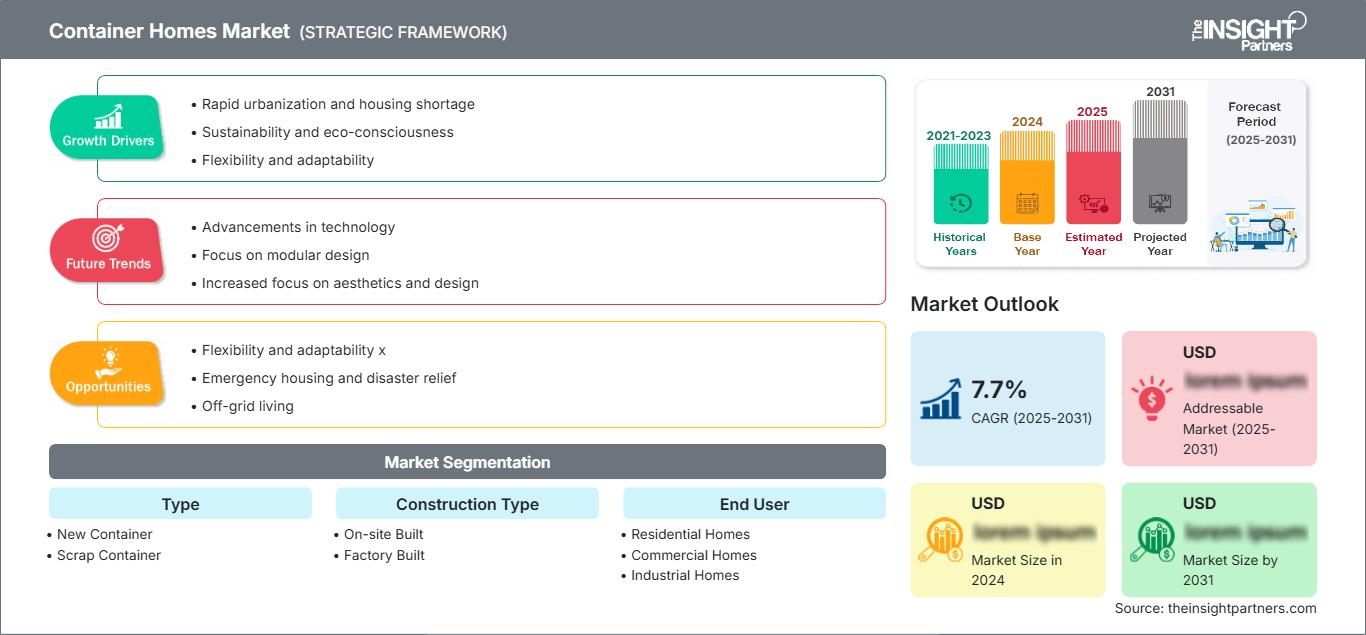
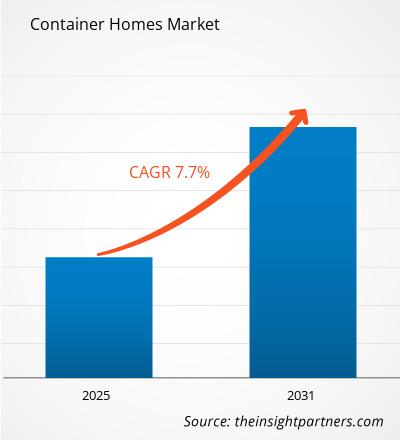
The global Container Homes market was valued at US$ 75.1 billion in 2025 and is expected to reach US$ 112.14 billion by 2034; it is estimated to record a CAGR of 4.56% during 2026-2034.
Container Homes Market Assessment and Insights
- North America held 35–38% share in 2025 and is expected to grow at a CAGR of 4.8–5.6% during 2026–2034, led by modular housing adoption, disaster recovery accommodation, and private investment in compact residential formats.
- US accounted for 78–82% of North America in 2025 and is projected to expand at a CAGR of 4.9–5.7% during 2026–2034, supported by affordable housing pressure and off-site construction.
- Europe represented 24–27% share in 2025 and is forecast to grow at a CAGR of 4.4–5.2% during 2026–2034, with the UK, Germany, Netherlands, France, and Spain leading adoption.
- Asia Pacific captured 21–24% share in 2025 and is expected to grow at a CAGR of 5.6–6.4% during 2026–2034, driven by China, India, Japan, South Korea, and Australia.
- Largest Segment Residential Homes held 54–58% market share in 2025 and is projected to grow at a CAGR of 4.9–5.6% during 2026–2034 due to affordability and customization.
- High Growth Segment Factory Built construction held 44–48% market share in 2025 and is projected to grow at a CAGR of 5.8–6.6% during 2026–2034 as quality control improves.
- Key companies analyzed in detail: HONOMOBO Corporation, SG Blocks Inc., Tempohousing B.V., Speed House Group of Companies, Anderco Pte Ltd, IQ Container Homes, Custom Container Living LLC, Backcountry Containers LLC, Alternative Living Spaces LLC, Giant Containers Inc.
Source: The Insight Partners' analysis based on proprietary research, government publications, company annual reports, investor presentations, industry databases, and expert interviews.
Construction techniques have changed from a haphazard conversion of containers to an engineered modular approach that incorporates better insulation, welding procedures, building envelope systems, and integrated utilities. Container homes' market development is associated with reduced construction periods, reduced site disturbance, and pre-fabricated elements that limit labor costs. Manufacturers are now increasingly blending recycled steel bodies with new containers where there is a need for robustness, code compliance, and longevity.
The greatest future growth will be seen in places where there are challenges with urban housing provision, tourism facilities, and accommodation of workers at sites that are involved with energy production, mining, and logistics. Market acceptance will improve with cities defining zoning requirements and manufacturers demonstrating high-quality designs. Funding will focus on modular systems manufactured in factories and hybrid modular communities, among other projects incorporating container structures with renewables.
Container Homes Market Report Scope
| Report Attribute | Details |
|---|---|
| Market size in 2025 | US$ 75.1 Billion |
| Market Size by 2034 | US$ 112.14 Billion |
| Global CAGR (2026 - 2034) | 4.56% |
| Historical Data | 2021-2024 |
| Forecast period | 2026-2034 |
Container Homes Market Analysis
Demand has been influenced by the integration of housing affordability, urbanization, and the need for flexible building designs. Container homes save on construction time through the use of standardized steel containers and the flexibility to design them for residential, hospitality cabin, office, and remote-site accommodation. The value chain has container producers, fabricators, architects, insulation companies, transportation, and local contractors.
Supply is still price-sensitive to steel, container availability, freight, and interpretation of building codes. Container home market analysis shows that there is an increased chance of success through standardizing container cores and making other elements flexible in terms of finish, layout, and energy systems.
The competitive structure comprises specialists who compete against modular construction companies and regional contractors. The HONOMOBO Corporation and SG Blocks Inc. specialize in engineered and ready for codes units. The Tempohousing B.V. and Speed House Group of Companies concentrate on scalable accommodation solutions. Customized residential requirements are satisfied by Custom Container Living LLC, Backcountry Containers LLC, and Alternative Living Spaces LLC.
The investment directions include automation of manufacturing processes, standardization of structural details, reduced carbon footprint, and collaboration with owners of land or hotels. Certification, transportation, and local installation networks become increasingly more important than innovation in positioning. Examples of regional specialists are Giant Containers Inc., Anderco Pte Ltd, and IQ Container Homes.
● REPORT CUSTOMIZATION
Tailor This Report To Align With Your Specific Business Requirements
This report can be customized to align precisely with your business objectives, scope, and target markets. Customization options include tailored segmentation, geography, competitive analysis, and strategic insights to support informed decision-making.
Customize This Report →WHAT YOU CAN ADJUST
- ● Segmentations
- ● Geography
- ● Competitive Analysis
- ● Language Preferences
Container Homes Market: Strategic Insights
Regional Insights
North America container homes market
North America had a share of 35–38% in 2025 and is anticipated to have a CAGR of 4.8–5.6% between 2026 and 2034. The container homes market share is characterized by increased acceptance of modular building, expensive housing, and demand for backyard structures, vacation cabins, emergency shelters, and remote workers housing.
Adoption is driven by innovative experiments with housing codes in U.S. states, interests in energy-efficient cabins in Canada, and developers that want to increase speed of their projects. The region is also advantageous due to existing infrastructure of container logistics and fabrication, and clients ready to pay for durable and customizable products.
U.S. Container Homes Market
The United States accounted for 78–82% of North America and is expected to witness a CAGR growth of 4.9–5.7% during 2026–2034. The demand is focused on states that have higher housing costs, recreational land developments, and an increasing acceptance of accessory dwelling units.
Corporate presence can be gauged by SG Blocks Inc., Custom Container Living LLC, Backcountry Containers LLC, and Alternative Living Spaces LLC, catering to different applications. The application includes the utilization of container units for residential purposes, guesthouses, office space, hospitality purposes, and disaster resilient buildings. Licensing is the key hurdle for adoption.
Europe Container Homes Market
The European share was 24-27% in 2025 and will grow at a CAGR of 4.4-5.2% during 2026-2034. United Kingdom dominates because of its modular hospitality, temporary accommodation, and urban infill developments. In contrast, Germany focuses on energy efficiency, certification, and quality of industrialized buildings.
France, Italy, and Spain reflect demand for tourism accommodation, student accommodation, and compact residential projects near costly urban areas. The Netherlands continues to play a significant role due to Tempohousing B.V. and modular housing concepts despite zoning differences between European countries.
APAC Container Homes Market
The market in APAC registered 21% to 24% market share in 2025 and will grow at CAGR of 5.6% to 6.4% from 2026 to 2034. China leads in manufacturing capacity, while India, Japan, South Korea, and Australia drive demand through construction camps, tourism projects, and small dwellings.
Growing policy focus on quicker infrastructure development and manufacturing facilities helps drive the growth region-wise. Australia is at an advanced stage of adoption in mining activities and small dwellings, while India’s urbanization and prefabricated manufacturing capacity in China provide conducive environment for scaling.
Middle East & Africa Container Homes Market
Middle East & Africa is projected to grow at a CAGR of 5.1–5.9% during 2026–2034, led by Saudi Arabia and the UAE for site offices, hospitality, and worker housing. South Africa adds demand for affordable and modular residential formats.
Energy projects, logistics zones, and large infrastructure programs create demand for rapidly deployable accommodation. Rest of MEA adoption remains project-specific, shaped by transport access, climate adaptation, insulation needs, and public-sector procurement.
Segmentation Analysis
Type
The Type segment is expected to grow at a CAGR of 4.7–5.5% during 2026–2034. The container homes market scope across new and scrap containers reflects different buyer priorities: certified structural performance for permanent buildings and lower entry cost for conversion-led projects. Selection depends on inspection standards, corrosion condition, insulation requirements, and intended lifecycle.
- New Container units are preferred for premium residences, hotels, and long-life commercial projects where uniform dimensions, cleaner surfaces, and predictable structural quality reduce engineering and finishing risk.
- Scrap Container units serve cost-sensitive builds and sustainability-focused projects, but require stronger inspection, reinforcement, rust treatment, and design discipline to ensure safety and code alignment.
Construction Type
The Construction Type segment is projected to grow at a CAGR of 5.2–6.0% during 2026–2034. Factory built models are gaining preference because controlled production improves insulation, waterproofing, fit-out quality, and schedule certainty. On-site built models remain relevant where transport restrictions, local customization, or phased assembly make factory delivery less practical.
- On-site Built projects suit remote land parcels, complex local layouts, and buyers requiring incremental construction, although quality depends heavily on contractor capability and site supervision.
- Factory Built units support repeatable production, faster delivery, and better finishing control, making them attractive for developers, hospitality operators, and institutional buyers seeking scalable deployment.
End User
The End User segment is expected to grow at a CAGR of 4.9–5.8% during 2026–2034. Residential Homes dominate adoption as households seek lower-cost, design-flexible alternatives. Commercial Homes expand through hospitality, office, and retail formats, while Industrial Homes remain important for construction, mining, logistics, and energy workforce accommodation.
- Residential Homes lead demand because buyers value affordability, faster build timelines, design flexibility, and lower material waste compared with conventional low-rise construction.
- Commercial Homes are used for boutique lodging, pop-up retail, offices, and community facilities where modular design enables rapid launch and brand-specific customization.
- Industrial Homes provide durable accommodation near energy, mining, logistics, and infrastructure sites where relocation, speed, and ruggedness are strategically important.
Opportunity Snapshot
| End User | Revenue Contribution | Trend Tag | Adoption Stage |
| Residential Homes | High | Affordable Living | Scaling |
| Commercial Homes | Medium | Modular Hospitality | Scaling |
| Industrial Homes | Medium | Workforce Camps | Mature |
Container Homes Market Growth Drivers and Impact Analysis
Affordable Housing Pressure and Faster Project Delivery
The higher cost of urban land and the shortage of the labor force have led people to look at modular options as a way to reduce construction time. Containers are built to set standards and use pre-manufactured parts, making the design process less risky. The greatest effect on the market will be seen in areas where local governments permit accessory units, infill housing, or temporary accommodation.
Sustainability Priorities in Built Environment Decisions
Customers are now considering embodied carbon, recycling materials, and construction debris while choosing building systems. Reused steel structures comply with the principles of circular economy when proper structural testing, insulation, and thermal bridging issues are considered. Developers install solar panels, rainwater system, and energy-efficient windows to increase lifecycle performance. This factor helps secure approval from environmentally conscious homeowners, hotels, and government bodies that want to achieve environmental benefits without relying solely on green building materials.
Growth in Remote Industrial and Infrastructure Accommodation
Construction, mining, logistics, and infrastructure development projects may require robust accommodation near temporary or remote sites. They suit containerized units as these can be moved around, stacked, anchored, and repositioned as different stages of the project evolve. The demand is further justified by the presence of huge construction projects in the Middle East, mining operations in Australia and Africa, and expansion in logistics at ports and inland locations.
Container Homes Market Future Trends
Factory Platforms with Digital Design Configuration
The next phase of container homes market trends will involve configurable factory platforms that allow buyers to select layouts, façades, energy packages, and finishes through digital tools before production. This approach can reduce design cycles, standardize engineering, and limit costly rework. Manufacturers that connect design software with fabrication data will improve quoting accuracy and delivery predictability. Over time, this will help container housing compete with mainstream modular construction on quality, speed, and compliance confidence.
Hybrid Communities Combining Containers and Conventional Systems
Developers are expected to use containers as repeatable cores within hybrid communities that also include timber frames, light-gauge steel, shared amenities, and landscaped public space. This model improves design acceptance by avoiding purely industrial aesthetics while preserving speed and modularity. It is particularly relevant for student housing, resort clusters, affordable rental communities, and worker villages. Successful projects will depend on planning approvals, acoustic performance, climate adaptation, and long-term maintenance arrangements.
Container Homes Market Opportunities
Institutional Affordable Housing Partnerships
Public agencies, nonprofit housing bodies, and private developers can create repeatable container housing programs where land, financing, and permitting are coordinated in advance. The container homes market forecasts indicate stronger opportunity where cities need small-footprint rental units, transitional housing, or rapid community expansion. Investors should prioritize certified designs, durable finishes, and operating models that include maintenance funding. Partnerships with local contractors can also reduce political resistance by creating jobs and improving installation accountability.
Hospitality and Eco-Tourism Deployment Models
Hospitality operators can use container units to expand capacity on rural, coastal, or adventure tourism sites without committing to heavy permanent construction. The opportunity is strongest where modular cabins can be installed with low site disturbance and upgraded with premium interiors, decks, and off-grid utilities. Operators benefit from phased investment, seasonal flexibility, and differentiated guest experiences. Manufacturers that offer design packages, compliance documentation, and installation support can capture higher-margin projects.
Recent Developments
- April 2026: HONOMOBO Corporation: The company showcased residential container home models designed for contemporary living, highlighting steel-frame durability, energy-conscious layouts, and modular configurations suitable for primary residences, cabins, and accessory spaces in North American markets.
- February 2025: Backcountry Containers LLC: The company promoted customized container homes and cabin-style units for residential and recreational buyers, reflecting sustained U.S. interest in compact, off-grid, and design-led alternative housing formats.
Frequently Asked Questions

- Comprehensive Market Sizing and Forecast Analysis
- Detailed Segmentation Analysis
- In-Depth Market Dynamics Assessment
- Regional and Country-Level Insights
- Competitive Landscape and Company Benchmarking
- Strategic Business Intelligence
Testimonials

The Insight Partners provided valuable market intelligence that supported our global go-to-market strategy. Their team was professional, responsive, and attentive to our feedback, providing thoughtful analysis and helpful methodological clarifications throughout the project.
Junmo Kim Chief Financial Officer (CFO), Enertech Co., Ltd.
The Insight Partners' SCADA System Market report is comprehensive, with valuable insights on current trends and future forecasts. The team was highly professional, responsive, and supportive throughout. We are very satisfied and highly recommend their services.
RAN KEDEM Partner, Reali Technologies LTDs
I requested a report on a very specific software market and the team produced the report in a few days. The information was very relevant and well presented. I then requested some changes and additions to the report. The team was again very responsive and I got the final report in less than a week.
JEAN-HERVE JENN Chairman, Future Analytica
We worked with The Insight Partners for an important market study and forecast. They gave us clear insights into opportunities and risks, which helped shape our plans. Their research was easy to use and based on solid data. It helped us make smart, confident decisions. We highly recommend them.
PIYUSH NAGPAL Sr. Vice President, High Beam Global
The Insight Partners delivered insightful, well-structured market research with strong domain expertise. Their team was professional and responsive throughout. The user-friendly website made accessing industry reports seamless. We highly recommend them for reliable, high-quality research services
YUKIHIKO ADACHI CEO, Deep Blue, LLC.
This is the first time I have purchased a market report from The Insight Partners.While I was unsure at first, I visited their web site and felt more comfortable to take the risk and purchase a market report.I am completely satisfied with the quality of the report and customer service. I had several questions and comments with the initial report, but after a couple of dialogs over email with their analyst I believe I have a report that I can use as input to our strategic planning process.Thank you so much for taking the extra time and making this a positive experience.I will definitely recommend your service to others and you will be my first call when we need further market data.
JOHN SUZUKI President and Chief Executive Officer, Board Director, BK Technologies
I wish to appreciate your support and the professionalism you displayed in the course of attending to my request for information regarding to infectious disease IVD market in Nigeria. I appreciate your patience, your guidance, and the fact that you were willing to offer a discount, which eventually made it possible for us to close a deal. I look forward to engaging The Insight Partners in the future, all thanks to the impression you have created in me as a result of this first encounter.
DR CHIJIOKE ONYIA MANAGING DIRECTOR, PineCrest Healthcare Ltd.Reason to Buy
- Informed Decision-Making
- Understanding Market Dynamics
- Competitive Analysis
- Identifying Emerging Markets
- Customer Insights
- Market Forecasts
- Risk Mitigation
- Boosting Operational Efficiency
- Strategic Planning
- Investment Justification
- Tracking Industry Innovations
- Aligning with Regulatory Trends





 Get Free Sample for