
Deflectable Catheters Market Trends, Share & Demand by 2034
Deflectable Catheters Market Size and Forecasts (2021–2034), Global and Regional Share, Trends, and Growth Opportunity Analysis Report Coverage : by Type (Unidirectional Deflectable, Didirectional Deflectable); Application (Coronary Interventions, Electrophysiology); and Geography (North America, Europe, Asia Pacific, and South and Central America)
- Status : Data Released
- Report Code : TIPRE00039921
- Category : Life Sciences
- No. of Pages : 150
- Available Report Formats :


- Last update date : August 17, 2026


2025 Market Size
US$ 3.73 Bn
Base year value
2034 Forecast
US$ 5.74 Bn
Projected by 2034
CAGR 2026-2034
5.54 %
Growth rate
Addressable Market
US$ 44.39 Bn
(2026-2034)
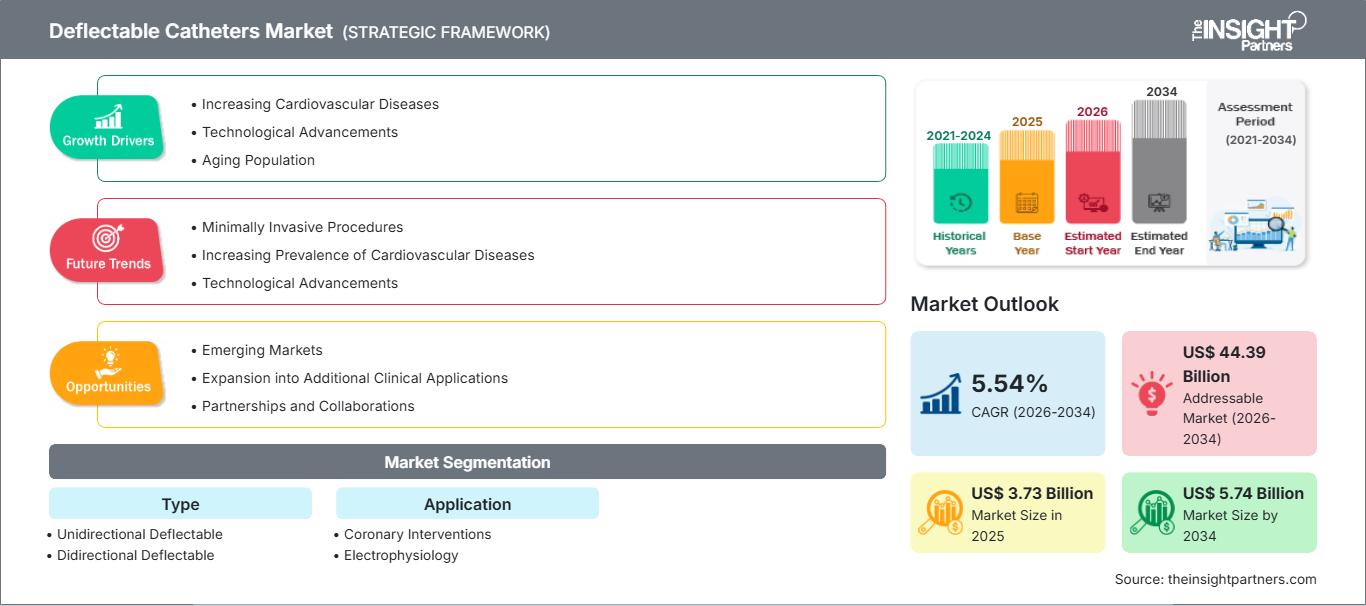
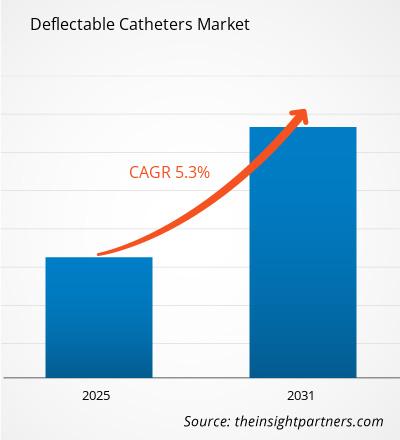
The Deflectable Catheters Market is positioned for sustained expansion, supported by increasing use of steerable catheter technologies in minimally invasive cardiovascular procedures. Market valuation of the market stands at US$ 3.73 Billion in 2025 and is estimated to be US$ 5.74 Billion by 2034, recording a CAGR of 5.54% from 2026 to 2034. Innovation in products focuses on control of tip maneuverability, anatomical accessibility, procedural reliability, and compatibility with imaging and electrophysiology systems.
Deflectable Catheters Market size across North America is driven by the presence of experienced electrophysiology laboratories, high rates of minimal invasive cardiac procedures, and consistent development in catheter technologies. This region is forecasted to grow at around 5.2–5.8% CAGR from 2026 to 2034, supported by procedural sophistication, experience of the physicians, and technology-driven hospitals procurement.
Deflectable Catheters Market Assessment and Insights
- North America: North America remains the leading regional market, with a 2025 share of 36–40% and CAGR of 5.2–5.8% between 2026–2034. Strong electrophysiology infrastructure and advanced catheterization facilities support continued adoption.
- US: The US represents approximately 89–94% of North American revenue in 2025 and is expected to grow at a 5.1–5.7% CAGR during 2026–2034, supported by advanced cardiac centers and procedural volumes.
- Europe: Europe accounts for a 2025 share of 27–30% and is expected to expand at a 5.5–6.3% CAGR through 2034. Germany, the UK, France, Italy, and Spain provide the principal demand base through mature cardiovascular services and technology adoption.
- Asia Pacific: Asia Pacific represents a 2025 share of 25–28% and is projected to register a 6.5–7.2% CAGR. China, Japan, India, South Korea, and Australia are strengthening procedural capacity through hospital modernization and specialist training.
- Largest Segment: Bidirectional deflectable catheters hold a 2025 market share of 44–48% and are modelled to grow at 5.6–6.1% CAGR during 2026–2034, reflecting superior directional control.
- High Growth Segment: Electrophysiology is the high-growth application, with a 2025 share of 47–51% and an estimated 6.0–6.6% CAGR through 2034, supported by expanding ablation and mapping activity.
- Key companies analyzed in detail: Medtronic plc, Boston Scientific Corporation, Abbott Laboratories, Johnson & Johnson (Biosense Webster, Inc.), Koninklijke Philips N.V., BIOTRONIK SE & Co. KG, Merit Medical Systems, Inc., Teleflex Incorporated, AngioDynamics, Inc., Acutus Medical, Inc.
Source: The Insight Partners' analysis based on proprietary research, government publications, company annual reports, investor presentations, industry databases, and expert interviews.
The Deflectable Catheters market has seen an evolution from the initial designs of steerable catheters to devices that possess controlled deflection, enhanced torque responsiveness, braiding of the device, hydrophilic coating, and ability to use with mapping and imaging systems. Focus on manufacturing has moved from ease of control towards reproducibility of control and consistency of materials. Bidirectional systems have become especially important since they allow controlled manipulation without the need for catheter changes.
Future perspectives are influenced by increased use of electrophysiology treatments, growth in specialized cardiac centers and availability of imaging systems. New emerging markets in Asia are becoming increasingly important as hospitals increase their capability for catheterization procedures and build expertise in the area. The acceptance of new ablation systems on the regulatory front also drives the need for catheter systems within the context of mapping, imaging and energy delivery.
Deflectable Catheters Market Report Scope
| Report Attribute | Details |
|---|---|
| Market size in 2025 | US$ 3.73 Billion |
| Market Size by 2034 | US$ 5.74 Billion |
| Global CAGR (2026 - 2034) | 5.54% |
| Historical Data | 2021-2024 |
| Forecast period | 2026-2034 |
Deflectable Catheters Market Analysis
Market growth for Deflectable Catheters depends greatly on the growing complexity of catheter-based treatments. Doctors need controlled access in case of complicated procedures, especially when it comes to electrophysiology. Value chain includes polymer and metal producers, catheter developers, manufacturers of different components, sterilizers, distributors, hospitals and specialized heart clinics. Supply becomes more and more favorable to companies that are able to keep close dimensional control in combination with multi-component technology of shafts.
Clinical buying process is also becoming more workflow-oriented. Hospital's choice depends on catheter effectiveness, compatibility with maps, procedure length, physicians' experience, stock and training issues. So now companies have to compete not only by their ability to steer but also for the whole procedure utility. This combination of single use, increased procedure complexity and predictable performance allows earning recurrent money from consumables as well as paying more attention to quality and regulation.
The Deflectable Catheters Market Report competitive positioning is characterized by diversified cardiovascular devices manufacturers possessing physician networks and compatible product lines. Medtronic plc possesses steerability and electrophysiology features, whereas Boston Scientific Corporation focuses on integrating electrophysiology workflow. Abbott Laboratories and Johnson & Johnson (Biosense Webster, Inc.) compete through their catheters connected with mapping and ablation systems to enhance their purchasing influence on specialists centers.
Strategic acquisitions are based on imaging and energy delivery ecosystem integration. Advanced imaging is available from Koninklijke Philips N.V., while BIOTRONIK SE & Co. KG, Merit Medical Systems, Inc., Teleflex Incorporated, and AngioDynamics, Inc. continue to be positioned in specialty catheter and access technologies. However, Acutus Medical, Inc. continues to be positioned in contract manufacturing and access technologies, although it is more limited than other multinational companies.
● REPORT CUSTOMIZATION
Tailor This Report To Align With Your Specific Business Requirements
This report can be customized to align precisely with your business objectives, scope, and target markets. Customization options include tailored segmentation, geography, competitive analysis, and strategic insights to support informed decision-making.
Customize This Report →WHAT YOU CAN ADJUST
- ● Segmentations
- ● Geography
- ● Competitive Analysis
- ● Language Preferences
Deflectable Catheters Market: Strategic Insights
Regional Insights
North America Deflectable Catheters Market
North America held the leading regional position in 2025, with a 36–40% of the Deflectable Catheters Market share, and is modelled to expand at 5.2–5.8% CAGR through 2034. The region benefits from sophisticated electrophysiology laboratories, established cardiac catheterization infrastructure, and high physician familiarity with steerable devices. Demand is reinforced by increasing use of minimally invasive treatment pathways and technology-intensive cardiac procedures.
The US represents the lion’s share of consumption in this region, with Canada being a relatively small but clinically sophisticated market. There is a growing preference for catheters which combine with the process of mapping, imaging and ablation. Research-oriented hospitals serve as test beds for advanced steering catheters as well. North American companies can rely on strong distribution, regulatory and health system connections in this market.
U.S. Deflectable Catheters Market
North America consists of the United States (US), which contributes around 89-94% of North America's revenues and is expected to register a CAGR of 5.1-5.7% from 2025-2034. The demand is driven by key academic institutions, electrophysiology centers, and interventional facilities. Medtronic plc, Boston Scientific Corporation, Abbott Laboratories, and Johnson & Johnson (Biosense Webster, Inc.) have a strong clinical and commercial footprint.
There is an increasing trend for electrophysiology procedures, especially catheter-based mapping, positioning, and ablations. Factors driving adoption include reimbursement systems, allocation of capital by hospitals, and preferences of physicians. Regulatory approval may help in fast-tracking the adoption of new platforms for catheters. The US acts as a launch pad for novel technologies that help manufacturers gain experience in the use of the technology before expanding globally.
Europe Deflectable Catheters Market
In 2025, Europe is predicted to account for 27–30% and will show CAGR 5.5–6.3% from 2025 to 2034. The main players within Europe are Germany, the UK, France, Italy, and Spain. Developed cardiovascular care, developed electrophysiology practices, and mature minimally invasive treatment routes ensure continued growth of demand for controllable catheters.
Within the UK market, the presence of specialized clinics and the rising trend toward effective procedural solutions are key trends. Hospitals are looking for tools that allow not only to improve navigability but also to maintain the consistent procedural workflow in complicated electrophysiological cases. Procurement and evidence-based framework continue to play the role of the key drivers. Specialized clinics represent an essential target for the penetration of new catheter systems, and widespread use will depend on the clinical value and compatibility with the existing mapping and imaging equipment.
Germany remains the leader in the European country market thanks to its wide hospital network, well-developed interventional cardiology, and numerous specialized cardiac centers. Demand is provided by well-developed electrophysiology practices and adoption of mapping, imaging, and ablation procedures. France, Italy, and Spain are other important contributors, which focus on minimally invasive cardiovascular treatment and training.
APAC Deflectable Catheters Market
Asia Pacific accounts for 25–28% of global revenue in 2025 and is expected to expand at 6.5–7.2% CAGR through 2034. China is the leading market, followed by Japan, South Korea, India, and Australia. Hospital modernization and expanding specialist capacity are increasing access to advanced catheter-based interventions.
Industrial growth is enhancing the local manufacturing and delivery processes, while public funding in the healthcare sector ensures wider accessibility to procedures. Technology adoption is well established in Japan, while China and India have the volume advantage due to the development of cardiovascular care. South Korea and Australia can boast of an advanced environment for specialists.
Middle East & Africa Deflectable Catheters Market
Middle East and Africa is a small share of the total worldwide consumption but provides targeted growth prospects, with the region projected to grow at around 4.8-6.0% CAGR till 2034. The leading markets in the region are Saudi Arabia and the UAE, driven by specialist hospitals, medical tourism, and investments in cutting-edge cardiovascular infrastructure.
South Africa is the leading market in sub-Saharan Africa, whereas the rest of MEA grows slowly due to the development of tertiary care facilities. Revenues from energy in Gulf nations help in building up healthcare infrastructure, which includes cardiac facilities and advanced imaging equipment. Market penetration depends on the strength of distributors, reimbursement, physician education, and regulations. Premium catheter products will succeed initially in high volume specialist hospitals.
Segmentation Analysis
Type
Type segmentation reflects differences in steering geometry, procedural control, and anatomical access. Bidirectional systems represent the largest category, supported by their ability to provide controlled directional movement across challenging anatomy. The Type segment is modelled to grow at 5.6–6.1% CAGR during 2026–2034 as hospitals prioritize maneuverability, procedural consistency, and compatibility with advanced interventions.
- Unidirectional Deflectable: Unidirectional systems remain relevant for procedures requiring controlled access along established anatomical pathways. Their simpler steering architecture can support predictable handling and cost-conscious procurement across routine interventional applications.
- Didirectional Deflectable: Didirectional systems provide enhanced directional control for complex anatomy and are strategically important where precise catheter positioning reduces manipulation. Their broader procedural utility supports strong adoption across electrophysiology and coronary interventions.
Application
Application segmentation is shaped by procedure volumes, disease burden, catheter navigation requirements, and technology integration. Electrophysiology represents the faster-growing application because ablation and mapping procedures increasingly require precise catheter control. The Application segment is modelled to expand at 6.0–6.6% CAGR during 2026–2034, supported by procedural specialization and technology integration.
- Coronary Interventions: Coronary interventions continue to generate consistent demand where controlled catheter positioning assists access through complex vascular pathways. Adoption remains closely linked to procedural volume, hospital infrastructure, physician expertise, and minimally invasive treatment preference.
- Electrophysiology: Electrophysiology has strategic importance because mapping and ablation require precise navigation and stable positioning. Growing adoption of advanced rhythm-management procedures strengthens demand for steerable systems compatible with sophisticated imaging and mapping environments.
Opportunity Snapshot
| Application | Revenue Contribution (High/Medium/Low) | Trend Tag (MAX 2 words) | Adoption Stage |
|---|---|---|---|
| Coronary Interventions | High | Complex Access | Mature |
| Electrophysiology | High | PFA Navigation | Scaling |
Deflectable Catheters Market Growth Drivers and Impact Analysis
Rising Electrophysiology Procedure Volumes
Growing utilization of electrophysiology procedures is increasing the addressable need for catheter systems capable of controlled navigation, stable positioning, and repeatable manipulation. Cardiovascular disease remains a major global health burden, with the World Health Organization reporting 19.8 million cardiovascular deaths in 2022. This underlying burden supports continued development of diagnostic and therapeutic cardiac pathways. For manufacturers, higher procedural complexity creates demand for differentiated catheter architectures rather than basic access products. Hospitals can justify premium systems when improved maneuverability contributes to workflow consistency and physician control. The market impact extends beyond unit sales because electrophysiology catheters are frequently embedded within broader mapping and ablation ecosystems. As procedure volumes rise, suppliers with compatible platforms, training capabilities, and established clinical relationships are positioned to capture recurring consumables demand.
Expansion of Minimally Invasive Cardiovascular Treatment
The shift toward minimally invasive cardiovascular treatment is expanding the role of catheter-based technologies across specialist hospitals and ambulatory procedural environments. Deflectable systems can provide controlled access without requiring large surgical exposures, making them relevant to increasingly sophisticated intervention pathways. The commercial impact is particularly significant where hospitals seek shorter procedural workflows, reproducible device handling, and efficient utilization of high-value catheterization laboratories. Manufacturers are responding by refining shaft flexibility, torque transmission, distal articulation, and surface characteristics while maintaining small profiles. This development creates opportunities for suppliers able to combine mechanical performance with compatibility across imaging and therapeutic platforms. As hospitals expand minimally invasive capabilities, procurement criteria are likely to move toward procedural efficiency and integrated technology value, increasing competitive differentiation among manufacturers with broad cardiovascular portfolios.
Integration of Imaging and Navigation Technologies
Integration with advanced imaging and navigation systems is transforming the value proposition of steerable catheters. Real-time visualization can help physicians understand catheter position relative to complex anatomy, while mapping technologies provide additional procedural information during electrophysiology interventions. The commercial effect is a gradual shift from standalone catheter purchasing toward system-level procurement decisions. Suppliers that combine catheter design with imaging, mapping, or energy-delivery capabilities can create stronger workflow relationships with hospitals. This integration also encourages software-enabled differentiation, including navigation assistance, procedural visualization, and data connectivity. As technologies mature, manufacturers will increasingly compete on interoperability and procedural intelligence rather than mechanical steering alone. The resulting ecosystem approach can support higher-value product portfolios while creating barriers for suppliers lacking compatible platforms or clinical infrastructure.
Deflectable Catheters Market Future Trends
Catheter Platforms Designed for Multi-Modal Procedures
Deflectable Catheters Market trends are moving toward catheter platforms capable of supporting multiple procedural functions without compromising maneuverability. Future designs are likely to combine steering, mapping, imaging, sensing, and energy-delivery capabilities within more integrated systems. This direction can reduce device exchanges and simplify procedural workflows, particularly in electrophysiology. Manufacturers are also expected to refine shaft construction through advanced polymers, reinforcement patterns, and smaller profiles that preserve pushability while improving distal flexibility. Greater compatibility with three-dimensional imaging and navigation platforms should strengthen the clinical value of these systems. Over time, purchasing decisions may increasingly favor platforms capable of supporting several stages of a procedure, particularly where hospitals seek to standardize equipment across specialist laboratories. This transition could encourage partnerships between catheter manufacturers, imaging companies, and software developers.
AI-Assisted Navigation and Procedure Visualization
Artificial intelligence is likely to become increasingly relevant to catheter navigation by helping physicians interpret anatomical information, visualize catheter position, and identify procedural targets. AI-supported imaging could complement existing electromagnetic or fluoroscopic navigation rather than immediately replacing established systems. Future applications may include automated anatomical segmentation, catheter pose estimation, procedural guidance, and workflow monitoring. These capabilities could be particularly useful in complex electrophysiology procedures where repeated manual manipulation increases operator workload. The broader opportunity is the creation of navigation environments in which catheter movement, imaging information, and procedural data are analyzed together. Successful commercialization will depend on clinical validation, cybersecurity, interoperability, and regulatory acceptance. Manufacturers that build data capabilities into catheter ecosystems early could establish stronger positions as procedural guidance becomes increasingly software-enabled.
Deflectable Catheters Market Opportunities
Expansion Across Emerging Cardiac Care Centers
Deflectable Catheters Market Forecasts indicate an opportunity to expand distribution and clinical adoption through emerging cardiac care centers in Asia Pacific, the Middle East, and selected Latin American markets. These regions are investing in tertiary hospitals, electrophysiology laboratories, specialist training, and advanced imaging. Suppliers can target this opportunity through tiered product portfolios that balance premium performance with procurement constraints. Distributor partnerships, physician education, local clinical evidence, and technical support can reduce adoption barriers. Manufacturers should prioritize countries where cardiovascular procedure volumes are increasing and hospital infrastructure is becoming capable of supporting complex interventions. Establishing relationships with specialist centers can also create reference sites that support broader regional adoption. The opportunity is therefore not limited to direct device sales but includes training, workflow integration, service support, and long-term institutional relationships.
Integrated Catheter and Imaging Ecosystems
A second opportunity lies in combining steerable catheter systems with imaging and navigation technologies to create integrated procedural ecosystems. Hospitals increasingly evaluate devices according to their contribution to workflow rather than isolated technical specifications. Companies can therefore pursue partnerships or internal development programs linking catheter articulation with three-dimensional imaging, mapping, sensing, and procedural data. Such integration can strengthen switching costs while creating opportunities for recurring consumables and software-enabled services. Investment priorities should focus on interoperability, reliable data exchange, compact catheter architecture, and clinical usability. Strategic positioning will be strongest where manufacturers can demonstrate measurable workflow improvements without introducing excessive complexity. The opportunity also extends to procedure-specific platforms for electrophysiology, where the combination of navigation, mapping, imaging, and ablation is increasingly central to technology selection.
Recent Developments
- June 2026: Medtronic plc announced strategic investments in Beluga Medical and CardioACC to strengthen its intracardiac echocardiography capabilities and support expansion of the Affera cardiac ablation ecosystem. The investments are intended to integrate advanced ICE technologies with electrophysiology mapping and ablation workflows, reinforcing the company’s strategy around real-time visualization and procedural efficiency.
- April 2026: Boston Scientific Corporation highlighted its FARAPULSE pulsed field ablation platform and broader electrophysiology portfolio at Heart Rhythm 2026. The company also presented clinical data and training activities involving mapping, ICE imaging, catheter manipulation, and advanced ablation workflows, demonstrating continued emphasis on integrated electrophysiology solutions and procedural education.
- May 2025: Abbott Laboratories launched the TactiFlex Sensor Enabled Ablation Catheter in India for atrial fibrillation treatment. The catheter combines a flexible electrode tip with contact-force sensing and is designed for use with Abbott’s EnSite X EP System, strengthening the company’s electrophysiology portfolio in an expanding Asian cardiac care market.
Frequently Asked Questions

- Comprehensive Market Sizing and Forecast Analysis
- Detailed Segmentation Analysis
- In-Depth Market Dynamics Assessment
- Regional and Country-Level Insights
- Competitive Landscape and Company Benchmarking
- Strategic Business Intelligence
Recent Reports
Testimonials

The Insight Partners' SCADA System Market report is comprehensive, with valuable insights on current trends and future forecasts. The team was highly professional, responsive, and supportive throughout. We are very satisfied and highly recommend their services.
RAN KEDEM Partner, Reali Technologies LTDs
I requested a report on a very specific software market and the team produced the report in a few days. The information was very relevant and well presented. I then requested some changes and additions to the report. The team was again very responsive and I got the final report in less than a week.
JEAN-HERVE JENN Chairman, Future Analytica
We worked with The Insight Partners for an important market study and forecast. They gave us clear insights into opportunities and risks, which helped shape our plans. Their research was easy to use and based on solid data. It helped us make smart, confident decisions. We highly recommend them.
PIYUSH NAGPAL Sr. Vice President, High Beam Global
The Insight Partners delivered insightful, well-structured market research with strong domain expertise. Their team was professional and responsive throughout. The user-friendly website made accessing industry reports seamless. We highly recommend them for reliable, high-quality research services
YUKIHIKO ADACHI CEO, Deep Blue, LLC.
This is the first time I have purchased a market report from The Insight Partners.While I was unsure at first, I visited their web site and felt more comfortable to take the risk and purchase a market report.I am completely satisfied with the quality of the report and customer service. I had several questions and comments with the initial report, but after a couple of dialogs over email with their analyst I believe I have a report that I can use as input to our strategic planning process.Thank you so much for taking the extra time and making this a positive experience.I will definitely recommend your service to others and you will be my first call when we need further market data.
JOHN SUZUKI President and Chief Executive Officer, Board Director, BK Technologies
I wish to appreciate your support and the professionalism you displayed in the course of attending to my request for information regarding to infectious disease IVD market in Nigeria. I appreciate your patience, your guidance, and the fact that you were willing to offer a discount, which eventually made it possible for us to close a deal. I look forward to engaging The Insight Partners in the future, all thanks to the impression you have created in me as a result of this first encounter.
DR CHIJIOKE ONYIA MANAGING DIRECTOR, PineCrest Healthcare Ltd.Reason to Buy
- Informed Decision-Making
- Understanding Market Dynamics
- Competitive Analysis
- Identifying Emerging Markets
- Customer Insights
- Market Forecasts
- Risk Mitigation
- Boosting Operational Efficiency
- Strategic Planning
- Investment Justification
- Tracking Industry Innovations
- Aligning with Regulatory Trends





 Get Free Sample for