
Accessories for Sound Market Size, Trends & Growth by 2034
Coverage: By Type Covers (In-The-Ear, In-The-Canal, behind-the-ear, Completely-In-Canal, Others); Application (Aged with Hearing Loss, The Deafs, Others), and Geography (North America, Europe, Asia Pacific, and South and Central America)
- Status : Data Released
- Report Code : TIPRE00008527
- Category : Life Sciences
- No. of Pages : 150
- Available Report Formats :


- Last update date : July 15, 2026


2025 Market Size
US$ 28.22 Bn
Base year value
2034 Forecast
US$ 46.28 Bn
Projected by 2034
CAGR 2026-2034
5.65 %
Growth rate
Addressable Market
US$ 337.68 Bn
(2026-2034)
The accessories for sound market size was valued at US$ 28.22 Billion in 2025 and is projected to reach US$ 46.28 Billion by 2034; it is expected to register a CAGR of 5.65% during 2026–2034. Demand is supported by increasing hearing assistance adoption, device personalization, replacement accessory needs, and expanding use of connected hearing solutions across clinical and consumer-assisted listening environments.
Across North America, the accessories for sound market size reflects mature audiology infrastructure, with an estimated CAGR range of 5.0–5.6% during 2026–2034. Growth is supported by high hearing aid penetration, reimbursement-linked replacement cycles, and wider use of rechargeable devices, wireless microphones, domes, earmolds, chargers, retention accessories, and connectivity tools that improve daily device usability for older adults and severe hearing loss users.
Accessories for Sound Market Assessment and Insights
- North America held an estimated 34–36% share in 2025 and is expected to grow at a CAGR between 2026–2034 of 5.0–5.6%, supported by strong audiology networks, device replacement cycles, and premium accessory adoption.
- US accounted for 83–86% of North America in 2025 and is projected to grow at a CAGR between 2026–2034 of 5.1–5.7%, led by private audiology chains and veteran care demand.
- Europe represented 28–30% share in 2025 and is forecast to grow at a CAGR between 2026–2034 of 4.7–5.3%, with Germany, the UK, and France leading through structured hearing care provision.
- Asia Pacific captured 24–26% share in 2025 and is expected to grow at a CAGR between 2026–2034 of 6.4–7.1%, led by China, Japan, India, South Korea, and Australia through rising screening and device access.
- Largest Segment Aged with Hearing Loss held 78–82% market share in 2025 and is projected to grow at a CAGR range of 5.2–5.8% during 2026–2034 due to demographic demand.
- High Growth Segment Completely-In-Canal held 10–13% market share in 2025 and is projected to grow at a CAGR range of 6.7–7.4% during 2026–2034 as discreet device demand rises.
- Key companies analyzed in detail: Oticon Medical A/S, Widex A/S, Sonova Holding AG, GN Store Nord A/S, Cochlear Limited, RION Co., Ltd., Starkey Laboratories, Inc., Natus Medical Incorporated, Microson S.A., Sunny Medical Equipment Limited.
Source: The Insight Partners' analysis based on proprietary research, government publications, company annual reports, investor presentations, industry databases, and expert interviews.
Accessories for hearing devices are now more inclined toward connectivity, comfort, and form factor-related items rather than being limited only to spare parts. Rechargeable covers, wireless connectivity features, domes, wax filters, earmolds, microphones, and customized shells are now affecting users' experience in addition to the actual hearing device itself. Market dynamics of hearing device accessories include miniaturization, advanced materials, water resistance features, Bluetooth ecosystem integration, and personalized fitting provided by clinics.
The future development of this market depends on accessibility to hearing screenings, demographic changes, and increased use of assistive devices. Asia Pacific and some Middle Eastern countries are building their hearing care infrastructure, whereas Europe and North America pay much attention to personalized fittings and aftercare. The focus of regulatory bodies on the quality and safety of medical devices and OTC hearing aids will benefit manufacturers who can provide such accessories and clear instructions.
Accessories for Sound Market Report Scope
| Report Attribute | Details |
|---|---|
| Market size in 2025 | US$ 28.22 Billion |
| Market Size by 2034 | US$ 46.28 Billion |
| Global CAGR (2026 - 2034) | 5.65% |
| Historical Data | 2021-2024 |
| Forecast period | 2026-2034 |
Accessories for Sound Market Analysis
Accessories for sound market growth are tied to the growing number of adult hearing impaired individuals, longer product life cycle and increasing demands for comfort and connectivity. According to WHO, more than 430 million people need rehabilitation services for disabling hearing loss around the world, ensuring sustained demand for the products and their supporting accessories. Accessories increase product lifespan, enhance wearing comfort and prevent abandonment.
The value chain consists of acoustic components manufacturers, precision plastics, silicone and acrylic materials, batteries and chargers, Bluetooth chipsets manufacturers, audiology centers, distributors, retailers and service providers. The supply stability will depend on the access to miniaturized components, quality control, packaging and compatibility with different generations of devices. Customers increasingly base their accessory evaluation on durability, ease of replacement, comfort, acoustic seal, water resistance and mobile applications integration.
The competitive environment is characterized by vertically integrated hearing technology firms and specialists, and accessories for sound market report suggest that ecosystem dominance is one of the key criteria. Sonova Holding AG, GN Store Nord A/S, Widex A/S, Starkey Laboratories, Inc., and RION Co., Ltd. use hearing aids platforms and compatible branded accessories to differentiate their products. Cochlear Limited is developing the market of implantable hearing technologies with sound processors and accessory ecosystems, while Natus Medical Incorporated provides diagnostic and fitting facilities. Microson S.A. and Sunny Medical Equipment Limited satisfy regional and value-oriented demands, and Oticon Medical A/S has legacy in the sphere of bone-anchored hearing care solutions. The investments are aimed at AI-powered sound processing, rechargeable accessories, remote support systems, and fit-personalized components.
● REPORT CUSTOMIZATION
Tailor This Report To Align With Your Specific Business Requirements
This report can be customized to align precisely with your business objectives, scope, and target markets. Customization options include tailored segmentation, geography, competitive analysis, and strategic insights to support informed decision-making.
Customize This Report →WHAT YOU CAN ADJUST
- ● Segmentations
- ● Geography
- ● Competitive Analysis
- ● Language Preferences
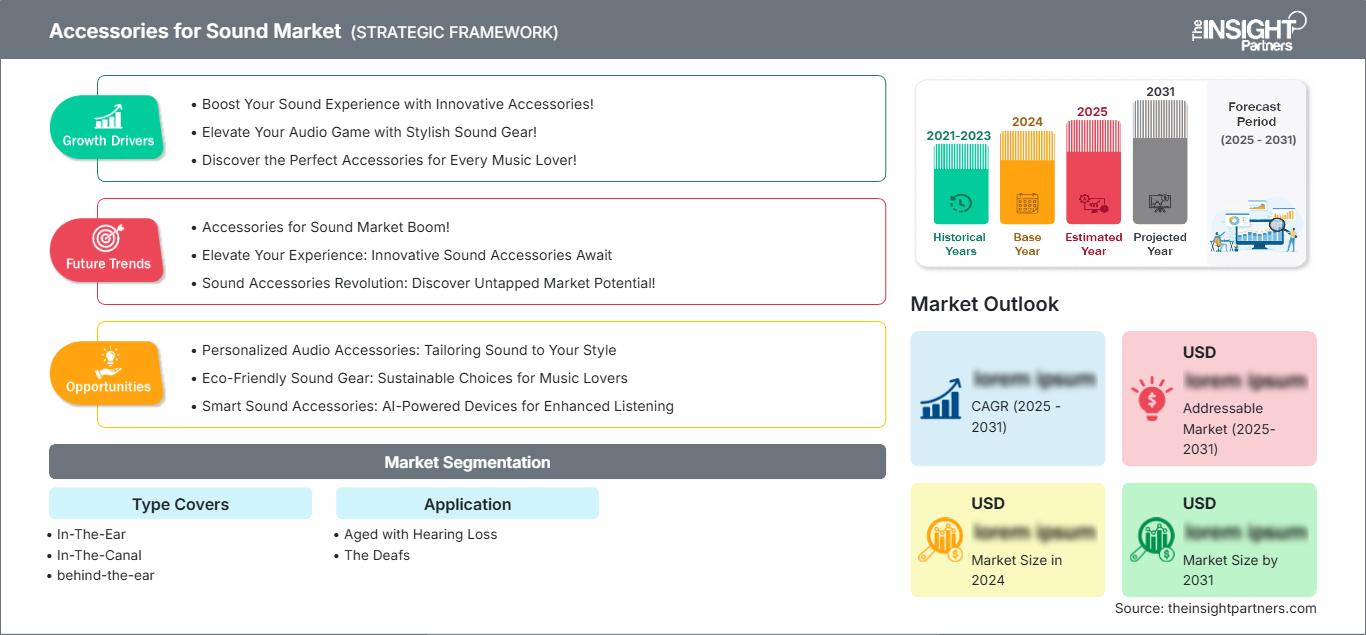
Accessories for Sound Market: Strategic Insights
Regional Insights
North America Accessories for sound market
North America accounted for an estimated 34–36% share in 2025 and is expected to grow at a CAGR of 5.0–5.6% during 2026–2034. The region benefits from established audiology networks, strong private insurance participation, veteran care programs, and higher adoption of premium hearing technologies. The accessories for sound market share is supported by recurring purchases of chargers, receivers, domes, cleaning kits, and connectivity accessories.
Demand is strongest where hearing aid users receive regular follow-up fitting, maintenance, and upgrade counseling. Clinics increasingly use accessories to improve patient adherence, especially for older adults struggling with insertion, charging, or speech understanding in noise. North America also supports faster uptake of wireless microphones and smartphone-linked accessories because connected care pathways are well established.
U.S. Accessories for sound market
The U.S. represented 83–86% of North America in 2025 and is projected to grow at a CAGR of 5.1–5.7% during 2026–2034. Demand is supported by private audiology practices, large retail hearing care chains, Veterans Affairs procurement, and direct-to-consumer awareness. Sonova Holding AG, GN Store Nord A/S, Starkey Laboratories, Inc., Cochlear Limited, and Natus Medical Incorporated maintain strong visibility.
Application trends emphasize accessories for aged users with mild-to-moderate hearing loss, rechargeable behind-the-ear devices, and connectivity tools for television, phone calls, and noisy environments. U.S. users increasingly expect replacement parts to be convenient, discreet, and compatible with mobile control. Clinics also rely on accessory sales to support aftercare revenue and device retention.
Europe Accessories for sound market
Europe held an estimated 28–30% share in 2025 and is expected to expand at a CAGR of 4.7–5.3% during 2026–2034. Germany is the leading country, supported by advanced audiology services, reimbursement structures, and strong hearing aid adoption. The UK and France remain important due to public and private hearing care channels.
The UK market is shaped by public hearing services, private upgrade pathways, and growing demand for rechargeable accessories. Germany benefits from dense audiology networks and high user acceptance of customized earmolds, receivers, and maintenance accessories. France maintains steady demand through structured hearing aid reimbursement and follow-up care that encourages routine accessory replacement.
Italy and Spain contribute meaningful volume through aging populations, specialist hearing centers, and rising awareness of untreated hearing loss. Southern European markets remain price-sensitive, but demand for comfort parts and cleaning accessories is expanding as device penetration improves. Across Europe, suppliers must balance premium innovation with reimbursement compliance and service affordability.
APAC Accessories for sound market
APAC represented 24–26% share in 2025 and is forecast to grow at a CAGR of 6.4–7.1% during 2026–2034. China is the leading country by scale, while Japan has strong aged-care demand and long-standing hearing technology adoption. India, South Korea, and Australia add growth through screening, retail expansion, and audiology capacity.
Industrial and policy drivers include broader hearing health awareness, domestic device production, aging demographics, and expanding private healthcare. Regional demand spans premium rechargeable accessories in Japan and Australia, value-oriented parts in India, and high-volume replacement needs in China. Suppliers with local service networks and multilingual fitting support are well positioned.
Middle East & Africa Accessories for sound market
Middle East & Africa is expected to grow at a CAGR of 5.4–6.0% during 2026–2034, led by Saudi Arabia and the UAE. Hospital investment, pediatric hearing programs, and private audiology clinics support demand for hearing aid and implant accessories. South Africa remains the most established sub-Saharan market.
Energy-linked fiscal capacity in Gulf countries supports specialist ENT centers, implant programs, and premium device access. Rest of MEA demand is uneven because affordability, audiologist availability, and import dependence limit consistent adoption. Suppliers offering training, durable accessories, and tiered pricing can improve penetration across public and private channels.
Segmentation Analysis
Type Covers
Type Covers are expected to grow at a CAGR of 5.6–6.2% during 2026–2034. The accessories for sound market scope across form factors is influenced by fit, acoustic performance, device visibility, maintenance requirements, and user dexterity. Behind-the-ear accessories dominate installed use, while in-the-ear and completely-in-canal formats gain attention from users prioritizing discreet appearance and customized comfort.
- In-The-Ear accessories support users who prefer larger custom devices with manageable handling, stable fit, and easier cleaning compared with smaller canal-based alternatives.
- In-The-Canal accessories address moderate discretion and comfort needs, requiring accurate sizing, wax protection, and replacement parts that maintain acoustic sealing during everyday use.
- behind-the-ear accessories remain commercially important because receivers, tubes, domes, earmolds, chargers, and retention parts require replacement across the largest installed device base.
- Completely-In-Canal accessories serve users seeking maximum discretion, making precision fit, moisture control, wax management, and miniaturized component reliability strategically important.
Application
Application is projected to grow at a CAGR of 5.3–5.9% during 2026–2034. Demand is concentrated among aged users with hearing loss because age-related auditory decline drives high device adoption and recurring accessory replacement. The deafs segment is smaller but strategically important, particularly where cochlear implant processors, retention systems, batteries, cables, and support accessories are needed for daily communication.
- Aged with Hearing Loss represents the primary demand base because older users require recurring maintenance accessories, easier charging, comfort improvements, and connectivity support for daily listening.
- The Deafs segment requires specialized accessory ecosystems for implantable and high-power hearing solutions, with reliability, durability, and clinician support influencing adoption and replacement patterns.
Opportunity Snapshot
| Segment Name | Revenue Contribution | Trend Tag | Adoption Stage |
| Aged with Hearing Loss | High | Senior Care | Mature |
| The Deafs | Medium | Implant Support | Scaling |
Accessories for Sound Market Growth Drivers and Impact Analysis
Rising age-related hearing loss and longer device use
Population aging is the greatest structural factor owing to the increase in the prevalence of hearing loss with age. The World Health Organization has identified hearing rehabilitation as a major need across the world, and elderly individuals may need accessories that facilitate ease of wearing, charging, cleaning, and connectivity of the devices. The commercial effect would be that of repeated purchases instead of just the device itself. The dome, earwax guard, ear mold, receiver, charger, and cleaning kit would be required across the life cycle of the device.
Connectivity expectations reshaping hearing device ecosystems
The users are now expecting the hearing aids to work with their phones, televisions, public sound systems, and remote fitting devices. This leads to the creation of demand for various accessories such as streamers, wireless microphones, applications, charging solutions, and pairing capability. The effect of the market goes beyond the users of high-end products due to the adoption of BLEA and Auracast technology into normal environments. This will lead to the advantage of the manufacturers by building an ecosystem of accessories and the audiologists by offering more personalization capabilities.
Clinical aftercare and replacement cycles supporting recurring revenue
Audiologists do not stop their services after prescribing devices but continue to offer aftercare, which leads to the consumption of accessories. Audiologists replace worn-out domes, tubing, receivers, molds, retention systems, and wax guards to ensure acoustic effectiveness and comfort of the devices. This has market implications because it ensures a continual revenue flow for clinics and companies, particularly for those who subscribe to service plans. This will not only minimize unnecessary repairs but also promote device adherence. Manufacturers who supply easily storable accessories, predictable compatibility, and training materials can make the process efficient.
Accessories for Sound Market Future Trends
AI-enabled personalization of accessory selection
The accessories for sound market trends will increasingly involve AI-supported fitting guidance that recommends domes, molds, receivers, and connectivity accessories based on hearing profile, ear anatomy, lifestyle, and usage data. Future systems may use app interactions and remote monitoring to identify poor fit, inconsistent charging, or acoustic leakage. This will shift accessories from simple add-ons to personalized care tools. As audiology providers manage larger patient bases, data-led accessory recommendations can improve efficiency, reduce trial-and-error fitting, and strengthen user retention across premium and mid-tier hearing platforms.
Expansion of public audio connectivity ecosystems
Public spaces, transportation services, classroom settings, and offices are supposed to embrace broadcast audio technology that enhances access. This will lead to increased demand for accessories that will be compatible and able to receive the audio stream. Users who have hearing impairment will be expecting to connect seamlessly with announcement services, meeting services, entertainment, and learning systems. The companies that can embrace the open standards but still ensure their brand name accessories work effectively can benefit competitively.
Accessories for Sound Market Opportunities
Rechargeable accessory bundles for older users
Adoption of rechargeable devices provides an obvious opening for bundled accessories that fit well with the lifestyle of senior users. The accessories for sound market forecast suggest that there will be increased demand for accessories such as chargers, battery cases, retaining clips, cleaning aids, and grip handles that make day-to-day management easier. Suppliers could work in collaboration with clinics and provide bundled accessories tailored for behind-the-ear and in-the-ear devices. Success will be dependent on good packaging, instructions from caregivers, and prompts for replacement.
Accessory ecosystems for severe-to-profound hearing solutions
Severe-to-profound hearing loss users require durable, high-reliability accessories that support communication in demanding environments. Opportunities exist in retention systems, wireless microphones, battery options, processor covers, TV streamers, school accessories, and implant-compatible connectivity tools. Manufacturers should design accessory portfolios around daily resilience, not only aesthetics. Partnerships with ENT centers, pediatric audiology programs, and rehabilitation providers can improve adoption. This opportunity is especially relevant in markets expanding cochlear implant access, where long-term success depends on external processors, replacement accessories, caregiver training, and ongoing service availability.
Recent Developments
- May 2026: Sonova Holding AG reported FY 2025/26 results and said it was preparing a new platform launch in the second half of 2026, with management emphasizing AI-enabled premium sound for patients. The company also expected 2026/27 sales to rise 5–8% at constant exchange rates, reflecting focus on innovation cycles in hearing instruments.
- March 2026: GN Store Nord A/S an agreement to sell its Hearing business to Amplifon S.p.A. for DKK 17.0 billion on a cash-free and debt-free basis. The transaction is expected to complete by the end of 2026, subject to regulatory approvals and hearing business separation, combining hearing technology with global retail audiology reach.
- July 2025: Cochlear Limited announced U.S. FDA approval of the Nucleus Nexa System, described as the world’s first smart cochlear implant system with upgradeable implant firmware. The portfolio includes the Nucleus Nexa Implant, Nucleus 8 Nexa Sound Processor, and Kanso 3 Nexa Sound Processor, strengthening connected implant accessory ecosystems.
Frequently Asked Questions

- Comprehensive Market Sizing and Forecast Analysis
- Detailed Segmentation Analysis
- In-Depth Market Dynamics Assessment
- Regional and Country-Level Insights
- Competitive Landscape and Company Benchmarking
- Strategic Business Intelligence
Recent Reports
Testimonials

The Insight Partners' SCADA System Market report is comprehensive, with valuable insights on current trends and future forecasts. The team was highly professional, responsive, and supportive throughout. We are very satisfied and highly recommend their services.
RAN KEDEM Partner, Reali Technologies LTDs
I requested a report on a very specific software market and the team produced the report in a few days. The information was very relevant and well presented. I then requested some changes and additions to the report. The team was again very responsive and I got the final report in less than a week.
JEAN-HERVE JENN Chairman, Future Analytica
We worked with The Insight Partners for an important market study and forecast. They gave us clear insights into opportunities and risks, which helped shape our plans. Their research was easy to use and based on solid data. It helped us make smart, confident decisions. We highly recommend them.
PIYUSH NAGPAL Sr. Vice President, High Beam Global
The Insight Partners delivered insightful, well-structured market research with strong domain expertise. Their team was professional and responsive throughout. The user-friendly website made accessing industry reports seamless. We highly recommend them for reliable, high-quality research services
YUKIHIKO ADACHI CEO, Deep Blue, LLC.
This is the first time I have purchased a market report from The Insight Partners.While I was unsure at first, I visited their web site and felt more comfortable to take the risk and purchase a market report.I am completely satisfied with the quality of the report and customer service. I had several questions and comments with the initial report, but after a couple of dialogs over email with their analyst I believe I have a report that I can use as input to our strategic planning process.Thank you so much for taking the extra time and making this a positive experience.I will definitely recommend your service to others and you will be my first call when we need further market data.
JOHN SUZUKI President and Chief Executive Officer, Board Director, BK Technologies
I wish to appreciate your support and the professionalism you displayed in the course of attending to my request for information regarding to infectious disease IVD market in Nigeria. I appreciate your patience, your guidance, and the fact that you were willing to offer a discount, which eventually made it possible for us to close a deal. I look forward to engaging The Insight Partners in the future, all thanks to the impression you have created in me as a result of this first encounter.
DR CHIJIOKE ONYIA MANAGING DIRECTOR, PineCrest Healthcare Ltd.Reason to Buy
- Informed Decision-Making
- Understanding Market Dynamics
- Competitive Analysis
- Identifying Emerging Markets
- Customer Insights
- Market Forecasts
- Risk Mitigation
- Boosting Operational Efficiency
- Strategic Planning
- Investment Justification
- Tracking Industry Innovations
- Aligning with Regulatory Trends





 Get Free Sample for