
Aerial Lift Market Demand, Share & Growth by 2034
Coverage: By Product Type (Boom Lifts#Scissor Lifts#Vertical Mast Lifts#Personal Portable Lifts); Application (Construction, Telecommunication, Transport and Logistics, Government, Others) , and Geography (North America, Europe, Asia Pacific, and South and Central America)
- Status : Data Released
- Report Code : TIPRE00024021
- Category : Manufacturing and Construction
- No. of Pages : 150
- Available Report Formats :


- Last update date : July 10, 2026


2025 Market Size
US$ 9.2 Bn
Base year value
2034 Forecast
US$ 16.41 Bn
Projected by 2034
CAGR 2026-2034
6.63 %
Growth rate
Addressable Market
US$ 115.71 Bn
(2026-2034)
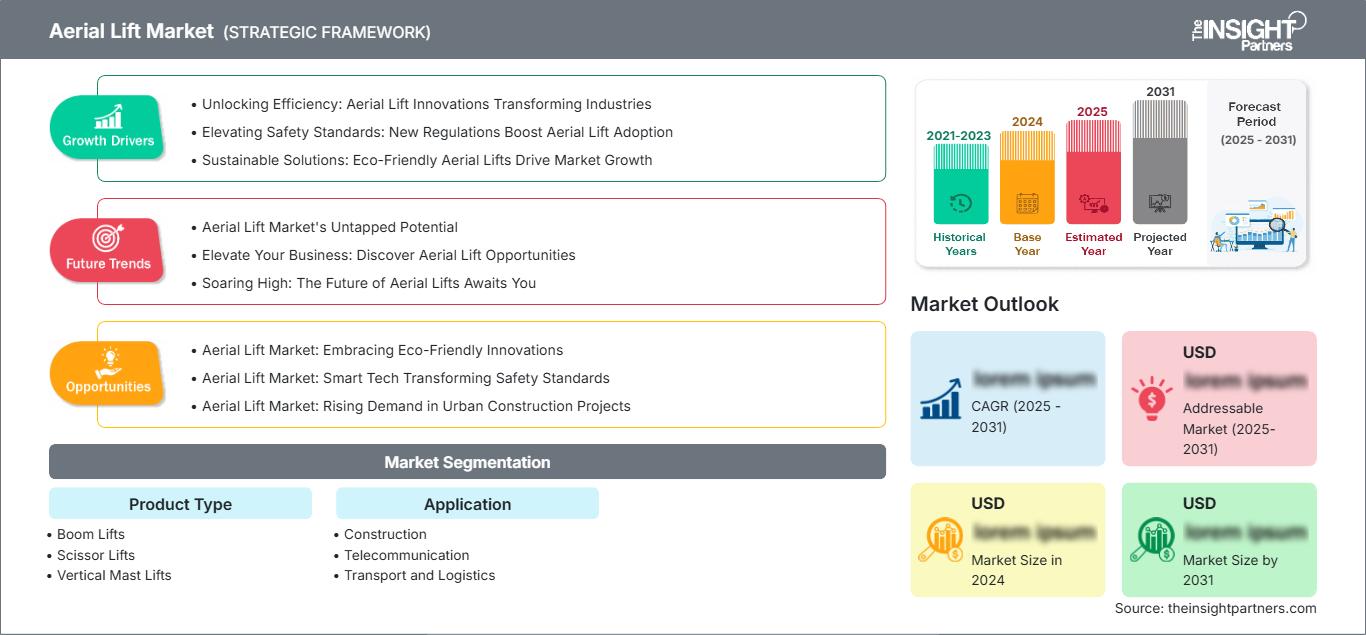
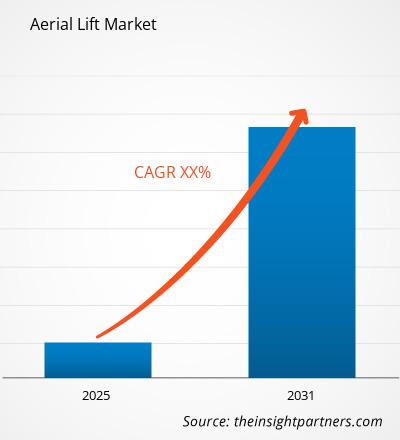
Aerial Lift Market Size will grow from US$ 9.2 Billion in 2025 to US$ 16.41 Billion in 2034, recording a CAGR of 6.63% during 2026-2034. This market indicates consistent demand for safe elevation access systems for construction, telecommunications, transport & logistics, and government applications. Adoption of products in boom lifts, scissor lifts, vertical mast lifts, and personal portable lifts has been seen in line with strict safety regulations and rental purchases.
According to the aerial lift market report, North America is anticipated to register a growth rate of 5.9–6.4% during 2026-2034, owing to the redevelopment of infrastructure and warehousing facilities, and the replacement of existing access equipment. With an emphasis on OSHA’s fall prevention initiatives, ANSI MEWP guidelines, and the use of a rental fleet, this will drive contractors towards buying emission-compliant platforms. In addition, there will be benefits from the high equipment rental penetration in the region.
Aerial Lift Market Assessment and Insights
- North America held 34–37% share in 2025 and is projected to grow at a 5.9–6.4% CAGR between 2026–2034, driven by rental fleet renewal, infrastructure construction, and stricter elevated-work compliance.
- The U.S. represented 78–82% of North America in 2025 and is expected to grow at a 5.8–6.3% CAGR between 2026–2034, led by commercial construction and telecom maintenance.
- Europe accounted for 24–27% aerial lift market share in 2025 and is forecast to grow at a 5.4–5.9% CAGR between 2026–2034, with Germany, the UK, and France leading electrified platform demand.
- Asia Pacific held 25–28% share in 2025 and is set to grow at a 7.3–7.9% CAGR between 2026–2034, supported by China, India, Japan, and South Korea industrial expansion.
- Largest Segment: Scissor lifts held 39–43% market share in 2025 and are projected to grow at a 6.1–6.6% CAGR between 2026–2034 due to indoor and slab-work demand.
- High Growth Segment: Boom lifts held 31–35% market share in 2025 and are expected to grow at a 6.8–7.4% CAGR between 2026–2034, supported by outdoor reach applications.
- Key companies analyzed in detail: JLG Industries, Inc.; Genie; Snorkel International, LLC; Niftylift Limited; Ballymore Company, Inc.; TEUPEN Maschinenbau GmbH; MEC Aerial Work Platforms; Haulotte Group; Skyjack Inc.; Zhejiang Dingli Machinery Co., Ltd.
Source: The Insight Partners' analysis based on proprietary research, government publications, company annual reports, investor presentations, industry databases, and expert interviews.
According to the aerial lifts Market forecast, there have been advancements from basic mechanical lift devices to highly advanced, interconnected, application-specific access devices. There is now increased emphasis on electric drive systems, load-sensing control, telematics, and compact sizes that not only enhance jobsite efficiency but also minimize emissions. There are also changes in production dynamics, as global manufacturers need to balance North American and European safety standards with Asia's cost advantages.
In addition, during the forecast period, emerging construction frontiers in countries such as India, Saudi Arabia, and Southeast Asia will broaden the scope of the aerial lifts market beyond those regions with mature rental economies. Public pipeline projects, industry decarbonization initiatives, and warehouse automation will increase demand for battery-powered lift devices, higher-reach boom devices, and low-level access products.
Aerial Lift Market Report Scope
| Report Attribute | Details |
|---|---|
| Market size in 2025 | US$ 9.2 Billion |
| Market Size by 2034 | US$ 16.41 Billion |
| Global CAGR (2026 - 2034) | 6.63% |
| Historical Data | 2021-2024 |
| Forecast period | 2026-2034 |
Aerial Lift Market Analysis
The aerial lift market demand centers on safety in accessing installations and maintenance work at elevation. The construction segment remains the dominant application due to a preference for mechanization over ladder and scaffold access. Telecom provides resilient demand for tower, fiber, and small-cell maintenance, whereas the transport and logistics segments need portable electric scissor lifts to service racks, lighting, and conveyors.
The ecosystem includes parts manufacturers, OES producers, dealers, rental firms, service technicians, trainers, and end-users. The dynamics of the supply chain are driven by the prices of steel, batteries, hydraulic components, and electronics used in lift trucks. Therefore, the increase in aerial lift size does not depend solely on the unit volumes shipped; it also depends on fleet usage and maintenance cycles.
There is moderate consolidation in the competitive environment of global access equipment providers. JLG Industries, Genie, Skyjack, Haulotte Group, and Zhejiang Dingli Machinery battle in terms of diversity in their product offerings, distribution networks, telemetry, and electrification of their product line. Niftylift, TEUPEN, Snorkel International, MEC Aerial Work Platforms, and Ballymore Company emphasize specialization, compact design, and application-specific solutions.
Capital investments include fleet renewal, lithium-ion batteries, diagnostic connectivity, and remanufacturing to extend equipment life. Strategic alignment rests on total cost of ownership, availability of service and repairs, finance packages, and compliance. The analysis of this aerial lift market shows that manufacturers with rental partnerships and local spare-parts availability will maintain market share, while newcomers will enter the market based on pricing and electric models.
● REPORT CUSTOMIZATION
Tailor This Report To Align With Your Specific Business Requirements
This report can be customized to align precisely with your business objectives, scope, and target markets. Customization options include tailored segmentation, geography, competitive analysis, and strategic insights to support informed decision-making.
Customize This Report →WHAT YOU CAN ADJUST
- ● Segmentations
- ● Geography
- ● Competitive Analysis
- ● Language Preferences
Aerial Lift Market: Strategic Insights
Regional Insights
North America aerial lift Market
The North American region held a 34-37% share in 2025 and will likely record a CAGR of 5.9-6.4% through 2034. Factors contributing to demand include the development of roadways, bridges, warehouses, and data centers, which will require compliant elevated work platforms. Experienced rental routes will assist in managing capital budgeting while ensuring access to new electric and hybrid platforms. Safety requirements, labor availability challenges, and fleet replacement will drive trends in aerial lift use across regions. According to the International Powered Access Federation, the North American MEWP fleet has been highly utilized, which has ensured prudent investment in newer fleets. Fleet owners are focusing on telematics, small slab scissor lifts, and rough-terrain boom lifts.
U.S. aerial lift Market
The U.S. accounted for 78% to 82% of North America in 2025 and is expected to grow at a 5.8% to 6.3% CAGR. Growth is prominent in non-residential construction, industrial maintenance, power utilities, and logistics facilities. OSHA’s fall-hazard enforcement ensures that contractors always prefer certified lift platforms over improvised systems. The company’s market penetration is intense, with JLG Industries, Genie, Skyjack, Snorkel International, and MEC Aerial Work Platforms as key players serving both the rental and direct industrial segments. Market applications include electric slab scissors for warehouses, articulating booms for crowded commercial sites, and large telescopic booms for energy, aviation, and stadium maintenance.
Europe aerial lift Market
Europe accounted for 24–27% of the market in 2025 and should grow at a 5.4–5.9% CAGR. The UK remains a leading rental-led market, where contractors use powered access for commercial refurbishment, infrastructure repair, and facilities maintenance. Demand is increasingly favoring low-noise electric units for dense urban job sites and indoor industrial projects. Growth of the aerial lift market in Germany stems from manufacturing maintenance, logistics automation, and infrastructure improvements in municipalities. Buyers in Germany value safety certification, machine reliability, and energy efficiency. Expensive labor is another factor that promotes the development of aerial lifts, since mechanized access is cheaper than scaffolding for regular maintenance work. Public works projects, tourism infrastructure, industrial areas, and city renovations drive sales in France, Italy, and Spain. Regional presence in Europe is ensured by the manufacturing facilities of the Haulotte Group and other international manufacturers, which helps maintain competition. Electrical aerial lifts are more prevalent inside buildings due to municipal regulations.
APAC aerial lift Market
APAC held 25–28% share in 2025 and is forecast to grow at a 7.3–7.9% CAGR, the fastest regional pace. China remains the leading country by production scale and domestic fleet depth, while India shows faster adoption from metro, airport, warehousing, and industrial corridor projects. The aerial lift market demand in Japan and Korea is driven by production, shipyards, utilities, and maintenance in dense urban areas. In Australia, the rental market still relies on mining, commercial construction, and public works to maintain its share of the aerial lift business. Infrastructure investment and workplace safety reforms, supported by policy, are slowly phasing out the use of ladders on construction sites. Local manufacturers such as Zhejiang Dingli Machinery are scaling up their production of electric and lithium-powered lifts for both domestic and export markets. Competitive prices, higher quality, and increasing distribution are driving the use of aerial lift equipment among rental businesses and contractors.
Middle East & Africa aerial lift Market
MEA’s growth rates are expected to be in the 6.2%-6.8% range, with the main driver being Saudi Arabia, driven by megaprojects, industrial complexes, and energy infrastructure projects. Demand in the UAE is driven by high-rise building maintenance, logistics, airports, and tourism-related facilities,, which require reliable and repeatable elevated work solutions. Sub-region of South Africa is the only developed one in terms of MEWP rentals, while other MEA markets have to rely on projects and imports. Oil & Gas, Utilities, Ports, and Public infrastructure are drivers of demand for rugged boom lifts and scissor lifts, despite some issues with fleet upgrades due to financial constraints. Due to the standardization of safety requirements, customers tend to shift from scaffolding and ladders to MEWP certification. Companies that provide local services, training, and spare parts would benefit from the aerial lift Market growth in this region.
Segmentation Analysis
Product Type
Product Type is projected to grow at a 6.2–6.8% CAGR during 2026–2034 as contractors and rental firms rebalance fleets toward safer, application-specific equipment. Demand is moving from general access products to compact electric lifts, higher-reach booms, and low-level platforms that improve productivity in constrained work environments.
- Boom lifts remain strategically important for outdoor construction, utilities, and maintenance where horizontal outreach, obstacle clearance, and high working height are essential for productivity and safer positioning.
- Scissor lifts dominate indoor slab applications, warehouses, retail facilities, and manufacturing maintenance because they provide stable vertical access, larger platforms, and strong rental utilization.
- Vertical mast lifts serve narrow aisles, facility maintenance, and low-level indoor work, offering compact maneuverability where larger scissors or booms cannot operate efficiently.
- Personal portable lifts address light-duty maintenance, institutional facilities, and government buildings, replacing ladders where users need safer, easily transportable access solutions.
Application
Application is expected to expand at a 6.3–6.9% CAGR during 2026–2034 as mechanized elevated access becomes more embedded in project planning. Construction generates the broadest demand, while telecommunications, logistics, and government applications support recurring maintenance cycles and fleet diversification across electric, rough-terrain, and compact models.
- Construction drives core demand through commercial buildings, infrastructure repair, façade work, and industrial projects where controlled elevated access improves schedule efficiency and worker safety.
- Telecommunication applications require boom lifts and compact platforms for tower, antenna, fiber, and small-cell maintenance, with demand rising as networks densify in urban and suburban areas.
- Transport and logistics users rely on electric scissors and mast lifts for warehouse racking, lighting, conveyor systems, fleet depots, and airport maintenance where uptime is critical.
- Government demand comes from municipal facilities, defense sites, utilities, schools, and public infrastructure maintenance, where procurement favors durable equipment, operator safety, and compliance documentation.
Opportunity Snapshot
| Application | Revenue Contribution | Trend Tag | Adoption Stage |
| Construction | High | Urban Access | Mature |
| Telecommunication | Medium | Network Densification | Scaling |
| Transport and Logistics | Medium | Warehouse Automation | Scaling |
| Government | Medium | Public Maintenance | Scaling |
Aerial Lift Market Growth Drivers and Impact Analysis
Infrastructure renewal and safer work-at-height practices
Infrastructure renovation serves as an explicit demand stimulus because repairs on bridges, airports, transit systems, utility infrastructure, and public buildings demand regular elevated work access. Safety concerns play an equal role, since falling from heights remains a significant danger in the industry, so more contractors prefer using MEWPs to ladders and scaffolding. The change positively impacts job-site productivity and shortens equipment setup, while increasing demand. The effect is particularly prominent in North America and Europe due to high levels of regulation.
Electrification of indoor and urban access fleets
The trend towards electrification is shifting the criteria for buying new equipment at warehouses, hospitals, shopping complexes, educational institutions, and densely packed urban construction areas. Battery-powered scissors lifts, vertical mast lifts, and smaller booms help reduce exhaust emissions, noise, and ventilation problems, leading to greater operating time indoors. Rental companies are responding by adjusting fleet mix toward electric slab models and hybrid rough-terrain units. This driver supports aerial lift growth by aligning equipment procurement with building decarbonization policies, indoor air-quality requirements, and customer preferences for lower operating costs.
Rental fleet utilization and lifecycle economics
Rental economics shape the aerial lift Market because many contractors prefer access to specialized equipment without ownership risk. High utilization, residual value management, reconditioning, and telematics-enabled maintenance allow rental firms to justify fleet investment even when interest rates pressure capital spending. OEMs that offer financing, parts support, and connected diagnostics can improve customer uptime and replacement decisions. The result is a more disciplined market in which fleet age, utilization, and service availability directly influence new equipment demand.
Aerial Lift Market Future Trends
Connected fleets and predictive service models
Connected fleet platforms will become a central differentiator as rental companies seek better visibility into location, battery state, fault codes, utilization, and operator behavior. Predictive service models can reduce unscheduled downtime by identifying component wear before failure, improving availability for time-sensitive projects. OEMs are likely to bundle telematics, remote diagnostics, and software-enabled maintenance guidance into equipment offerings. Over time, this trend should shift buyer evaluation from purchase price alone toward lifecycle performance, data quality, and service responsiveness.
Robotics-assisted elevated work
Robotics-assisted elevated work is emerging as a longer-term aerial lift market trend for repetitive, hazardous, or labor-constrained tasks. Robotic end effectors mounted on boom platforms can support applications such as drywall finishing, painting, inspection, material handling, and façade work. Adoption will be gradual because customers must validate safety, productivity, and liability frameworks. However, as construction labor shortages persist, manufacturers that integrate automation-ready controls and platform stability could unlock higher-value use cases beyond traditional personnel lifting.
Aerial Lift Market Opportunities
Battery-electric platforms for logistics facilities
Logistics facilities offer a focused opportunity because warehouses, fulfilment centres, cold storage sites, and airport cargo terminals require frequent indoor maintenance at height. Battery-electric scissor lifts and vertical mast lifts fit these environments by reducing fumes, improving maneuverability, and supporting quiet operation near active workflows. Suppliers can target facility managers with service contracts, operator training, and fast parts availability. Rental companies can also build specialized indoor-access fleets that match racking heights, floor loading limits, and maintenance schedules.
Emerging-market rental fleet development
The Aerial Lift Market forecast indicates that emerging markets present an investment opportunity where formal rental channels are still developing. Contractors in India, Southeast Asia, Saudi Arabia, and parts of Africa often face project peaks that make ownership inefficient, creating room for access-equipment rental models. OEMs and dealers can support this transition through financing, training, maintenance packages, and fleet planning. The opportunity is not only equipment sales; it includes parts, certification, used machines, and digital tools that professionalize work-at-height practices.
Recent Developments
- April 2026: JLG Industries, Inc. — previewed the new 600AJ+ boom lift, advancing productivity and serviceability in the 60-ft class with updates aimed at rental fleet uptime, operator confidence, and jobsite performance. The launch reflects OEM focus on higher utilization and practical service improvements in core boom categories.
- June 2026: Haulotte Group — announced activity around Drive Confidence and showcased advanced safety solutions at APEX 2026, including the HA20 E PRO. The update highlights the company’s emphasis on electric rough-terrain equipment, operator assistance, and product support for European and global access-equipment customers.
- January 2026: Skyjack Inc. — launched the SJ6940 RTE, its largest electric rough-terrain scissor lift, extending battery-powered access into applications that previously relied more heavily on internal combustion machines. The product supports demand for lower-emission outdoor platforms on construction, maintenance, and rental fleet applications.
Frequently Asked Questions

- Comprehensive Market Sizing and Forecast Analysis
- Detailed Segmentation Analysis
- In-Depth Market Dynamics Assessment
- Regional and Country-Level Insights
- Competitive Landscape and Company Benchmarking
- Strategic Business Intelligence
Recent Reports
Testimonials

The Insight Partners' SCADA System Market report is comprehensive, with valuable insights on current trends and future forecasts. The team was highly professional, responsive, and supportive throughout. We are very satisfied and highly recommend their services.
RAN KEDEM Partner, Reali Technologies LTDs
I requested a report on a very specific software market and the team produced the report in a few days. The information was very relevant and well presented. I then requested some changes and additions to the report. The team was again very responsive and I got the final report in less than a week.
JEAN-HERVE JENN Chairman, Future Analytica
We worked with The Insight Partners for an important market study and forecast. They gave us clear insights into opportunities and risks, which helped shape our plans. Their research was easy to use and based on solid data. It helped us make smart, confident decisions. We highly recommend them.
PIYUSH NAGPAL Sr. Vice President, High Beam Global
The Insight Partners delivered insightful, well-structured market research with strong domain expertise. Their team was professional and responsive throughout. The user-friendly website made accessing industry reports seamless. We highly recommend them for reliable, high-quality research services
YUKIHIKO ADACHI CEO, Deep Blue, LLC.
This is the first time I have purchased a market report from The Insight Partners.While I was unsure at first, I visited their web site and felt more comfortable to take the risk and purchase a market report.I am completely satisfied with the quality of the report and customer service. I had several questions and comments with the initial report, but after a couple of dialogs over email with their analyst I believe I have a report that I can use as input to our strategic planning process.Thank you so much for taking the extra time and making this a positive experience.I will definitely recommend your service to others and you will be my first call when we need further market data.
JOHN SUZUKI President and Chief Executive Officer, Board Director, BK Technologies
I wish to appreciate your support and the professionalism you displayed in the course of attending to my request for information regarding to infectious disease IVD market in Nigeria. I appreciate your patience, your guidance, and the fact that you were willing to offer a discount, which eventually made it possible for us to close a deal. I look forward to engaging The Insight Partners in the future, all thanks to the impression you have created in me as a result of this first encounter.
DR CHIJIOKE ONYIA MANAGING DIRECTOR, PineCrest Healthcare Ltd.Reason to Buy
- Informed Decision-Making
- Understanding Market Dynamics
- Competitive Analysis
- Identifying Emerging Markets
- Customer Insights
- Market Forecasts
- Risk Mitigation
- Boosting Operational Efficiency
- Strategic Planning
- Investment Justification
- Tracking Industry Innovations
- Aligning with Regulatory Trends





 Get Free Sample for