
Agricultural Colorants Market Size, Share & Growth by 2034
Coverage: By Type (Dyes, Pigments); Category (Synthetic/Chemical, Non-synthetic/Organic); Application (Seed Treatment, Ponds and Lakes, Fertilizers, Turf and Ornaments, Crop Protection Products), and Geography (North America, Europe, Asia Pacific, and South and Central America)
- Status : Data Released
- Report Code : TIPRE00018463
- Category : Chemicals and Materials
- No. of Pages : 150
- Available Report Formats :


- Last update date : August 14, 2026


2025 Market Size
US$ 2.33 Bn
Base year value
2034 Forecast
US$ 3.82 Bn
Projected by 2034
CAGR 2026-2034
5.64 %
Growth rate
Addressable Market
US$ 27.87 Bn
(2026-2034)
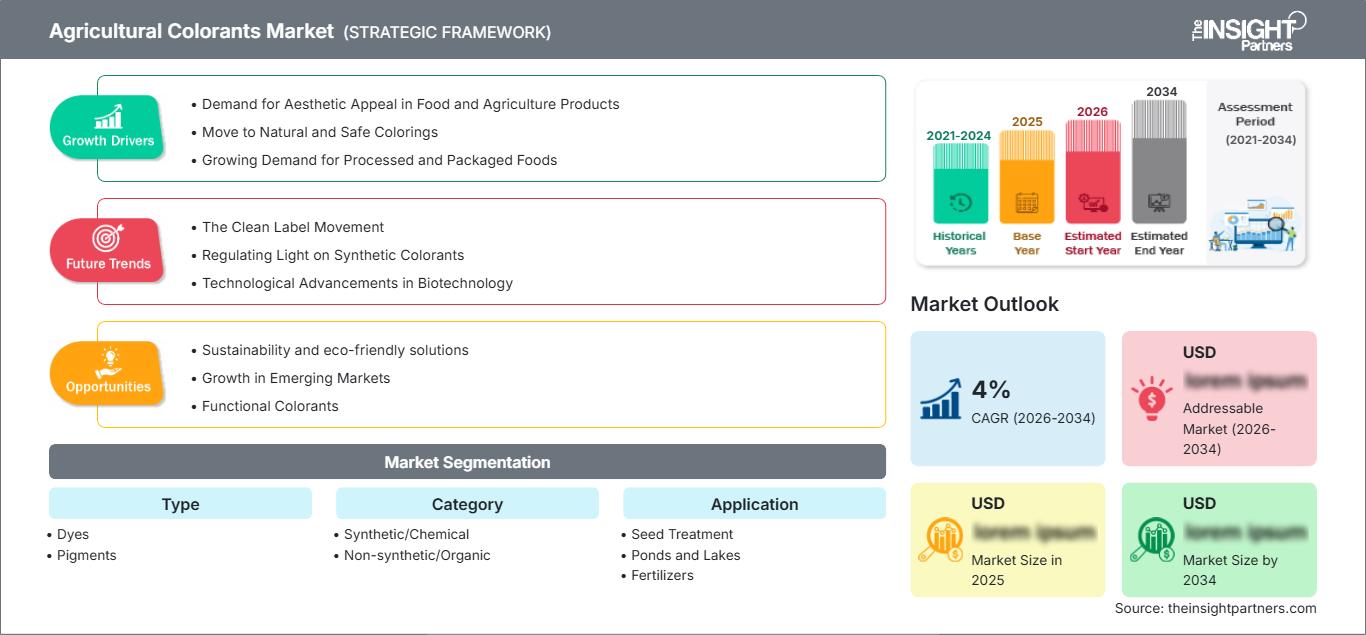
The agricultural colorants market was valued at US$ 2.33 billion in 2025 and is projected to reach US$ 3.82 billion by 2034, registering a CAGR of 5.64% during 2026–2034. Market expansion is supported by increasing adoption of seed treatment technologies, rising use of crop protection formulations, and growing demand for product differentiation in fertilizers and turf applications. Regulatory emphasis on safe chemical handling and improved product traceability is further encouraging the adoption of specialized agricultural colorants across global agricultural value chains.
Across North America, the agricultural colorants market size continues to expand as commercial farming adopts advanced seed treatment formulations and precision agriculture practices. The region is expected to grow at a CAGR of 5.2–5.8% through 2034, supported by increasing investments in high-value seeds, stringent product identification requirements, and growing utilization of colored crop protection formulations that improve application accuracy and worker safety.
Agricultural Colorants Market Assessment and Insights
- North America: Accounted for 31–34% share in 2025 and is projected to grow at a CAGR of 5.2–5.8% during 2026–2034. Strong seed treatment adoption, advanced crop protection technologies, and extensive commercial farming continue to support regional demand.
- US: Represented 74–78% of the North American market in 2025 and is anticipated to register a CAGR of 5.1–5.7% during 2026–2034, driven by extensive use of treated seeds, specialty fertilizers, and turf management products.
- Europe: Held 25–28% market share in 2025 and is forecast to expand at a CAGR of 5.0–5.6% during 2026–2034. Germany, France, the UK, Italy, and Spain remain major markets due to strict agricultural input regulations and sustainable farming initiatives.
- Asia Pacific: Captured 29–32% share in 2025 and is expected to witness the fastest expansion at a CAGR of 6.2–6.8% during 2026–2034, led by China, India, Japan, South Korea, and Australia through increasing seed treatment penetration.
- Largest Segment: Application – Seed Treatment accounted for 38–42% market share in 2025 and is projected to grow at a CAGR of 5.8–6.4% during 2026–2034, supported by growing use of colorants for product identification, safety, and treatment uniformity.
- High Growth Segment: Category – Non-synthetic/Organic represented 24–28% market share in 2025 and is anticipated to record a CAGR of 6.7–7.3% during 2026–2034, driven by regulatory preference for environmentally compatible agricultural inputs.
- Key companies analyzed in detail: Aakash Chemicals; BASF SE; Bayer AG; Chromatech Incorporated; Clariant AG; Germains Seed Technology; Keystone Aniline Corporation; Organic Dyes and Pigments LLC; SABIC; Sensient Technologies Corporation.
Source: The Insight Partners' analysis based on proprietary research, government publications, company annual reports, investor presentations, industry databases, and expert interviews.
Modern agricultural production requires the use of various advanced color technologies to facilitate the identification of the product, its precise application, and compliance with regulations. Ongoing developments of synthetic pigments, organic dyes, pigments for polymers, and environmentally friendly colorants have increased the range of possible performance attributes of agricultural products. Advanced dispersion technologies, stable under UV exposure and biodegradable colorants are currently being introduced by manufacturers to increase the stability of formulations while satisfying emerging environmental requirements.
The future market growth would be significantly influenced by sustainability initiatives, precision farming practices, and increased use of acreage for treated seeds in emerging markets. Bio-based coloring agents, seed traceability through digital technologies, and eco-friendly formulations would generate more possibilities of commercial success. Regulatory coherence among major agricultural economies and continued innovation in formulation technologies would enhance competitiveness in the long term.
Agricultural Colorants Market Report Scope
| Report Attribute | Details |
|---|---|
| Market size in 2025 | US$ 2.33 Billion |
| Market Size by 2034 | US$ 3.82 Billion |
| Global CAGR (2026 - 2034) | 5.64% |
| Historical Data | 2021-2024 |
| Forecast period | 2026-2034 |
Agricultural Colorants Market Analysis
Increasing demand for high-performance treated seeds remains a primary factor supporting the agricultural colorants market growth. Colorants enable clear identification of treated seeds, minimize accidental misuse, improve handling efficiency, and enhance regulatory compliance throughout agricultural supply chains. The increasing usage of hybrid seeds, biological seed treatments, and precision farming techniques is leading to increased demand for colorant formulations of high quality in the agricultural industry, both developed and developing nations.
The value chain includes specialty chemicals, pigments suppliers, seed treatment formulators, fertilizers, agrochemicals manufacturers, distributors, and farm enterprises. Increasing R&D activities on specialty pigments, dispersion technologies, and formulation of environment-friendly products are allowing manufacturers to offer stable and weather-resistant products.
Competitive intensity continues to increase as global specialty chemical companies invest in sustainable product development, regional manufacturing expansion, and customized formulation capabilities. The agricultural colorants market analysis indicates that BASF SE, Clariant AG, Sensient Technologies Corporation, Chromatech Incorporated, and Keystone Aniline Corporation maintain strong competitive positions through diversified product portfolios, extensive research capabilities, and strategic partnerships with seed treatment and crop protection manufacturers.
The emphasis for strategic investments is now on biological pigments, low-toxic dyes technology, and superior colorants that can be used with biological crop protection agents. Some of the companies like Bayer AG, Germains Seed Technology, SABIC, Organic Dyes and Pigments LLC, and Aakash Chemicals, are extending their collaboration with agricultural formulation providers to offer differentiating solutions that conform to the changing regulations and enable efficient operations in agriculture.
● REPORT CUSTOMIZATION
Tailor This Report To Align With Your Specific Business Requirements
This report can be customized to align precisely with your business objectives, scope, and target markets. Customization options include tailored segmentation, geography, competitive analysis, and strategic insights to support informed decision-making.
Customize This Report →WHAT YOU CAN ADJUST
- ● Segmentations
- ● Geography
- ● Competitive Analysis
- ● Language Preferences
Agricultural Colorants Market: Strategic Insights
Regional Insights
North America Agricultural Colorants Market
North America accounted for 31–34% of the agricultural colorants market share in 2025 and is anticipated to expand at a CAGR of 5.2–5.8% during 2026–2034. The area enjoys the high uptake of certified seed treatment technologies, the rising prevalence of precision agriculture techniques, and the commercialization of crop protection products. The regulatory role played by organizations such as the US Environmental Protection Agency and Health Canada has encouraged the adoption of colorants that aid in product identification, safe handling, and accuracy of application. Further investments in seed enhancement technologies and biological crop protection products contribute to regional demand.
The US is the primary contributor, while Canada has experienced a rising uptake of treated cereal, canola, and pulses. Manufacturers of agricultural inputs continue making investments in environmentally friendly pigments and dyes with high weather stability and product formulation. High demand for high-quality seeds, growing biological agriculture, and technological advancements in seed coating machinery will continue supporting the regional growth during the forecast period.
U.S. Agricultural Colorants Market
The United States represented 74–78% of the North American market in 2025 and is projected to register a CAGR of 5.1–5.7% during 2026–2034. Large-scale cultivation of corn, soybean, cotton, and wheat supports consistent demand for treated seeds requiring high-performance colorants. Commercial seed producers increasingly utilize advanced pigment technologies to improve product differentiation, regulatory compliance, and visual identification across extensive agricultural distribution networks. The country also hosts several leading manufacturers involved in agricultural formulation technologies, specialty pigments, and crop protection innovations.
Growing investments in biological seed treatments and precision agriculture continue to reshape product development priorities. Demand is increasing for organic-compatible dyes, UV-resistant pigments, and formulation-specific colorants that maintain stability during storage and transportation. Collaboration among seed companies, formulation specialists, and specialty chemical manufacturers is accelerating innovation while supporting sustainable agricultural production across the country.
Europe Agricultural Colorants Market
Europe captured 25–28% of the agricultural colorants market in 2025 and is forecast to expand at a CAGR of 5.0–5.6% during 2026–2034. Strict environmental regulations, increasing adoption of sustainable farming practices, and widespread use of certified treated seeds continue to drive demand for advanced agricultural colorants. Germany remains the leading regional market due to its strong agrochemical manufacturing base, while France, the UK, Italy, and Spain collectively contribute significant demand through commercial agriculture and specialty crop production.
Germany is still developing environmental formulations, which are in line with current European Union laws and also help in efficient seed treatments. The United Kingdom is focused on developing high-quality seeds and implementing precise farming practices that encourage the use of specialized colorants. France, Italy, and Spain together enjoy a lot of benefits because of extensive production of cereals, vegetables, and horticulture products, where there is an increasing use of treated seeds and crop protection products using durable pigments.
APAC Agricultural Colorants Market
Asia Pacific accounted for 29–32% of the market in 2025 and is expected to register the fastest CAGR of 6.2–6.8% during 2026–2034. The country with the leading consumption in the region is China because of its large-scale agriculture, while India is still working on its hybrid seed penetration. Japan, South Korea, and Australia are contributing to the market via seed technology and investments in sustainable agricultural inputs.
Government efforts in improving agriculture production, commercial seed production, and seed quality awareness have contributed to the growth of the market. Increased manufacturing of crop protection chemicals and fertilizers in the region will provide further growth opportunities for agricultural colorants.
Middle East & Africa Agricultural Colorants Market
The Middle East & Africa market is projected to grow at a CAGR of 5.4–6.0% during 2026–2034. Saudi Arabia and the UAE are investing in modern agricultural technologies to improve food security, while South Africa maintains a well-established commercial farming sector utilizing treated seeds and advanced crop protection products.
Growing irrigation projects, expansion of horticultural farming, and increasing adoption of high-value crops are creating new demand for specialty agricultural formulations throughout the region. Continued investment in agricultural modernization and improved seed quality programs is expected to support the gradual adoption of high-performance colorants across both domestic production and imported agricultural inputs.
Segmentation Analysis
Type
The Type segment is projected to register a CAGR of 5.6–6.2% during 2026–2034. The agricultural colorants market scope continues to expand as manufacturers develop advanced dyes and pigments that improve product visibility, formulation stability, and compatibility with seed treatments and crop protection products. Growing regulatory requirements for product identification and increasing adoption of precision agriculture are encouraging investments in high-performance color technologies across agricultural applications.
- Dyes: Widely utilized in liquid crop protection formulations and seed treatment products due to their excellent solubility, uniform coloration, and ease of incorporation into water-based and solvent-based agricultural formulations.
- Pigments: Preferred for applications requiring superior opacity, UV resistance, weatherability, and long-term color retention. Pigments are extensively used in coated fertilizers, treated seeds, and specialty agricultural products requiring durable visual identification.
Category
The Category segment is expected to grow at a CAGR of 5.8–6.4% during 2026–2034. Increasing environmental regulations and sustainability initiatives are encouraging manufacturers to develop safer and biodegradable colorant solutions while maintaining high formulation performance. Although synthetic products continue to dominate commercial applications, demand for naturally derived alternatives is rising across environmentally sensitive agricultural operations.
- Synthetic/Chemical: Represents the largest category owing to superior color consistency, broad shade availability, cost efficiency, and compatibility with diverse agricultural formulations, including seed treatments, fertilizers, and crop protection products.
- Non-synthetic/Organic: Demand is increasing steadily as agricultural producers adopt environmentally responsible farming practices. These colorants are gaining acceptance in biological seed treatments, organic farming systems, and sustainable agricultural input formulations.
Application
The Application segment is anticipated to record a CAGR of 5.9–6.5% during 2026–2034. Rising utilization of specialty agricultural inputs, improved seed enhancement technologies, and increasing emphasis on safe product handling continue to expand application opportunities for agricultural colorants. Manufacturers are developing application-specific formulations that deliver enhanced adhesion, weather resistance, and compatibility across diverse agricultural products.
- Seed Treatment: The leading application owing to widespread use of colorants for identifying treated seeds, improving handling safety, minimizing accidental consumption, and supporting regulatory compliance throughout agricultural supply chains.
- Ponds and Lakes: Colorants are utilized to improve water aesthetics, reduce excessive sunlight penetration, suppress algae formation, and support water quality management in agricultural reservoirs and irrigation systems.
- Fertilizers: Increasingly incorporated into coated and specialty fertilizers to improve product differentiation, facilitate application monitoring, and enhance brand recognition while maintaining formulation stability during storage and transportation.
- Turf and Ornaments: Growing landscaping activities, golf course management, sports fields, and ornamental horticulture continue to support demand for specialized colorants used in turf care products and decorative agricultural formulations.
- Crop Protection Products: Colorants improve identification, application visibility, formulation differentiation, and operator safety across herbicides, fungicides, insecticides, and biological crop protection products, supporting more efficient and accurate field applications.
Opportunity Snapshot
| Application | Revenue Contribution | Trend Tag | Adoption Stage |
|---|---|---|---|
| Seed Treatment | High | Precision Seeds | Mature |
| Ponds and Lakes | Low | Water Quality | Emerging |
| Fertilizers | Medium | Controlled Release | Scaling |
| Turf and Ornaments | Medium | Landscape Care | Scaling |
| Crop Protection Products | High | Biological Inputs | Mature |
Agricultural Colorants Market Growth Drivers and Impact Analysis
Growing Adoption of Seed Treatment Technologies
The worldwide seed industry will move to high-end hybrid and genetically modified seeds that need to undergo various processes prior to planting. Agricultural colorants are important because they help differentiate the treated seeds from the untreated ones, ensure safety in handling, prevent unintentional ingestion, and also meet the label requirements set by regulatory bodies. There is more demand for quality dyes and pigments since biological seed treatments and advanced precision seed coating processes are becoming common. Certified seeds are encouraged to increase agricultural production, so there is a greater need to develop colorants that have better adhesion and resistance to UV light while at the same time being compatible with seed treatments.
Increasing Demand for Sustainable and Bio-Based Agricultural Inputs
Agricultural chemical environmental regulations are pushing manufacturers to opt for safer, degradable, and environmentally friendly raw materials. Agricultural colorants are not exempt from this trend, and there is a growing demand for eco-friendly dyes and non-toxic pigments in various agricultural formulations such as seed treatment, fertilizers, and crop protection solutions. The producers of agricultural inputs are producing formulations that have minimal environmental impact and provide the same quality of coloring and effectiveness. The rising use of organic farming methods, biological crop protection solutions, and sustainable nutrient management systems in North America and Europe is driving research into bio-colors.
Expansion of Precision Agriculture and Specialty Crop Production
Precision agriculture technologies have revolutionized crop management practices through increased efficiency in input use, traceability, and accuracy in applications. Agricultural colorants have helped achieve these goals through providing visible differentiation of treated inputs, minimizing errors in applications, and offering quality assurance along agricultural value chains. The increased demand for fruits, vegetables, specialty grains, and horticulture crops has further increased the need for differentiated seed treatments, specialty fertilizers, and crop protection inputs. Moreover, digital farming and automated seed treatment equipment have further increased the demand for precise color performance. These factors are driving the industry towards developing custom-designed colorant technologies for modern-day agricultural practices.
Agricultural Colorants Market Future Trends
Transition Toward Bio-Based and Sustainable Colorant Technologies
Growing environmental awareness and tightening regulations governing agricultural inputs are accelerating the development of biodegradable and naturally derived colorants. Agricultural colorants market trends indicate increasing investments in renewable raw materials, plant-derived pigments, and low-impact formulation technologies that support sustainable farming practices. Manufacturers are also improving compatibility between bio-based colorants and biological seed treatments to maintain product performance while reducing environmental impact. Continued innovation in green chemistry and sustainable formulation technologies is expected to reshape product portfolios over the forecast period.
Integration of Smart Seed Enhancement Technologies
The seed coating technologies are getting more advanced due to their implementation alongside precision agriculture, traceability and biological protection of crops. The companies are working on creating multi-functional dyes which will be able to contribute to better coating of seeds, to automatic monitoring of the quality and traceability in agricultural processes. In the future, the development of products is supposed to include both identification by visual methods and coating performance, along with advanced biological formulas.
Agricultural Colorants Market Opportunities
Expansion Opportunities Across Emerging Agricultural Economies
Rapid agricultural modernization in the Asia Pacific, Latin America, and parts of Africa is creating attractive investment opportunities for manufacturers of specialty agricultural inputs. Rising adoption of hybrid seeds, commercial farming, and advanced crop protection technologies is increasing demand for high-performance agricultural colorants. Agricultural colorants Market Forecasts indicate that companies investing in regional manufacturing facilities, technical support capabilities, and locally customized formulations will be well-positioned to capitalize on expanding agricultural production. Strategic partnerships with regional seed treatment companies and fertilizer manufacturers can further strengthen long-term market penetration.
Development of High-Performance Specialty Formulations
The growing demand by customers for application-specific agricultural products offers prospects to the manufacturer in terms of providing tailor-made solutions in colorant which is more UV stable and weather-resistant and formulation compatible. Colorants specifically formulated for use in biological seed treatments, controlled-release fertilizers, and environmentally friendly crop protection agents are anticipated to be more valuable. Manufacturers with investments in R&D can leverage their strengths to satisfy changing customer demands in commercial agriculture, horticulture, and specialty crops segments.
Recent Developments
- April 7, 2025: BASF SE introduced Sokalan CP 301, its first readily biodegradable dispersant developed for agricultural formulations. The new additive improves dispersion stability and performance of agrochemical formulations while supporting compliance with evolving environmental regulations, enabling manufacturers to develop more sustainable formulations incorporating pigments and colorants for seed treatment and crop protection products.
- April 2, 2025: Bayer AG announced the issuance of its first carbon credits generated through regenerative farming practices in India. The initiative promotes sustainable agricultural production, including direct-seeded rice cultivation, reinforcing industry investment in environmentally responsible crop management systems that are expected to accelerate adoption of sustainable seed treatment technologies and associated agricultural colorant formulations.
Frequently Asked Questions

- Comprehensive Market Sizing and Forecast Analysis
- Detailed Segmentation Analysis
- In-Depth Market Dynamics Assessment
- Regional and Country-Level Insights
- Competitive Landscape and Company Benchmarking
- Strategic Business Intelligence
Recent Reports
Testimonials

The Insight Partners provided valuable market intelligence that supported our global go-to-market strategy. Their team was professional, responsive, and attentive to our feedback, providing thoughtful analysis and helpful methodological clarifications throughout the project.
Junmo Kim Chief Financial Officer (CFO), Enertech Co., Ltd.
The Insight Partners' SCADA System Market report is comprehensive, with valuable insights on current trends and future forecasts. The team was highly professional, responsive, and supportive throughout. We are very satisfied and highly recommend their services.
RAN KEDEM Partner, Reali Technologies LTDs
I requested a report on a very specific software market and the team produced the report in a few days. The information was very relevant and well presented. I then requested some changes and additions to the report. The team was again very responsive and I got the final report in less than a week.
JEAN-HERVE JENN Chairman, Future Analytica
We worked with The Insight Partners for an important market study and forecast. They gave us clear insights into opportunities and risks, which helped shape our plans. Their research was easy to use and based on solid data. It helped us make smart, confident decisions. We highly recommend them.
PIYUSH NAGPAL Sr. Vice President, High Beam Global
The Insight Partners delivered insightful, well-structured market research with strong domain expertise. Their team was professional and responsive throughout. The user-friendly website made accessing industry reports seamless. We highly recommend them for reliable, high-quality research services
YUKIHIKO ADACHI CEO, Deep Blue, LLC.
This is the first time I have purchased a market report from The Insight Partners.While I was unsure at first, I visited their web site and felt more comfortable to take the risk and purchase a market report.I am completely satisfied with the quality of the report and customer service. I had several questions and comments with the initial report, but after a couple of dialogs over email with their analyst I believe I have a report that I can use as input to our strategic planning process.Thank you so much for taking the extra time and making this a positive experience.I will definitely recommend your service to others and you will be my first call when we need further market data.
JOHN SUZUKI President and Chief Executive Officer, Board Director, BK Technologies
I wish to appreciate your support and the professionalism you displayed in the course of attending to my request for information regarding to infectious disease IVD market in Nigeria. I appreciate your patience, your guidance, and the fact that you were willing to offer a discount, which eventually made it possible for us to close a deal. I look forward to engaging The Insight Partners in the future, all thanks to the impression you have created in me as a result of this first encounter.
DR CHIJIOKE ONYIA MANAGING DIRECTOR, PineCrest Healthcare Ltd.Reason to Buy
- Informed Decision-Making
- Understanding Market Dynamics
- Competitive Analysis
- Identifying Emerging Markets
- Customer Insights
- Market Forecasts
- Risk Mitigation
- Boosting Operational Efficiency
- Strategic Planning
- Investment Justification
- Tracking Industry Innovations
- Aligning with Regulatory Trends





 Get Free Sample for