
Animal Intestinal Health Market Size, Share & Growth by 2034
Animal Intestinal Health Market Size and Forecasts (2021 - 2034), Global and Regional Share, Trends, and Growth Opportunity Analysis Report Coverage : by Livestock (Aquaculture, Poultry, Ruminant, Swine); Additive (Probiotics, Prebiotics, Immunostimulants, Phytogenics); Form (Dry and Liquid); Source (Microbial and Plant Based); and Geography (North America, Europe, Asia Pacific, and South and Central America)
- Status : Data Released
- Report Code : TIPRE00040142
- Category : Life Sciences
- No. of Pages : 150
- Available Report Formats :


- Last update date : August 05, 2026


2025 Market Size
US$ 5.52 Bn
Base year value
2034 Forecast
US$ 10.71 Bn
Projected by 2034
CAGR 2026-2034
7.64 %
Growth rate
Addressable Market
US$ 73.09 Bn
(2026-2034)
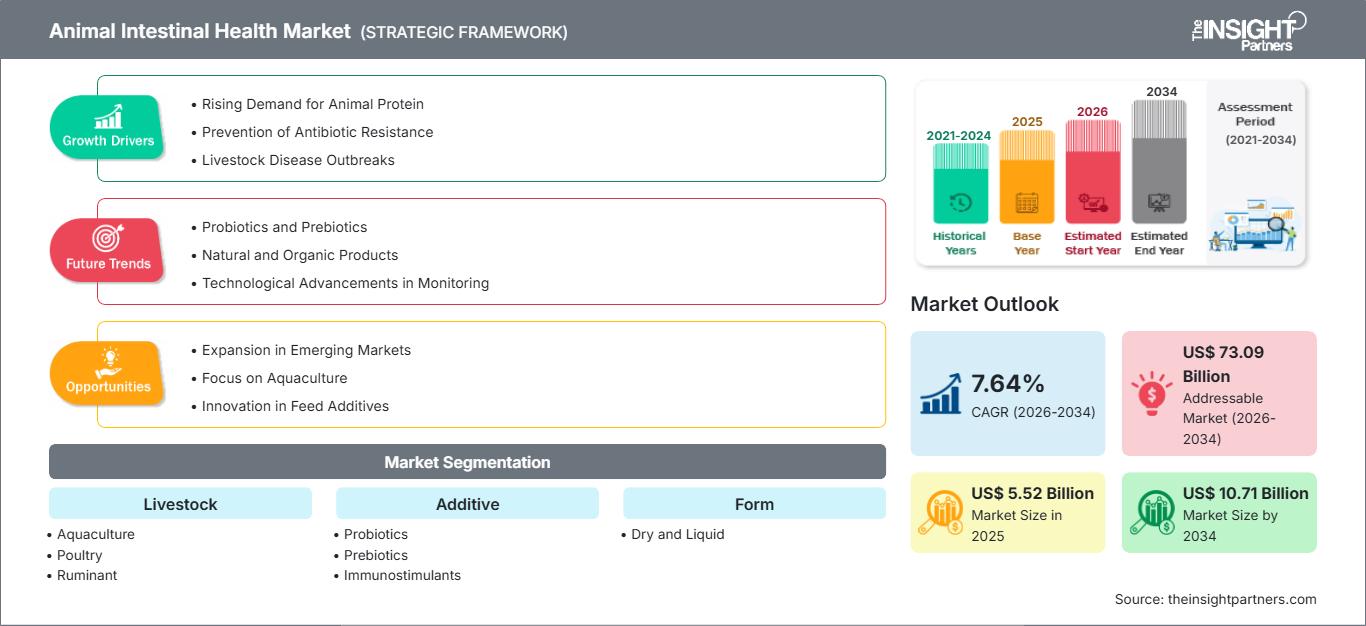
The animal intestinal health market is forecasted to be worth US$ 5.52 billion in 2025 and is further projected to reach US$ 10.71 billion by 2034 with a CAGR of 7.64% from 2026 to 2034. The market is due to the increasing demand for animal feed additives which help in maintaining the integrity of the gut lining, nutrient absorption, and improved immunity in addition to being non-reliant on antimicrobial growth promoters.
North America is anticipated to be one of the most technologically advanced regions where the animal intestinal health market size will be boosted by the estimated CAGR ranging between 7.0–7.6% from 2026 to 2034. The driving factors include antibiotic stewardship, comprehensive feed programs along with greater use of probiotics, prebiotics, and phyto blends in poultry and dairy farms for improved performance in challenging conditions.
Animal Intestinal Health Market Assessment and Insights
- North America held 30–33% share in 2025 and is expected to grow at a CAGR between 2026–2034 of 7.0–7.6%, supported by antibiotic-free livestock programs, advanced feed mills, and precision nutrition adoption.
- US accounted for 78–81% of North America in 2025 and is projected to grow at a CAGR between 2026–2034 of 7.1–7.7%, led by poultry, swine, dairy, and pet nutrition applications.
- Europe represented 27–30% share in 2025 and is anticipated to grow at a CAGR between 2026–2034 of 6.8–7.4%, with Germany, France, the UK, Spain, and Italy leading additive reformulation.
- Asia Pacific captured 29–32% share in 2025 and is forecast to grow at a CAGR between 2026–2034 of 8.5–9.2%, led by China, India, Vietnam, Japan, and Australia through protein demand growth.
- Largest Segment Poultry held 34–38% market share in 2025 and is expected to expand at a CAGR range of 7.5–8.1% during 2026–2034 due to intensive production and disease-risk management.
- High Growth Segment Aquaculture accounted for 15–18% market share in 2025 and is projected to grow at a CAGR range of 8.8–9.6% during 2026–2034, supported by sustainable aquatic protein production.
- Key companies analyzed in detail: AB Vista, Agrihealth, Alltech, Inc., ANCO Animal Nutrition Competence GmbH, Arm & Hammer Animal and Food Production, BENEO GmbH, Biorigin, Adisseo, Calpis Co., Ltd., Cargill, Incorporated.
Source: The Insight Partners' analysis based on proprietary research, government publications, company annual reports, investor presentations, industry databases, and expert interviews.
Development in technology is moving the market for animal intestinal health from single-function enzymes or acidifiers into multiple-function microbiome solutions that incorporate probiotics, prebiotics, immunomodulators, and botanicals. Development in production has been made more scientific, involving investments in strain selection, fermentation, stability, encapsulation, post-pellet survival and efficacy trials based on species. Feed manufacturers now assess additives based on practical effects including villus health, feed conversion, litter quality, immunological indicators and pathogen resistance.
For the forecast period, growth will be guided by protein consumption in Asia Pacific, intensification in aquaculture and regulations for reduction of unnecessary use of antimicrobials. Investments will be made in areas where there are modern feed mills and integrators analyzing gut health using performance analytics. Strong regulatory tailwinds will be experienced in those areas where animal welfare, residues management and farm assurance schemes affect purchasing decisions, particularly poultry, swine, dairy and export-oriented aquaculture.
Animal Intestinal Health Market Report Scope
| Report Attribute | Details |
|---|---|
| Market size in 2025 | US$ 5.52 Billion |
| Market Size by 2034 | US$ 10.71 Billion |
| Global CAGR (2026 - 2034) | 7.64% |
| Historical Data | 2021-2024 |
| Forecast period | 2026-2034 |
Animal Intestinal Health Market Analysis
Increased demand arises as a result of antimicrobial stewardship, efficiencies in protein production, and stability in performance due to feed ingredient variations. The fastest-growing areas in the market for animal intestinal health include regions where producers understand the connection between improved intestinal resilience and mortality reduction, improved feed conversion, increased digestibility of nutrients, and reduction in production loss. This is evidenced by FAO research which shows that the antibiotic usage in livestock may increase by up to 30% by 2040 unless some measures are taken. FAO leads this research.
The supply chain involves microbial strains suppliers, botanical extract providers, fermentation, premix manufacturers, feed companies, veterinarians, nutritionists, and livestock producers. There is an improvement in the supply chain owing to increased fermentation capabilities, standardization of active ingredients, and localization of the production to feed milling facilities. Formulation difficulty is high since the formulations have to withstand pelleting, mineral interactions, and consistent performance among other challenges.
The competition revolves around efficacy proven, technical services, consistency in manufacturing and positioning specific to the application. The competitive analysis of the animal intestinal health market report reveals that Cargill, Incorporated, Alltech, Inc., Adisseo, AB Vista, BENEO GmbH, and Arm & Hammer Animal and Food Production are competing with scientifically-proven feed products, whereas Biorigin, Calpis Co., Ltd., Agrihealth, and ANCO Animal Nutrition Competence GmbH are competing with specialized ingredients and performance.
The investments are going to microbiome diagnostic tools, precision feeding technologies, and additives for antibiotic-free and no-antibiotics ever systems. Positioning strategy is in favor of those companies who can integrate scientific data with the data collected from farms. Manufacturers are also developing specialized product offerings for poultry, swine, ruminants, and aquaculture due to the fact that different species have different intestinal problems; for example, coccidiosis, dysbiosis in poultry, weaning stress in piglets, enteritis in farmed fish.
● REPORT CUSTOMIZATION
Tailor This Report To Align With Your Specific Business Requirements
This report can be customized to align precisely with your business objectives, scope, and target markets. Customization options include tailored segmentation, geography, competitive analysis, and strategic insights to support informed decision-making.
Customize This Report →WHAT YOU CAN ADJUST
- ● Segmentations
- ● Geography
- ● Competitive Analysis
- ● Language Preferences
Animal Intestinal Health Market: Strategic Insights
Regional Insights
North America animal intestinal health market
North America held 30–33% share in 2025 and is expected to grow at a CAGR range of 7.0–7.6% during 2026–2034. The animal intestinal health market share in the region is supported by mature feed manufacturing, antibiotic-free poultry programs, and strong veterinary oversight. U.S. and Canadian integrators increasingly use gut health additives to protect feed conversion during heat stress, mycotoxin exposure, and disease cycles.
The markets for these products are mainly found in poultry, swine, dairy, beef, and aquaculture feeds, with poultry being the most dominant application sector. Feed producers have also focused on additives that provide value via increased livability, litter performance, and nutrient absorption. In North America, there are technical support services and field trials using nutrition software that enable the feed formulators to test probiotics, prebiotics, phytogenics, and yeast products under commercial conditions.
U.S. animal intestinal health Market
The U.S. accounted for 78–81% of North America in 2025 and is estimated to grow at a CAGR range of 7.1–7.7% during 2026–2034. The country’s leadership reflects large-scale poultry and swine integration, dairy herd productivity programs, and strong adoption of feed additives after restrictions on medically important antibiotics for growth promotion. Retailer and foodservice expectations further encourage antibiotic-reduction strategies.
Company presence is wide-ranging and includes Cargill, Incorporated, Alltech, Inc., Arm & Hammer Animal and Food Production, AB Vista, and Adisseo. Applications trends include higher utilization of mixes over single ingredients. Nutritionists are blending probiotics, yeast-based products, organic acids, phytogenic compounds, and enzymes to target gut health issues, pathogens, and digestibility all at once.
Europe animal intestinal health Market
Europe held 27-30% share in 2025 and is expected to witness a CAGR of 6.8-7.4% from 2026 to 2034. Germany is the top country because of its sophisticated feed formulation process and livestock rearing and also because of adopting the alternative to antibiotics. The UK stimulates the market for poultry and swine because of the consumer-focused welfare retail standards in UK, whereas France has programs for dairy, poultry, and specialized livestock nutrition.
Germany is a favorable country for the development of probiotics, phytogenics, and prebiotic ingredient formulations due to technological innovations and stringent regulations on feed quality. France has high demand in the market for both ruminant and poultry owing to transparency in food chains and the producers' focus on enhancing digestibility. Residue management, farm assurance, and feed additives are key parameters for suppliers' evaluation.
Italy and Spain provide their support by providing feed applications of poultry, swine, dairy, and aquaculture feed. The Netherlands and Denmark have influenced practices on antimicrobials and precision livestock nutrition. Europe market is developed but not stagnant, with growth coming from reformulation, premium animal proteins, and demand for plant-based and microbial solution.
APAC animal intestinal health Market
APAC held 29–32% share in 2025 and is expected to grow at a CAGR range of 8.5–9.2% during 2026–2034. China is the leading country, supported by large poultry, swine, aquaculture, and feed manufacturing capacity. India is expanding dairy and poultry nutrition programs, while Vietnam and Indonesia support demand through intensive livestock and aquaculture expansion.
Feed quality, animal welfare, and stable performance are key focuses of Japan and South Korea. In Australia, the use of gut health products is prevalent in the beef, dairy, poultry, and aquaculture industries. Drivers from the government side include food safety, antimicrobials, and protein security for domestic use. Industrial drivers include better feed efficiency, premix innovation, and farm consolidation to allow probiotic, prebiotic, and phytogenic product application consistently.
Middle East & Africa animal intestinal health Market
The Middle East and Africa market will see a CAGR of 7.7-8.4% between 2026 and 2034. Saudi Arabia leads among all countries due to investments in food security, poultry development, and advanced dairy farm facilities under heat stress conditions. The UAE focuses on efficient production of animals, and South Africa adds to this market via poultry, ruminants, and aquaculture sectors.
Rest of MEA demand varies as some countries may have more sophisticated feed mill capabilities or better veterinary services than others. At the same time, investment into cold chain protein production, integration of poultry facilities, and construction of aquaculture units stimulates the demand for products that prevent disruption of digestive tract under climatic or infectious conditions.
Segmentation Analysis
Livestock
The Livestock segment in the market is expected to grow at a CAGR range of 7.4–8.0% during 2026–2034. The animal intestinal health market scope across livestock is shaped by species biology, production intensity, disease pressure, and feed efficiency targets. Poultry dominates because intestinal balance directly affects feed conversion and livability, while aquaculture is gaining attention as producers seek non-antibiotic tools to manage gut performance in intensive pond and cage systems.
- Aquaculture is strategically important as fish and shrimp producers use microbial and immunostimulant additives to improve intestinal balance, feed utilization, survival, and resilience under intensive farming conditions.
- Poultry leads demand because broilers and layers are highly sensitive to dysbiosis, coccidial pressure, and diet changes, making gut-focused additives central to antibiotic-reduction and productivity programs.
- Ruminant applications focus on digestive stability, milk yield support, calf development, and rumen efficiency, with yeast derivatives, prebiotics, and botanical solutions used alongside mineral and protein strategies.
- Swine demand is driven by weaning stress, enteric disease risk, and feed transition challenges, creating strong need for probiotics, phytogenics, and immunostimulants in nursery and grower diets.
Additive
The Additive segment in the animal intestinal health market is expected to grow at a CAGR range of 7.6–8.2% during 2026–2034. Adoption differs by mode of action, evidence base, and compatibility with species-specific feed programs. Probiotics and prebiotics support microbial balance, immunostimulants strengthen defense response, and phytogenics address digestibility, appetite, and gut environment. Buyers increasingly prefer combinations that show measurable commercial performance rather than generic wellness claims.
- Probiotics hold a strong position because selected microbial strains can support gut flora balance, competitive exclusion, immune modulation, and production consistency in poultry, swine, aquaculture, and young ruminants.
- Prebiotics are valued for selectively supporting beneficial microbiota and improving digestive stability, especially where producers need non-antibiotic tools compatible with broad feed formulations and life stages.
- Immunostimulants are important in aquaculture, poultry, and piglets because they help animals respond to pathogen exposure, vaccination stress, transport pressure, and environmental variability.
- Phytogenics are gaining traction as plant-derived compounds support feed intake, digestive secretions, gut barrier function, and flavor profile, particularly in antibiotic-reduction and premium animal protein systems.
Form
The Form segment in the animal intestinal health market is expected to grow at a CAGR range of 7.2–7.8% during 2026–2034. Dry products dominate commercial feed inclusion because they are easier to store, dose, blend, and distribute through premix channels. Liquid products remain relevant where drinking water application, hatchery programs, aquaculture use, or rapid intervention is needed. Form selection depends on processing temperature, bioavailability, dosing flexibility, and farm-level handling.
- Dry additive formats are preferred in compound feed and premix production because they support bulk handling, consistent inclusion rates, shelf stability, and compatibility with pelleted or mash feeds.
- Liquid formats serve farms needing flexible administration through water lines, tanks, or top-dressing systems, making them useful during stress events, early life phases, and targeted recovery programs.
Source
The Source segment in the animal intestinal health market is expected to grow at a CAGR range of 7.5–8.1% during 2026–2034. Microbial sources are central to probiotic, yeast, and fermentation-derived solutions, while plant-based sources support phytogenic, fiber, and botanical strategies. Market preference is moving toward traceable production, consistent active concentration, and evidence of stability during processing. Sustainability claims are increasingly relevant, but buyers still prioritize performance, safety, and regulatory acceptance.
- Microbial sources are essential for probiotics, yeast derivatives, postbiotics, and fermentation metabolites, providing targeted mechanisms for microbial balance, immune support, gut integrity, and performance stability.
- Plant Based sources support phytogenic and fiber-related strategies, offering botanical compounds, functional carbohydrates, and natural positioning valued in residue-conscious, welfare-oriented, and premium livestock programs.
Opportunity Snapshot
| Source | Revenue Contribution | Trend Tag | Adoption Stage |
|---|---|---|---|
| Microbial | High | Fermented Inputs | Mature |
| Plant Based | Medium | Botanical Sourcing | Scaling |
Animal Intestinal Health Market Growth Drivers and Impact Analysis
Antimicrobial Stewardship in Intensive Animal Production
Antimicrobial stewardship is a core driver because livestock and aquaculture producers need practical alternatives that protect productivity without relying on routine antibiotic growth promotion. FAO analysis indicates that livestock antibiotic use could rise substantially by 2040 without productivity-focused interventions, while WOAH continues to emphasize responsible antimicrobial use in animal health. This creates direct demand for probiotics, prebiotics, immunostimulants, and phytogenics that support gut balance and disease resilience. The real-world impact is strongest in poultry and swine, where dense production systems make enteric stability essential. Feed mills and integrators are increasingly treating intestinal health programs as risk-management tools that protect livability, feed conversion, and market access.
Feed Efficiency Pressure and High Raw Material Volatility
Feed represents the largest production cost in most livestock systems, so additives that improve nutrient utilization can deliver measurable economic value. Volatile corn, soybean meal, fishmeal, and energy ingredient costs have made gut function a board-level productivity concern for integrators and feed producers. Additives that improve digestion, stabilize microbiota, or reduce inflammation help animals convert feed more efficiently, particularly during diet changes or environmental stress. In commercial settings, even small improvements in feed conversion can influence profitability across millions of birds, pigs, or fish. This driver supports recurring demand for evidence-backed products that can be integrated into least-cost formulation without compromising animal performance.
Growth of Aquaculture and High-Protein Food Supply Chains
Aquaculture is increasing demand for intestinal health products because intensive systems face bacterial pressure, feed transition issues, and water-quality stress. FAO’s fisheries and aquaculture outlook highlights the need for sustainable expansion of aquatic foods, making gut health additives relevant to feed efficiency, survival, and responsible health management. Fish and shrimp producers are adopting probiotics, immunostimulants, yeast derivatives, and phytogenic ingredients to support intestinal balance and reduce production losses. The market impact extends beyond direct additive sales because feed companies are creating species-specific functional diets for salmon, tilapia, shrimp, carp, and marine fish. This expands technical service requirements and encourages partnerships between additive suppliers and aquafeed manufacturers.
Animal Intestinal Health Market Future Trends
Microbiome-Mapped Precision Nutrition
The next phase of animal intestinal health market trends will involve microbiome-mapped formulations that connect sequencing data, production records, and additive responses. Instead of relying only on broad product categories, nutritionists will select strains, fibers, botanicals, and immune-support ingredients based on species, gut challenge, diet composition, and farm history. Commercial adoption will begin in large poultry, swine, dairy, and aquaculture systems that already collect performance data. Over time, suppliers will compete on predictive models, field validation, and integration with feed formulation systems. This trend will shift the market from generalized gut health messaging toward measurable biological targeting and farm-specific recommendations.
Postbiotic and Heat-Stable Functional Additives
Postbiotics and heat-stable functional ingredients are expected to gain importance as feed mills seek reliable performance through pelleting, storage, and transportation. Live probiotics remain important, but processing conditions can reduce viability when temperature management is inconsistent. Postbiotic metabolites, yeast fractions, and stabilized plant extracts offer a route to more predictable inclusion in commercial feed. This trend is likely to appeal to high-throughput feed manufacturers, export-oriented premix suppliers, and producers operating in hot climates. Product developers will focus on defining mechanisms, standardizing active compounds, and demonstrating benefits through commercial-scale trials rather than laboratory-only indicators.
Animal Intestinal Health Market Opportunities
Species-Specific Programs for Antibiotic-Free Poultry
Antibiotic-free poultry systems offer a high-value opportunity because producers need consistent support for gut integrity, litter quality, immune response, and feed conversion. Vendors can win business by building species-specific programs that combine probiotics, prebiotics, phytogenics, enzymes, and technical service rather than selling isolated ingredients. animal intestinal health market Forecasts indicate that integrators will increasingly evaluate products through flock-level performance dashboards, not ingredient descriptions. Investment should prioritize commercial trials, formulation support, and tools that help nutritionists adjust programs by breed, feed phase, disease pressure, and regional climate. Suppliers that link additive performance to measurable return will strengthen long-term customer contracts.
Functional Aquafeed Partnerships in Emerging Markets
Emerging aquaculture markets create an investment opportunity for suppliers that can partner with aquafeed manufacturers, hatcheries, and certification-focused producers. Gut health additives can support survival, growth, and feed utilization in shrimp, tilapia, carp, and marine fish systems where disease pressure and water-quality variation remain major constraints. Companies should prioritize localized trials, stable formulations, and affordable inclusion strategies suited to regional species. Partnerships with mills in India, Vietnam, Indonesia, Egypt, and Saudi Arabia can accelerate adoption. The strongest value proposition will combine intestinal resilience, reduced production losses, and compatibility with responsible aquaculture standards required by retailers and export buyers.
Recent Developments
- December 2025: Adisseo released an updated Microvit Nutrition Guide covering vitamin recommendations for 18 animal species and 35 developmental stages. The guide supports feed producers facing changing production conditions, heat stress, feed processing losses, and antibiotic-free systems by refining micronutrient strategies for poultry, swine, ruminants, pets, horses, and aquatic animals.
- November 2025: Cargill, Incorporated expanded its animal micronutrition and health positioning through increased production capacity and a broader science-based portfolio for species-specific feed solutions. The development supports rising demand for products linked to digestive health, immune support, mycotoxin control, and precision nutrition across poultry, swine, ruminant, aquaculture, pet, and equine applications.
- September 2025: Alltech, Inc. and Archer-Daniels-Midland Company signed a definitive agreement to create a North American animal feed joint venture expected to launch in Q1 2026. The venture combines Alltech’s Hubbard Feeds and Masterfeeds businesses with ADM’s U.S. feed mills, strengthening technical nutrition capabilities and customer access across livestock, equine, backyard, and leisure animal markets.
Frequently Asked Questions

- Comprehensive Market Sizing and Forecast Analysis
- Detailed Segmentation Analysis
- In-Depth Market Dynamics Assessment
- Regional and Country-Level Insights
- Competitive Landscape and Company Benchmarking
- Strategic Business Intelligence
Recent Reports
Testimonials

The Insight Partners' SCADA System Market report is comprehensive, with valuable insights on current trends and future forecasts. The team was highly professional, responsive, and supportive throughout. We are very satisfied and highly recommend their services.
RAN KEDEM Partner, Reali Technologies LTDs
I requested a report on a very specific software market and the team produced the report in a few days. The information was very relevant and well presented. I then requested some changes and additions to the report. The team was again very responsive and I got the final report in less than a week.
JEAN-HERVE JENN Chairman, Future Analytica
We worked with The Insight Partners for an important market study and forecast. They gave us clear insights into opportunities and risks, which helped shape our plans. Their research was easy to use and based on solid data. It helped us make smart, confident decisions. We highly recommend them.
PIYUSH NAGPAL Sr. Vice President, High Beam Global
The Insight Partners delivered insightful, well-structured market research with strong domain expertise. Their team was professional and responsive throughout. The user-friendly website made accessing industry reports seamless. We highly recommend them for reliable, high-quality research services
YUKIHIKO ADACHI CEO, Deep Blue, LLC.
This is the first time I have purchased a market report from The Insight Partners.While I was unsure at first, I visited their web site and felt more comfortable to take the risk and purchase a market report.I am completely satisfied with the quality of the report and customer service. I had several questions and comments with the initial report, but after a couple of dialogs over email with their analyst I believe I have a report that I can use as input to our strategic planning process.Thank you so much for taking the extra time and making this a positive experience.I will definitely recommend your service to others and you will be my first call when we need further market data.
JOHN SUZUKI President and Chief Executive Officer, Board Director, BK Technologies
I wish to appreciate your support and the professionalism you displayed in the course of attending to my request for information regarding to infectious disease IVD market in Nigeria. I appreciate your patience, your guidance, and the fact that you were willing to offer a discount, which eventually made it possible for us to close a deal. I look forward to engaging The Insight Partners in the future, all thanks to the impression you have created in me as a result of this first encounter.
DR CHIJIOKE ONYIA MANAGING DIRECTOR, PineCrest Healthcare Ltd.Reason to Buy
- Informed Decision-Making
- Understanding Market Dynamics
- Competitive Analysis
- Identifying Emerging Markets
- Customer Insights
- Market Forecasts
- Risk Mitigation
- Boosting Operational Efficiency
- Strategic Planning
- Investment Justification
- Tracking Industry Innovations
- Aligning with Regulatory Trends





 Get Free Sample for