
Animal Vaccination Market Demand, Trends & Forecast by 2034
Coverage: By Product Type (Attenuated Vaccines, Inactivated Vaccines, Subunit Vaccines, Toxoid Vaccines, Conjugate Vaccines, Recombinant Vaccines, DNA Vaccines); Animal Type (Livestock animal, Companion Animals); Route of Administration (Oral, Parenteral, Others); Distribution Channel (Veterinary Hospitals, Veterinary Clinics, Pharmacies and Drug Stores, Others) , and Geography (North America, Europe, Asia Pacific, and South and Central America)
- Status : Data Released
- Report Code : TIPRE00022450
- Category : Life Sciences
- No. of Pages : 150
- Available Report Formats :


- Last update date : August 04, 2026


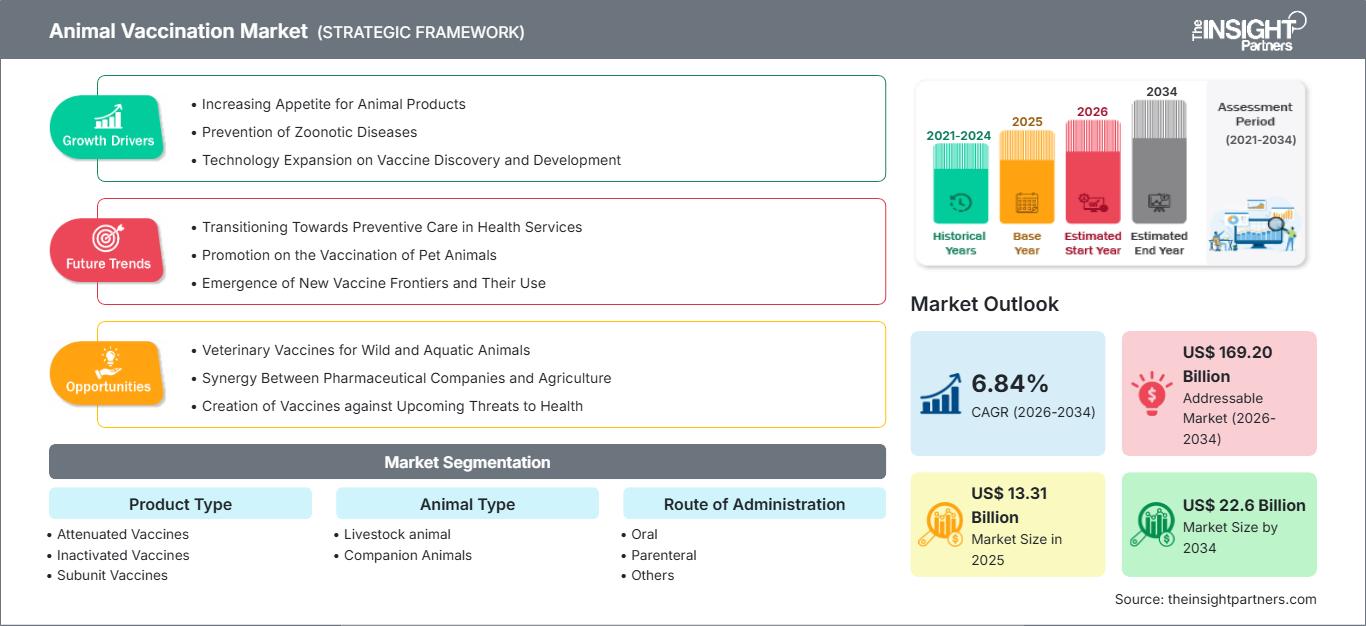
2025 Market Size
US$ 13.31 Bn
Base year value
2034 Forecast
US$ 22.6 Bn
Projected by 2034
CAGR 2026-2034
6.84 %
Growth rate
Addressable Market
US$ 169.20 Bn
(2026-2034)
The animal vaccination market is anticipated to be US$ 13.31 Billion in 2025 and is expected to reach US$ 22.6 Billion in 2034 at a CAGR of 6.84%. The market is growing due to the significance of preventive veterinary services as a key element in the performance of livestock animals, companions, and disease control programs globally for poultry, cattle, swine, companion, and multispecies veterinary operations.
In North America, the animal vaccination market size is driven by the well-developed veterinary sector, high degree of medicalization of companion animals, and existing biosecurity programs for livestock. The market is anticipated to grow in the 6.20% - 6.80% CAGR range during 2026-2034 because of poultry disease prevention, swine herd immunization, pet wellness, and increased use of recombinant and multivalent vaccines.
Animal Vaccination Market Assessment and Insights
- North America is estimated to hold 34–37% share in 2025, growing at a CAGR range of 6.20–6.80% during 2026–2034, supported by structured pet vaccination, poultry automation, swine disease prevention, and regulatory oversight.
- US accounts for 79–83% of North America in 2025 and is projected to grow at a CAGR range of 6.30–6.90% during 2026–2034, led by companion animal clinics and production animal programs.
- Europe holds 27–30% share in 2025, growing at a CAGR range of 5.80–6.40% during 2026–2034, with Germany, France, the UK, Spain, and Italy leading vaccine adoption.
- Asia Pacific represents 23–26% share in 2025 and is expected to grow at a CAGR range of 7.20–8.00% during 2026–2034, led by China, India, Japan, Australia, and South Korea.
- Largest Segment Livestock animal holds 68–72% market share in 2025, growing at a CAGR range of 6.70–7.30% during 2026–2034, supported by poultry, cattle, and swine vaccination.
- High Growth Segment Recombinant Vaccines holds 12–15% market share in 2025, growing at a CAGR range of 8.20–9.10% during 2026–2034, driven by vector platforms and disease-specific innovation.
- Key companies analyzed in detail: Ceva Santé Animale S.A., Neogen Corporation, Merck Animal Health, Boehringer Ingelheim International GmbH, Zoetis Inc., Novartis AG, ImmuCell Corporation, Merial Limited, Biovac, Virbac S.A., Elanco Animal Health Incorporated.
Source: The Insight Partners' analysis based on proprietary research, government publications, company annual reports, investor presentations, industry databases, and expert interviews.
The use of vaccines has evolved beyond traditional methods using killed and live vaccines, with the industry embracing the use of vector, recombinant, conjugate, and nucleic acid based technologies that could improve the safety, specificity, and efficacy of vaccine production. There is also an increased complexity in production, where there is need for cold chain transportation, quality batches, and dosage certainty in the poultry hatcheries, swine integrators, dairy farms, and companion animal practices.
In the future, emerging regions will increase volume through consolidation of farms, pet ownership, and better veterinary care availability. Investments will focus on regional manufacture, genomics-based surveillance, hatchery based vaccination, and multivalent vaccines. There is regulatory headwind driven by One Health initiatives, reduced use of antimicrobials, food security and transboundary diseases control. Companies that can integrate compliant manufacture, veterinary training, and multi-species coverage will have an edge in the market.
Animal Vaccination Market Report Scope
| Report Attribute | Details |
|---|---|
| Market size in 2025 | US$ 13.31 Billion |
| Market Size by 2034 | US$ 22.6 Billion |
| Global CAGR (2026 - 2034) | 6.84% |
| Historical Data | 2021-2024 |
| Forecast period | 2026-2034 |
Animal Vaccination Market Analysis
The animal vaccination market is fueled by increased spending on disease prevention in livestock and companion animals. Producers invest in vaccinations to maintain feed efficiency, breeding capabilities, survival rates, and continued trade operations, while companion animal owners are now more willing to adhere to immunization schedules for core and non-core diseases. The industry consists of vaccine manufacturers, antigen suppliers, contract manufacturers, regulatory bodies, veterinarians, distributors, farms, shelters, and disease control organizations.
The supply chain remains challenging from a technical standpoint due to the fact that biological products need to undergo strain selection, aseptic processing, potency testing, and proper logistics involving controlled temperatures. According to WOAH recommendations, vaccination is one of the cost-effective components of animal disease control, which include surveillance, biosecurity, and movement control.
Positioning of competition revolves around technology competency, species expertise, evidence from practice, and commercialization capability. According to the animal vaccination market report, Zoetis Inc., Merck Animal Health, Boehringer Ingelheim International GmbH, Ceva Santé Animale S.A., Virbac S.A., and Elanco Animal Health Incorporated position their products through multivalent vaccines, poultry-based vaccines, companion animal vaccines, and livestock disease programs.
Investments will be directed to recombinant vectors, DNA technologies, hatchery devices, and regional vaccine capabilities. Neogen Corporation will help build capabilities in biosecurity and testing adjacent to its current business. ImmuCell Corporation will concentrate on building capabilities for passive immunity. Biovac will add manufacturing capabilities in select regions. Novartis AG and Merial Limited will stay relevant based on their vaccine portfolio.
● REPORT CUSTOMIZATION
Tailor This Report To Align With Your Specific Business Requirements
This report can be customized to align precisely with your business objectives, scope, and target markets. Customization options include tailored segmentation, geography, competitive analysis, and strategic insights to support informed decision-making.
Customize This Report →WHAT YOU CAN ADJUST
- ● Segmentations
- ● Geography
- ● Competitive Analysis
- ● Language Preferences
Animal Vaccination Market: Strategic Insights
Regional Insights
North America animal vaccination market
North America is estimated to hold 34–37% share in 2025 and to grow at a CAGR range of 6.20–6.80% during 2026–2034. The animal vaccination market share is supported by strong veterinary clinic access, USDA-regulated biologics, structured livestock health programs, and high compliance with companion animal vaccination schedules across dogs, cats, horses, cattle, swine, and poultry.
Demand is increasingly reinforced by corporate veterinary networks, pet insurance-linked wellness plans, and producer investment in outbreak resilience. Poultry and swine operators use vaccines to reduce mortality, stabilize throughput, and support export-sensitive production. The market in the region remains innovation-led, with recombinant platforms, single-dose products, and administration convenience shaping supplier differentiation.
U.S. animal vaccination Market
The US accounts for 79–83% of North America in 2025 and is projected to grow at a CAGR range of 6.30–6.90% during 2026–2034. Companion animal vaccines benefit from routine veterinary visits, shelter protocols, and lifestyle-based immunization, while livestock vaccines are embedded in herd health plans for poultry, cattle, and swine operations.
Company presence is broad, with Zoetis Inc., Merck Animal Health, Boehringer Ingelheim International GmbH, Elanco Animal Health Incorporated, and Virbac S.A. maintaining strong commercial channels. Applications are moving toward Bordetella protection, feline vaccination improvement, poultry vector vaccines, swine circovirus prevention, and digital ordering systems. Regulatory review and adverse-event monitoring make clinical evidence central to supplier credibility.
Europe animal vaccination Market
Europe represents 27–30% market share in 2025 and has a CAGR between 5.80% to 6.40% for 2026 to 2034 period. The UK focuses on companion animal boosters, equine vaccines, and biosecure poultry operations. Germany remains dominant owing to its livestock size, government-regulated veterinary practices, and extensive use of preventive programs on herds level.
France plays an important role owing to its requirement for poultry, swine, and ruminant health with help of local players like Ceva Santé Animale S.A. and Virbac S.A. Spain and Italy represent stable demand among companion animals, poultry, and ruminants, driven by vaccination policy, farming consolidation, and European-wide diseases surveillance. The market is also driven by reduction goals in antimicrobials usage.
APAC animal vaccination Market
APAC represents 23–26% share in 2025 and is forecast to grow at a CAGR range of 7.20–8.00% during 2026–2034. China is the leading country because of large swine and poultry populations, farm modernization, and recurring disease-control priorities.
India adds volume through cattle, buffalo, poultry, and expanding veterinary access, while Japan and South Korea emphasize premium pet vaccines and biosecure livestock systems. Australia contributes through export-oriented livestock disease control. Policy focus on food security, zoonotic risk, and local biologics capacity supports faster adoption.
Middle East & Africa animal vaccination Market
The Middle East & Africa region is estimated to grow at a CAGR range of 6.50–7.30% during 2026–2034. Saudi Arabia leads adoption through poultry self-sufficiency programs, ruminant vaccination, and improving veterinary infrastructure.
The UAE focuses on companion animal vaccination and imports livestock biosecurity, while South Africa anchors regional demand through commercial poultry, cattle, and companion animal care. Rest of MEA uptake remains uneven, but cold-chain expansion, government campaigns, and food-security investments are improving access to preventive biologics.
Segmentation Analysis
Product Type
Product Type is projected to grow at a CAGR range of 6.60–7.20% during 2026–2034. The animal vaccination market scope under this segment is defined by gradual migration from conventional platforms to more targeted technologies. Attenuated and inactivated vaccines remain widely used because of established field confidence, while recombinant and DNA vaccines attract investment where faster strain response, better safety profiles, and differentiated claims are strategically important.
- Attenuated Vaccines retain strong relevance in high-volume livestock and companion animal programs because they can generate robust immune responses, particularly where established safety profiles and veterinarian familiarity support routine use.
- Inactivated Vaccines are widely used when safety, stability, and reduced reversion risk are priorities. Their market role is important in farm systems and regulated companion animal channels.
- Subunit Vaccines address targeted immune responses by using selected antigenic components. Demand is strongest where disease specificity, safety, and compatibility with modern manufacturing processes matter.
- Toxoid Vaccines serve defined disease-prevention needs where bacterial toxins drive clinical risk. They remain strategically important in livestock and equine protocols requiring predictable protection.
- Conjugate Vaccines are used where enhanced immune recognition is needed. Their position is specialized, but they support premium vaccine development for complex bacterial disease prevention.
- Recombinant Vaccines are gaining strategic attention as vector-based and engineered platforms improve multivalent protection, hatchery administration, and differentiation against evolving poultry, swine, and companion animal pathogens.
- DNA Vaccines represent an emerging platform linked to rapid design, genomic surveillance, and future outbreak response. Adoption depends on regulatory confidence, manufacturing scalability, and field-performance evidence.
Animal Type
Animal Type is projected to grow at a CAGR range of 6.80–7.40% during 2026–2034. Livestock animal vaccination generates the majority of demand because disease events can affect mortality, productivity, trade access, and food supply. Companion Animals remain important due to scheduled immunization, urban pet ownership, shelter protocols, travel requirements, and owner willingness to invest in preventive veterinary care.
- Livestock animal accounts for the largest demand base because poultry, cattle, swine, and small ruminants require vaccination programs to manage endemic disease, protect productivity, and support biosecure production.
- Companion Animals generate recurring value through puppy and kitten protocols, adult boosters, lifestyle vaccines, shelter intake requirements, and growing awareness of preventable infectious diseases among pet owners.
Route of Administration
Route of Administration is projected to grow at a CAGR range of 6.50–7.10% during 2026–2034. Route selection affects labor, compliance, welfare, and dose consistency. Parenteral delivery remains dominant in clinics and farms, while oral delivery is strategically useful for wildlife, herd, and mass-administration programs. Producers increasingly evaluate administration routes based on throughput, stress reduction, and compatibility with automated systems.
- Oral vaccination supports mass delivery where handling every animal is difficult. It is strategically relevant in wildlife programs, selected livestock use cases, and practical field immunization.
- Parenteral delivery remains central because it provides controlled dosing, veterinarian confidence, and compatibility with many established and advanced vaccine formulations across companion and livestock channels.
Distribution Channel
Distribution Channel is projected to grow at a CAGR range of 6.40–7.00% during 2026–2034. Channel performance depends on regulation, prescription control, cold-chain handling, and veterinarian influence. Hospitals and clinics remain critical for companion animal compliance, while pharmacies and drug stores support access in selected markets. Professional guidance remains important because improper storage or administration can undermine vaccine effectiveness.
- Veterinary Hospitals contribute high-value demand through complex cases, referral services, companion animal protocols, and livestock advisory programs requiring clinical oversight and product confidence.
- Veterinary Clinics are the core access point for routine pet vaccination, booster compliance, owner education, and farm-level preventive programs in many developed and emerging markets.
- Pharmacies and Drug Stores improve convenience where local rules permit vaccine purchase or distribution, especially in markets with expanding veterinary access and standardized preventive care products.
Opportunity Snapshot
| Segment Name | Revenue Contribution | Trend Tag | Adoption Stage |
|---|---|---|---|
| Veterinary Hospitals | High | Clinical Protocols | Mature |
| Veterinary Clinics | High | Booster Compliance | Mature |
| Pharmacies and Drug Stores | Medium | Retail Access | Scaling |
Animal Vaccination Market Growth Drivers and Impact Analysis
Rising livestock disease prevention and food security priorities
Vaccinations are now considered by livestock breeders as a means of managing operational risks instead of being an optional expenditure on veterinary care. Diseases in poultry, cattle, and pigs affect their health and, consequently, influence feed efficiency, meat and eggs production, milk production, animal transportation, and exports. In this regard, vaccinations can be useful to reduce mortality rates, improve production planning, and ensure compliance with regulations. The effect can be easily seen in large and integrated farms, where vaccinations can protect thousands or even millions of animals on hatcheries, in barns, and in finishing facilities. Moreover, vaccination is recognized as one of the ways of ensuring food security by public authorities.
Expanding companion animal preventive healthcare
Vaccines for companion animals are gaining from the trend towards wellness programs. Core vaccinations and lifestyle vaccines are becoming routine practices for dogs and cats at veterinarian clinics, hospitals, shelters, and virtual health care providers. There is more regular demand among owners living in urban areas and more openness to investing in wellness care, particularly in North America, Europe, Japan, Australia, and wealthy Asian Pacific countries. Pet vaccination allows clinics to ensure their clients’ retention, since vaccination services provide an opportunity to address parasites, perform diagnostics, do dental examinations, and screen for diseases. The market implication of the trend is a predictable revenue stream and increased demand for vaccines enhancing comfort and compliance.
Technology innovation in recombinant and multivalent vaccines
Innovations in technology have made it possible to differentiate vaccines among livestock and companion animals. Platforms such as recombinant, vector, conjugate, and DNA can make it possible for immunity to be much more targeted and producers can be able to tackle different pathogens using less frequent administrations. Multivalent vaccines are particularly useful in poultry hatcheries and swine production since they eliminate extra work and minimize the chance of failure in administering doses. In companion animals, differentiated vaccines are important because of increased confidence by veterinarians and owners. Commercially speaking, this is all about making the product better with solid data on efficacy, safety, and administration..
Animal Vaccination Market Future Trends
Next-generation vaccine platforms linked to surveillance data
Next-generation animal vaccination market trends will increasingly connect genomic surveillance, antigen matching, and rapid vaccine design. Pathogens such as avian influenza, swine viruses, and respiratory agents evolve quickly, making static product portfolios less sufficient. Manufacturers will use sequencing data, bioinformatics, and field intelligence to refine strain selection and support faster updates. This trend favors companies investing in recombinant vectors, DNA platforms, and flexible manufacturing. Regulatory confidence will remain essential, but surveillance-linked development can improve outbreak preparedness, reduce production losses, and strengthen trust among veterinarians, producers, and public authorities.
Automation and welfare-focused vaccine delivery
Automation will become more important as farms seek consistent dosing, lower labor dependency, and improved animal welfare. Hatchery vaccination equipment, precision spray systems, and digital dose tracking can help producers manage large bird populations while reducing manual variability. Similar thinking may influence swine and cattle systems through better handling design and data integration. Welfare-focused delivery also matters in companion animal clinics, where comfort and owner perception affect compliance. The future market will reward suppliers that combine vaccines with devices, training, monitoring, and service models that reduce stress while improving immunization reliability across high-throughput settings.
Animal Vaccination Market Opportunities
Regional manufacturing and vaccine access partnerships
Emerging countries present strong animal vaccination market Forecasts where companies can combine local manufacturing, cold-chain investment, and public-private disease-control partnerships. The opportunity is especially relevant in poultry, cattle, small ruminants, and companion animal segments where disease burden is high, but access remains inconsistent. Companies can expand by tailoring pack sizes, improving field education, and collaborating with governments on strategic vaccine reserves. This approach reduces supply disruption, improves affordability, and supports faster outbreak response. It also helps manufacturers meet local content expectations while building long-term customer confidence in quality-assured, temperature-controlled biologics.
Integrated vaccination programs for farms and clinics
Suppliers can create value by moving beyond single-product sales toward integrated vaccination programs. Farms need schedules, monitoring tools, staff training, booster reminders, and outcome measurement linked to productivity. Companion animal clinics similarly need protocols that improve compliance through reminders, bundled wellness plans, and client education. Investment in digital vaccination records, veterinary training, and species-specific advisory support can increase retention and reduce missed immunization windows. This opportunity is attractive because it strengthens customer relationships while demonstrating measurable benefits. Companies that provide evidence-backed programs can defend market access and improve uptake of premium vaccine technologies.
Recent Developments
- July 2026: Zoetis Inc. received European Commission marketing authorization for Poulvac Procerta HVT-ND, a recombinant vector vaccine protecting chickens against Newcastle disease and Marek’s disease in one dose. The vaccine can be administered in ovo or subcutaneously at hatch, strengthening Zoetis’ poultry vaccine position across Europe and selected export-linked markets.
- June 2026: Merck Animal Health signed a definitive agreement to acquire TARGAN, a poultry biodevice company with WingScan technology and precision ocular spray vaccine delivery capabilities. The transaction is expected to expand Merck Animal Health’s commercial poultry platform by combining vaccine expertise with hatchery automation for high-throughput chick processing and respiratory vaccine administration.
- September 2025: Boehringer Ingelheim International GmbH launched Ingelvac Circoflex AD in the United States, a swine vaccine combining PCV2a and PCV2d antigens in one dose. The product targets porcine circovirus type 2 protection offers onset of immunity after two weeks and supports producers facing shifting PCV2 genotype prevalence.
Frequently Asked Questions

- Comprehensive Market Sizing and Forecast Analysis
- Detailed Segmentation Analysis
- In-Depth Market Dynamics Assessment
- Regional and Country-Level Insights
- Competitive Landscape and Company Benchmarking
- Strategic Business Intelligence
Recent Reports
Testimonials

The Insight Partners' SCADA System Market report is comprehensive, with valuable insights on current trends and future forecasts. The team was highly professional, responsive, and supportive throughout. We are very satisfied and highly recommend their services.
RAN KEDEM Partner, Reali Technologies LTDs
I requested a report on a very specific software market and the team produced the report in a few days. The information was very relevant and well presented. I then requested some changes and additions to the report. The team was again very responsive and I got the final report in less than a week.
JEAN-HERVE JENN Chairman, Future Analytica
We worked with The Insight Partners for an important market study and forecast. They gave us clear insights into opportunities and risks, which helped shape our plans. Their research was easy to use and based on solid data. It helped us make smart, confident decisions. We highly recommend them.
PIYUSH NAGPAL Sr. Vice President, High Beam Global
The Insight Partners delivered insightful, well-structured market research with strong domain expertise. Their team was professional and responsive throughout. The user-friendly website made accessing industry reports seamless. We highly recommend them for reliable, high-quality research services
YUKIHIKO ADACHI CEO, Deep Blue, LLC.
This is the first time I have purchased a market report from The Insight Partners.While I was unsure at first, I visited their web site and felt more comfortable to take the risk and purchase a market report.I am completely satisfied with the quality of the report and customer service. I had several questions and comments with the initial report, but after a couple of dialogs over email with their analyst I believe I have a report that I can use as input to our strategic planning process.Thank you so much for taking the extra time and making this a positive experience.I will definitely recommend your service to others and you will be my first call when we need further market data.
JOHN SUZUKI President and Chief Executive Officer, Board Director, BK Technologies
I wish to appreciate your support and the professionalism you displayed in the course of attending to my request for information regarding to infectious disease IVD market in Nigeria. I appreciate your patience, your guidance, and the fact that you were willing to offer a discount, which eventually made it possible for us to close a deal. I look forward to engaging The Insight Partners in the future, all thanks to the impression you have created in me as a result of this first encounter.
DR CHIJIOKE ONYIA MANAGING DIRECTOR, PineCrest Healthcare Ltd.Reason to Buy
- Informed Decision-Making
- Understanding Market Dynamics
- Competitive Analysis
- Identifying Emerging Markets
- Customer Insights
- Market Forecasts
- Risk Mitigation
- Boosting Operational Efficiency
- Strategic Planning
- Investment Justification
- Tracking Industry Innovations
- Aligning with Regulatory Trends





 Get Free Sample for