
Apple Filling Market Analysis, Size, Share, Growth, Trends, and Forecast by 2034
Coverage: by Product Type (High Sugar Jam, Low Sugar Jam); End User (Dairy Industry, Baked Product Industry, Ice-Cream Industry, Others) , and Geography (North America, Europe, Asia Pacific, and South and Central America)
- Status : Data Released
- Report Code : TIPRE00011411
- Category : Food and Beverages
- No. of Pages : 150
- Available Report Formats :


- Last update date : August 26, 2026


2025 Market Size
US$ 2.94 Bn
Base year value
2034 Forecast
US$ 4.4 Bn
Projected by 2034
CAGR 2026-2034
4.58 %
Growth rate
Addressable Market
US$ 33.32 Bn
(2026-2034)
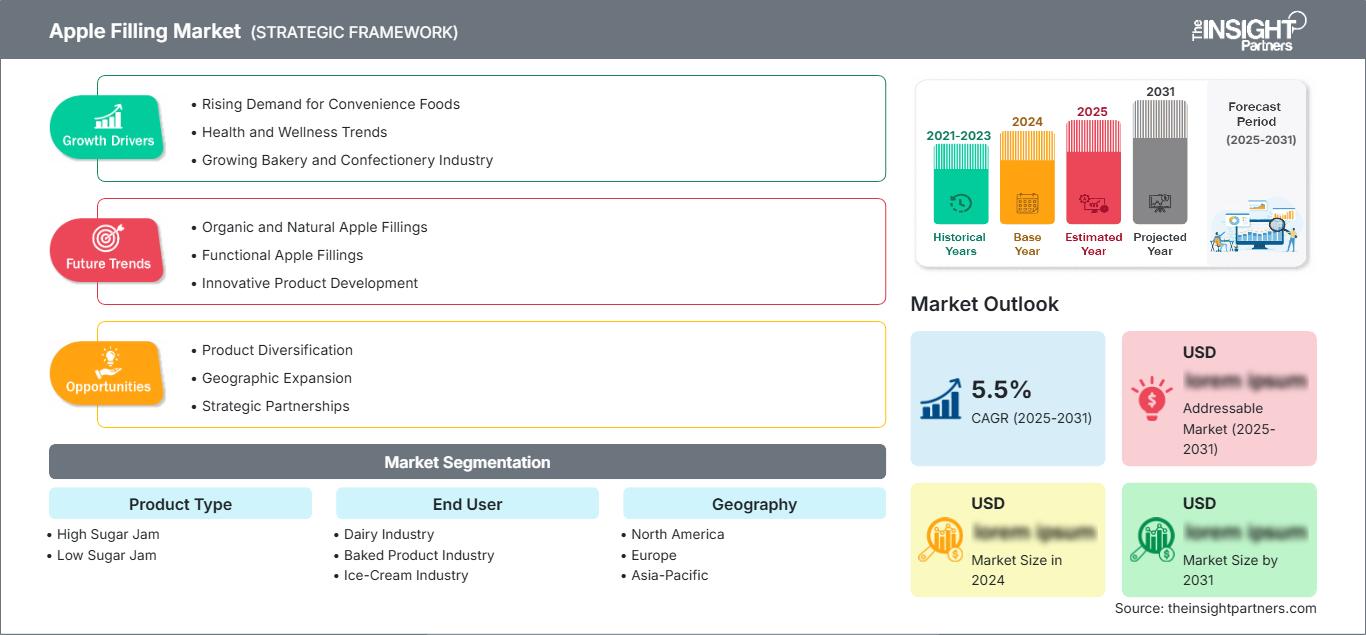
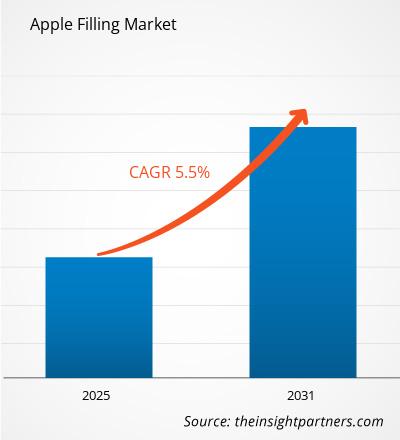
The global Apple Filling market was valued at US$ 2.94 billion in 2025 and is expected to reach US$ 4.4 billion by 2034; it is estimated to record a CAGR of 4.58% during 2026-2034.
Apple Filling Market Assessment and Insights
- North America held a 31–34% share in 2025 and is expected to grow at a CAGR range of 4.4–4.8% during 2026–2034, driven by industrial bakery lines, refrigerated desserts, and premium apple pie formats.
- US accounted for 76–80% of North America in 2025 and is projected to grow at a CAGR range of 4.3–4.7%, supported by scale bakery manufacturing and frozen sweet goods.
- Europe represented a 27–30% share in 2025 and is forecast to grow at a CAGR range of 4.2–4.6%, with Germany, France, the UK, Italy, and Spain leading demand.
- Asia Pacific captured a 22–25% share in 2025 and is projected to grow at a CAGR range of 5.5–6.1%, led by China, Japan, South Korea, India, and Australia.
- Largest Segment: Baked Product Industry held a market share range of 48–52% in 2025, with a CAGR range of 4.8–5.2% during 2026–2034.
- High Growth Segment: Low Sugar Jam accounted for a market share range of 34–38% in 2025, with a CAGR range of 5.4–5.9% during 2026–2034.
- Key companies analyzed in detail: AGRANA Beteiligungs-AG, Döhler GmbH, Fresh Food Industries Pty Ltd, Frulact, S.A., Ingredion Incorporated, The J.M. Smucker Co., Puratos NV/SA, Valio Ltd, Zentis GmbH & Co. KG, Zuegg S.p.A.
Source: The Insight Partners' analysis based on proprietary research, government publications, company annual reports, investor presentations, industry databases, and expert interviews.
Commercial apple filling market production has moved from basic preserved fillings toward application-specific fruit systems engineered for bake stability, freeze-thaw resistance, pumpability, and consistent fruit-piece distribution. Processors are focusing on aseptic processing, controlled pectin systems, starch-based texture management, and fruit preparation technologies to enable bakery and dairy producers to minimize reject rates without compromising sensory properties through lengthy processes and chilled distribution.
In terms of future capacity addition, it is likely that capacity addition will be aligned with changes in consumption in Asia-Pacific, the Middle East, and certain Latin American regions where Western-style bakery products and value-added dairy desserts are growing. Changes in regulations favoring clean labeling, reduced sugar content, and transparent fruit sourcing are also influencing procurement strategies.
Apple Filling Market Report Scope
| Report Attribute | Details |
|---|---|
| Market size in 2025 | US$ 2.94 Billion |
| Market Size by 2034 | US$ 4.4 Billion |
| Global CAGR (2026 - 2034) | 4.58% |
| Historical Data | 2021-2024 |
| Forecast period | 2026-2034 |
Apple Filling Market Analysis
Demand for the apple filling market growth is anchored in the resilience of bakery snacks, frozen desserts, and fruit-layered dairy products. Apples remain a cost-effective fruit base because they deliver recognizable flavor, fiber perception, acidity control, and compatibility with cinnamon, caramel, vanilla, and brown-sugar profiles. Commercial buyers increasingly require standardized Brix, viscosity, and fruit-piece integrity to maintain line efficiency.
Supply dynamics are shaped by apple crop availability, concentrate pricing, sugar costs, energy use in thermal processing, and packaging logistics. Ingredient suppliers are responding with blended sourcing models, low-sugar texturizing systems, and modular fruit preparations that can be adapted for pies, turnovers, yogurts, ice creams, cheesecakes, and portion-controlled foodservice desserts.
The apple filling market analysis shows a competitive field split between diversified ingredient platforms and fruit-preparation specialists. AGRANA Beteiligungs-AG, Döhler GmbH, Puratos NV/SA, Zentis GmbH & Co. KG, and Frulact, S.A. compete on application support and global supply networks, while The J.M. Smucker Co. and Zuegg S.p.A. maintain strong retail and foodservice recognition.
The investment is now heading towards automation, traceability of fruits, and formulation libraries that cut down the customer’s development time. The Ingredion Incorporated company provides an ecosystem boost in terms of texturizing ingredients and clean-label products. The Valio Ltd and the Fresh Food Industries Pty Ltd companies contribute region-specific expertise.
● REPORT CUSTOMIZATION
Tailor This Report To Align With Your Specific Business Requirements
This report can be customized to align precisely with your business objectives, scope, and target markets. Customization options include tailored segmentation, geography, competitive analysis, and strategic insights to support informed decision-making.
Customize This Report →WHAT YOU CAN ADJUST
- ● Segmentations
- ● Geography
- ● Competitive Analysis
- ● Language Preferences
Apple Filling Market: Strategic Insights
Regional Insights
North America apple filling market
North America held a 31–34% share in 2025 and is projected to grow at a CAGR range of 4.4–4.8% during 2026–2034. The region benefits from established bakery consumption, deep frozen dessert penetration, and ingredient procurement programs that favor consistent quality. The apple filling market share is concentrated in industrial bakery, pie, Danish, turnover, and foodservice dessert manufacturing.
Growth is supported by premiumization in bakery cases, broader availability of clean-label fruit fillings, and demand for reduced-sugar dessert formats. U.S. and Canadian processors are also improving production efficiency through ready-to-use fruit systems that limit labor variability. Suppliers offering Washington apple sourcing, aseptic packs, totes, and frozen-stable fillings gain an advantage.
U.S. apple filling Market
The U.S. accounted for 76–80% of North America in 2025 and is expected to expand at a CAGR range of 4.3–4.7% during 2026–2034. Demand drivers include large bakeries, in-store bakery programs, frozen pie makers, and quick-service restaurant dessert platforms. The apple continues to be one of the main flavors for turnovers, snack pies, cobblers, cheesecakes, and LTO applications.
The company has an extensive reach, with Puratos NV/SA, The J.M. Smucker Co., Zentis GmbH & Co. KG, Ingredion Incorporated, and Döhler GmbH providing fillings, texture systems, fruit preparations, and development services to U.S. food manufacturers. Trending application areas include visible pieces of fruit, low sugar fillings, cinnamon spice profiles, and fillings that withstand baking, freezing, rethermalization, and high-speed filling equipment.
Europe apple filling Market
Europe represented a 27–30% share in 2025 and is forecast to grow at a CAGR range of 4.2–4.6% during 2026–2034. Germany is the leading nation, backed by the advanced bakery consumption, production of dairy desserts, and fruit preparation expertise. The UK continues to be influential with regard to chilled desserts, pies, and clean-label bakery products.
Germany enjoys the presence of strong industrial bakery production capabilities and the availability of a large number of fruit processors. Zentis GmbH & Co. KG, AGRANA Beteiligungs-AG, and Zuegg S.p.A. are well-positioned to meet the European requirements for authentic fruit products, moderate sweetness, and fillings specific to particular applications. Recyclable packaging and traceable fruits are key concerns for manufacturers.
France, Italy, and Spain are contributing through their patisseries, yogurt, gelato, and ambient bakery offerings. The preferences of French consumers include quality dessert fillings with natural taste and creamy texture, while Italians prepare apples in accordance with their use in pastries and gelatos. In Spain, there is an increasing trend of private-labeling.
APAC apple filling Market
APAC held a 22–25% share in 2025 and is expected to grow at a CAGR range of 5.5–6.1% during 2026–2034. China is the dominant player in terms of development through bakery chain expansion, western-style pastry, frozen desserts and innovation in dairy products. Japan and South Korea focus on quality textures and portioned desserts.
India and Australia contribute through planned baking café concepts and novel ice creams. The policy focuses on food processing, cold chain infrastructure and the use of local fruits for developing regional capacities, which can help suppliers that localize sweetness, spices and pack sizes.
Middle East & Africa apple filling Market
The Middle East & Africa is projected to grow at a CAGR range of 4.7–5.2% during 2026–2034. Saudi Arabia is the leading country, with demand supported by bakery chains, hotel catering, frozen desserts, and foodservice expansion. The UAE acts as a regional distribution and re-export hub.
South Africa and the Rest of MEA show gradual adoption through retail bakery, dairy desserts, and institutional foodservice. Energy costs, cold-chain gaps, and import dependency affect margins, but investments in food manufacturing infrastructure and hospitality support demand. Shelf-stable and aseptic fillings are especially relevant for warmer climates.
Segmentation Analysis
Product Type
Product Type is projected to grow at a CAGR range of 4.7–5.1% during 2026–2034 as manufacturers balance indulgence with sugar moderation. The apple filling market scope across this segment includes traditional high-sugar formats for bake stability and low-sugar systems using pectin, starch, or fiber-based texture support. Reformulation remains strongest where retailers and foodservice operators seek cleaner labels.
- High Sugar Jam remains important in classic pies, pastries, and ambient bakery products because sugar supports preservation, gloss, sweetness, and texture stability during heating, depositing, and shelf-life extension.
- Low Sugar Jam is gaining strategic relevance as brands reformulate desserts for wellness-positioned consumers while maintaining viscosity, fruit flavor, and process tolerance in bakery, dairy, and ice-cream applications.
End User
End User is forecast to grow at a CAGR range of 4.8–5.3% during 2026–2034, led by industrial bakery adoption and broader use in chilled and frozen desserts. Demand varies by process requirement: bakeries need heat stability, dairy plants require fruit suspension and microbial control, and ice-cream processors prioritize freeze-thaw performance and swirl consistency.
- Dairy Industry uses apple fillings in yogurts, curds, cream cheese desserts, and spoonable products where fruit identity, acidity control, and suspension stability influence repeat purchasing.
- Baked Product Industry is the largest demand base, using apple fillings in pies, turnovers, pastries, cakes, biscuits, and frozen bakery formats where bake stability is critical.
- Ice-Cream Industry applies apple fillings in swirls, inclusions, and seasonal desserts, with demand shaped by freeze stability, aromatic spice pairing, and premium flavor launches.
Opportunity Snapshot
| End User | Revenue Contribution (High/Medium/Low) | Trend Tag | Adoption Stage |
| Dairy Industry | Medium | Fruit Layers | Scaling |
| Baked Product Industry | High | Bake Stable | Mature |
| Ice-Cream Industry | Medium | Frozen Swirls | Scaling |
Apple Filling Market Growth Drivers and Impact Analysis
Industrial Bakery Expansion and Frozen Dessert Scale
Commercial bakeries are the best volume driver since the use of apple fillings makes preparation work easier, provides uniform results and helps in fast deposition in pie, pastry, danish, snack cake and frozen sweet products. With the change in approach from batch-wise preparation to automation for bakery producers, the apple fillings should retain piece structure, viscosity and baking stability under repetitive heating cycles. This leaves scope for suppliers who have technical expertise in tailoring pectin, starch and fruit solids systems for different process parameters. The effects are seen in stricter qualifications of suppliers, longer contract periods and demands for industrial packaging like pails, drums, totes and aseptic bulk forms.
Clean-Label Reformulation and Sugar Reduction
Consumers focused on their health needs are forcing producers of dessert fillings to use less sugar without affecting the flavor, texture, and indulgence of products. Apple fillings are perfect candidates for this trend since the use of apples can guarantee the natural sweetening of a product, its acidity, fruit character and compatibility with fiber- or pectin-based formulas. For dessert fillers, the major issue is to retain shine, spreadability, baking stability and freezing-thawing resistance, along with lowering the amount of sugar used. Companies able to partially compensate for sugar functionality using starches, fibers, fruit concentrates, or hydrocolloids have better technical leverage.
Foodservice Dessert Standardization
The food service industry tends to favor the use of fillings that offer a uniform taste and help minimize the problem of waste in the kitchen environment. The apple filling is useful for making turnovers, pies, breakfast pastries, pancakes, waffles, ice cream toppings, and limited-time dessert items. It allows the foodservice provider to have a standard ingredient for their menus, which can be recognized by the consumers. The need for consistency becomes more relevant where there is unequal access to labor. Packaging convenience and stability of fillings are valuable to suppliers under this driver.
Apple Filling Market Future Trends
Texture-Engineered Fruit Systems
Future apple filling market trends will move toward texture-engineered systems that combine visible fruit pieces with controlled viscosity, lower sugar, and application-specific stability. Manufacturers will increasingly request fillings designed for automated depositing, laminated pastry processing, frozen storage, chilled dairy layering, and ice-cream swirl behavior rather than buying one standard formulation. This trend will make application testing, pilot kitchens, and sensory validation more important in supplier selection. It also supports deeper collaboration between fruit processors, starch specialists, and bakery technologists as customers seek fillings that can deliver indulgence, process reliability, and cleaner labels simultaneously.
Traceable Apple Sourcing and Regional Flavor Positioning
Traceability will become a stronger differentiator as retailers and food brands ask for clearer sourcing claims, orchard-level transparency, and documentation on pesticide management, labor practices, and carbon reduction. Apple varieties may also become more visible in product positioning, especially in premium pies, pastries, yogurts, and frozen desserts. Washington, European, and regional-origin apple claims can help brands justify premium pricing and communicate authenticity. Suppliers able to secure stable apple streams, document origin, and translate variety differences into flavor, acidity, and texture benefits will gain strategic value with branded and private-label manufacturers.
Apple Filling Market Opportunities
Low-Sugar Bakery Reformulation Programs
Low-sugar bakery reformulation offers a practical investment route for ingredient suppliers, co-manufacturers, and industrial bakeries. Apple filling market Forecasts indicate that reformulated pastries, snack pies, and chilled desserts can grow faster where brands preserve indulgence while responding to sugar-reduction policies and retailer nutrition targets. Companies should invest in pilot-scale bake testing, sensory panels, and ingredient systems that replace sugar’s texture and water-activity functions. The most attractive opportunities are partnerships with private-label retailers and bakery chains seeking consistent fillings that meet lower-sugar claims without production disruption or higher reject rates.
Localized Production in High-Growth Asian Markets
Localized production in China, India, and Southeast Asia can reduce freight exposure, improve freshness perception, and help suppliers tailor sweetness, spice, and fruit-piece size to regional preferences. Investment opportunities include aseptic fruit preparation plants, cold-chain partnerships, and co-development centers near bakery and dairy clusters. Local production also supports faster sampling cycles and better response to seasonal promotional launches. Companies entering these markets should prioritize food safety certification, flexible pack sizes, and relationships with organized bakery chains, dairy processors, and ice-cream manufacturers. The opportunity is strongest where imported fillings remain costly or slow to customize.
Frequently Asked Questions

- Comprehensive Market Sizing and Forecast Analysis
- Detailed Segmentation Analysis
- In-Depth Market Dynamics Assessment
- Regional and Country-Level Insights
- Competitive Landscape and Company Benchmarking
- Strategic Business Intelligence
Recent Reports
Testimonials

The Insight Partners provided valuable market intelligence that supported our global go-to-market strategy. Their team was professional, responsive, and attentive to our feedback, providing thoughtful analysis and helpful methodological clarifications throughout the project.
Junmo Kim Chief Financial Officer (CFO), Enertech Co., Ltd.
The Insight Partners' SCADA System Market report is comprehensive, with valuable insights on current trends and future forecasts. The team was highly professional, responsive, and supportive throughout. We are very satisfied and highly recommend their services.
RAN KEDEM Partner, Reali Technologies LTDs
I requested a report on a very specific software market and the team produced the report in a few days. The information was very relevant and well presented. I then requested some changes and additions to the report. The team was again very responsive and I got the final report in less than a week.
JEAN-HERVE JENN Chairman, Future Analytica
We worked with The Insight Partners for an important market study and forecast. They gave us clear insights into opportunities and risks, which helped shape our plans. Their research was easy to use and based on solid data. It helped us make smart, confident decisions. We highly recommend them.
PIYUSH NAGPAL Sr. Vice President, High Beam Global
The Insight Partners delivered insightful, well-structured market research with strong domain expertise. Their team was professional and responsive throughout. The user-friendly website made accessing industry reports seamless. We highly recommend them for reliable, high-quality research services
YUKIHIKO ADACHI CEO, Deep Blue, LLC.
This is the first time I have purchased a market report from The Insight Partners.While I was unsure at first, I visited their web site and felt more comfortable to take the risk and purchase a market report.I am completely satisfied with the quality of the report and customer service. I had several questions and comments with the initial report, but after a couple of dialogs over email with their analyst I believe I have a report that I can use as input to our strategic planning process.Thank you so much for taking the extra time and making this a positive experience.I will definitely recommend your service to others and you will be my first call when we need further market data.
JOHN SUZUKI President and Chief Executive Officer, Board Director, BK Technologies
I wish to appreciate your support and the professionalism you displayed in the course of attending to my request for information regarding to infectious disease IVD market in Nigeria. I appreciate your patience, your guidance, and the fact that you were willing to offer a discount, which eventually made it possible for us to close a deal. I look forward to engaging The Insight Partners in the future, all thanks to the impression you have created in me as a result of this first encounter.
DR CHIJIOKE ONYIA MANAGING DIRECTOR, PineCrest Healthcare Ltd.Reason to Buy
- Informed Decision-Making
- Understanding Market Dynamics
- Competitive Analysis
- Identifying Emerging Markets
- Customer Insights
- Market Forecasts
- Risk Mitigation
- Boosting Operational Efficiency
- Strategic Planning
- Investment Justification
- Tracking Industry Innovations
- Aligning with Regulatory Trends





 Get Free Sample for