
Argan Oil Market Trends, Demand & Growth by 2034
Coverage: By Category (Organic, Conventional); Application (Food and beverages, Personal care, Aromatherapy, Others) , and Geography (North America, Europe, Asia Pacific, and South and Central America)
- Status : Data Released
- Report Code : TIPRE00010448
- Category : Food and Beverages
- No. of Pages : 150
- Available Report Formats :


- Last update date : August 28, 2026


2025 Market Size
US$ 1.32 Bn
Base year value
2034 Forecast
US$ 2.5 Bn
Projected by 2034
CAGR 2026-2034
7.34 %
Growth rate
Addressable Market
US$ 17.21 Bn
(2026-2034)
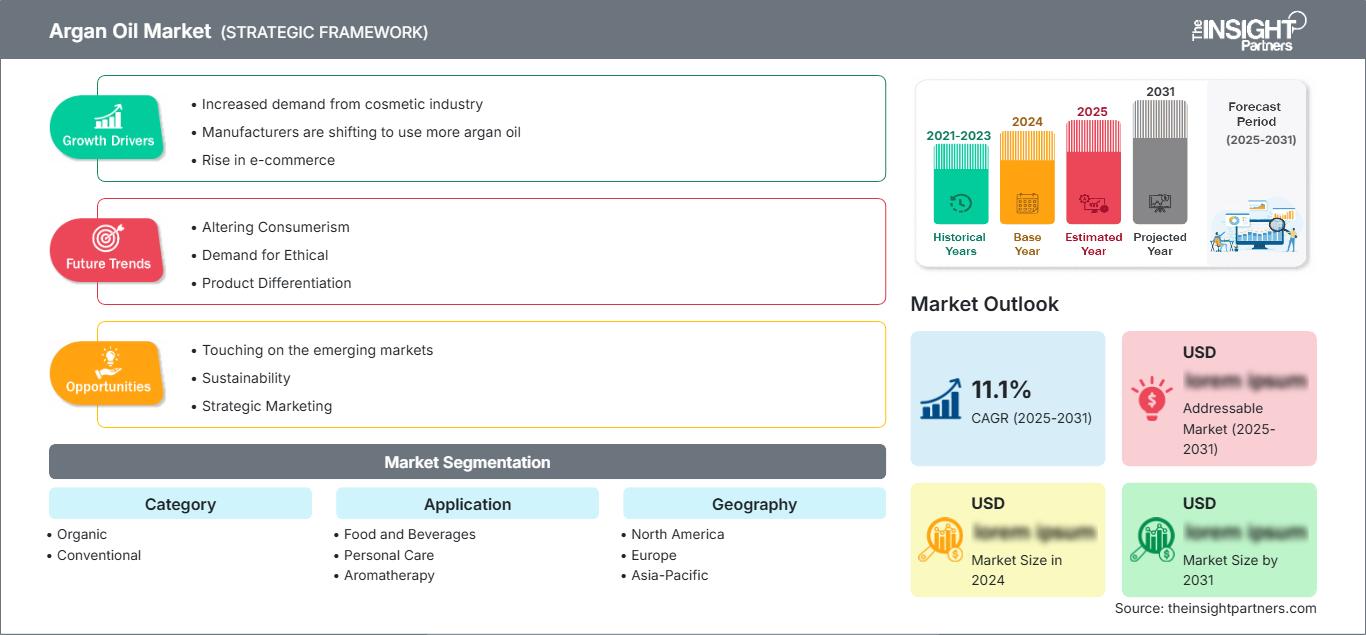
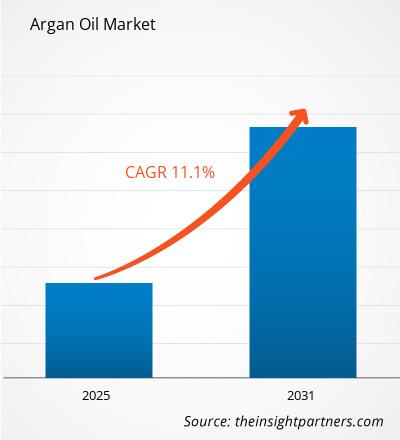
The argan oil market was valued at US$ 1.32 Billion in 2025 and is projected to reach US$ 2.5 Billion by 2034, registering a CAGR of 7.34% from 2026 to 2034. Demand is supported by the oil’s established use in premium personal care, food and beverages, and aromatherapy applications, while constrained Moroccan supply keeps pricing discipline central to procurement strategies.
Across North America, the argan oil market size is expected to expand at an estimated 6.8–7.5% CAGR during 2026–2034, supported by clean beauty reformulation and specialty food retail adoption. Ingredient buyers are prioritizing traceable Moroccan origin, organic certification, and cold-pressed quality. Growth is also reinforced by premium hair care, facial oils, massage blends, and natural culinary oils sold through omnichannel retail.
Argan Oil Market Assessment and Insights
- North America accounted for 28–32% share in 2025 and is growing at a CAGR between 2026–2034 of 6.8–7.5%, supported by clean-label personal care, specialty grocery penetration, and certified natural ingredient sourcing.
- US represented 72–78% of North America share in 2025 and is growing at a CAGR between 2026–2034 of 6.9–7.6%, driven by premium hair oils and facial serum formats.
- Europe held 30–34% share in 2025 and is growing at a CAGR between 2026–2034 of 6.4–7.1%, led by France, Germany, Italy, Spain, and the UK through cosmetics, organic retail, and culinary adoption.
- Asia Pacific captured 20–24% share in 2025 and is growing at a CAGR between 2026–2034 of 8.1–8.8%, with China, Japan, South Korea, India, and Australia expanding beauty and wellness demand.
- Largest Segment: Personal Care held 66–70% market share in 2025, with a CAGR range of 7.1–7.8%, reflecting broad use in hair care, facial oils, body care, and anti-aging formulations.
- High Growth Segment: Aromatherapy held 9–12% market share in 2025, with a CAGR range of 8.4–9.2%, supported by massage oil, spa, wellness, and premium carrier oil blending.
- Key companies analyzed in detail: ARGANisme Cosmetics S.A.R.L, Biopur Sarl, Frontier Co-operative, L'Occitane International S.A., Malak Bio, OLVEA Group, Purus International, Zineglob Ltd, ARGANBULK, Organica Group S.A.R.L.
Source: The Insight Partners' analysis based on proprietary research, government publications, company annual reports, investor presentations, industry databases, and expert interviews.
Mechanized cold-pressing, batch-level traceability, and certification-led sourcing have changed the argan oil market from a cooperative-led artisanal category into a structured B2B ingredient system. Supply is concentrated in Morocco, where drought risk, labor availability, and kernel production are factors. Refining practices now include quality assessment, deodorization, and organic segregation to meet demands from cosmetic formula designers, food companies, and distributors needing standardized sensory and purity qualities.
In terms of future trends, the focus is on investment in certified sourcing channels, breeder-free forestry practices, and added-value derivatives. Exporters have placed emphasis on private label products, bulk ingredients deals, and sustainability credentials beyond the commodity oil market. An increasing regulatory focus on labeling, organic sourcing, and sustainability will drive buyer preference for certified sources in North America, Europe, and the Asia Pacific regions.
Argan Oil Market Report Scope
| Report Attribute | Details |
|---|---|
| Market size in 2025 | US$ 1.32 Billion |
| Market Size by 2034 | US$ 2.5 Billion |
| Global CAGR (2026 - 2034) | 7.34% |
| Historical Data | 2021-2024 |
| Forecast period | 2026-2034 |
Argan Oil Market Analysis
The argan oil market growth is driven by rising demand for plant-derived oils with recognizable origin, functional positioning, and premium sensory performance. In personal care products, the use of argan oil is intended for moisturizing, shine, scalp conditioning, and barrier claims, whereas food product makers target culinary-grade oil as one that provides flavor and unsaturated fatty acids. The supply structure is unique since commercialization requires Moroccan argan forest, cooperative labor force, and seasonal kernels.
The value chain control becomes crucial as demand shifts from spot buying to multiyear contracts. Organically certified lots are more profitable, but still, there is a place for conventional argan oil. Exporters that integrate collection, cracking, pressing, filtration, testing, and documentation are better positioned within the argan oil market analysis environment because they reduce contamination risk and shorten qualification cycles for manufacturers.
Competition is fragmented across Moroccan specialists, ingredient distributors, and branded beauty groups. OLVEA Group, Zineglob Ltd, ARGANisme Cosmetics S.A.R.L, Biopur Sarl, and Organica Group S.A.R.L compete on origin control, certification, and bulk supply reliability, while L'Occitane International S.A. influences premium consumer awareness through Melvita and natural beauty channels. Frontier Co-operative and Purus International support retail and wellness-oriented distribution.
The strategy of strategic positioning is leaning more towards a defensible supply chain as opposed to just scale. The two companies, ARGANBULK and Malak Bio have direct Moroccan supply stories while the big players focus on compliance, audits, and formulation support. Funding is anticipated in laboratory analysis, carbon footprint, collaborative relations, and private label packaging.
● REPORT CUSTOMIZATION
Tailor This Report To Align With Your Specific Business Requirements
This report can be customized to align precisely with your business objectives, scope, and target markets. Customization options include tailored segmentation, geography, competitive analysis, and strategic insights to support informed decision-making.
Customize This Report →WHAT YOU CAN ADJUST
- ● Segmentations
- ● Geography
- ● Competitive Analysis
- ● Language Preferences
Argan Oil Market: Strategic Insights
Regional Insights
North America Argan Oil Market
North America represented 28–32% of global demand in 2025 and is projected to grow at a 6.8–7.5% CAGR during 2026–2034. The region benefits from strong premium hair care penetration, clean beauty retail standards, and consumer willingness to pay for certified oils. The argan oil market share is concentrated in branded personal care, natural grocery channels, direct-to-consumer beauty, and professional salon products.
Ingredient qualification has become more rigorous as brands request organic certificates, allergen documentation, country-of-origin proof, and traceability records. Canadian and U.S. buyers increasingly favor suppliers with stable Moroccan relationships and third-party sustainability credentials. Growth is supported by aromatherapy carriers, spa massage blends, and small-batch culinary oils, but price sensitivity remains higher in mass retail hair care.
U.S. Argan Oil Market
The U.S. accounted for 72–78% of North America's Argan Oil Market demand in 2025 and is forecast to grow at a 6.9–7.6% CAGR through 2034. The beauty application type takes precedence, particularly leave-on conditioners, treatment oils, scalp care, beard oil, and facial serum. The retail environment now differentiates between 100% pure oils and oils that contain argan.
Company participation is high among import bulk providers, natural products distributors, and premium beauty companies with claims of Moroccan origin. Frontier Co-operative caters to the natural channel via the Aura Cacia brand, and L'Occitane International S.A., through the Melvita brand, appeals to the premium consumer. United States formulation trends include lightweight formulas, refills, clean INCI positioning, and test volumes.
Europe Argan Oil Market
Europe held 30–34% share of the Argan Oil Market in 2025 and is expected to grow at a 6.4–7.1% CAGR during 2026–2034, with France leading demand. The UK market is served by online clean beauty retail and hair oil. The German market has a lot of organic purchases and those based on certifications where COSMOS, Ecocert, and fair sources of raw materials determine the ingredients’ approval.
France continues to be important due to the combination of the knowledge of beauty brands, pharmacies, and the natural cosmetics industry. Italy and Spain create another demand due to the Mediterranean cuisine acceptance, spa products, and expensive skincare. European importers benefit from being located near Morocco.
APAC Argan Oil Market
APAC accounted for 20–24% share of the Argan Oil Market in 2025 and is projected to grow at an 8.1–8.8% CAGR from 2026–2034. China dominates regional volumes, benefiting from quality beauty e-commerce, ingredients-based branding, and increasing disposable incomes. Japan and South Korea prefer light formulas, whereas India and Australia grow by means of hair oils, wellness retail, and natural ingredients.
Government promotion of clean labels, international e-commerce, and local cosmetics production facilitates the application of ingredients. Industrial customers evaluate argan oil in combination formulas involving plant oils, scalp serums, and aromatherapy mixes. The price is a limiting factor, which is why pack sizes and blend formulas are crucial to gain faster access to the market.
Middle East & Africa Argan Oil Market
The Middle East & Africa Argan Oil Market is projected to grow at a 7.6–8.3% CAGR during 2026–2034, with the UAE leading premium retail and Morocco anchoring production. Saudi Arabia is witnessing the growth of luxury personal care products, whereas South Africa is encouraging natural hair care and specialty wellness segments. The rest of MEA is still a relatively small market, but increasingly importing-oriented.
Investments in infrastructure such as cold chain logistics, airport retail, and premium malls have a positive effect on packaged oil sales in the Gulf countries. Morocco is advantaged by collaborative development, export capabilities, and forest conservation programs, despite facing recurrent supply challenges, including droughts and seed pricing volatility.
Segmentation Analysis
Category
Category is expected to register a 7.0–7.7% CAGR during 2026–2034 as buyers balance certification value with cost and formulation flexibility. The argan oil market scope across category segmentation is shaped by organic claims, conventional availability, sensory requirements, and procurement scale. Organic oil gains in premium skin care and wellness retail, while conventional oil supports broader personal care and food applications.
- Organic remains strategically important for premium beauty, wellness, and natural retail brands because certification enables stronger labeling claims, higher consumer trust, and improved supplier differentiation in export markets.
- Conventional supports larger-volume applications where affordability, blending compatibility, and consistent supply are essential, particularly in mass hair care, private-label products, and culinary distribution.
Application
Application is projected to grow at a 7.2–7.9% CAGR during 2026–2034, led by personal care but supported by food and beverages and aromatherapy. Demand varies by grade, sensory profile, pack format, and purity documentation. The segment benefits from cross-category positioning, as the same Moroccan-origin narrative supports beauty, wellness, and culinary differentiation without requiring significant consumer education.
- Food and Beverages demand is concentrated in gourmet oils, specialty condiments, and wellness diets, where roasted flavor, nutritional positioning, and Moroccan culinary authenticity support premium pricing.
- Personal Care dominates application demand through hair oils, facial serums, body care, nail products, and anti-aging formulations, making it the key volume and value contributor.
- Aromatherapy is gaining relevance as spas, massage therapists, and wellness brands use argan oil as a premium carrier oil for blends targeting skin nourishment and relaxation.
Opportunity Snapshot
| Application | Revenue Contribution | Trend Tag | Adoption Stage |
| Food and Beverages | Medium | Gourmet Oils | Scaling |
| Personal Care | High | Hair Serums | Mature |
| Aromatherapy | Low | Spa Blends | Emerging |
Argan Oil Market Growth Drivers and Impact Analysis
Premium Personal Care Reformulation
Reformulation through clean beauty remains the main driving force since argan oil provides a proven botanical source, good skin feel, and wide compatibility in hair and skin care formulations. Companies are now substituting synthetic emollients with natural oils in order to align with retail requirements and consumer label claims. The effect is noticeable in concentrated serums, leave-on treatments, beard oils, body oils, and refillable high-end products. The demand from ingredient buyers for consistent peroxide value, odor management, and proven Moroccan source becomes an advantage for companies having built quality control and certification capabilities. As companies increasingly engage in the race for transparency, ingredient suppliers capable of providing cooperative sourcing, organic, and contaminant analysis become valued contract partners and avoid commodity price wars.
Constrained Moroccan Supply and Traceability Needs
The geographic nature of the crop gives rise to scarcity and procurement challenges. Argan trees are mainly found in southwestern Morocco, so factors such as weather patterns, forest conditions, labor availability, and seed-collection efficiency are critical to the smooth flow of supply to international markets. Drought, fears over over-harvesting, and high prices of seeds have made it essential to have reliable sourcing relationships. Thus, buyers are becoming stricter about traceability measures such as lot tracking, origin verification, and supplier audit. This factor is leading to a change in the approach of purchases from opportunistic buying to qualified suppliers.
Expansion of Wellness and Specialty Food Channels
The culinary specialty and wellness channels generate additional demand beyond cosmetics by marketing the culinary argan oil as high-quality, nutritious, and regionally specific. The adoption process will be driven by gourmet food shops, chef-driven product discovery, online specialty stores, and consumer demand for oils meant for finishing, dipping, and salad dressing. Despite the lower volume in food compared to personal care, culinary oils present better storytelling opportunities and can be an alternative revenue source. The wellness channel also offers the opportunity of marketing the carrier oil for massages and tying together the aromatherapy benefit with the skin hydration benefit.
Argan Oil Market Future Trends
Biofermented and Functional Oil Blends
The argan oil market trends over the next decade will include functionalized formats such as biofermented argan derivatives, microbiome-oriented oils, and blends paired with ceramides, peptides, or other botanical lipids. The formats above will enable formulators to go beyond ingredient inclusion into performance positioning. Premium skincare lines will probably apply argan oil to formulations like barrier repair serums, anti-aging creams, scalp microbiome formulations, and overnight creams. The trend will benefit suppliers who provide information on ingredient performance and stability in formulations. With increasing competition, differentiation will depend on performance, sensory enhancement, and sustainability information rather than purity alone.
Digital Traceability for Origin Assurance
Digital traceability is set to become an essential feature for high-end buyers instead of being a marketing gimmick. The exporters will rely on QR codes, batch registries, joint registries, and documentation connected to certifications in order to ensure the origin, production process, and sustainability of their products. The above trend arises in response to consumer and retail skepticism towards natural and ethical claims of producers. From the viewpoint of suppliers, traceability lowers the risk of disputes, helps to achieve premium prices, and allows them to be better prepared for recalls. From the perspective of manufacturers, it helps to enhance the quality of labeling and procurement.
Argan Oil Market Opportunities
Certified Private-Label Beauty Programs
Private-label beauty offers a practical route for suppliers seeking higher-margin growth because retailers want natural oils, refill pouches, and premium hair care products without building sourcing systems from scratch. The strongest opportunity lies in certified organic argan oil, deodorized cosmetic grades, and finished oils packaged for salon, spa, and online retail. Suppliers can capture value by offering formulation, packaging, compliance files, and origin documentation as a bundled service. The argan oil market Forecasts indicate that private-label demand will favor partners able to manage both Moroccan sourcing and destination-market documentation. This creates space for mid-sized exporters to compete with larger branded players.
Asia Pacific Premium Hair and Scalp Care
An Asia Pacific-based opportunity is found via hair and scalp care launches specific to the region’s textures, climatic conditions, and price points. There is a need for separate positioning within China, Japan, South Korea, India, and Australia, ranging from light-weight hair serums providing shine to hair oils and scalp cleansers. Lowering entry barriers can be achieved through small packages, the use of blended oils, and sampling via e-commerce. In addition to the efficacy of the products, there is a need for local regulatory registration, educating influencers, and storytelling about the ingredients used. Stable supply from Morocco, along with clean documentation, is useful in providing premium value to regional brands.
Frequently Asked Questions

- Comprehensive Market Sizing and Forecast Analysis
- Detailed Segmentation Analysis
- In-Depth Market Dynamics Assessment
- Regional and Country-Level Insights
- Competitive Landscape and Company Benchmarking
- Strategic Business Intelligence
Recent Reports
Testimonials

The Insight Partners' SCADA System Market report is comprehensive, with valuable insights on current trends and future forecasts. The team was highly professional, responsive, and supportive throughout. We are very satisfied and highly recommend their services.
RAN KEDEM Partner, Reali Technologies LTDs
I requested a report on a very specific software market and the team produced the report in a few days. The information was very relevant and well presented. I then requested some changes and additions to the report. The team was again very responsive and I got the final report in less than a week.
JEAN-HERVE JENN Chairman, Future Analytica
We worked with The Insight Partners for an important market study and forecast. They gave us clear insights into opportunities and risks, which helped shape our plans. Their research was easy to use and based on solid data. It helped us make smart, confident decisions. We highly recommend them.
PIYUSH NAGPAL Sr. Vice President, High Beam Global
The Insight Partners delivered insightful, well-structured market research with strong domain expertise. Their team was professional and responsive throughout. The user-friendly website made accessing industry reports seamless. We highly recommend them for reliable, high-quality research services
YUKIHIKO ADACHI CEO, Deep Blue, LLC.
This is the first time I have purchased a market report from The Insight Partners.While I was unsure at first, I visited their web site and felt more comfortable to take the risk and purchase a market report.I am completely satisfied with the quality of the report and customer service. I had several questions and comments with the initial report, but after a couple of dialogs over email with their analyst I believe I have a report that I can use as input to our strategic planning process.Thank you so much for taking the extra time and making this a positive experience.I will definitely recommend your service to others and you will be my first call when we need further market data.
JOHN SUZUKI President and Chief Executive Officer, Board Director, BK Technologies
I wish to appreciate your support and the professionalism you displayed in the course of attending to my request for information regarding to infectious disease IVD market in Nigeria. I appreciate your patience, your guidance, and the fact that you were willing to offer a discount, which eventually made it possible for us to close a deal. I look forward to engaging The Insight Partners in the future, all thanks to the impression you have created in me as a result of this first encounter.
DR CHIJIOKE ONYIA MANAGING DIRECTOR, PineCrest Healthcare Ltd.Reason to Buy
- Informed Decision-Making
- Understanding Market Dynamics
- Competitive Analysis
- Identifying Emerging Markets
- Customer Insights
- Market Forecasts
- Risk Mitigation
- Boosting Operational Efficiency
- Strategic Planning
- Investment Justification
- Tracking Industry Innovations
- Aligning with Regulatory Trends





 Get Free Sample for