
Asia Pacific Canned Seafood Market Analysis and Forecast by Size, Share, Growth, Trends 2034
Coverage: By Product (Tuna, Salmon, Sardines, Mackerel, Shrimps and Prawns, Clams, Crabs, Lobsters, and Others) and Distribution Channel (Supermarket and Hypermarkets, Convenience Stores, Online Retail, and Others)
- Status : Published
- Report Code : TIPRE00043919
- Category : Consumer Goods
- No. of Pages : 182
- Available Report Formats :


- Last update date : July 31, 2026


2025 Market Size
US$ 13,238.1 Mn
Base year value
2034 Forecast
US$ 23,000.5 Mn
Projected by 2034
CAGR 2026-2034
6.3 %
Growth rate
Addressable Market
US$ 163,728.50 Mn
(2026-2034)
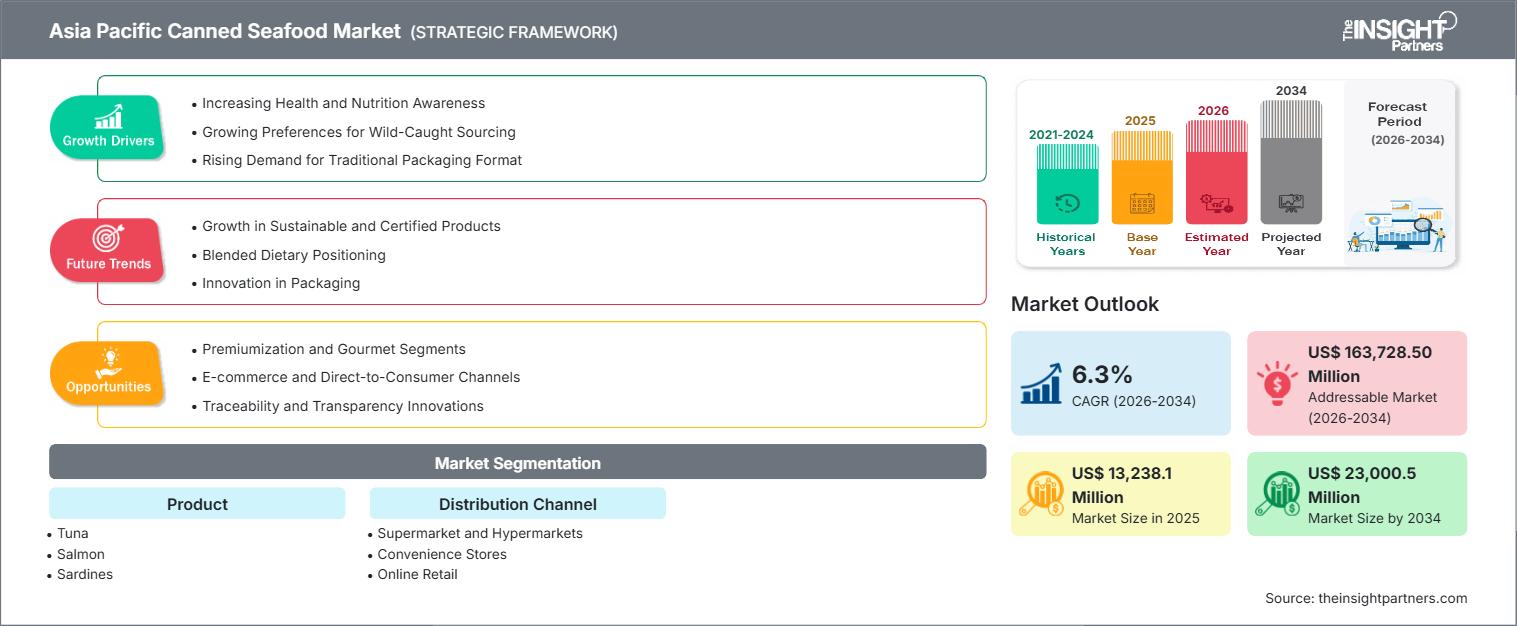
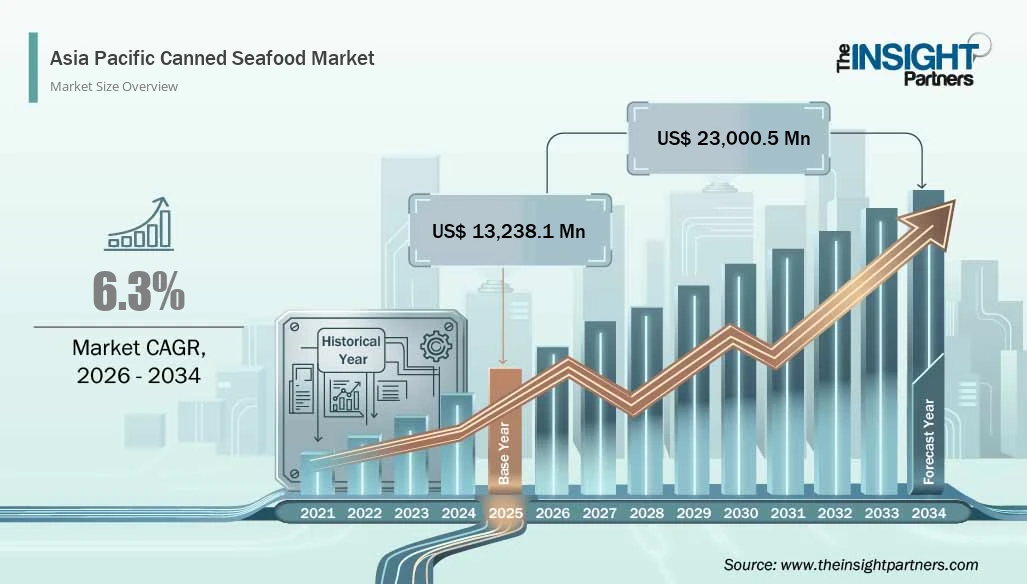
The Asia Pacific Canned Seafood Market size is expected to reach US$ 23,000.5 Million by 2034 from US$ 13,238.1 Million in 2025. The market is estimated to record a CAGR of 6.3% from 2026 to 2034.
Executive Summary and Asia Pacific Canned Seafood Market Analysis:
Strong seafood consumption traditions, rapid urbanization, and increasing demand for convenient food products support the demand for canned seafood in the Asia Pacific. Seafood is a staple in many regional diets, particularly in countries such as Japan, China, Thailand, and Indonesia, where fish and marine products are integral to daily meals. Canned seafood provides a convenient extension of these consumption habits, especially in urban areas with busy lifestyles. Population growth, rising disposable incomes, and expanding middle-class segments are contributing to increased demand for processed and packaged food products, including canned seafood. Awareness of the health benefits of seafood-particularly its nutritional value and role in balanced diets-is strengthening, particularly among urban consumers.
The region also benefits from a strong production base and proximity to raw material sources, supporting both domestic consumption and export-oriented growth. Cultural familiarity with various seafood species supports product diversity, while innovations in flavors, spices, and ready-to-eat formats cater to local taste preferences. Convenience, affordability, and long shelf life make canned seafood particularly attractive in emerging markets and inland regions. Increasing awareness of food safety, quality, and sustainability is gradually influencing consumer choices, supporting the development of higher-value and branded product segments across the Asia Pacific market.
● REPORT CUSTOMIZATION
Tailor This Report To Align With Your Specific Business Requirements
This report can be customized to align precisely with your business objectives, scope, and target markets. Customization options include tailored segmentation, geography, competitive analysis, and strategic insights to support informed decision-making.
Customize This Report →WHAT YOU CAN ADJUST
- ● Segmentations
- ● Geography
- ● Competitive Analysis
- ● Language Preferences
Asia Pacific Canned Seafood Market: Strategic Insights
-
Get Top Key Market Trends of this report.This FREE sample will include data analysis, ranging from market trends to estimates and forecasts.
Asia Pacific Canned Seafood Market Segmentation Analysis:
- By Product, the Asia Pacific Canned Seafood Market is segmented into Tuna, Salmon, Sardines, Mackerel, Shrimps and Prawns, Clams, Crabs, Lobsters, and Others. The Tuna segment dominated the market in 2025.
- By Distribution Channel, the Asia Pacific Canned Seafood Market is segmented into Supermarket and Hypermarkets, Convenience Stores, Online Retail, and Others. The Supermarket and Hypermarkets segment dominated the market in 2025.
Asia Pacific Canned Seafood Market Report Scope
| Report Attribute | Details |
|---|---|
| Market size in 2025 | US$ 13,238.1 Million |
| Market Size by 2034 | US$ 23,000.5 Million |
| CAGR (2026 - 2034) | 6.3% |
| Historical Data | 2021-2024 |
| Forecast period | 2026-2034 |
| Segments Covered |
By Product
|
| Regions and Countries Covered |
Asia Pacific
|
| Market leaders and key company profiles |
|
Asia Pacific Canned Seafood Market Players Density: Understanding Its Impact on Business Dynamics
The Asia Pacific Canned Seafood Market is growing rapidly, driven by increasing end-user demand due to factors such as evolving consumer preferences, technological advancements, and greater awareness of the product's benefits. As demand rises, businesses are expanding their offerings, innovating to meet consumer needs, and capitalizing on emerging trends, which further fuels market growth.
Asia Pacific Canned Seafood Market Outlook
Increasing consumer awareness of sustainability, food safety, and ethical sourcing has elevated the importance of providing clear, verifiable product information across the value chain. Technological solutions such as QR codes, blockchain-based tracking systems, and integrated digital platforms enable companies to share detailed insights into seafood origin, species identification, harvesting or farming methods, processing stages, and distribution pathways. This level of transparency supports informed purchasing decisions and enhances trust in both wild-caught and aquaculture products.
Traceability innovations are relevant in a global market characterized by complex, multi-country supply chains and varying regulatory frameworks. Enhanced visibility helps mitigate risks related to mislabeling, illegal fishing, and quality inconsistencies, while aligning with stringent international standards and compliance requirements.
From a competitive standpoint, transparent communication of sourcing and sustainability practices helps brands differentiate themselves in a crowded marketplace where core product attributes are often similar. It also supports alignment with retailer expectations, certification bodies, and private-label standards that emphasize accountability and responsible sourcing. As transparency becomes an integral part of consumer expectations worldwide, continued investment in traceability technologies is strengthening brand credibility, improving supply chain efficiency, and supporting long-term growth and sustainability in the global seafood market.
Asia Pacific Canned Seafood Market Country Insights
By country, the Asia Pacific Canned Seafood Market is segmented into Australia, China, India, Japan, South Korea, and the Rest of Asia Pacific. China held the largest share in 2025.
In China, demand for canned seafood is increasing due to rapid urbanization, busy work schedules, and a growing middle class seeking convenient yet nutritious meal solutions. Tuna and sardines are gaining popularity among younger consumers in cities such as Shanghai and Beijing for quick office lunches, rice bowls, and noodle dishes. The expansion of e-commerce platforms such as Tmall and JD.com, alongside modern convenience stores, has made imported and domestic canned seafood widely accessible. Rising health awareness, particularly around protein intake and omega-3 fatty acids, encourages consumers to view canned fish as a healthier alternative to processed meats. Brands are introducing mild flavors and easy-open lids to appeal to first-time users, while Western-inspired recipes such as tuna salads and sandwiches enter household kitchens. Food safety concerns over fresh seafood from polluted waters push some consumers toward trusted, shelf-stable canned options, sustaining steady volume growth driven by convenience and evolving dietary patterns.
Asia Pacific Canned Seafood Market Company Profiles
Some of the key players operating in the market include Princes Limited, Conservas Ortiz S.A., Bolton Group S.p.A, Frinsa, Petrossian, John West Foods Limited, King Oscar AS, Pinhais & Ca Lda, RAMIREZ, and FANGST.
These players are adopting various strategies such as expansion, product innovation, and mergers and acquisitions to provide innovative products to their consumers and increase their market share.
Asia Pacific Canned Seafood Market Research Methodology
The following methodology has been followed for the collection and analysis of data presented in this report:
Secondary Research
The research process begins with comprehensive secondary research, utilizing internal and external sources to gather qualitative and quantitative data for each market. Commonly referenced secondary research sources include, but are not limited to:
- Company websites, annual reports, financial statements, broker analyses, and investor presentations
- Industry trade journals and other relevant publications
- Government documents, statistical databases, and market reports
- News articles, press releases, and webcasts specific to companies operating in the market
Note:
All financial data included in the Company Profiles section has been standardized to US$. For companies reporting in other currencies, figures have been converted to US$ using the relevant exchange rates for the corresponding year.Primary Research
The Insight Partners conducts a significant number of primary interviews each year with industry stakeholders and experts to validate its data analysis and gain valuable insights. These research interviews are designed to:
- Validate and refine findings from secondary research
- Enhance the expertise and market understanding of the analysis team
- Gain insights into market size, trends, growth patterns, competitive dynamics, and future prospects
Primary research is conducted via email interactions and telephone interviews, encompassing various markets, categories, segments, and sub-segments across different regions. Participants typically include:
- Industry stakeholders: Vice Presidents, Business Development Managers, Market Intelligence Managers, and National Sales Managers
- External experts: Valuation specialists, research analysts, and key opinion leaders with industry-specific expertise

- Comprehensive Market Sizing and Forecast Analysis
- Detailed Segmentation Analysis
- In-Depth Market Dynamics Assessment
- Regional and Country-Level Insights
- Competitive Landscape and Company Benchmarking
- Strategic Business Intelligence
Recent Reports
Testimonials

The Insight Partners' SCADA System Market report is comprehensive, with valuable insights on current trends and future forecasts. The team was highly professional, responsive, and supportive throughout. We are very satisfied and highly recommend their services.
RAN KEDEM Partner, Reali Technologies LTDs
I requested a report on a very specific software market and the team produced the report in a few days. The information was very relevant and well presented. I then requested some changes and additions to the report. The team was again very responsive and I got the final report in less than a week.
JEAN-HERVE JENN Chairman, Future Analytica
We worked with The Insight Partners for an important market study and forecast. They gave us clear insights into opportunities and risks, which helped shape our plans. Their research was easy to use and based on solid data. It helped us make smart, confident decisions. We highly recommend them.
PIYUSH NAGPAL Sr. Vice President, High Beam Global
The Insight Partners delivered insightful, well-structured market research with strong domain expertise. Their team was professional and responsive throughout. The user-friendly website made accessing industry reports seamless. We highly recommend them for reliable, high-quality research services
YUKIHIKO ADACHI CEO, Deep Blue, LLC.
This is the first time I have purchased a market report from The Insight Partners.While I was unsure at first, I visited their web site and felt more comfortable to take the risk and purchase a market report.I am completely satisfied with the quality of the report and customer service. I had several questions and comments with the initial report, but after a couple of dialogs over email with their analyst I believe I have a report that I can use as input to our strategic planning process.Thank you so much for taking the extra time and making this a positive experience.I will definitely recommend your service to others and you will be my first call when we need further market data.
JOHN SUZUKI President and Chief Executive Officer, Board Director, BK Technologies
I wish to appreciate your support and the professionalism you displayed in the course of attending to my request for information regarding to infectious disease IVD market in Nigeria. I appreciate your patience, your guidance, and the fact that you were willing to offer a discount, which eventually made it possible for us to close a deal. I look forward to engaging The Insight Partners in the future, all thanks to the impression you have created in me as a result of this first encounter.
DR CHIJIOKE ONYIA MANAGING DIRECTOR, PineCrest Healthcare Ltd.Reason to Buy
- Informed Decision-Making
- Understanding Market Dynamics
- Competitive Analysis
- Identifying Emerging Markets
- Customer Insights
- Market Forecasts
- Risk Mitigation
- Boosting Operational Efficiency
- Strategic Planning
- Investment Justification
- Tracking Industry Innovations
- Aligning with Regulatory Trends





 Get Free Sample for