
Asia Pacific Peritoneal Dialysis Equipment Market Analysis and Forecast by Size, Share, Growth, Trends 2031
Asia Pacific Peritoneal Dialysis Equipment Market Size and Forecast (2021 - 2031), Regional Share, Trend, and Growth Opportunity Analysis Report Coverage: By Product Type (Peritoneal Dialysis Solution, Peritoneal Dialysis Catheters, Peritoneal Dialysis Transfer Sets, and Others), Dialysis Type [Continuous Ambulatory Peritoneal Dialysis (CAPD) and Automated Peritoneal Dialysis (APD)], and End User (In-Center Dialysis Settings and Home Care Settings)
Historic Data: 2021-2023 | Base Year: 2024 | Forecast Period: 2025-2031- Status : Published
- Report Code : TIPRE00042577
- Category : Life Sciences
- No. of Pages : 212
- Available Report Formats :




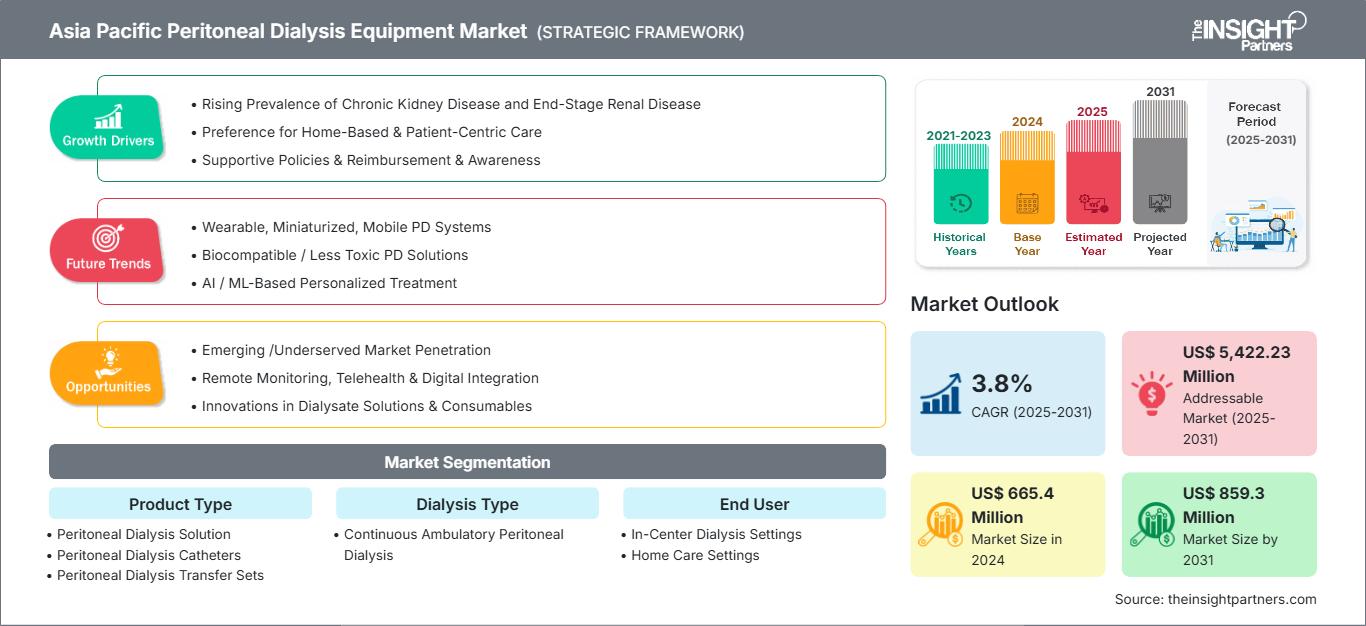
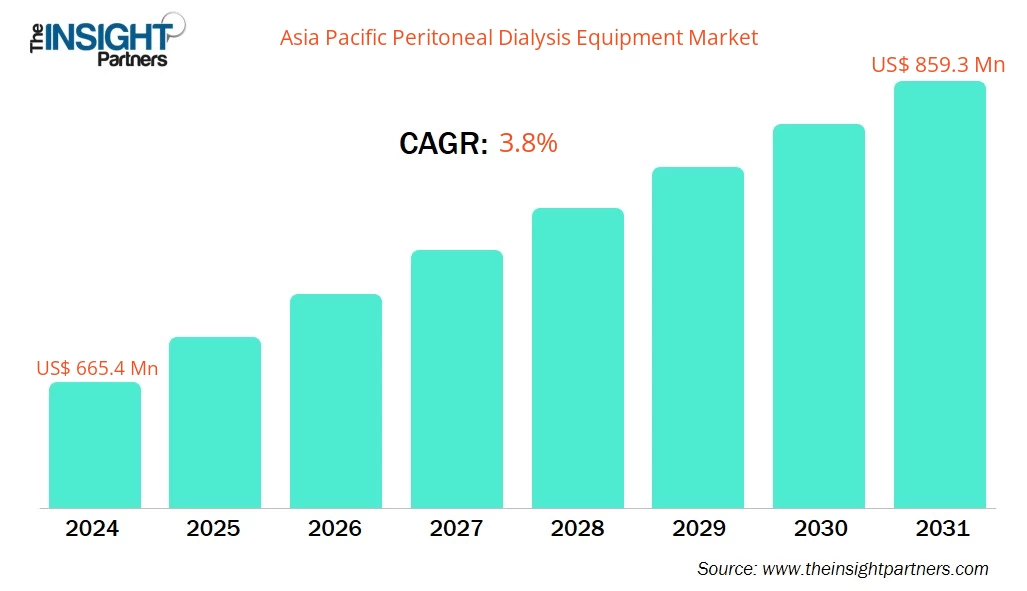
The Asia Pacific Peritoneal Dialysis Equipment Market size is expected to reach US$ 859.3 Million by 2031 from US$ 665.4 Million in 2024. The market is estimated to record a CAGR of 3.8% from 2025 to 2031.
Executive Summary and Asia Pacific Peritoneal Dialysis Equipment Market Analysis:
Asia Pacific is progressively becoming a significant growth engine in the peritoneal dialysis (PD) equipment market. In 2024, the region was responsible for ~38-39% of the global peritoneal dialysis market value, driven by the increasing prevalence of end-stage renal disease (ESRD), chronic kidney disease (CKD) related to diabetes and hypertension, and the limited availability of hemodialysis facilities. China is the leader in the region, accounting for more than one-third of the overall market share of Asia Pacific, primarily driven by the vast patient volumes, growing healthcare infrastructure, and increasing reimbursement coverage. Japan is a major contributor, with deep investments in automated peritoneal dialysis (APD) systems. There is a strong trend toward using home-based PD, supported by government policies (including PD-favored or PD-first strategies), local manufacturing that enables lower prices, and the increasing availability of smart/remote-monitoring enabled APD cyclers.
Customize This Report To Suit Your Requirement
Get FREE CUSTOMIZATIONAsia Pacific Peritoneal Dialysis Equipment Market: Strategic Insights
-
Get Top Key Market Trends of this report.This FREE sample will include data analysis, ranging from market trends to estimates and forecasts.
Asia Pacific Peritoneal Dialysis Equipment Market Segmentation Analysis:
- By Product Type, the Asia Pacific Peritoneal Dialysis Equipment Market is segmented into Peritoneal Dialysis Solution, Peritoneal Dialysis Catheters, Peritoneal Dialysis Transfer Sets, and Others. The Peritoneal Dialysis Solution segment dominated the market in 2024.
- By Dialysis Type, the Asia Pacific Peritoneal Dialysis Equipment Market is segmented into Continuous Ambulatory Peritoneal Dialysis (CAPD) and Automated Peritoneal Dialysis (APD). The Continuous Ambulatory Peritoneal Dialysis (CAPD) segment dominated the market in 2024.
- By End User, the Asia Pacific Peritoneal Dialysis Equipment Market is segmented into In-Center Dialysis Settings and Home Care Settings. The In-Center Dialysis Settings segment dominated the market in 2024.
Asia Pacific Peritoneal Dialysis Equipment Market Report Scope
| Report Attribute | Details |
|---|---|
| Market size in 2024 | US$ 665.4 Million |
| Market Size by 2031 | US$ 859.3 Million |
| CAGR (2025 - 2031) | 3.8% |
| Historical Data | 2021-2023 |
| Forecast period | 2025-2031 |
| Segments Covered |
By Product Type
|
| Regions and Countries Covered |
Asia Pacific
|
| Market leaders and key company profiles |
|
Asia Pacific Peritoneal Dialysis Equipment Market Players Density: Understanding Its Impact on Business Dynamics
The Asia Pacific Peritoneal Dialysis Equipment Market is growing rapidly, driven by increasing end-user demand due to factors such as evolving consumer preferences, technological advancements, and greater awareness of the product's benefits. As demand rises, businesses are expanding their offerings, innovating to meet consumer needs, and capitalizing on emerging trends, which further fuels market growth.
Asia Pacific Peritoneal Dialysis Equipment Market Outlook
The demand for peritoneal dialysis (PD) is rising rapidly in low- and middle-income countries (LMICs) as well as in regions with rural and underserved populations. Manufacturers and health systems are thus presented with a significant opportunity to enter these markets with suitable PD devices and provide services. Policy discussions and health programs.
With better awareness and diagnosis, newly detected patients are rapidly progressing to ESRD in areas far from primary hemodialysis clinics, making PD the most preferable option, as it can be administered either at a patient's home or a nearby clinic.
This progress also reflects an increasing commitment from the governments and NGOs to train more local clinicians and strengthen capacity in rural and less privileged areas. By associating with health ministries, PD equipment manufacturers have an opportunity to provide district hospitals with more suitable apparatuses (including easier APD cyclers that are sturdy in low-resource environments, a supply of consumables, catheters, etc.), help with remote support & telehealth services, and ensure dependable maintenance. The launch of district hospital pilot PD units, in addition to tertiary centers, dramatically reduces the distance to care for most ESRD patients, thereby increasing access.
Underprivileged groups often encounter cost and logistics obstacles, including travel time, transportation expenses, and income loss. PD equipment that is more user-friendly for setup, upkeep, patient training, and has lower power/water requirements, or a modular design, has a competitive edge. User-friendly governments are determined to extend CKD care to low-income and rural populations (for instance, by integrating it with primary healthcare or health insurance schemes). In that case, the procurement of PD equipment in these areas can increase significantly.
The potential in underserved/emerging markets is to harmonize product designs and service models (affordable, robust, user-friendly PD systems), raise awareness, put money into clinician and patient training, and collaborate with local health systems to open and support PD in districts and home settings. Such deepening can advance health equity and be a growth route for PD equipment suppliers.
On the contrary, the risk of peritonitis and catheter-related complications hamper the growth of the Asia Pacific peritoneal dialysis equipment market.
Asia Pacific Peritoneal Dialysis Equipment Market Country Insights
By country, the Asia Pacific Peritoneal Dialysis Equipment Market is segmented into China, Japan, India, Australia, South Korea, Rest of APAC. Japan held the largest share in 2024.
In Japan, peritoneal dialysis accounts for only a small fraction of dialysis care. Its growth, however, has been slow but steady for the last few years. According to the Annual Dialysis Data Report 2023 by the Japanese Society for Dialysis Therapy (JRDR), as of the end of 2023, the total number of patients on dialysis was 343,508. Among them, only 10,585 were on PD, which shows a slight increase over the last couple of years. The overall prevalence of dialysis was approximately 2,762.4 per million population, with the mean age of prevalent patients being around 70 years. Diabetic nephropathy is still the main cause of the disease, which leads to dialysis both in prevalent and incident patients (about 39-40% in each group), followed by chronic glomerulonephritis and nephrosclerosis.
About half of the PD patients are on a cycler device in Japan; hence, automated peritoneal dialysis (APD) has gained acceptance in the country. Around 40-50% of patients are on a cycler, which shows that patients are more willing to accept convenience and lifestyle flexibility, especially for night treatments. Patients might also be using hybrid PD + hemodialysis/HDF regimens, which are around 20-21%, as a treatment option.
Asia Pacific Peritoneal Dialysis Equipment Market Company Profiles
Some of the key players operating in the market include Terumo Corp, Medtronic Plc, Asahi Kasei Corp, Baxter International Inc, Fresenius Medical Care AG & Co KGaA, B. Braun Melsungen AG, Angiplast, Becton Dickinson and Co, Utah Medical Products Inc, Poly Medicure Ltd
These players are adopting various strategies such as expansion, product innovation, and mergers and acquisitions to provide innovative products to their consumers and increase their market share.
Asia Pacific Peritoneal Dialysis Equipment Market Research Methodology
The following methodology has been followed for the collection and analysis of data presented in this report:
Secondary Research
The research process begins with comprehensive secondary research, utilizing internal and external sources to gather qualitative and quantitative data for each market. Commonly referenced secondary research sources include, but are not limited to:
- Company websites, annual reports, financial statements, broker analyses, and investor presentations
- Industry trade journals and other relevant publications
- Government documents, statistical databases, and market reports
- News articles, press releases, and webcasts specific to companies operating in the market
Note:
All financial data included in the Company Profiles section has been standardized to US$. For companies reporting in other currencies, figures have been converted to US$ using the relevant exchange rates for the corresponding year.Primary Research
The Insight Partners conducts a significant number of primary interviews each year with industry stakeholders and experts to validate its data analysis and gain valuable insights. These research interviews are designed to:
- Validate and refine findings from secondary research
- Enhance the expertise and market understanding of the analysis team
- Gain insights into market size, trends, growth patterns, competitive dynamics, and future prospects
Primary research is conducted via email interactions and telephone interviews, encompassing various markets, categories, segments, and sub-segments across different regions. Participants typically include:
- Industry stakeholders: Vice Presidents, Business Development Managers, Market Intelligence Managers, and National Sales Managers
- External experts: Valuation specialists, research analysts, and key opinion leaders with industry-specific expertise

- Historical Analysis (2 Years), Base Year, Forecast (7 Years) with CAGR
- PEST and SWOT Analysis
- Market Size Value / Volume - Regional, Country
- Industry and Competitive Landscape
- Excel Dataset
Recent Reports
Testimonials

The Insight Partners' SCADA System Market report is comprehensive, with valuable insights on current trends and future forecasts. The team was highly professional, responsive, and supportive throughout. We are very satisfied and highly recommend their services.
RAN KEDEM Partner, Reali Technologies LTDs
I requested a report on a very specific software market and the team produced the report in a few days. The information was very relevant and well presented. I then requested some changes and additions to the report. The team was again very responsive and I got the final report in less than a week.
JEAN-HERVE JENN Chairman, Future Analytica
We worked with The Insight Partners for an important market study and forecast. They gave us clear insights into opportunities and risks, which helped shape our plans. Their research was easy to use and based on solid data. It helped us make smart, confident decisions. We highly recommend them.
PIYUSH NAGPAL Sr. Vice President, High Beam Global
The Insight Partners delivered insightful, well-structured market research with strong domain expertise. Their team was professional and responsive throughout. The user-friendly website made accessing industry reports seamless. We highly recommend them for reliable, high-quality research services
YUKIHIKO ADACHI CEO, Deep Blue, LLC.
This is the first time I have purchased a market report from The Insight Partners.While I was unsure at first, I visited their web site and felt more comfortable to take the risk and purchase a market report.I am completely satisfied with the quality of the report and customer service. I had several questions and comments with the initial report, but after a couple of dialogs over email with their analyst I believe I have a report that I can use as input to our strategic planning process.Thank you so much for taking the extra time and making this a positive experience.I will definitely recommend your service to others and you will be my first call when we need further market data.
JOHN SUZUKI President and Chief Executive Officer, Board Director, BK Technologies
I wish to appreciate your support and the professionalism you displayed in the course of attending to my request for information regarding to infectious disease IVD market in Nigeria. I appreciate your patience, your guidance, and the fact that you were willing to offer a discount, which eventually made it possible for us to close a deal. I look forward to engaging The Insight Partners in the future, all thanks to the impression you have created in me as a result of this first encounter.
DR CHIJIOKE ONYIA MANAGING DIRECTOR, PineCrest Healthcare Ltd.Reason to Buy
- Informed Decision-Making
- Understanding Market Dynamics
- Competitive Analysis
- Identifying Emerging Markets
- Customer Insights
- Market Forecasts
- Risk Mitigation
- Boosting Operational Efficiency
- Strategic Planning
- Investment Justification
- Tracking Industry Innovations
- Aligning with Regulatory Trends
Unlock Exclusive Report Discounts
Enquire Now




 Get Free Sample For