
Asteroid Mining Market Share, Size & Demand by 2034
Coverage: By Phase (Spacecraft Design, Launch, Operation); Asteroid Type (Type C, Type S, Others); Extraction Technology (Shaft Mining, Magnetic Rakes, Surface Mining, Mond Process, Others) , and Geography (North America, Europe, Asia Pacific, and South and Central America)
- Status : Data Released
- Report Code : TIPRE00022347
- Category : Aerospace and Defense
- No. of Pages : 150
- Available Report Formats :


- Last update date : November 03, 2026


2025 Market Size
US$ 2.64 Bn
Base year value
2034 Forecast
US$ 13.85 Bn
Projected by 2034
CAGR 2026-2034
20.22 %
Growth rate
Addressable Market
US$ 66.64 Bn
(2026-2034)
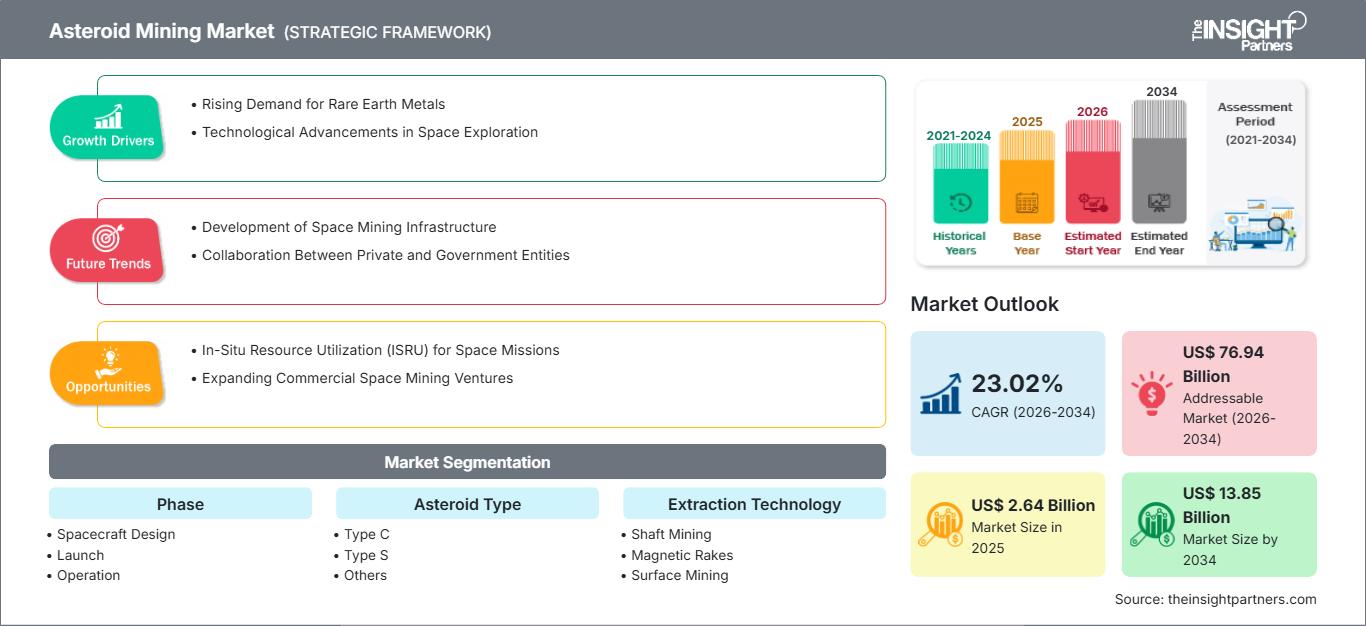
The asteroid mining market was valued at US$ 2.64 Billion in 2025 and is projected to reach US$ 13.85 Billion by 2034, expanding at a CAGR of 20.22% from 2026 to 2034. Growth is supported by advances in autonomous spacecraft, resource prospecting, deep-space communications, extraction technologies, and lower-cost launch architectures. Increasing attention to in-space resource utilization is also shifting the industry from conceptual studies toward technology demonstrations, prospecting missions, and commercially oriented spacecraft development.
North America is positioned as a major development center for the asteroid mining market size, supported by private deep-space ventures, established aerospace capabilities, government technology programs, and access to launch infrastructure. The region is expected to record a ~20% CAGR through 2034, with growth increasingly linked to autonomous navigation, spacecraft miniaturization, asteroid characterization, and commercialization of in-space resources.
Asteroid Mining Market Assessment and Insights
Regional Outlook
- North America: ~41% of the global market in 2025 | ~20% CAGR through 2034. Market position: North America holds the leading regional position because of strong private-space investment, advanced spacecraft engineering, launch access, deep-space mission heritage, and a dense ecosystem connecting government programs with commercial resource-extraction ventures.
- US: ~76% of North American market revenue in 2025 | ~20% CAGR through 2034. Market position: The US represents the dominant country within North America, supported by commercial spacecraft development, NASA technology programs, venture investment, and growing interest in resource prospecting, autonomous operations, and deep-space infrastructure.
- Europe: ~27% of the global market in 2025 | ~18% CAGR through 2034. Market position: Europe has an established space-industrial base and supportive regulatory initiatives. The UK leads Europe, while Germany and France provide strong aerospace engineering capabilities; Italy and Spain contribute through spacecraft manufacturing, robotics, and scientific programs.
- Asia Pacific: ~22% of the global market in 2025 | ~26% CAGR through 2034. Market position: Asia Pacific is the fastest-growing region, driven by Japan's resource-utilization programs, China's expanding deep-space capabilities, India's growing space ecosystem, South Korean technology investment, and Australia's interest in space-resource exploration.
Segment Outlook
- Operation: ~36% Share in 2025 | ~22% CAGR through 2034. Market position: Operation represents the largest phase because successful resource missions require sustained autonomous spacecraft activity, navigation, prospecting, extraction, processing, communications, and mission control capabilities after launch and deployment.
- Extraction Technology: ~28% Share in 2025 | ~25% CAGR through 2034. Market position: Extraction Technology has the strongest growth outlook as commercial projects increasingly focus on moving beyond characterization toward practical resource recovery, processing, material separation, and demonstration of repeatable extraction systems in low-gravity environments.
Competitive Coverage
Asteroid Mining Corporation Limited, Bradford, iSpace, Inc., Kleos Space, Moon Express, ConsenSys, Spacefab.US, Sierra Nevada Corporation, OffWorld, Virgin Galactic, AstroForge, TransAstra, ExLabs
Methodology
The Insight Partners follows Data Collection & Secondary Research, Primary Research, Data Analysis, and Data Triangulation & Final Review to validate market estimates and insights.
Source: The Insight Partners' analysis based on proprietary research, government publications, company annual reports, investor presentations, industry databases, and expert interviews.
Market development has moved from resource assessment of the asteroids to the integration of mission architectures comprising of spacecraft, prospecting tools, automated navigation, robotics, and resource-processing technology. The asteroid missions by NASA have shown how important detailed characterization and sample return of these celestial bodies are, whereas commercial missions are exploring the possibility of miniaturized spacecraft and fast development cycles. This has led to technology developments in the form of modular spacecraft, autonomous mission operations, communication, and resource extraction systems robust enough to work under weak gravitational forces, rough terrain, and uncertain material compositions.
For the future, investments will expand geographically as countries put in place policies for commercial space resource activities and the industry explores collaborative efforts in areas of exploration, robotics, launches, and resource processing. The emergence of programs in countries such as Japan, Luxembourg, United States, and others shows that through clear regulation and private-public collaboration, the obstacles for experimentation will be lowered. Market development over time will need demonstration of repeatable economics, reliable automation, resource concentrations, and ways of using the mined resources in space or on earth when economically viable.
Asteroid Mining Market Report Scope
| Report Attribute | Details |
|---|---|
| Market size in 2025 | US$ 2.64 Billion |
| Market Size by 2034 | US$ 13.85 Billion |
| Global CAGR (2026 - 2034) | 20.22% |
| Historical Data | 2021-2024 |
| Forecast period | 2026-2034 |
Asteroid Mining Market Analysis
The asteroid mining market growth is primarily connected to the increasing economic importance of operating beyond Earth orbit. Resource prospecting can provide water, metals, volatiles, and other materials that may support spacecraft operations and future space infrastructure. The value chain therefore extends from asteroid identification and characterization to spacecraft design, launch, navigation, surface interaction, extraction, processing, storage, and transportation. Demand is developing around technologies that reduce mission mass, improve autonomy, and increase the probability of successful resource recovery.
The supply-side development for the industry is also highly specialized since many commercial systems have yet to reach either demonstration or pre-commercial phases. Businesses are thus incorporating spacecraft engineering, robotics, propulsion, sensing, and mission operation into their supply chain, instead of being dependent only on conventional aerospace supply chains. The supply chain is helped by low launch barriers and the availability of standardized spacecraft parts but deep space propulsion, radiation resistance, autonomy, and resource processing technology is difficult.
As per the asteroid mining market report, the competition in the industry lies in technical differences and not production scale. Asteroid Mining Corporation Limited and OffWorld bring resource-robotics expertise while iSpace, Inc. contributes operational experience related to space resources. AstroForge specializes in small spacecraft and asteroid characterization, TransAstra creates resource processing and capture technology while ExLabs works on modular deep space infrastructure. Sierra Nevada Corporation, Moon Express, Spacefab.US, Bradford, Kleos Space, ConsenSys, and Virgin Galactic add to the competitive picture with their aerospace, space infrastructure, software, or exploration capability.
The need for incremental demonstration of technology, as opposed to an expensive single mission, is increasingly becoming a priority. Areas where companies can make money include modular spaceflight systems, autonomous navigation, prospecting equipment, robots on the surface, and in-space processing technology. Positioning strategies will thus be focused on models such as mission-as-a-service, partnerships, technology licensing, and platforming. Companies capable of turning scientific prospecting into engineering data will have a head start before large-scale mining becomes commercially viable.
● REPORT CUSTOMIZATION
Tailor This Report To Align With Your Specific Business Requirements
This report can be customized to align precisely with your business objectives, scope, and target markets. Customization options include tailored segmentation, geography, competitive analysis, and strategic insights to support informed decision-making.
Customize This Report →WHAT YOU CAN ADJUST
- ● Segmentations
- ● Geography
- ● Competitive Analysis
- ● Language Preferences
Asteroid Mining Market: Strategic Insights
Regional Insights
North America asteroid mining market
North America accounted for approximately ~41% of the asteroid mining market in 2025 and is expected to expand at a ~20% CAGR through 2034. The US dominates regional activity because of its concentration of launch providers, spacecraft developers, research institutions, defense contractors, and commercial deep-space startups. Government technology programs help validate robotics, autonomous navigation, resource characterization, and propulsion technologies that can later be adapted for commercial missions.
This region is fortunate to have a fully developed venture network that is able to fund risky ventures in the aerospace industry, which includes several stages of development. Private firms are now investing in low-cost space craft, asteroid flybys, rendezvous missions, and resource-prospecting vehicles. The reason is that such firms prefer to first explore the resources before embarking on the actual extraction of those resources. The US is still developing the extraction architecture, while Canada provides the robotics and resource engineering skills.
U.S. asteroid mining market
The US represented approximately ~76% of North American asteroid mining market share in 2025 and is projected to record a ~20% CAGR through 2034. Its position is supported by NASA's long-standing asteroid exploration expertise, a broad commercial space ecosystem, and increasing private investment in deep-space spacecraft and autonomous systems. Commercial developers are targeting prospecting, imaging, resource identification, and eventually extraction.
Application trends increasingly favor technologies that can operate without continuous ground intervention. Autonomous navigation, compact propulsion systems, high-resolution imaging, robotic manipulation, and resource-processing equipment are therefore receiving attention. Companies including AstroForge, OffWorld, Sierra Nevada Corporation, Moon Express, and ExLabs illustrate different approaches to extending commercial capabilities beyond conventional Earth-orbit missions. The US also benefits from regulatory and policy activity supporting private-sector space-resource development, although commercial viability still depends on mission reliability, transportation costs, resource concentration, and the ability to create repeatable revenue streams.
Europe asteroid mining market
Europe represented approximately ~27% of the asteroid mining market in 2025 and is expected to grow at a ~18% CAGR through 2034. The UK is the leading country in Europe, supported by an active commercial space sector and interest in space-resource technologies. Germany and France contribute substantial spacecraft engineering, scientific research, propulsion, and industrial capabilities, while Italy and Spain add expertise in satellites, robotics, navigation, and aerospace manufacturing.
European development is strongly influenced by regulatory experimentation and multinational collaboration. Luxembourg has established a legal framework for space-resource activities, providing an important institutional reference for commercial resource utilization. The UK combines private-sector innovation with established aerospace supply chains and research capabilities. Germany's industrial base supports high-reliability spacecraft technologies, while France benefits from its broader launch and space-science ecosystem.
Italy and Spain are positioned to participate through robotics, sensors, spacecraft subsystems, and research partnerships rather than immediate large-scale extraction. Across Europe, the commercial model is therefore likely to develop through technology demonstrations and international missions before dedicated mining operations achieve maturity. Collaboration among governments, agencies, universities, and private developers remains important for managing technical and financial risk.
APAC asteroid mining market
Asia Pacific accounted for approximately ~22% of the asteroid mining market share in 2025 and is forecast to expand at a ~26% CAGR, making it the fastest-growing region. Japan is the leading country in Asia Pacific, supported by sophisticated asteroid exploration heritage, robotics capabilities, and growing interest in resource utilization. China has substantial deep-space engineering capacity, while India is rapidly expanding its commercial space ecosystem.
Japan's experience with asteroid sample-return missions provides important technical knowledge for characterization and material handling. South Korea is strengthening space technology capabilities, while Australia contributes mining expertise, robotics, remote operations, and resource-engineering knowledge. Regional policy programs are increasingly connecting space exploration with long-term industrial development. The combination of government-backed missions, commercial participation, robotics, and terrestrial mining expertise creates a favorable environment for resource-prospecting technologies.
Middle East & Africa asteroid mining market
The Middle East & Africa region is expected to record a ~22% CAGR through 2034 as governments and private-sector organizations expand space capabilities. The UAE is the leading country in the Middle East & Africa based on its comparatively advanced space program, international partnerships, and investment in planetary science and exploration. Saudi Arabia is also developing capabilities through research and institutional collaboration.
South Africa provides established astronomical and scientific infrastructure, while the rest of the Middle East & Africa offers emerging opportunities in satellite services, engineering education, launch-related infrastructure, and technology investment. Energy-sector expertise can also contribute to resource-processing concepts, autonomous industrial operations, and remote-system management. However, the regional market remains smaller than North America, Europe, and Asia Pacific, and near-term participation is more likely to center on technology partnerships, scientific missions, and infrastructure services than independent extraction operations.
Segmentation Analysis
Phase
Phase is a central market category because commercial resource missions require coordinated development from spacecraft architecture through launch and sustained operations. Buyers prioritize reliability, autonomy, mission flexibility, and the ability to integrate resource-specific payloads without excessive spacecraft mass. The category is therefore shifting toward modular mission architectures and iterative technology demonstrations. The strongest category-level expansion is associated with ~22% CAGR as operational capabilities become increasingly important for repeatable deep-space missions.
- Spacecraft Design: Spacecraft design determines payload capacity, propulsion integration, power availability, communications, thermal control, and autonomous operating capability. Modular architectures can reduce redesign requirements as developers transition from prospecting missions toward resource-extraction demonstrations.
- Launch: Launch services provide access to increasingly capable commercial and government transportation systems. Mission planners prioritize rideshare compatibility, trajectory flexibility, payload integration, and launch reliability because transportation constraints directly influence asteroid selection and mission economics.
- Operation: Operation encompasses navigation, communications, spacecraft control, surface interaction, resource characterization, and mission management. Long-duration autonomous operation is strategically important because communication delays and distance make continuous Earth-based control impractical for many deep-space activities.
Asteroid Type
Asteroid Type influences prospecting priorities because composition determines potential resource availability, extraction complexity, and processing requirements. Investors and mission designers increasingly use spectral observations and returned-sample knowledge to identify promising targets before committing to expensive rendezvous or landing missions. The category's commercial significance therefore depends on better resource characterization and target-selection accuracy. The leading category-level outlook is associated with ~24% CAGR as improved sensing supports more selective mission planning.
- Type C: Type C asteroids are attractive for resource utilization because carbon-rich materials can contain hydrated minerals and other volatiles. Their potential water content makes them relevant to future life-support, propellant, and in-space manufacturing concepts.
- Type S: Type S asteroids contain silicate-rich materials and may offer opportunities for construction-related resources and metallic elements. Their comparatively well-studied composition supports continued investigation of extraction and processing methods.
- Others: Other asteroid classes encompass targets with distinct mineralogical characteristics that may become commercially relevant as prospecting instruments improve. Their importance will depend on target accessibility, concentration of useful materials, and processing requirements.
Extraction Technology
Extraction Technology is becoming a major commercialization bottleneck because identifying resources does not guarantee that they can be recovered economically. Developers are therefore testing technologies designed for irregular surfaces, weak gravity, limited power, and autonomous operation. The category has the strongest overall growth outlook, with ~25% CAGR, as resource missions progress from observation toward physical interaction and processing.
- Shaft Mining: Shaft mining concepts may support access to subsurface material where surface composition does not adequately represent resource concentration. Engineering priorities include anchoring, excavation stability, debris management, and low-gravity material transport.
- Magnetic Rakes: Magnetic rakes can selectively collect magnetic materials from regolith, potentially reducing mechanical complexity for specific asteroid compositions. Their usefulness depends on target mineralogy and the concentration of magnetically responsive particles.
- Surface Mining: Surface mining involves collecting accessible material from exposed asteroid terrain. Robotic mobility, anchoring, excavation force, dust control, and material containment are key considerations for maintaining operational stability.
- Mond Process: The Mond Process is relevant to processing nickel-rich material through chemical purification. Its future application depends on resource concentration, process energy requirements, spacecraft mass, and the feasibility of conducting refining in space.
- Others: Other technologies include emerging thermal, mechanical, pneumatic, optical, and hybrid approaches. Their adoption will depend on whether they can achieve higher resource recovery while reducing power, mass, and mechanical complexity.
Opportunity Snapshot
| Phase | Revenue Contribution | Trend Tag | Adoption Stage |
|---|---|---|---|
| Spacecraft Design | High | Modular Platforms | Scaling |
| Launch | Medium | Rideshare Access | Scaling |
| Operation | High | Autonomous Control | Scaling |
Asteroid Mining Market Growth Drivers and Impact Analysis
Advances in Autonomous Deep-Space Operations
Autonomy is becoming a fundamental requirement for the asteroid mining market because spacecraft operating far from Earth cannot depend on continuous real-time commands. Improvements in onboard navigation, fault management, computer vision, guidance, and mission planning can allow spacecraft to respond to uncertain surface conditions while reducing communication dependence. This directly affects mission economics by lowering operational workload and increasing the number of spacecraft that can be managed from a common ground infrastructure. Autonomous systems can also improve the feasibility of coordinated prospecting fleets, where multiple spacecraft characterize different targets before a dedicated extraction mission is selected. As autonomy matures, it should shift competitive emphasis from individual spacecraft performance toward repeatable mission architectures and software-enabled operational scalability.
Falling Spacecraft and Launch Development Costs
Lower spacecraft development costs and greater access to commercial launch opportunities are expanding the range of missions that can be attempted by private companies. Smaller spacecraft can carry focused prospecting instruments rather than requiring a single vehicle to perform every function, enabling developers to validate technologies incrementally. Rideshare arrangements can further reduce transportation barriers when mission trajectories are compatible. For the market, this creates a pathway in which characterization, navigation, communications, landing, extraction, and processing technologies can be demonstrated through separate missions. The resulting iterative development model reduces the need for a single high-value mission to prove every technical component simultaneously, although deep-space propulsion, communications, and reliability remain significant cost centers.
Growing Interest in In-Space Resource Utilization
Interest in using resources away from Earth is strengthening the strategic case for asteroid prospecting. Water and other volatiles could eventually support life support, propellant production, radiation protection, and industrial processes, while metals and mineral material could contribute to construction or manufacturing. This changes the commercial proposition from simply returning valuable commodities to Earth toward supplying infrastructure located in space. Such a model can potentially reduce dependence on Earth-launched consumables as deep-space activity expands. The market impact is significant because it broadens the customer base from commodity buyers to spacecraft operators, infrastructure developers, exploration agencies, and future in-space manufacturers. Commercial success will depend on proving that extracted resources can be delivered at competitive cost.
Asteroid Mining Market Future Trends
Shift Toward Modular Prospecting and Extraction Fleets
A major future trend is the movement from single-purpose spacecraft toward modular fleets that can be adapted for different asteroids and mission objectives. Instead of designing an entirely new spacecraft for every target, developers can standardize propulsion, communications, avionics, power, and navigation while changing payloads according to resource characteristics. This approach could support repeated missions and allow companies to build engineering knowledge across multiple targets. The asteroid mining market trends will increasingly favor architectures capable of prospecting first and adding extraction hardware only after resource concentration has been confirmed. Such modularity can also create new revenue models based on payload hosting, mission services, data sales, and technology licensing, reducing dependence on direct resource sales during the industry's early commercialization stage.
Integration of Resource Processing With Deep-Space Infrastructure
Future systems are likely to combine prospecting, extraction, processing, storage, and transportation rather than treating mining as an isolated activity. This trend is particularly important where returning bulk material to Earth is less attractive than consuming resources in space. Processing systems could convert extracted materials into water, propellant feedstocks, construction inputs, or concentrated commodities, depending on asteroid composition. Integration would require improvements in thermal management, power generation, material handling, chemical processing, and autonomous control. The resulting architecture could connect asteroid operations with cislunar infrastructure and other deep-space assets. Over time, resource processing may therefore become an infrastructure business, with spacecraft designed to service multiple missions rather than complete one extraction campaign and return.
Asteroid Mining Market Opportunities
Commercial Deep-Space Mission Services
The asteroid mining market forecast offers an opportunity for companies to build mission infrastructure that serves multiple customers before full-scale extraction becomes commercially established. Deep-space rideshare platforms, hosted payload services, communications, navigation support, spacecraft operations, and prospecting-as-a-service can generate revenue from scientific institutions, governments, universities, and commercial developers. This model distributes mission costs across several users and creates an operational track record that can later support extraction missions. Companies with modular spacecraft and flexible payload interfaces can position themselves as infrastructure providers rather than commodity producers. The opportunity is especially relevant because early asteroid missions require extensive characterization, creating demand for instruments and services even when commercial resource recovery remains technically immature.
Specialized Robotics and Resource-Processing Systems
Specialized robotics represents another investment opportunity because asteroid surfaces impose operating conditions that differ substantially from terrestrial mining. Robots must function with limited gravity, irregular terrain, uncertain surface strength, extreme thermal conditions, and restricted communication. Developers can therefore create value through anchoring mechanisms, excavation tools, collection systems, material containment, autonomous manipulation, and low-energy processing equipment. The commercial opportunity extends beyond asteroid missions because many of these technologies can also support lunar, orbital, and planetary applications. Companies able to demonstrate adaptable hardware across multiple space-resource environments may reduce customer concentration and build recurring technology revenues before dedicated asteroid extraction becomes mature.
Frequently Asked Questions

- Comprehensive Market Sizing and Forecast Analysis
- Detailed Segmentation Analysis
- In-Depth Market Dynamics Assessment
- Regional and Country-Level Insights
- Competitive Landscape and Company Benchmarking
- Strategic Business Intelligence
Testimonials

The Insight Partners provided valuable market intelligence that supported our global go-to-market strategy. Their team was professional, responsive, and attentive to our feedback, providing thoughtful analysis and helpful methodological clarifications throughout the project.
Junmo Kim Chief Financial Officer (CFO), Enertech Co., Ltd.
The Insight Partners' SCADA System Market report is comprehensive, with valuable insights on current trends and future forecasts. The team was highly professional, responsive, and supportive throughout. We are very satisfied and highly recommend their services.
RAN KEDEM Partner, Reali Technologies LTDs
I requested a report on a very specific software market and the team produced the report in a few days. The information was very relevant and well presented. I then requested some changes and additions to the report. The team was again very responsive and I got the final report in less than a week.
JEAN-HERVE JENN Chairman, Future Analytica
We worked with The Insight Partners for an important market study and forecast. They gave us clear insights into opportunities and risks, which helped shape our plans. Their research was easy to use and based on solid data. It helped us make smart, confident decisions. We highly recommend them.
PIYUSH NAGPAL Sr. Vice President, High Beam Global
The Insight Partners delivered insightful, well-structured market research with strong domain expertise. Their team was professional and responsive throughout. The user-friendly website made accessing industry reports seamless. We highly recommend them for reliable, high-quality research services
YUKIHIKO ADACHI CEO, Deep Blue, LLC.
This is the first time I have purchased a market report from The Insight Partners.While I was unsure at first, I visited their web site and felt more comfortable to take the risk and purchase a market report.I am completely satisfied with the quality of the report and customer service. I had several questions and comments with the initial report, but after a couple of dialogs over email with their analyst I believe I have a report that I can use as input to our strategic planning process.Thank you so much for taking the extra time and making this a positive experience.I will definitely recommend your service to others and you will be my first call when we need further market data.
JOHN SUZUKI President and Chief Executive Officer, Board Director, BK Technologies
I wish to appreciate your support and the professionalism you displayed in the course of attending to my request for information regarding to infectious disease IVD market in Nigeria. I appreciate your patience, your guidance, and the fact that you were willing to offer a discount, which eventually made it possible for us to close a deal. I look forward to engaging The Insight Partners in the future, all thanks to the impression you have created in me as a result of this first encounter.
DR CHIJIOKE ONYIA MANAGING DIRECTOR, PineCrest Healthcare Ltd.Reason to Buy
- Informed Decision-Making
- Understanding Market Dynamics
- Competitive Analysis
- Identifying Emerging Markets
- Customer Insights
- Market Forecasts
- Risk Mitigation
- Boosting Operational Efficiency
- Strategic Planning
- Investment Justification
- Tracking Industry Innovations
- Aligning with Regulatory Trends





 Get Free Sample for