
Audiometric Screening Equipment Market Size, Demand & Growth by 2034
Coverage: By Type (OAE Screening Equipment, and ABR Screening Equipment); End Use (Hospitals, Clinics, Home Care, Audiology Centers, Research Communities, and Others), and Geography (North America, Europe, Asia Pacific, and South and Central America)
- Status : Data Released
- Report Code : TIPRE00024844
- Category : Life Sciences
- No. of Pages : 150
- Available Report Formats :


- Last update date : October 30, 2026


2025 Market Size
US$ 1.75 Bn
Base year value
2034 Forecast
US$ 3.1 Bn
Projected by 2034
CAGR 2026-2034
6.56 %
Growth rate
Addressable Market
US$ 21.93 Bn
(2026-2034)
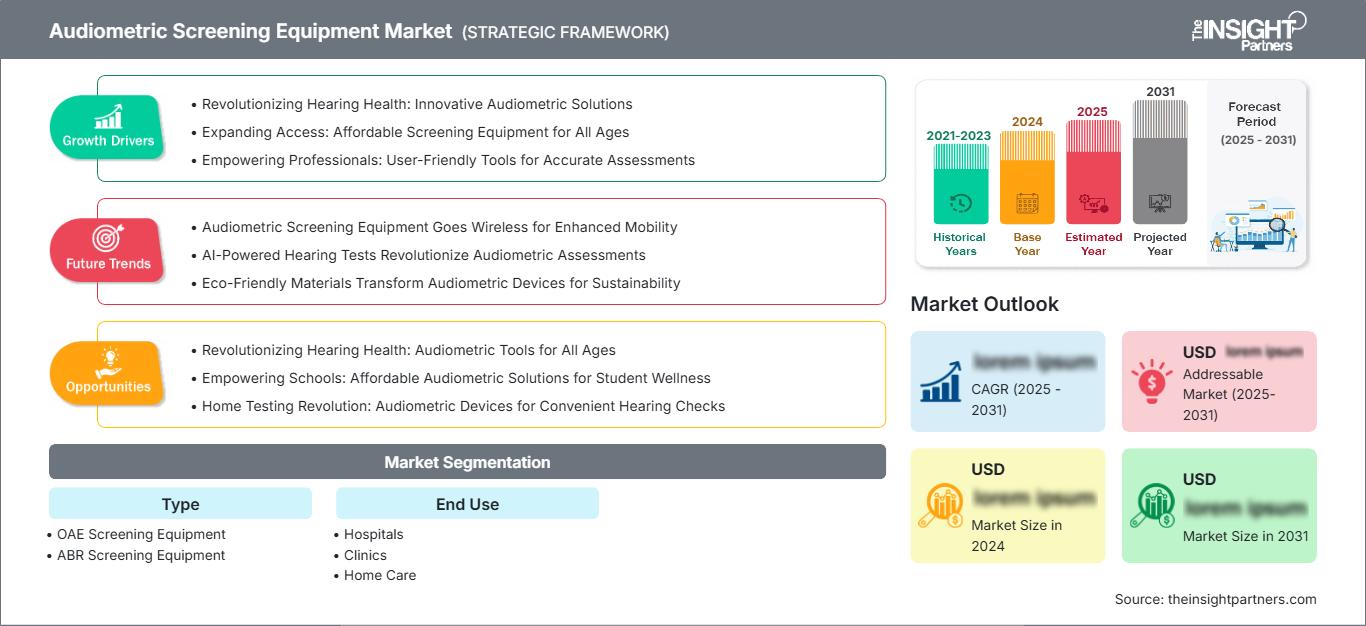
The audiometric screening equipment market generated a global market size of US$ 1.75 Billion in 2025 and is projected to reach US$ 3.1 Billion by 2034, reflecting a CAGR of 6.56% during 2026–2034. The market covers OAE Screening Equipment and ABR Screening Equipment across hospitals, clinics, home care, audiology centers, and research communities. Demand is being shaped by broader hearing-loss identification programs, pediatric screening requirements, portable instrumentation, and increasing integration of screening workflows with digital patient-management systems.
North America represents a mature demand base, supported by established newborn hearing screening infrastructure and high utilization of automated testing technologies. The region is modeled to expand at a ~6% CAGR through 2034, with replacement demand, pediatric screening, clinical workflow digitization, and portable devices supporting continued equipment investment. The audiometric screening equipment market size is also influenced by the movement of screening beyond specialist facilities toward primary-care and community settings.
Audiometric Screening Equipment Market Assessment and Insights
Regional Outlook
- North America: ~38% of the global audiometric screening equipment market share in 2025 | ~6% CAGR through 2034. Market position: North America holds the largest regional position, supported by established newborn hearing screening programs, extensive audiology infrastructure, replacement demand, and high adoption of automated and digitally connected screening equipment.
- US: ~86% of North American market revenue in 2025 | ~6% CAGR through 2034. Market position: The US is the largest country market in North America, supported by widespread newborn screening, specialist audiology services, hospital-based screening, and adoption of portable and automated systems for pediatric and community applications.
- Europe: ~29% of the global market in 2025 | ~5% CAGR through 2034. Market position: Europe represents a mature screening environment, with Germany the leading country in Europe by addressable clinical demand. The UK, France, Italy, and Spain add demand through hospital, pediatric, and specialist audiology programs.
- Asia Pacific: ~25% of the global market in 2025 | ~9% CAGR through 2034. Market position: Asia Pacific is the fastest-growing region, supported by expanding hospital capacity, rising awareness of childhood hearing loss, localization of medical devices, and increasing adoption across China, Japan, South Korea, India, and Australia.
Segment Outlook
- OAE Screening Equipment: ~58% Share in 2025 | ~6% CAGR through 2034. Market position: OAE equipment leads because screening is relatively rapid, automated, portable, and suitable for high-volume newborn and pediatric programs. Lower workflow complexity and comparatively limited consumable requirements support broad institutional adoption.
- ABR Screening Equipment: ~42% Share in 2025 | ~8% CAGR through 2034. Market position: ABR screening equipment has the higher growth outlook because it assesses neural pathway responses, supports more comprehensive newborn screening, and is increasingly deployed where clinical protocols emphasize sensitivity and reduced referral uncertainty.
Competitive Coverage
Demant A/S, Auditdata, GN Otometrics A/S, Natus Medical Incorporated, Inventis S.r.l., Benson Medical Instruments, Piston, Resonance, Micro-DSP, LISOUND, Beijing Beier, Otometrics, MAICO Diagnostics GmbH, Interacoustics A/S
Methodology
The Insight Partners follows Data Collection & Secondary Research, Primary Research, Data Analysis, and Data Triangulation & Final Review to validate market estimates and insights.
Source: The Insight Partners' analysis based on proprietary research, government publications, company annual reports, investor presentations, industry databases, and expert interviews.
The market for audiometric screening equipment has shifted from being composed of screening devices alone to more portable, automated devices enabled by software technology. The OAE devices have greatly improved through faster pass or refer processes, while ABR equipment has integrated more automatic processes that decrease interpretation needs. Additionally, manufacturers are integrating various types of tests in one portable platform, making screening and further testing easier through fewer equipment. This trend can be seen in the product design which includes OAE, ABR, auditory evoked potential tests, and even data management and connectivity. Hospitals continue to be key customers; however, other facilities such as clinics and mobile testing also need portable devices.
Prospects for the future indicate that there will be a positive impact on the market owing to increased screening coverage and investments in pediatric diagnosis in new healthcare systems. In the Asia Pacific region, hospitals' improvements in terms of neonatal care facilities as well as manufacturers' improved distribution networks offer a promising avenue for the growth of the market. Increased focus on the early detection of hearing loss in patients through regulations has also contributed to the adoption of equipment by institutions. Interoperability of data will become increasingly important as screenings need to feed into patient records.
Audiometric Screening Equipment Market Report Scope
| Report Attribute | Details |
|---|---|
| Market size in 2025 | US$ 1.75 Billion |
| Market Size by 2034 | US$ 3.1 Billion |
| Global CAGR (2026 - 2034) | 6.56% |
| Historical Data | 2021-2024 |
| Forecast period | 2026-2034 |
Audiometric Screening Equipment Market Analysis
The demand factors in the audiometric screening equipment market include newborn screening, pediatric screening, occupational screening, general practice testing, and specialty audiology. Screening processes nowadays tend to give preference to fast tests with objective outcomes, which leads to demand for automated OAE and ABR tests. Key players include device manufacturers, manufacturers of sensors and probes, software developers, distributors, hospitals, clinics, audiologists, and government agencies. Purchase depends on test accuracy, test speed, consumables cost, calibration needs, portability, ability to handle data and system integration.
The audiometric screening equipment market report shows that supply factors include both global manufacturers and specialists serving certain regions. Larger manufacturers have the capacity to conduct international marketing, regulatory filings, service provision, and software integration; whereas smaller ones compete due to their small size and price advantages. Natus offers infant screening and auditory evoked potential solutions separately, while MAICO integrates OAE and ABR into one device. Interoperability becomes more important because medical institutions require storing and transferring of test results without significant data input.
There exists a diversified competitive landscape in the market for equipment for audiometric screenings including global hearing health care organizations, diagnostic equipment companies, specialized audiology equipment manufacturers, and regional technology providers. Demant offers a combination of hearing healthcare services and diagnostic equipment, whereas Natus offers infant hearing screening, OAE, ABR, and auditory evoked potential platforms. Auditdata improves software and equipment integration, and Interacoustics expands audiology workflow by means of PC-based equipment and pediatric functionalities. Inventis enters the competition with portable and integrated audiology equipment, while MAICO stresses small-size combined OAE and ABR screening solutions.
Growing investments in software-driven workflow, portability, automation, and multifunctional platforms suggest that the strategic positioning is moving away from the sale of individual devices toward complete screening workflows. Organizations capable of linking their screening devices with patient databases, reporting tools, electronic medical records, and remote service can provide solutions not only in terms of equipment acquisition but also in terms of workflow costs for institutions. Partnership and distribution channels are particularly important in emerging countries because of the regulatory and service knowledge within local environment.
● REPORT CUSTOMIZATION
Tailor This Report To Align With Your Specific Business Requirements
This report can be customized to align precisely with your business objectives, scope, and target markets. Customization options include tailored segmentation, geography, competitive analysis, and strategic insights to support informed decision-making.
Customize This Report →WHAT YOU CAN ADJUST
- ● Segmentations
- ● Geography
- ● Competitive Analysis
- ● Language Preferences
Audiometric Screening Equipment Market: Strategic Insights
Regional Insights
North America Audiometric Screening Equipment Market
North America accounts for ~38% of the audiometric screening equipment market in 2025 and is modeled to expand at a ~6% CAGR through 2034. The region is characterized by hearing screening system infrastructure, hospital network, specialty audiology clinics, and equipment replacement needs. The US is well-recognized in newborn hearing screening procedures with OAE and automated ABR screening being part of the early identification programs. Hospitals will continue to purchase equipment whereas clinics and audiology practices will help sustain the need for portable systems.
The US makes up for ~86% of North American revenue and expected to grow at ~6% CAGR. Needs in equipment range from newborn hearing screening, pediatric audiology, general primary-care screening and occupational screening through specialty clinics. Equipment providers will continue competing in terms of automation, workflow solutions, portability and data management. Canada constitutes smaller market with structural development driven by provincial healthcare systems and pediatric hearing programs.
U.S. Audiometric Screening Equipment Market
The US contributes ~86% of North American audiometric screening equipment market revenue in 2025 and is projected to grow at a ~6% CAGR through 2034. The demand basis of this industry is enabled by extensive newborn hearing screening programs and pathways for early hearing detection and intervention. Automation technology for OAE and ABR tests is appropriate for use in hospital settings due to the capability of carrying out the test before discharging the baby from the hospital and does not need the behavioral reaction from the baby.
The hospitals continue to be the main buyers especially for neonatal and pediatric testing while the audiologists and clinics need portable systems. Natus has an extensive portfolio of screening devices with OAE and AABR systems, with other vendors such as Demant, Interacoustics, Auditdata, among others playing important roles in the diagnostics. Growth will consequently come from both replacing existing equipment as well as adoption of small and connected devices.
Europe Audiometric Screening Equipment Market
Europe represented ~29% of the global audiometric screening equipment market in 2025 and is modeled to grow at a ~5% CAGR through 2034. Germany is the largest market in Europe owing to its large healthcare sector and specialist audiology background. The UK has established pediatric hearing pathways, while France, Italy, and Spain have added through their hospital sector, specialist centers, and increasing diagnostics capabilities. Well-established procurement processes ensure that replacement and upgrades form major sources of equipment demand.
The market in Germany focuses on hospital and specialist audiology uses, where manufacturers compete on measurement accuracy, automation, connectivity, and service. The UK offers an excellent environment for pediatric hearing testing because the screening process and follow-ups have been incorporated in healthcare pathways in the country. France and Italy provide equipment demand from hospitals and specialist centers, while Spain has demand from both public healthcare procurement and private audiology. The need for data interoperability and workflow efficiency are factors increasingly taken into consideration by buyers alongside measurement capability.
APAC Audiometric Screening Equipment Market
APAC accounts for ~25% of the global audiometric screening equipment market in 2025 and is the fastest-growing region, with a modeled ~9% CAGR through 2034. China is the dominant nation in the Asia Pacific region in terms of addressable demand due to the presence of an extensive healthcare system and a growing diagnostic base. Technology maturity comes from Japan and South Korea, while India and Australia are sources of opportunity due to hospital expansions and pediatric testing programs.
China's size provides for local production and wider access to the screening systems. Japan focuses on advanced audiological services and technology replacements, whereas South Korea has advanced hospital structures. India has considerable growth potential as capacity for neonatal and pediatric care grows. Australia is a combination of well-established healthcare facilities and geographically scattered population leading to the need for portable screening technology.
Middle East & Africa Audiometric Screening Equipment Market
The Middle East and Africa market is modeled to grow at a ~7% CAGR through 2034. Saudi Arabia is the leading country in the Middle East and Africa based on healthcare investment, hospital development, and the scale of addressable institutional demand. The UAE provides a highly developed private healthcare environment, while South Africa remains an important specialist and regional healthcare hub.
Energy-sector revenues in Gulf countries support investment in modern hospitals and digital healthcare infrastructure, creating procurement opportunities for connected diagnostic equipment. Saudi Arabia and the UAE are particularly relevant for newborn and pediatric screening programs, while South Africa supports demand through specialist audiology centers and private healthcare providers. Rest of MEA markets remain more heterogeneous, with procurement constrained in some areas by equipment affordability, specialist availability, maintenance infrastructure, and geographic access.
Segmentation Analysis
Type
Type represents a key segmentation dimension of the audiometric screening equipment market, covering OAE Screening Equipment and ABR Screening Equipment used for objective hearing assessment. OAE Screening Equipment accounts for the largest category, while ABR Screening Equipment is expected to expand at a CAGR of ~8% during 2026–2034. Increasing demand for automated newborn screening, rapid pass-or-refer workflows, portable systems, and comprehensive physiological assessment continues to influence technology adoption across healthcare settings.
- OAE Screening Equipment: OAE platforms measure cochlear responses to acoustic stimulation and are widely suited to newborn and pediatric screening. Their compact architecture, rapid workflow, and automated interpretation make them useful where large numbers of patients must be screened efficiently.
- ABR Screening Equipment: ABR platforms evaluate neural responses to auditory stimulation and can assess the pathway beyond the cochlea. Their strategic importance increases where screening protocols prioritize comprehensive physiological assessment, particularly for newborns at elevated risk of auditory disorders.
End Use
End Use represents a key segmentation dimension of the audiometric screening equipment market, covering hospitals, clinics, home care, audiology centers, and research communities. Hospitals account for the largest category, while home care is expected to expand at a CAGR of ~9% during 2026–2034. Increasing adoption of decentralized screening, portable equipment, community-based hearing assessment, and digitally connected workflows continues to influence equipment utilization across healthcare and research settings.
- Hospitals :Hospitals remain a core purchasing environment because newborn screening is frequently performed before discharge and requires reliable equipment with high workflow availability. Neonatal intensive care units, maternity departments, pediatric services, and audiology departments can use OAE and ABR platforms within integrated screening pathways. Procurement increasingly emphasizes portability, automation, data management, and service support.
- Clinics: Clinics use screening equipment for pediatric follow-up, primary-care assessment, community screening, and referrals from broader healthcare networks. Compact devices are strategically important where dedicated audiology rooms are unavailable. Demand is also influenced by the need to document screening outcomes and transfer patients efficiently into diagnostic or treatment pathways.
- Home Care: Home Care remains an emerging application area because portable screening technologies can support outreach and selected decentralized workflows. Adoption depends on simplified interfaces, remote support, data transmission, and appropriate clinical governance. Equipment designed for trained community personnel may expand the addressable setting as screening programs become more distributed.
- Audiology Centers: Audiology centers represent an important specialist environment for screening and subsequent diagnostic assessment. These facilities increasingly seek multifunction equipment that can support screening, electrophysiology, and follow-up testing without requiring separate systems for every clinical procedure. Software integration and efficient patient throughput are important purchasing considerations.
- Research Communities: Research Communities use screening and evoked-response systems for pediatric hearing studies, auditory pathway research, device validation, and clinical-method development. Although procurement volumes are smaller than hospital demand, research institutions can influence technology adoption by evaluating new protocols, automated algorithms, portable platforms, and emerging measurement approaches.
Opportunity Snapshot
| End Use | Revenue Contribution | Trend Tag | Adoption Stage |
|---|---|---|---|
| Hospitals | High | Neonatal Screening | Mature |
| Clinics | Medium | Community Testing | Scaling |
| Home Care | Low | Remote Screening | Emerging |
| Audiology Centers | High | Workflow Integration | Mature |
| Research Communities | Low | Clinical Research | Scaling |
Audiometric Screening Equipment Market Growth Drivers and Impact Analysis
Expansion of Universal and Targeted Hearing Screening Programs
The expansion of structured hearing screening programs is a direct demand catalyst for the audiometric screening equipment market. Public-health guidance emphasizes screening newborns, infants, schoolchildren, and older adults at appropriate stages of care, creating multiple institutional use cases. Newborn screening is particularly equipment-intensive because facilities require objective technologies capable of testing patients who cannot provide behavioral responses. Program expansion creates recurring procurement requirements as hospitals establish new screening capacity and replace aging devices. It also increases demand for standardized data capture and referral management. Manufacturers that combine screening hardware with automated interpretation and reporting can address both equipment requirements and program administration. The impact is strongest in regions where screening coverage is expanding from specialist facilities toward maternity units, pediatric services, community clinics, and decentralized healthcare settings.
Demand for Faster, Portable, and Automated Screening Workflows
Workflow efficiency is becoming a central purchasing criterion as healthcare providers seek to screen more patients without proportionally increasing specialist staffing. Automated OAE and ABR systems can reduce manual interpretation and support standardized pass-or-refer decisions. Portable form factors also allow devices to move between neonatal units, pediatric departments, outpatient clinics, and community programs. For the audiometric screening equipment market, this changes competition from basic measurement performance toward total workflow productivity. Equipment that combines rechargeable power, intuitive interfaces, onboard storage, automated testing protocols, and data export can reduce operational friction. The effect is particularly relevant to smaller facilities that cannot justify large fixed installations. As screening programs broaden, compact devices can provide a practical route to extending coverage while maintaining consistent testing procedures.
Integration of Screening Results With Digital Clinical Workflows
Digital integration is creating another demand mechanism by reducing the administrative burden associated with screening documentation and follow-up. Modern screening programs generate patient identifiers, test outcomes, referral decisions, quality-control information, and follow-up records that need to be retained and reviewed. Equipment with data-management software can consolidate results from multiple screening devices and reduce manual entry. This supports the audiometric screening equipment market by increasing the value of connected platforms relative to isolated instruments. Hospitals and larger clinics increasingly evaluate compatibility with electronic records, reporting systems, and centralized databases when purchasing equipment. Vendors that provide software updates, cybersecurity controls, remote support, and interoperable data structures can strengthen customer retention. Digital connectivity also creates opportunities for centralized monitoring of screening program performance.
Audiometric Screening Equipment Market Future Trends
AI-Assisted Interpretation and Adaptive Screening Protocols
The next stage of the audiometric screening equipment market is likely to involve greater use of software intelligence to optimize screening protocols and identify technically unreliable measurements. Rather than replacing objective OAE or ABR measurements, intelligent software can help recognize noise contamination, poor probe placement, electrode impedance problems, and atypical response patterns. Adaptive protocols could adjust test sequences based on initial results, potentially reducing unnecessary repeated measurements while preserving clinical safeguards. Such capabilities may be particularly valuable in high-throughput newborn screening environments where small workflow improvements accumulate across large patient populations. Future systems are also likely to emphasize transparent reporting, audit trails, and configurable clinical rules. Adoption will depend on validation, regulatory requirements, clinician acceptance, and the ability of manufacturers to demonstrate that software improves consistency without compromising established screening protocols.
Convergence of Portable Screening, Connectivity, and Decentralized Care
The Audiometric Screening Equipment Market trends show that portable screening systems are likely to become increasingly connected to broader care networks. Future equipment can combine lightweight hardware, wireless communication, cloud-enabled data transfer, rechargeable operation, and guided workflows to support screening outside traditional audiology rooms. This trend could extend the market into maternity outreach, pediatric primary care, schools, community health programs, and selected home-based services. Decentralized screening will require strong governance because screening results must be linked to appropriate diagnostic referral and follow-up pathways. Manufacturers therefore have an opportunity to differentiate through secure connectivity, patient identification, multilingual interfaces, remote technical support, and centralized program dashboards. The combination of portability and digital infrastructure can reduce the practical barriers to expanding screening coverage in geographically dispersed populations.
Audiometric Screening Equipment Market Opportunities
Localized Manufacturing and Distribution in Emerging Healthcare Systems
The Audiometric Screening Equipment Market forecast shows that emerging healthcare systems offer manufacturers an opportunity to develop equipment configurations aligned with local procurement economics and service capabilities. Local assembly, regional distribution partnerships, multilingual interfaces, simplified maintenance, and modular product architectures can reduce barriers to adoption. The opportunity is particularly relevant across Asia Pacific, where hospital capacity is expanding and local manufacturers can compete on cost and customization. International companies can complement this trend through technology transfer, distributor partnerships, training programs, and regional service centers. A localized commercial model also allows suppliers to address differences in screening protocols and infrastructure rather than relying on a single global configuration. Investment in regional calibration, technical support, and replacement-parts availability can strengthen long-term customer relationships and reduce total ownership concerns for healthcare facilities.
Integrated Screening Platforms for Hospital and Community Networks
Integrated screening platforms represent an opportunity to move procurement from individual instruments toward coordinated screening infrastructure. A hospital network can benefit from common software, standardized protocols, centralized reporting, and compatible OAE and ABR devices deployed across maternity units, pediatric departments, and audiology centers. Such systems can create recurring revenue opportunities through software, service, training, calibration, and equipment upgrades while improving operational consistency. Community healthcare networks provide another application, particularly where screening equipment needs to be portable and results must be transmitted to specialist centers. Vendors can pursue this opportunity by combining screening hardware with secure data-management tools and workflow analytics. The commercial proposition becomes stronger when equipment can remain useful across multiple screening stages rather than being limited to a single test.
Recent Developments
- October 2025: Auditdata announced a strategic partnership with Natus Sensory under which Natus Sensory would distribute Auditdata Measure worldwide as Otometrics Measure. The collaboration combines Auditdata's software and clinical capabilities with Natus Sensory's international sales and service infrastructure, supporting broader access to digitally enabled hearing-care equipment and expanding screening and diagnostic workflow capabilities.
- October 2025: Inventis S.r.l. presented its audiology portfolio at EUHA 2025, highlighting diagnostic and screening technologies alongside a new PC-based solution for auditory and vestibular evoked potentials. The company also highlighted portable screening audiometers and tympanometry technologies, reflecting continued development toward compact, digitally managed audiology workflows.
- March 2025: Interacoustics A/S introduced the Equinox Evo and Touch Keyboard, a PC-based audiometry platform designed for hospitals and clinics and equipped with pediatric functionality. The system combines flexible test capabilities with a wireless keyboard approach intended to improve clinician workflow, particularly for pediatric assessments and environments requiring multiple audiometric procedures.
Frequently Asked Questions

- Comprehensive Market Sizing and Forecast Analysis
- Detailed Segmentation Analysis
- In-Depth Market Dynamics Assessment
- Regional and Country-Level Insights
- Competitive Landscape and Company Benchmarking
- Strategic Business Intelligence
Recent Reports
Testimonials

The Insight Partners provided valuable market intelligence that supported our global go-to-market strategy. Their team was professional, responsive, and attentive to our feedback, providing thoughtful analysis and helpful methodological clarifications throughout the project.
Junmo Kim Chief Financial Officer (CFO), Enertech Co., Ltd.
The Insight Partners' SCADA System Market report is comprehensive, with valuable insights on current trends and future forecasts. The team was highly professional, responsive, and supportive throughout. We are very satisfied and highly recommend their services.
RAN KEDEM Partner, Reali Technologies LTDs
I requested a report on a very specific software market and the team produced the report in a few days. The information was very relevant and well presented. I then requested some changes and additions to the report. The team was again very responsive and I got the final report in less than a week.
JEAN-HERVE JENN Chairman, Future Analytica
We worked with The Insight Partners for an important market study and forecast. They gave us clear insights into opportunities and risks, which helped shape our plans. Their research was easy to use and based on solid data. It helped us make smart, confident decisions. We highly recommend them.
PIYUSH NAGPAL Sr. Vice President, High Beam Global
The Insight Partners delivered insightful, well-structured market research with strong domain expertise. Their team was professional and responsive throughout. The user-friendly website made accessing industry reports seamless. We highly recommend them for reliable, high-quality research services
YUKIHIKO ADACHI CEO, Deep Blue, LLC.
This is the first time I have purchased a market report from The Insight Partners.While I was unsure at first, I visited their web site and felt more comfortable to take the risk and purchase a market report.I am completely satisfied with the quality of the report and customer service. I had several questions and comments with the initial report, but after a couple of dialogs over email with their analyst I believe I have a report that I can use as input to our strategic planning process.Thank you so much for taking the extra time and making this a positive experience.I will definitely recommend your service to others and you will be my first call when we need further market data.
JOHN SUZUKI President and Chief Executive Officer, Board Director, BK Technologies
I wish to appreciate your support and the professionalism you displayed in the course of attending to my request for information regarding to infectious disease IVD market in Nigeria. I appreciate your patience, your guidance, and the fact that you were willing to offer a discount, which eventually made it possible for us to close a deal. I look forward to engaging The Insight Partners in the future, all thanks to the impression you have created in me as a result of this first encounter.
DR CHIJIOKE ONYIA MANAGING DIRECTOR, PineCrest Healthcare Ltd.Reason to Buy
- Informed Decision-Making
- Understanding Market Dynamics
- Competitive Analysis
- Identifying Emerging Markets
- Customer Insights
- Market Forecasts
- Risk Mitigation
- Boosting Operational Efficiency
- Strategic Planning
- Investment Justification
- Tracking Industry Innovations
- Aligning with Regulatory Trends





 Get Free Sample for