
Automated Dialysis Concentrated Production System Professional Market Growth, Demand & Size by 2034
Coverage: By Type (Open Automated Dialysis Concentrated Production System and closed automated dialysis concentrated production systems); Application (hospitals, clinics, and renal care centers) , and Geography (North America, Europe, Asia Pacific, and South and Central America)
- Status : Data Released
- Report Code : TIPRE00026512
- Category : Life Sciences
- No. of Pages : 150
- Available Report Formats :


- Last update date : October 30, 2026


2025 Market Size
US$ 1.33 Bn
Base year value
2034 Forecast
US$ 2.54 Bn
Projected by 2034
CAGR 2026-2034
7.45 %
Growth rate
Addressable Market
US$ 17.44 Bn
(2026-2034)
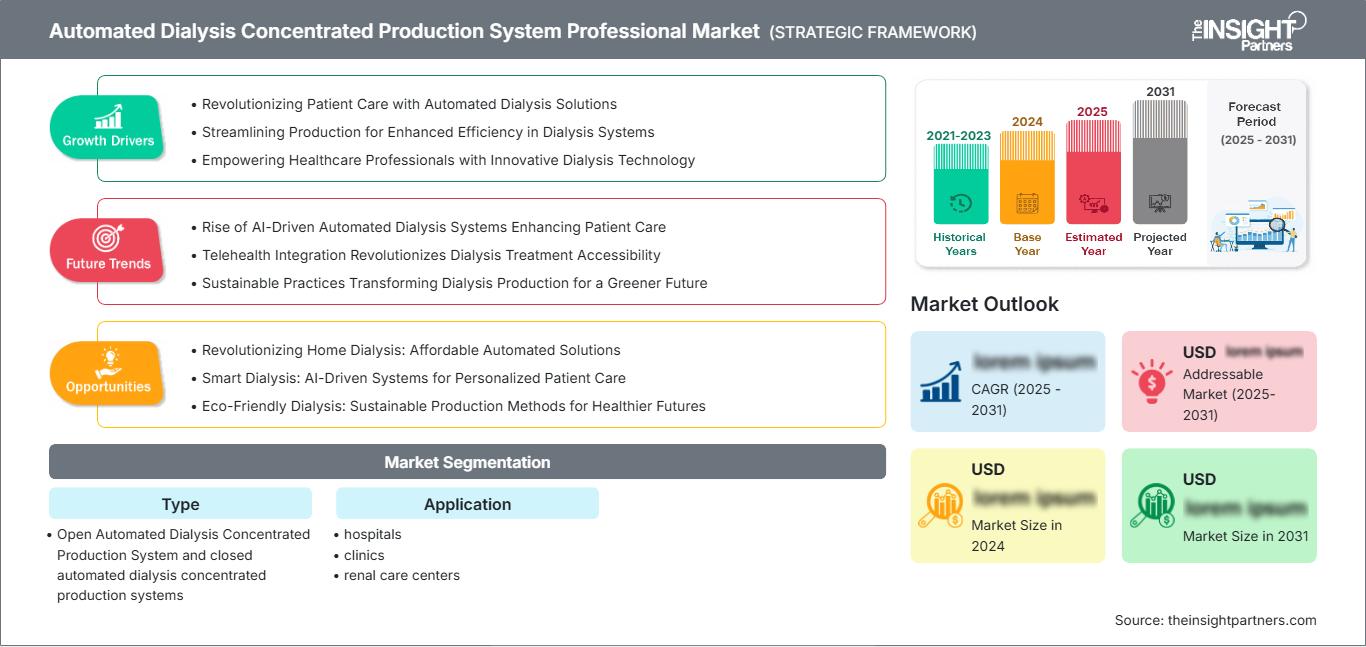
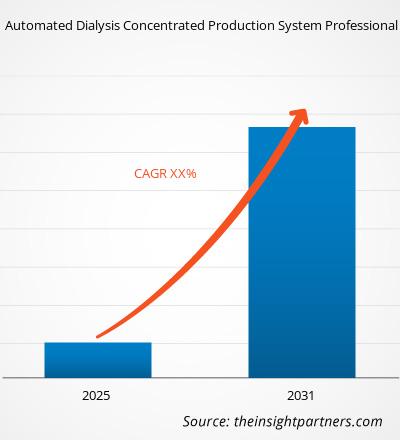
The automated dialysis concentrated production system professional market size is assessed at US$ 1.33 Billion in 2025 and is projected to reach US$ 2.54 Billion by 2034, reflecting a CAGR of 7.45% during 2026–2034. The market covers automated systems used to prepare, store, monitor, and centrally distribute dialysis concentrates within professional dialysis environments. Its scope is structured by Type into Open Automated Dialysis Concentrated Production System and Closed Automated Dialysis Concentrated Production Systems, and by Application into hospitals, clinics, and renal care centers.
North America is positioned for steady expansion at a modeled CAGR of ~7% through 2034, supported by the replacement of labor-intensive concentrate handling processes and continued investment in dialysis infrastructure. Demand is also being shaped by operational requirements for reliable concentrate availability, automated monitoring, closed-loop distribution, and integration with water treatment and dialysis equipment. Large provider networks and established renal care infrastructure support adoption of centralized production and delivery configurations.
Automated Dialysis Concentrated Production System Professional Market Assessment and Insights
Regional Outlook
- North America: ~35% of the global automated dialysis concentrated production system professional market share in 2025 | ~7% CAGR through 2034. Market position: North America represents the largest regional market, supported by extensive in-center hemodialysis infrastructure, established renal care networks, equipment replacement requirements, and increasing interest in reducing manual concentrate handling across high-volume facilities.
- US: ~78% of North American market revenue in 2025 | ~7% CAGR through 2034. Market position: The US represents the largest country market in North America, supported by a large installed base of dialysis facilities, vertically integrated renal care operators, centralized procurement, and demand for dependable concentrate supply across high-throughput treatment environments.
- Europe: ~30% of the global market in 2025 | ~6% CAGR through 2034. Market position: Europe is a mature market with established central concentrate infrastructure. Germany is the leading country in Europe, while the UK, France, Italy, and Spain provide additional demand through hospital modernization, resource-efficiency initiatives, and dialysis-center replacement programs.
- Asia Pacific: ~25% of the global market in 2025 | ~10% CAGR through 2034. Market position: Asia Pacific is the fastest-growing region, supported by expanding dialysis capacity and modernization. Japan is the leading country in Asia Pacific, while China, South Korea, India, and Australia support incremental investment in automated renal-care infrastructure.
Segment Outlook
- Closed Automated Dialysis Concentrated Production Systems: ~65% Share in 2025 | ~8% CAGR through 2034. Market position: Closed systems lead because they support controlled preparation, reduced contamination exposure, automated monitoring, and consistent concentrate transfer. Their suitability for high-throughput renal care centers strengthens adoption where operational continuity and process standardization are priorities.
- Open Automated Dialysis Concentrated Production System: ~35% Share in 2025 | ~9% CAGR through 2034. Market position: Open systems have a higher growth outlook as facilities seek scalable automation without committing to fully closed architectures. Demand is supported by modernization of smaller and mid-sized centers and flexible integration with existing water and concentrate infrastructure.
Competitive Coverage
Baxter International Inc., B. Braun Melsungen AG, REN MED MEDICAL PRODUCTS & TRADE LTD. CO., Nipro Europe Group Companies, FLG Automation AG, Fresenius Medical Care AG & Co. KGaA, Toray Medical Co., Ltd., Medtronic, DaVita Inc., Becton, Dickinson, and Company (BD)
Methodology
The Insight Partners follows Data Collection & Secondary Research, Primary Research, Data Analysis, and Data Triangulation & Final Review to validate market estimates and insights.
Source: The Insight Partners' analysis based on proprietary research, government publications, company annual reports, investor presentations, industry databases, and expert interviews.
The evolution of automated concentrate production has shifted dialysis facilities from manual preparation and container-based handling toward integrated mixing, storage, monitoring, and distribution architectures. Modern systems increasingly connect concentrate preparation with reverse-osmosis water treatment, storage tanks, central loops, sensors, alarms, and digital monitoring. Automated density or concentration checks help standardize preparation, while automated tank switching and circulation reduce interruptions. These changes are particularly relevant to large facilities where repeated concentrate handling creates labor requirements, storage constraints, and logistics complexity.
Looking ahead, adoption is expected to broaden as emerging dialysis markets expand treatment capacity, and established markets replace aging infrastructure. Investment is increasingly linked to resource efficiency, reduced packaging, lower transport requirements, and centralized operational control. Regulatory emphasis on water quality, device safety, process validation, and traceability will continue to favor systems capable of documenting operating conditions. The combination of dialysis capacity expansion and modernization creates opportunities for suppliers that can integrate concentrate production with water treatment, dialysis machines, data platforms, and facility engineering.
Automated Dialysis Concentrated Production System Professional Market Report Scope
| Report Attribute | Details |
|---|---|
| Market size in 2025 | US$ 1.33 Billion |
| Market Size by 2034 | US$ 2.54 Billion |
| Global CAGR (2026 - 2034) | 7.45% |
| Historical Data | 2021-2024 |
| Forecast period | 2026-2034 |
Automated Dialysis Concentrated Production System Professional Market Analysis
The automated dialysis concentrated production system professional market growth is driven by the increasing operational complexity of professional hemodialysis facilities. Concentrate preparation is part of a broader value chain that begins with purified water and dry or liquid concentrate inputs and extends through mixing, quality verification, storage, distribution, and connection to dialysis machines. Automation reduces the number of manual interventions between these stages. Fresenius Medical Care, for example, describes automated concentrate mixing, operating-data monitoring, network connectivity, remote control, and centralized delivery as components of its concentrate-supply portfolio.
Supply-side considerations in the automated dialysis concentrated production system professional market have started favoring integrated equipment as opposed to dedicated mixing equipment. Suppliers could gain competitive advantage by ensuring that their products would be compatible with reverse osmosis systems, tanks, central loops, alarms management, and remote monitoring among others. The ECOMix Revolution from B. Braun has dry concentrate cartridges and automated mixing whereas the GravineXt from Nipro has automated tank switchover, monitoring, and central transfer to dialysis machines.
Competition in the automated dialysis concentrated production system professional market is driven by the capability to integrate concentrate production with the wider portfolio of renal care solutions. Fresenius Medical Care integrates concentrate manufacturing and central delivery systems, B. Braun integrates concentrate manufacturing with renal care and water treatment systems, Nipro integrates concentrate delivery with dialysis and water treatment equipment, and Toray Medical integrates concentrate delivery with dialysis equipment and systems management. Baxter, Medtronic, BD, DaVita, FLG Automation, and REN MED are involved in adjacent equipment, clinical systems, automation, and renal care systems.
Investment in the automated dialysis concentrated production system professional market is shifting towards automation, digital monitoring, material efficiency, and infrastructure compatibility. Competition consequently stretches further than just the price of the production unit. Installation needs, validation, maintenance, technical services, concentrate compatibility, water treatment integration, and total cost of ownership may impact purchasing decisions. Providers with large installed base can leverage equipment compatibility and technical service offerings to drive their accounts, while automation providers can leverage system flexibility and engineering capability.
● REPORT CUSTOMIZATION
Tailor This Report To Align With Your Specific Business Requirements
This report can be customized to align precisely with your business objectives, scope, and target markets. Customization options include tailored segmentation, geography, competitive analysis, and strategic insights to support informed decision-making.
Customize This Report →WHAT YOU CAN ADJUST
- ● Segmentations
- ● Geography
- ● Competitive Analysis
- ● Language Preferences
Automated Dialysis Concentrated Production System Professional Market: Strategic Insights
Regional Insights
North America Automated Dialysis Concentrated Production System Professional Market
The automated dialysis concentrated production system professional market forecast shows that North America accounts for ~35% of the global market in 2025 and is projected to expand at ~7% CAGR through 2034. The region benefits from a large installed base of professional dialysis facilities and established procurement channels. Concentrate production is increasingly considered part of facility-level process automation because high treatment volumes make manual preparation, storage, and handling more operationally significant.
The US is the key demand center, and the players include dialysis providers, hospitals, and renal network systems that are interested in infrastructure and workflow efficiency. In addition, there is growth potential from the installation of newer water and concentrate systems, along with automated systems that can be integrated with the central treatment utility systems. The other major contributor is Canada, which is contributing through the modernization of hospital-based dialysis systems.
U.S. Automated Dialysis Concentrated Production System Professional Market
The US represents ~78% of North American market revenue in 2025 and is expected to grow at ~7% CAGR through 2034. This is an indication of the size of professional dialysis service provision and the existence of large networks of providers. Fresenius Medical Care and DaVita are among the firms with huge networks for renal care provision, while Baxter, B. Braun, Nipro, among others, provide services for equipment and consumables.
The need for the application of technology is found in high-volume hospitals, clinics, and centers that provide renal care because such institutions can benefit from centralization of concentrate preparation, thereby eliminating manual handling. Large institutions may consider integrating automation technologies, whereas small centers may go for modular automation systems. Maintenance capabilities, technical assistance, compatibility with water treatment, as well as integration of alarms into facility operations, among others, are procurement considerations.
Europe Automated Dialysis Concentrated Production System Professional Market
Europe represents ~30% of the global market in 2025 and is projected to expand at ~6% CAGR through 2034. Germany is the leading country in Europe, supported by a strong medical technology manufacturing base and established dialysis infrastructure. The UK maintains demand through hospital and renal-service modernization, while France combines hospital-based dialysis with specialized renal care networks. Italy and Spain contribute through replacement programs and investment in efficient dialysis-center operations.
European adoption is increasingly influenced by sustainability and resource-efficiency considerations. Central concentrate delivery can reduce dependence on individual liquid containers and streamline logistics within treatment facilities. Germany has a particularly developed ecosystem for integrated dialysis utilities, including concentrate mixing and centralized delivery. France, Italy, Spain, and the UK provide additional opportunities where providers are evaluating automation as part of broader facility upgrades.
The region's procurement environment places importance on process safety, water quality, traceability, technical validation, and lifecycle performance. This favors suppliers capable of integrating automated concentrate production with water treatment and clinical equipment. Demand will also be shaped by replacement cycles, facility consolidation, and the need to standardize processes across multi-site dialysis networks.
APAC Automated Dialysis Concentrated Production System Professional Market
Asia Pacific represents ~25% of the global market in 2025 and is projected to grow at ~10% CAGR through 2034, making it the fastest-growing region. Japan is the leading country in Asia Pacific, supported by mature dialysis infrastructure and extensive use of centralized dialysis utility systems. China, South Korea, India, and Australia provide additional demand as treatment capacity and facility modernization increase.
Industrial expansion and healthcare infrastructure investment are supporting broader adoption of automated systems. Japan emphasizes integrated dialysis operations, while China is expanding renal-care capacity and local equipment capabilities. South Korea has advanced hospital infrastructure, India is adding dialysis capacity across public and private settings, and Australia continues to modernize established renal services. These differences create demand for both standardized systems and configurable architectures.
Middle East & Africa Automated Dialysis Concentrated Production System Professional Market
Middle East & Africa is expected to expand at ~8% CAGR through 2034. Saudi Arabia represents the leading country in the Middle East & Africa market where evidence supports the strongest concentration of modern renal-care investment. UAE demand is supported by advanced private healthcare infrastructure, while South Africa remains an important market for established dialysis services.
Energy availability, water treatment requirements, infrastructure development, and imported equipment dependence influence procurement decisions across the region. Automated systems can support centralized operations where staffing, logistics, and quality-control requirements make manual concentrate handling less attractive. New hospital projects and renal care facilities can incorporate integrated water treatment and concentrate production during facility design, while established centers may adopt modular systems during equipment replacement.
Segmentation Analysis
Type
Type segmentation reflects the technological architecture used for automated concentrate preparation and distribution in professional dialysis facilities. Closed Automated Dialysis Concentrated Production Systems represent the largest type of category and are modeled to grow at a CAGR of ~8% during 2026–2034. Their position is supported by controlled concentrate preparation, automated monitoring, reduced manual handling, and compatibility with centralized dialysis infrastructure.
- Closed Automated Dialysis Concentrated Production Systems: Closed automated systems represent the largest main segment and are expected to expand at ~8% CAGR during 2026–2034. Their adoption is supported by controlled concentrate preparation, automated monitoring, reduced exposure during transfer, and compatibility with centralized distribution loops. These systems are particularly relevant to high-volume facilities seeking repeatable processes, lower manual intervention, and reliable supply continuity.
- Open Automated Dialysis Concentrated Production System: Open configurations provide flexibility for facilities that need automated concentrate preparation while retaining more adaptable connections to existing infrastructure. Their strategic importance is strongest in modernization projects where full closed-loop conversion may require higher capital expenditure or extensive facility modifications.
Application
Application segmentation reflects the healthcare settings in which automated dialysis concentrated production systems are installed and operated. Hospitals represent the largest application category and are modeled to grow at a CAGR of ~8% during 2026–2034. Their position is supported by high dialysis treatment volumes, established renal-care infrastructure, centralized utility systems, and increasing adoption of automated concentrate preparation.
- Hospitals: Hospitals remain an important application because dialysis services require reliable utilities, validated water quality, and dependable concentrate availability. Automated production can be incorporated into new renal units or hospital infrastructure upgrades, particularly where centralized engineering systems support multiple treatment stations and where process monitoring is required.
- Clinics: Clinics represent a substantial demand base because many professional dialysis services operate through dedicated outpatient facilities. Automation can reduce preparation work, simplify concentrate storage, and support consistent operations where staffing efficiency and space utilization are important procurement considerations.
- Renal Care Centers: Renal care centers are strategically suited to automated production because treatment volumes and dedicated renal infrastructure can support centralized concentrate preparation. Integrated mixing, storage, distribution, and monitoring can streamline routine operations and reduce reliance on individual concentrate containers.
Opportunity Snapshot
| Application | Revenue Contribution | Trend Tag | Adoption Stage |
| Hospitals | High | Integrated Utilities | Mature |
| Clinics | Medium | Modular Automation | Scaling |
| Renal Care Centers | High | Central Delivery | Mature |
Automated Dialysis Concentrated Production System Professional Market Growth Drivers and Impact Analysis
Centralization of High-Volume Dialysis Operations
High-volume dialysis facilities have an operational incentive to centralize concentrate preparation because repeated handling of individual containers can consume storage space, staff time, and internal logistics capacity. Automated systems shift the process toward controlled preparation and distribution, enabling concentrate to move through dedicated storage and piping infrastructure. This can make production more predictable and reduce routine manual interventions. Fresenius Medical Care's concentrate portfolio illustrates the progression from in-house preparation toward automated mixing and central delivery, while Nipro's GravineXt demonstrates automated tank changeover and distribution. The impact extends beyond labor because centralized systems can simplify inventory planning, improve continuity, and support facility-level monitoring. As dialysis networks standardize operations across multiple sites, repeatable concentrate infrastructure can become an important component of facility engineering specifications.
Demand for Safer and More Consistent Concentrate Preparation
Concentrate quality directly influences dialysis fluid preparation, making concentration control, water quality, monitoring, and process traceability important operational requirements. Automated production systems can incorporate sensors, density measurement, alarm functions, controlled mixing, and automated release procedures that reduce dependence on manual checks. B. Braun's ECOMix Revolution, for example, uses automated density measurement and cartridge identification to support controlled preparation. Toray Medical's TC-EX also incorporates concentration feedback and integrated operational controls. These capabilities can influence procurement as providers seek to reduce process variability while maintaining compliance with facility and device requirements. The resulting market impact is a shift from basic mixing equipment toward integrated platforms where automation, validation, monitoring, and compatibility with the wider dialysis infrastructure are considered together during capital-equipment decisions.
Resource Efficiency and Reduction of Concentrate Logistics
Resource efficiency is becoming a relevant purchasing consideration because dialysis concentrate supply can involve significant packaging, transportation, storage, and waste-management requirements. Dry concentrate cartridges and centralized preparation can reduce the physical volume of material transported compared with ready-to-use liquid containers. A 2025 life-cycle assessment of a central acid concentrate delivery system at University Medical Center Utrecht reported a substantial reduction in carbon emissions after adoption of a dry-powder centralized configuration. Such evidence can strengthen the business case for automation when environmental objectives are evaluated alongside operational efficiency. Suppliers can therefore differentiate through reusable cartridges, lower packaging requirements, automated inventory monitoring, and integration with water-treatment infrastructure. For healthcare networks, the effect is a broader evaluation of concentrate production as part of sustainability and facility-management strategies rather than as an isolated consumable-handling function.
Automated Dialysis Concentrated Production System Professional Market Future Trends
Integration of Production Data with Renal-Care Digital Platforms
The automated dialysis concentrated production system professional market analysis shows that the next phase of automation is likely to connect concentrate production data more directly with renal-care information systems and facility-management platforms. Instead of operating as an isolated utility, mixing equipment can provide operating status, concentrate consumption, alarm conditions, tank levels, and maintenance information to authorized digital interfaces. B. Braun's NEXADIA ecosystem already illustrates the direction by making technical data from ECOMix and water-treatment equipment accessible through a mobile companion. Through 2034, interoperability can become increasingly relevant to multi-site dialysis operators seeking centralized oversight. The commercial opportunity will extend beyond hardware toward software connectivity, remote diagnostics, predictive maintenance, automated replenishment signals, and analytics that help facilities coordinate concentrate production with treatment schedules.
Expansion of Closed-Loop and Low-Waste Production Architectures
The automated dialysis concentrated production system professional market trends show that future system development is expected to favor architectures that combine automated mixing, closed distribution, reusable storage components, and lower-waste concentrate inputs. This trend can reduce dependence on single-use liquid containers while strengthening process control. New facilities may increasingly specify concentrate production and distribution as part of an integrated water-treatment and dialysis utility design rather than adding the equipment after construction. Established centers can adopt modular configurations during renovation to limit disruption. The technical emphasis will likely move toward reliable sensors, automated cleaning, remote monitoring, redundancy, and flexible connections with different concentrate formats. Such designs can make automated production relevant across both large renal networks and smaller professional centers as suppliers refine system capacity and installation requirements.
Automated Dialysis Concentrated Production System Professional Market Opportunities
Retrofitting Existing Dialysis Infrastructure
A significant commercial opportunity lies in retrofitting existing dialysis centers that still rely on manual concentrate handling or decentralized liquid containers. Retrofitting can address demand without requiring a complete rebuild of the renal-care facility. Suppliers can develop modular mixing, storage, pumping, piping, monitoring, and control packages that connect with existing reverse-osmosis systems and dialysis machines. Engineering firms and equipment manufacturers can create standardized installation protocols to reduce downtime during conversion. The commercial model can also combine equipment, validation, maintenance, staff training, and digital monitoring. This approach is particularly relevant for established markets where dialysis infrastructure already exists but requires modernization. Vendors that can demonstrate compatibility with legacy systems and provide predictable installation requirements can access replacement-driven demand while avoiding dependence solely on new facility construction.
Integrated Water, Concentrate, and Dialysis Utility Platforms
Another opportunity is the development of integrated platforms that coordinate water treatment, concentrate preparation, centralized distribution, and dialysis-machine connectivity. Procurement teams can increasingly evaluate these functions as a single operational infrastructure because failures or inefficiencies in one stage can affect downstream treatment availability. Suppliers with complementary portfolios can bundle equipment, controls, monitoring, service, and consumables, while specialist automation providers can supply standardized interfaces to established dialysis platforms. Integration can also enable more precise consumption tracking and maintenance planning. Through 2034, commercial differentiation is likely to depend on interoperability, service responsiveness, validation capabilities, and lifecycle economics as much as on mixing capacity. This creates opportunities for partnerships between dialysis-equipment manufacturers, water-treatment specialists, automation companies, and healthcare engineering providers.
Recent Developments
- November 2025: B. Braun Melsungen AG, a peer-reviewed life-cycle assessment published in BMC Nephrology evaluated a central acid concentrate delivery system using dry powder and reusable containers at University Medical Center Utrecht. The study reported a 58% reduction in carbon emissions following implementation and identified reduced transport weight, packaging, and manual handling as important contributors to the environmental benefit.
- March 2025: Toray Medical Co., Ltd. began sales of the TC-EX multi-patient dialysis fluid supply system in Japan. The system incorporates automated operation scheduling, concentration feedback, dualized flow and concentrate-pump functions, cleaning capabilities, emergency operation, and integration with Toray's broader dialysis-system management infrastructure, strengthening centralized control of dialysis fluid supply.
- March 2026: Fresenius Medical Care AG & Co. KGaA, a published German utility-model record described a device designed to ensure availability of dialysis concentrate batches using automated planning and sensing concepts. The filing indicates continued engineering activity around concentrate availability, automated supply planning, and process reliability within centralized dialysis infrastructure.
Frequently Asked Questions

- Comprehensive Market Sizing and Forecast Analysis
- Detailed Segmentation Analysis
- In-Depth Market Dynamics Assessment
- Regional and Country-Level Insights
- Competitive Landscape and Company Benchmarking
- Strategic Business Intelligence
Recent Reports
Testimonials

The Insight Partners provided valuable market intelligence that supported our global go-to-market strategy. Their team was professional, responsive, and attentive to our feedback, providing thoughtful analysis and helpful methodological clarifications throughout the project.
Junmo Kim Chief Financial Officer (CFO), Enertech Co., Ltd.
The Insight Partners' SCADA System Market report is comprehensive, with valuable insights on current trends and future forecasts. The team was highly professional, responsive, and supportive throughout. We are very satisfied and highly recommend their services.
RAN KEDEM Partner, Reali Technologies LTDs
I requested a report on a very specific software market and the team produced the report in a few days. The information was very relevant and well presented. I then requested some changes and additions to the report. The team was again very responsive and I got the final report in less than a week.
JEAN-HERVE JENN Chairman, Future Analytica
We worked with The Insight Partners for an important market study and forecast. They gave us clear insights into opportunities and risks, which helped shape our plans. Their research was easy to use and based on solid data. It helped us make smart, confident decisions. We highly recommend them.
PIYUSH NAGPAL Sr. Vice President, High Beam Global
The Insight Partners delivered insightful, well-structured market research with strong domain expertise. Their team was professional and responsive throughout. The user-friendly website made accessing industry reports seamless. We highly recommend them for reliable, high-quality research services
YUKIHIKO ADACHI CEO, Deep Blue, LLC.
This is the first time I have purchased a market report from The Insight Partners.While I was unsure at first, I visited their web site and felt more comfortable to take the risk and purchase a market report.I am completely satisfied with the quality of the report and customer service. I had several questions and comments with the initial report, but after a couple of dialogs over email with their analyst I believe I have a report that I can use as input to our strategic planning process.Thank you so much for taking the extra time and making this a positive experience.I will definitely recommend your service to others and you will be my first call when we need further market data.
JOHN SUZUKI President and Chief Executive Officer, Board Director, BK Technologies
I wish to appreciate your support and the professionalism you displayed in the course of attending to my request for information regarding to infectious disease IVD market in Nigeria. I appreciate your patience, your guidance, and the fact that you were willing to offer a discount, which eventually made it possible for us to close a deal. I look forward to engaging The Insight Partners in the future, all thanks to the impression you have created in me as a result of this first encounter.
DR CHIJIOKE ONYIA MANAGING DIRECTOR, PineCrest Healthcare Ltd.Reason to Buy
- Informed Decision-Making
- Understanding Market Dynamics
- Competitive Analysis
- Identifying Emerging Markets
- Customer Insights
- Market Forecasts
- Risk Mitigation
- Boosting Operational Efficiency
- Strategic Planning
- Investment Justification
- Tracking Industry Innovations
- Aligning with Regulatory Trends





 Get Free Sample for