
Automatic Door Market Demand, Size & Forecast by 2034
Coverage: By Type (Sliding Door, Swing Door, Revolving Door, Folding Door, Others); End-user (Residential, Commercial, Industrial) , and Geography (North America, Europe, Asia Pacific, and South and Central America)
- Status : Data Released
- Report Code : TIPRE00007908
- Category : Manufacturing and Construction
- No. of Pages : 150
- Available Report Formats :


- Last update date : July 13, 2026


2025 Market Size
US$ 27.18 Bn
Base year value
2034 Forecast
US$ 49.04 Bn
Projected by 2034
CAGR 2026-2034
6.78 %
Growth rate
Addressable Market
US$ 344.47 Bn
(2026-2034)
The automatic door market size is projected to grow from US$ 27.18 Billion in 2025 to US$ 49.04 Billion by 2034, registering a CAGR of 6.78% during 2026–2034. Demand is supported by commercial construction, healthcare access needs, airport modernization, and energy-efficient building systems. The automatic door category is moving from convenience-led adoption toward essential infrastructure for safe, controlled, and accessible movement.
Across North America, demand is expected to expand at a CAGR range of 5.8–6.3% through 2034, supported by healthcare retrofits, airport terminal upgrades, and accessibility compliance. The automatic door market size outlook in the region is shaped by renovation-heavy commercial real estate and higher adoption of touchless entry in hospitals, offices, logistics facilities, and transport hubs.
Automatic Door Market Assessment and Insights
- North America held 28–31% of the automatic door market share in 2025 and is projected to grow at a CAGR of 5.8–6.3% during 2026–2034, driven by healthcare upgrades, airports, and commercial retrofits.
- US represented 74–78% of North America in 2025 and is expected to grow at a CAGR of 5.7–6.2% during 2026–2034.
- Europe accounted for 30–33% share in 2025 and is forecast to grow at 5.9–6.4%, led by Germany, the UK, France, Italy, and Spain.
- Asia Pacific captured 27–30% share in 2025 and is set to grow at 7.4–8.1%, with China, India, Japan, South Korea, and Australia supporting installations.
- Largest Segment Sliding Door held 48–52% market share in 2025, growing at a CAGR of 6.5–7.0% during 2026–2034, supported by high-traffic commercial use.
- High Growth Segment Commercial held 57–61% market share in 2025, advancing at a CAGR of 7.0–7.6% during 2026–2034, driven by offices, retail, airports, and hospitals.
- Key companies analyzed in detail: ASSA ABLOY AB, dormakaba Holding AG, Entrematic Group AB, GEZE GmbH, Gilgen Door Systems AG, PORTALP International SAS, Rite-Hite Holding Corporation, Royal Boon Edam International B.V., SHIPYARDDOOR PVC Fabric Door Systems, STANLEY Access Technologies LLC.
Source: The Insight Partners' analysis based on proprietary research, government publications, company annual reports, investor presentations, industry databases, and expert interviews.
Migrating technology has moved automatic door manufacturers from using electromechanical operators to sensor-intensive, networked entrance doors. Integration of microwave, infrared, and safety beam operating systems is being seen alongside access control systems, diagnostic systems, and building management systems. In addition, production has moved towards modularity, where operators can be standardized while frames, glass, activation devices, and safety features can be customized for airport facilities, hospital facilities, logistics, retailing, and residences.
Demand in the future will be shaped by new city infrastructure, aging populations, and tougher accessibility standards. There will be investments in retrofit-friendly products to limit downtime and enhance energy efficiency. The automatic door market will see a boost from airport recovery, smart hospital facilities, and industrial facilities that need controlled movement, resilient operators, and improved pedestrian or goods movement.
Automatic Door Market Report Scope
| Report Attribute | Details |
|---|---|
| Market size in 2025 | US$ 27.18 Billion |
| Market Size by 2034 | US$ 49.04 Billion |
| Global CAGR (2026 - 2034) | 6.78% |
| Historical Data | 2021-2024 |
| Forecast period | 2026-2034 |
Automatic Door Market Analysis
The growth model of automatic doors is built on the need for fast, safe, and sterile movement in certain buildings. Automatic doors in hospitals serve to streamline the infection control procedures; whereas airports and metros need the automatic entry and exit systems to ensure efficient passenger flow. The retail and hospitality buildings install the systems to increase the accessibility as well as provide climate stability, thus assisting in energy management.
The supply chain includes manufacturers of sensors, motors and drives, aluminum and glass producers, system integrators, installers and service providers. The supply favors businesses offering certified safety equipment, local services, and retrofit capabilities. The demand increasingly becomes specification-based, as architects and facility managers choose systems according to the criteria of reliability, code compliance, energy efficiency, and service speed.
The automatic door market report portrays a relatively consolidated competitive environment, where there is competition between global access solution firms and specialized door automation firms. The firms that include ASSA ABLOY AB, dormakaba Holding AG, GEZE GmbH, and STANLEY Access Technologies LLC are distinguished by their focus on product lineups, installed base services, and compatibility with access control systems.
Royal Boon Edam International B.V., on the other hand, distinguishes itself by providing revolving and security entrance systems. Investment trends are focused on smart operators, predictive maintenance, energy-efficient motors, and compact solutions used in refurbishment works. Local specialists like Gilgen Door Systems AG, PORTALP International SAS, Rite-Hite Holding Corporation, and SHIPYARDDOOR PVC Fabric Door Systems compete on account of application focus and industrial strength.
● REPORT CUSTOMIZATION
Tailor This Report To Align With Your Specific Business Requirements
This report can be customized to align precisely with your business objectives, scope, and target markets. Customization options include tailored segmentation, geography, competitive analysis, and strategic insights to support informed decision-making.
Customize This Report →WHAT YOU CAN ADJUST
- ● Segmentations
- ● Geography
- ● Competitive Analysis
- ● Language Preferences
Automatic Door Market: Strategic Insights
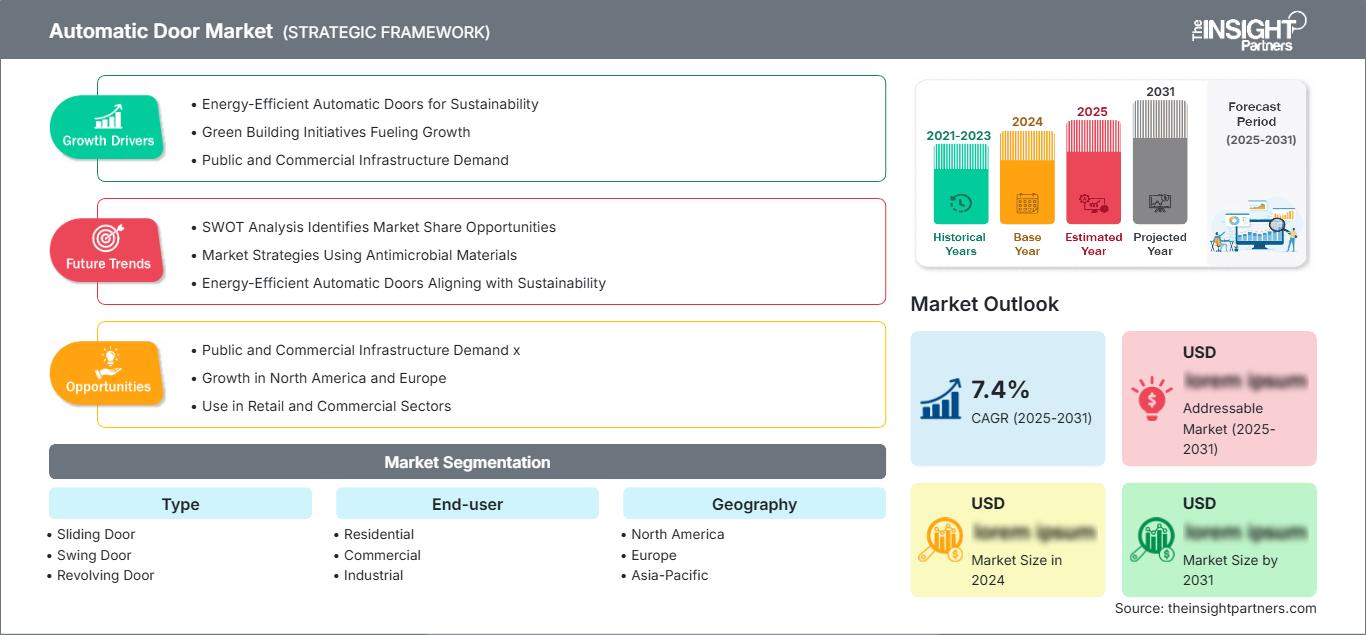
Regional Insights
North America automatic door Market
North America accounted for 28–31% share in 2025, with the automatic door market share supported by healthcare spending, airport renovation, and accessibility-focused building codes. Growth within the sector is expected to be recorded at a CAGR of 5.8-6.3% between 2026 and 2034. There is high demand in hospitals, outpatient facilities, supermarkets, airports, and institutional facilities that prioritize the need for touchless mobility, regulated access control, and energy efficiency.
Retrofit demand will remain significant due to the fact that much of the commercial real estate has been developed. Building facility owners are looking to install sliding and swing operators to cut down on points of contact. The return of airport traffic also contributes to installation, given the fact that IATA recorded passenger growth in 2025.
U.S. automatic door Market
The U.S. represented 74–78% of North America in 2025 and is expected to grow at a CAGR of 5.7–6.2% through 2034. Automatic door adoption is supported by hospital renovation, large retail chains, airports, warehouses, and office campuses. ADA compliance and safety standards create recurring replacement demand, while energy-focused building owners prefer systems that reduce air infiltration.
Company presence is broad, with ASSA ABLOY AB, dormakaba Holding AG, Rite-Hite Holding Corporation, and STANLEY Access Technologies LLC serving national accounts and high-traffic projects. The automatic door market trends in terms of application favor sliding doors for hospitals and retail, swing operators for accessible entrances, and high-speed industrial doors in logistics. Maintenance contracts are a key differentiator because downtime can affect safety and facility throughput.
Europe automatic door Market
Europe held 30–33% share in 2025 and is forecast to grow at a CAGR of 5.9–6.4% during 2026–2034. Germany is the leading country because of industrial automation, transport infrastructure, and strict building performance standards. The UK shows strong demand from retail refurbishments, healthcare estates, rail stations, and airport terminals, where accessibility upgrades remain a steady investment theme.
Germany benefits from manufacturing depth and high acceptance of automated access in commercial and industrial facilities. France, Italy, and Spain contribute through hospitality, healthcare, transport, and supermarket investments. European buyers often emphasize EN safety compliance, low-energy operation, and reliable aftersales support. GEZE GmbH, dormakaba Holding AG, ASSA ABLOY AB, Gilgen Door Systems AG, and Royal Boon Edam International B.V. maintain strong regional visibility.
APAC automatic door Market
APAC captured 27–30% share in 2025 and is projected to grow at a CAGR of 7.4–8.1% during 2026–2034, making it the fastest regional market. China leads demand through transport, commercial real estate, hospitals, and industrial facilities. Japan and South Korea emphasize sensor precision, safety, and compact designs, while India and Australia add growth through urban infrastructure and healthcare construction.
Policy support for smart cities, transit modernization, and energy-efficient buildings strengthens adoption. Industrial users are adding high-cycle doors for warehouses, factories, and cold-chain facilities. APAC demand is also shaped by airports and metro systems that require reliable pedestrian flow management. Suppliers that combine cost-competitive manufacturing with certified safety systems are positioned to gain share.
Middle East & Africa automatic door Market
Middle East & Africa is expected to grow at a CAGR of 6.2–6.8% during 2026–2034, supported by airport, hospitality, healthcare, and commercial infrastructure. Saudi Arabia is the leading country, followed by the UAE, where large mixed-use developments and transport projects require premium entrance systems. South Africa and Rest of MEA add demand through retail and institutional upgrades.
Energy and infrastructure investment influences procurement across the region. Developers favor revolving and sliding doors for climate control in malls, hotels, airports, and office towers. Industrial applications are expanding around logistics, food processing, and manufacturing zones. Service capability and system durability remain decisive because temperature, dust, and high-use environments increase maintenance requirements.
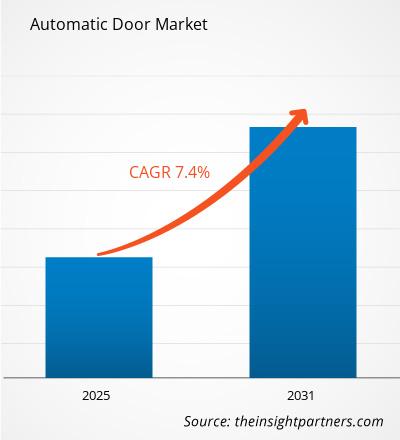
Segmentation Analysis
Type
Type is projected to grow at a CAGR of 6.4–7.1% during 2026–2034. The automatic door market scope across product types is shaped by traffic volume, entry width, safety requirements, building aesthetics, and climate-control needs. Sliding configurations remain the most widely specified, while revolving and folding systems gain relevance in premium commercial and constrained-space applications.
- Sliding Door remains the dominant type because it supports wide openings, high pedestrian movement, and space-efficient layouts in hospitals, airports, supermarkets, office buildings, and transport terminals.
- Swing Door is favored for retrofits, accessible entrances, clinics, hotels, and low-to-medium traffic facilities where existing hinged doors can be automated with minimal structural changes.
- Revolving Door supports climate separation and continuous flow in office towers, airports, hotels, and malls, making it strategically important for energy-conscious premium buildings.
- Folding Door serves constrained entrances, transit facilities, and compact commercial spaces where wider clear passage is needed without the wall pocket requirements of sliding systems.
End-user
End-user is expected to expand at a CAGR of 6.7–7.4% during 2026–2034. Commercial buyers represent the largest demand base because automated entry improves accessibility, hygiene, traffic flow, and building energy performance. Residential adoption is gradually increasing through premium apartments and assisted-living facilities, while industrial users focus on high-cycle durability and controlled access.
- Residential demand is concentrated in premium housing, assisted-living communities, and accessible home retrofits where convenience, safety, and mobility support justify higher installation costs.
- Commercial applications dominate because hospitals, airports, offices, hotels, supermarkets, and shopping centers require reliable high-traffic entry systems that improve user flow and hygiene.
- Industrial users adopt automated doors for warehouses, cleanrooms, manufacturing sites, cold storage, and logistics facilities where speed, safety, sealing, and durability affect productivity.
Opportunity Snapshot
| End-user | Revenue Contribution | Trend Tag | Adoption Stage |
| Residential | Low | Assisted Living | Emerging |
| Commercial | High | Touchless Entry | Mature |
| Industrial | Medium | High Cycle | Scaling |
Automatic Door Market Growth Drivers and Impact Analysis
Accessibility Codes and Aging Infrastructure
The accessibility standards are transforming the automatic opening feature from being an optional feature to one that makes an upgrade necessary in order to meet legal obligations. The facilities such as hospitals, governmental buildings, airports, educational institutions, office spaces, and retail buildings require consideration of those individuals who have disabilities and those who carry their care givers or equipment along with them. In older commercial properties in North America and Europe, there is need for retrofits since their present entrance doors lack certain features including operators, sensors, clearance, and safety features.
Healthcare and Transport Modernization
Healthcare and transportation centers are critical demand centers since access mechanisms play a role in security, sanitation, and efficiency. In the healthcare setting, there is a requirement to be able to move freely with ease without any barriers for patients, employees, beds, wheelchairs, or supplies. The same is true for airports and subway stations, where it is important to maintain control of traffic flow at entryways, checkpoints, waiting lounges, and service corridors. Passenger traffic recovery makes a good argument for having robust sensor-operated systems. The IATA figures indicating that airline travel will grow in 2025 support such an investment.
Energy Efficiency and Smart Building Integration
Energy performance is becoming a stronger purchase criterion as building owners seek to reduce heating and cooling losses at entrances. Revolving doors, fast-closing sliding systems, and smart controls help limit uncontrolled air exchange in malls, airports, hotels, hospitals, and office towers. Integration with building management systems allows doors to coordinate with security, occupancy, and HVAC strategies. This shifts procurement from upfront price toward total cost of ownership. Manufacturers that provide low-energy operators, diagnostics, and data-ready controls are better positioned for premium projects and long-term service contracts.
Automatic Door Market Future Trends
Predictive Maintenance Becomes Standard
In the coming years, the trend in the automatic door market will be focused on predictive maintenance as opposed to corrective maintenance. With cycle counting, motor load measurement, failure warnings, and connectivity capabilities, operators can assist facility managers in identifying wear issues before they lead to equipment breakdown. This is particularly useful for hospitals, airports, and logistics centers where downtime at the entry point affects both efficiency and safety. In the next few years, service agreements will feature uptime parameters and planned replacement of components.
Low-Energy Operators for Retrofit Buildings
Retrofit-friendly low-energy operators are expected to gain wider specification as owners modernize older buildings without major structural changes. These systems are attractive for clinics, schools, offices, residential complexes, and small retail properties because they improve accessibility while limiting installation complexity. Manufacturers will likely focus on quieter motors, compact headers, safer sensors, and faster commissioning. The trend also supports sustainability objectives by extending the useful life of existing buildings. Installers with retrofit expertise will gain advantage over providers focused only on new-build projects.
Automatic Door Market Opportunities
Commercial Retrofit Programs
Automatic door retrofits represent the most promising opportunity in the short term for predicting automatic door market forecast due to the possibility of renovating buildings without having to start from scratch in new construction projects. Healthcare facilities, grocery stores, hotels, educational facilities, financial institutions, and offices are changing their manual doors into automatic doors due to accessibility, hygienic, and efficiency reasons. Automatic door suppliers could convert more customers through providing audit services, retrofitting kits, financing, and maintenance packages. This is a great opportunity especially in North America and Europe due to developed building stock in these regions.
Industrial and Cold-Chain Access Automation
There are plenty of opportunities within industrial buildings as warehouse facilities, food production plants, cold storage facilities, and logistics centers increasingly look for quicker controlled entry. High-cycle doors minimize open periods, assist with temperature control, and provide separation between walkways and handling areas. There is an increased demand for high cycle doors within e-commerce warehousing, pharmaceutical industry, and food processing, in which continuity of operations and hygiene are important. Rugged operators, fabric doors, safety sensors, and preventive maintenance will make a difference within the competitive landscape.
Recent Developments
- February 2026: ASSA ABLOY Entrance Systems has launched the new ASSA ABLOY RT1000, a high-performance spiral high speed door designed for energy efficiency, security and durability in demanding industrial environments. Engineered for rapid operation and long service life, the RT1000 is ideally suited to logistics, warehousing and manufacturing facilities
- March 2025- dormakaba presented its latest developments and innovations in access solutions at International Security Conference and Exposition (ISC) West 2025. One of them is automatic sliding doors dormakaba ESA400 provide continuous, self-monitored access for exterior entrances.
Frequently Asked Questions

- Comprehensive Market Sizing and Forecast Analysis
- Detailed Segmentation Analysis
- In-Depth Market Dynamics Assessment
- Regional and Country-Level Insights
- Competitive Landscape and Company Benchmarking
- Strategic Business Intelligence
Recent Reports
Testimonials

The Insight Partners' SCADA System Market report is comprehensive, with valuable insights on current trends and future forecasts. The team was highly professional, responsive, and supportive throughout. We are very satisfied and highly recommend their services.
RAN KEDEM Partner, Reali Technologies LTDs
I requested a report on a very specific software market and the team produced the report in a few days. The information was very relevant and well presented. I then requested some changes and additions to the report. The team was again very responsive and I got the final report in less than a week.
JEAN-HERVE JENN Chairman, Future Analytica
We worked with The Insight Partners for an important market study and forecast. They gave us clear insights into opportunities and risks, which helped shape our plans. Their research was easy to use and based on solid data. It helped us make smart, confident decisions. We highly recommend them.
PIYUSH NAGPAL Sr. Vice President, High Beam Global
The Insight Partners delivered insightful, well-structured market research with strong domain expertise. Their team was professional and responsive throughout. The user-friendly website made accessing industry reports seamless. We highly recommend them for reliable, high-quality research services
YUKIHIKO ADACHI CEO, Deep Blue, LLC.
This is the first time I have purchased a market report from The Insight Partners.While I was unsure at first, I visited their web site and felt more comfortable to take the risk and purchase a market report.I am completely satisfied with the quality of the report and customer service. I had several questions and comments with the initial report, but after a couple of dialogs over email with their analyst I believe I have a report that I can use as input to our strategic planning process.Thank you so much for taking the extra time and making this a positive experience.I will definitely recommend your service to others and you will be my first call when we need further market data.
JOHN SUZUKI President and Chief Executive Officer, Board Director, BK Technologies
I wish to appreciate your support and the professionalism you displayed in the course of attending to my request for information regarding to infectious disease IVD market in Nigeria. I appreciate your patience, your guidance, and the fact that you were willing to offer a discount, which eventually made it possible for us to close a deal. I look forward to engaging The Insight Partners in the future, all thanks to the impression you have created in me as a result of this first encounter.
DR CHIJIOKE ONYIA MANAGING DIRECTOR, PineCrest Healthcare Ltd.Reason to Buy
- Informed Decision-Making
- Understanding Market Dynamics
- Competitive Analysis
- Identifying Emerging Markets
- Customer Insights
- Market Forecasts
- Risk Mitigation
- Boosting Operational Efficiency
- Strategic Planning
- Investment Justification
- Tracking Industry Innovations
- Aligning with Regulatory Trends





 Get Free Sample for