
Automobile Toys Market Growth, Share & Trends by 2034
Coverage: By Type (Handheld Toys, Motorized Toys); Distribution Channel (Supermarkets and Hypermarkets, Specialty Stores, Online Retail, Others) , and Geography (North America, Europe, Asia Pacific, and South and Central America)
- Status : Data Released
- Report Code : TIPRE00024839
- Category : Consumer Goods
- No. of Pages : 150
- Available Report Formats :


- Last update date : August 24, 2026


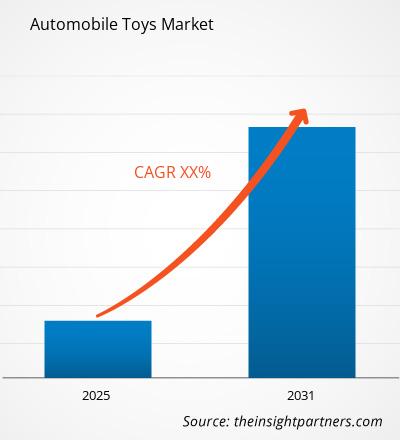
2025 Market Size
US$ 6.17 Bn
Base year value
2034 Forecast
US$ 10.80 Bn
Projected by 2034
CAGR 2026-2034
6.41 %
Growth rate
Addressable Market
US$ 76.74 Bn
(2026-2034)
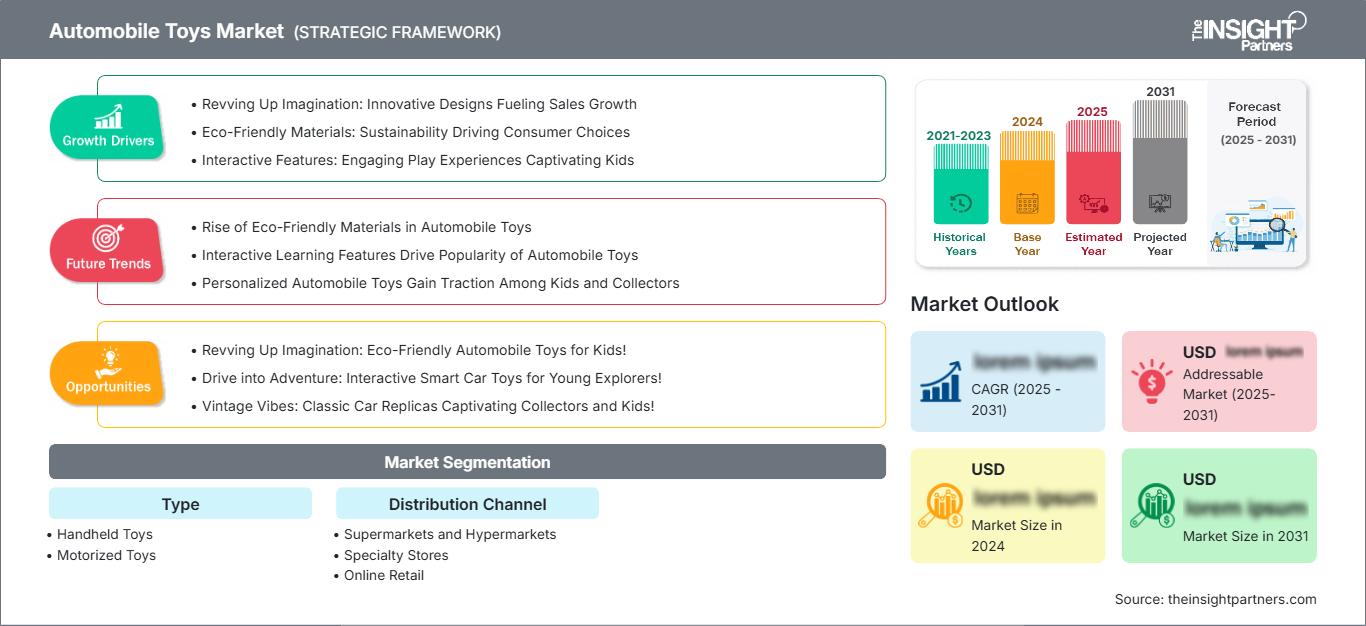
The automobile toys market was valued at US$ 6.17 Billion in 2025 and is projected to reach US$ 10.80 Billion by 2034, growing at a CAGR of 6.14% during 2026–2034. Demand is supported by branded toy cars, construction vehicle kits, remote-control models, collectible die-cast products, and licensed mobility-themed playsets across child and adult consumer groups.
North America remains a high-value region as premium retail, collector communities, licensed entertainment tie-ins, and online gifting support the expansion of the automobile toys market size. The region is estimated to hold 28–31% share in 2025 and grow at a CAGR of 5.7–6.3% during 2026–2034, supported by strong specialty toy chains, mass retail seasonal demand, and direct-to-consumer brand stores.
Automobile Toys Market Assessment and Insights
- North America is estimated to hold 28–31% share in 2025 and grow at a CAGR of 5.7–6.3% during 2026–2034, driven by licensed vehicle ranges, collector releases, and omnichannel toy retail.
- US represents 80–84% of North America in 2025 and is projected to grow at a CAGR of 5.6–6.2% as holiday gifting, e-commerce, and specialty hobby stores support recurring purchases.
- Europe is estimated at 24–27% share in 2025 and a CAGR of 5.4–6.0%, with Germany, the UK, France, Italy, and Spain supporting demand for die-cast, construction, and licensed racing toys.
- Asia Pacific accounts for 34–38% share in 2025 and is expected to grow at a CAGR of 6.7–7.4%, led by China, Japan, South Korea, India, and Australia.
- Largest Segment: Handheld Toys hold 61–65% market share in 2025 and are expected to grow at a CAGR of 5.8–6.4% due to affordability, collectability, and broad retail availability.
- High Growth Segment: Online Retail holds 27–31% share in 2025 and is projected to grow at a CAGR of 7.2–8.0% as marketplaces, brand stores, and hobby platforms expand access.
- Key companies analyzed in detail: Mattel, Inc., Hasbro, Inc., LEGO A/S, TOMY Company, Ltd., Bandai Namco Holdings Inc., Simba Dickie Group GmbH, Spin Master Corp., AOSHIMA BUNKA KYOZAI Co., Ltd., Moose Enterprise Pty Ltd, and Tru Kids Brands.
Source: The Insight Partners' analysis based on proprietary research, government publications, company annual reports, investor presentations, industry databases, and expert interviews.
Category evolution has moved beyond simple miniature cars toward licensed race vehicles, buildable automotive kits, battery-powered stunt models, and collector-grade assortments. Product pipelines increasingly combine traditional play value with entertainment franchises, motorsport partnerships, and premium detailing. The automobile toys market report highlights that market growth reflects this shift because manufacturers can serve preschool play, school-age imaginative play, STEM-oriented building, and adult collecting through differentiated price tiers.
Demand going forward will hinge on how brands strike the right balance between pricing, regulatory safety requirements, licensed designs, and sustainability. Emerging markets will contribute through growth in middle-class families, whereas mature markets will provide through the use of limited edition drops and motorsports-inspired lines. Companies that refresh their lines and enhance digital discovery will be best placed for future purchases.
Automobile Toys Market Report Scope
| Report Attribute | Details |
|---|---|
| Market size in 2025 | US$ 6.17 Billion |
| Market Size by 2034 | US$ 10.80 Billion |
| Global CAGR (2026 - 2034) | 6.41% |
| Historical Data | 2021-2024 |
| Forecast period | 2026-2034 |
Automobile Toys Market Analysis
Demand is driven by gift cycles, parents' appreciation for durable toys and the broad appeal of mobility themes. Market expansion is also facilitated by entertainment licensing, social media exposure and collectors interested in limited edition die-cast cars. Mass accessibility is ensured through supermarkets and hypermarkets, whereas specialty stores and brand websites contribute to the luxury position through product selection, release schedules and collector groups.
Cost factors include the price of plastic, metal, packaging and electronics parts. Brands address this with modular molds, chassis sharing and mixed-material designs, which lower development costs but still provide variety. Licensing, retailing, contract manufacturing, online marketplaces and hobby distribution form the supply chain, offering multiple channels to gauge demand before going global with their offerings.
The competitive positioning is mainly centered around brand equity and portfolio depth. Market analysis indicates that Mattel Inc. and TOMY Company Ltd. continue to be relevant in die-cast and toy vehicles, miniature, whereas LEGO A/S has the edge in buildable race cars and motorsport licenses. Other competitors such as Hasbro Inc., Bandai Namco Holdings Inc., Spin Master Corp., Simba Dickie Group GmbH, AOSHIMA BUNKA KYOZAI Co., Ltd., Moose Enterprise Pty Ltd., and Tru Kids Brands compete via licensing, retailing, and play age formats.
Investments are being made in quicker cycle time, direct-to-consumer introductions, and alliances in order to create a link between toys and entertainment, racing, and content. Brands that manage the integration of design, licensing, safety and internet merchandising are set for high margins. Strategy is becoming increasingly critical in terms of creating franchise products out of temporary trends.
● REPORT CUSTOMIZATION
Tailor This Report To Align With Your Specific Business Requirements
This report can be customized to align precisely with your business objectives, scope, and target markets. Customization options include tailored segmentation, geography, competitive analysis, and strategic insights to support informed decision-making.
Customize This Report →WHAT YOU CAN ADJUST
- ● Segmentations
- ● Geography
- ● Competitive Analysis
- ● Language Preferences
Automobile Toys Market: Strategic Insights
Regional Insights
North America automobile toys market
North America is estimated to hold 28–31% share in 2025 and grow at a CAGR of 5.7–6.3% during 2026–2034. The automobile toys market share in the region is supported by mass retailers, specialty hobby stores, large holiday gifting budgets, and strong brand recognition for vehicle-themed products.
Demand is particularly resilient because consumers buy across multiple use cases, including preschool play, birthday gifting, collector additions, and entertainment-linked launches. Retailers use exclusive assortments and seasonal displays to drive store traffic, while online channels support long-tail collector demand. Premium die-cast vehicles and licensed motorsport sets give brands room for price-tier expansion.
U.S. automobile toys Market
The U.S. represents 80–84% of North America in 2025 and is expected to grow at a CAGR of 5.6–6.2% during 2026–2034. Demand is driven by national retail chains, online marketplaces, brand-owned stores, and collector communities that follow release calendars closely.
American consumers show strong interest in Hot Wheels, remote-control trucks, construction vehicle kits, and licensed racing products. Product visibility is reinforced by entertainment franchises, social media unboxing, and seasonal gift guides. Domestic distribution scale helps companies manage promotional calendars and replenish high-volume SKUs during peak holiday and back-to-school periods.
Europe automobile toys Market
Europe is estimated to hold 24–27% share in 2025 and grow at a CAGR of 5.4–6.0% during 2026–2034. Germany is the leading country because of a strong automotive culture, premium toy purchasing, and established model vehicle collecting. The UK supports online and specialty retail demand, especially for licensed racing products.
France, Italy, and Spain contribute through family gifting, supermarket toy aisles, and demand for construction and die-cast vehicles. European safety expectations and sustainability preferences influence material choices, packaging, and product claims. Brands that connect motorsport, design authenticity, and educational building are positioned to capture value across both children and adult collectors.
APAC automobile toys Market
APAC accounts for 34–38% share in 2025 and is projected to grow at a CAGR of 6.7–7.4% during 2026–2034. China drives demand from scale, e-commerce adoption, and increasing middle-class purchasing power. Japan provides high-end model culture, whereas South Korea backs licensed character and collectible demand.
India and Australia contribute to growth through growing organized retail, gifting, and Internet access. Deeper manufacturing capacity in the region also allows for faster assortment development and lower landed cost. The mix of manufacturing scale and consumer base growth makes the APAC region the best volume opportunity for automotive playthings.
Middle East & Africa automobile toys Market
The Middle East & Africa is expected to grow at a CAGR of 4.8–5.5% during 2026–2034, led by the UAE, Saudi Arabia, and South Africa. Demand is supported by mall-based retail, international toy stores, premium gifting, and interest in branded cars and remote-control vehicles.
Adoption remains uneven because price sensitivity and distribution gaps limit access in some markets. However, urban retail development, tourism-driven shopping, and expanding online delivery support gradual growth. Premium imported toys perform well in Gulf markets, while value-oriented handheld vehicles remain important across broader MEA households.
Segmentation Analysis
Type
Type is expected to grow at a CAGR of 5.9–6.5% during 2026–2034. The market scope across types is defined by price accessibility, play complexity, and repeat purchase frequency. Handheld toys remain the backbone of volume sales because they are affordable, portable, and easy to collect, while motorized toys add interactivity and higher average selling prices.
- Handheld Toys dominate volume through die-cast cars, push vehicles, and small playsets that suit impulse purchases, gifting, and collector accumulation across supermarkets, specialty stores, and online channels.
- Motorized Toys attract buyers seeking motion, stunts, remote control, and battery-powered engagement, making them strategically important for premium pricing and technology-enhanced play experiences.
Distribution Channel
Distribution Channel is expected to grow at a CAGR of 6.3–6.9% during 2026–2034. Supermarkets and hypermarkets provide visibility for mainstream SKUs, specialty stores build trust through curated assortments, and online retail accelerates discovery of limited editions and niche hobby products. Channel strategy increasingly determines how quickly launches reach collectors and family buyers.
- Supermarkets and Hypermarkets support high-volume purchases through shelf visibility, seasonal promotions, and price-led bundles, especially for handheld toy cars and entry-level vehicle playsets.
- Specialty Stores remain important for premium assortments, collector guidance, brand storytelling, and access to licensed or limited vehicle models that benefit from knowledgeable retail staff.
- Online Retail is the fastest-scaling channel because marketplaces, brand shops, and hobby platforms provide broad choice, release alerts, reviews, and access to hard-to-find products.
Opportunity Snapshot
| Distribution Channel | Revenue Contribution | Trend Tag | Adoption Stage |
| Supermarkets and Hypermarkets | High | Impulse Gifting | Mature |
| Specialty Stores | Medium | Collector Retail | Mature |
| Online Retail | High | Limited Drops | Scaling |
Automobile Toys Market Growth Drivers and Impact Analysis
Licensed Vehicle Franchises and Motorsport Partnerships
The connection between vehicles and toys would do well when it has good connections to the world of racing, movies, games, animation, and automobiles. Assorted licensed toys will ensure that there are recognizable toys that will not only entice children but also their parents and adult collectors, too. The use of Formula 1 licenses, movie cars, and even branded die-cast lines will enable manufacturers to stimulate demand without having to recreate the category consciousness.
Expansion of Online Retail and Collector Communities
The online shopping environment has impacted the manner in which toy vehicles are discovered, compared and purchased by buyers. Online marketplaces, brand shops and hobby websites have made it easier for buyers to monitor new launches, regional exclusives and buy collector-grade products regardless of their absence from physical stores. Social media groups and unboxing reviews also affect purchases. This driver contributes to higher sell-through of limited product lines as well as tail sales of older products.
Rising Demand for Interactive and Buildable Play
There is a growing preference among parents for toys that balance entertainment with building, coordination, and thinking skills. Toys such as motorized cars, remote-controlled trucks, buildable race tracks, and stunt tracks satisfy this requirement by adding activity into what would have been otherwise passive play with toy vehicles. The result is an ability to command premium pricing and to extend beyond the traditional preschool buyer. This is evident in the broad product ladder within the industry.
Automobile Toys Market Future Trends
Sustainable Materials and Responsible Packaging
The automobile toys market trends will increasingly reflect sustainability expectations from retailers, regulators, and parents. Brands are expected to reduce plastic-heavy packaging, expand recycled or bio-based materials where safety permits, and communicate durability as part of value. The transition will be gradual because vehicle toys require strength, paint quality, and safety-tested components. However, companies that improve material transparency and packaging efficiency can strengthen retailer relationships and appeal to environmentally aware buyers without weakening product performance.
Digital Discovery Around Physical Toy Launches
In the future, there will be more use of digital anticipation for upcoming launches. Brands can make use of such things as countdowns, creator teasers, exclusive online content, and collector databases to move from awareness to urgency of purchase. This phenomenon will become particularly pertinent when it comes to die-cast cars, racing sets, and model kits. With the growing number of research before purchasing, successful brands will have to synchronize content, availability, and community involvement.
Automobile Toys Market Opportunities
Premium Collectibles for Adult and Family Buyers
The automobile toys market Forecasts point to a stronger role for adult collectors and family buyers who value detailed models, nostalgia, and licensed automotive brands. It is possible for companies to offer premium lineups that will be based on genuine design elements and limited production runs, combined with packages that are suitable for merchandising. This creates an opportunity for higher margins from each sale and less need to depend on budget offers that create impulse buying.
Emerging Market Distribution Partnerships
Room for distribution is present in emerging economies through supermarkets, toy store chains, markets, and regional distributors. Manufacturers may customize their assortments according to pricing levels, safety standards, gift-giving calendar, and use the Internet to gauge demand before launching the product on the retail shelf. This is particularly the case in areas where there are growing numbers of middle-class households looking for toys with a brand name and quality.
Frequently Asked Questions

- Comprehensive Market Sizing and Forecast Analysis
- Detailed Segmentation Analysis
- In-Depth Market Dynamics Assessment
- Regional and Country-Level Insights
- Competitive Landscape and Company Benchmarking
- Strategic Business Intelligence
Testimonials

The Insight Partners provided valuable market intelligence that supported our global go-to-market strategy. Their team was professional, responsive, and attentive to our feedback, providing thoughtful analysis and helpful methodological clarifications throughout the project.
Junmo Kim Chief Financial Officer (CFO), Enertech Co., Ltd.
The Insight Partners' SCADA System Market report is comprehensive, with valuable insights on current trends and future forecasts. The team was highly professional, responsive, and supportive throughout. We are very satisfied and highly recommend their services.
RAN KEDEM Partner, Reali Technologies LTDs
I requested a report on a very specific software market and the team produced the report in a few days. The information was very relevant and well presented. I then requested some changes and additions to the report. The team was again very responsive and I got the final report in less than a week.
JEAN-HERVE JENN Chairman, Future Analytica
We worked with The Insight Partners for an important market study and forecast. They gave us clear insights into opportunities and risks, which helped shape our plans. Their research was easy to use and based on solid data. It helped us make smart, confident decisions. We highly recommend them.
PIYUSH NAGPAL Sr. Vice President, High Beam Global
The Insight Partners delivered insightful, well-structured market research with strong domain expertise. Their team was professional and responsive throughout. The user-friendly website made accessing industry reports seamless. We highly recommend them for reliable, high-quality research services
YUKIHIKO ADACHI CEO, Deep Blue, LLC.
This is the first time I have purchased a market report from The Insight Partners.While I was unsure at first, I visited their web site and felt more comfortable to take the risk and purchase a market report.I am completely satisfied with the quality of the report and customer service. I had several questions and comments with the initial report, but after a couple of dialogs over email with their analyst I believe I have a report that I can use as input to our strategic planning process.Thank you so much for taking the extra time and making this a positive experience.I will definitely recommend your service to others and you will be my first call when we need further market data.
JOHN SUZUKI President and Chief Executive Officer, Board Director, BK Technologies
I wish to appreciate your support and the professionalism you displayed in the course of attending to my request for information regarding to infectious disease IVD market in Nigeria. I appreciate your patience, your guidance, and the fact that you were willing to offer a discount, which eventually made it possible for us to close a deal. I look forward to engaging The Insight Partners in the future, all thanks to the impression you have created in me as a result of this first encounter.
DR CHIJIOKE ONYIA MANAGING DIRECTOR, PineCrest Healthcare Ltd.Reason to Buy
- Informed Decision-Making
- Understanding Market Dynamics
- Competitive Analysis
- Identifying Emerging Markets
- Customer Insights
- Market Forecasts
- Risk Mitigation
- Boosting Operational Efficiency
- Strategic Planning
- Investment Justification
- Tracking Industry Innovations
- Aligning with Regulatory Trends





 Get Free Sample for