
Blockchain in Fintech Market Demand, Size & Forecast by 2034
Coverage: By Provider (Infrastructure Provider, Middleware Provider, and Application Provider); Application (Payments Clearing, & Settlements, Smart Contracts, Identity Management, Exchange & Remittance Compliance Management, and Others); End Use (Banking,Non-Banking Financial Companies, and Insurance); and Geography.
- Status : Data Released
- Report Code : TIPRE00003119
- Category : Banking, Financial Services, and Insurance
- No. of Pages : 150
- Available Report Formats :


- Last update date : March 25, 2026


2025 Market Size
US$ 6.93 Bn
Base year value
2034 Forecast
US$ 105.97 Bn
Projected by 2034
CAGR 2026-2034
35.4 %
Growth rate
Addressable Market
US$ 378.92 Bn
(2026-2034)
Blockchain in Fintech market is expected to register a CAGR of 42.44% from 2026 to 2034, with the market size expanding from US$ 6.77 Billion in 2025 to US$ 163.45 Billion by 2034.
Key market dynamics include the rapid adoption of decentralized ledger technology for secure transactions, the expansion of digital asset platforms, and a global surge in fintech innovation. Additionally, the market is expected to benefit from increasing regulatory clarity for blockchain adoption, the rise of tokenized financial assets, and the integration of artificial intelligence with decentralized infrastructure to enhance risk management and customer experience.
Blockchain in Fintech Market Analysis
The blockchain in fintech market analysis reveals a significant pivot toward high-security, transparent financial ecosystems as institutions prioritize fraud reduction and operational efficiency. The market is diversifying into interoperable protocols that bridge traditional banking with decentralized finance (DeFi). Strategic opportunities are emerging in automated compliance and programmable finance, where the immutability of blockchain offers a substantial edge over legacy systems. The analysis also notes that market expansion depends on the scalability of cloud-based blockchain solutions and the efficiency of cross-chain communication. Competitive differentiation is increasingly determined by the ability to offer seamless integration with existing financial APIs and the implementation of advanced security audits to protect against evolving cyber threats.
Blockchain in Fintech Market Overview
Financial technology has transitioned from basic digital banking to sophisticated, autonomous ecosystems. Blockchain in fintech encompasses everything from instant cross-border remittances to fractionalized asset ownership and self-executing insurance claims. Both global technology giants and specialized blockchain startups compete in this space, utilizing private, public, and hybrid blockchain architectures. Growing demand for 24/7 financial services and lower transaction fees among retail and institutional users has solidified blockchain as a critical pillar of modern finance. North America remains the revenue leader due to its early adoption of crypto-assets and strong venture capital support, while Asia-Pacific is rapidly advancing in digital payment infrastructure and regulatory sandboxes. The market is also seeing a shift toward green blockchain initiatives, prioritizing energy-efficient consensus mechanisms to meet global sustainability standards.
The US market is the most developed global hub, driven by a high concentration of blockchain innovators and widespread institutional adoption. Leading through the mainstreaming of digital assets and spot ETFs, the region prioritizes regulatory-compliant infrastructure, advanced cybersecurity, and the integration of decentralized protocols into traditional banking and enterprise systems.
Market Research Highlights
- Global market for Blockchain in Fintech was valued at US$ 6.77 Billion in 2025
- Annual market size is expected to reach US$ 163.45 Billion by 2034
- Total addressable market (TAM) during 2026-2034 is projected to reach approximately US$ 525.72 Billion
- Market is anticipated to register a CAGR of 42.44% during the forecast period
- The United States represents a key market, supported by Unlocking Blockchain: Transforming Fintech for Everyone, Empowering Transactions: Blockchain's Role in Financial Inclusion, Trust and Transparency: How Blockchain is Reshaping Fintech, as well as evolving industry dynamics
- Market analysis covers North America, Europe, Asia-Pacific, South and Central America, Middle East and Africa, with growth evaluated across the forecast period
- Market opportunities such as Blockchain Revolutionizes Trust in Fintech Transactions, Decentralized Finance: The Future of Banking is Here, Smart Contracts: Automating Trust in Financial Services are expected to influence market dynamics and addressable market
- Report profiles industry participants, including AWS, IBM, Microsoft, Ripple, Earthport, Bitfury, Circle, Oracle, Factom, Abra, while analyzing competitive strategies and innovation developments
-
Source: The Insight Partners' analysis based on proprietary research, government publications, company annual reports, investor presentations, industry databases, and expert interviews.
● REPORT CUSTOMIZATION
Tailor This Report To Align With Your Specific Business Requirements
This report can be customized to align precisely with your business objectives, scope, and target markets. Customization options include tailored segmentation, geography, competitive analysis, and strategic insights to support informed decision-making.
Customize This Report →WHAT YOU CAN ADJUST
- ● Segmentations
- ● Geography
- ● Competitive Analysis
- ● Language Preferences
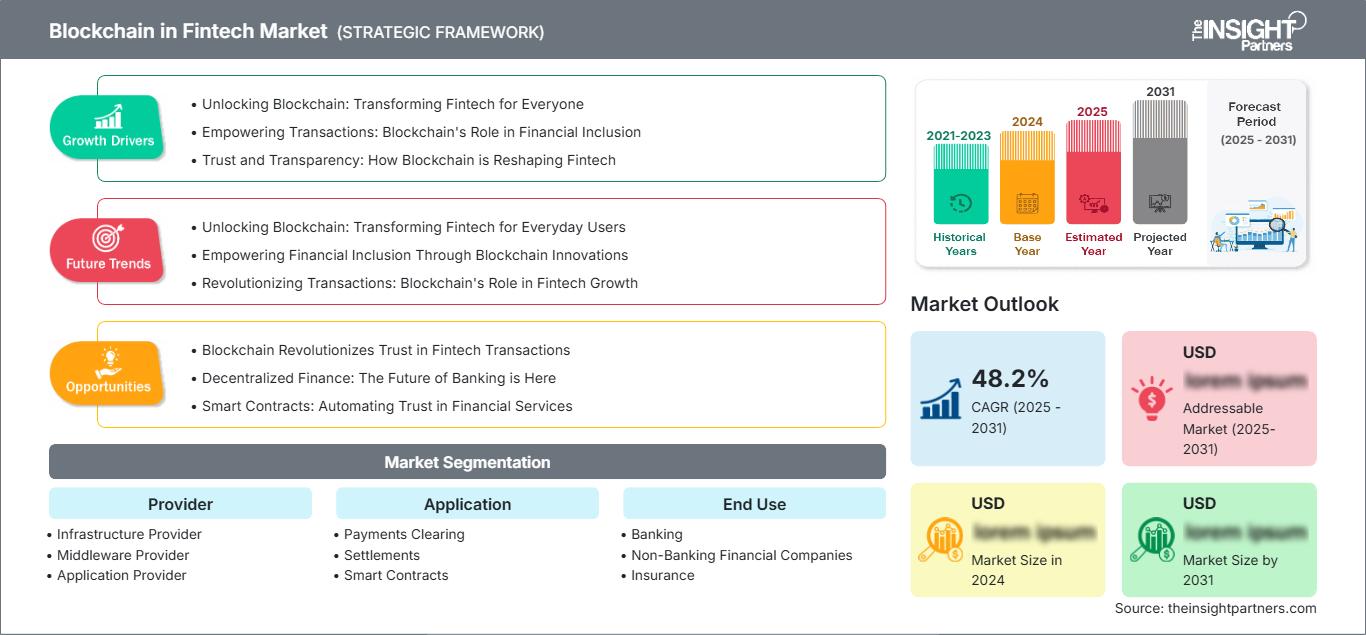
Blockchain in Fintech Market: Strategic Insights
-
Get Top Key Market Trends of this report.This FREE sample will include data analysis, ranging from market trends to estimates and forecasts.
Blockchain in Fintech Market: Drivers and Opportunities
Market Drivers:
- Rising Demand for Transparency and Security: Blockchain provides an immutable ledger that makes it nearly impossible for unauthorized parties to alter transaction data, addressing the primary security concerns of the financial industry.
- Faster Transaction Times and Lower Fees: By removing intermediaries and decentralizing the approval process, blockchain enables near-instant settlements and significantly reduces processing costs for global transfers.
- Mainstreaming of Digital Identity: The need for secure, tamper-proof KYC and AML processes is driving the integration of blockchain-based identity management to streamline onboarding and reduce identity theft.
Market Opportunities:
- Expansion of Tokenized Real-World Assets: Converting physical assets into digital tokens on a blockchain opens up massive liquidity in markets like real estate and private equity.
- Institutional Adoption of Smart Contracts: Automating complex financial agreements through self-executing code offers vast potential in trade finance, loan processing, and derivative settlements.
- Synergy with Agentic AI: Combining autonomous AI agents with blockchain rails allows for real-time fraud detection and automated portfolio management without human intervention.
Blockchain in Fintech Market Report Segmentation Analysis
The Blockchain in Fintech Market share is analyzed across various segments to provide a clearer understanding of its structure, growth potential, and emerging trends. Below is the standard segmentation approach used in most industry reports:
By Provider:
- Infrastructure Provider: Captures the largest share, providing the essential hardware, servers, and base-layer protocols necessary for blockchain operations.
- Middleware Provider: A high-growth segment focusing on software layers that bridge blockchain networks with legacy banking systems and third-party APIs.
- Application Provider: Projected to grow at the fastest rate, delivering tailored end-user solutions for payments, identity, and asset management.
By Application:
- Payments Clearing and Settlements: The dominant application volume driver, fueled by the global push for real-time cross-border remittance solutions.
- Smart Contracts: Accelerating rapidly as institutions deploy automated agreements to minimize administrative costs and human error.
- Identity Management: Growing significantly as a foundational tool for secure digital onboarding and self-sovereign identity.
- Exchange and Remittance Compliance Management: Critical for the growing retail and institutional trade of digital assets and stablecoins. Uses blockchain to automate regulatory reporting and ensure real-time adherence to global financial laws.
By End Use:
- Banking: The largest end-use segment, leveraging blockchain for core settlement, real estate monitoring, and collateral management.
- Non-Banking Financial Companies (NBFCs): Expanding quickly by using blockchain to offer innovative lending and credit solutions to underserved markets.
- Insurance: Utilizing smart contracts to automate claims processing and enhance transparency in policy management.
By Geography:
- North America
- Europe
- Asia-Pacific
- South & Central America
- Middle East & Africa
Blockchain in Fintech Market Report Scope
| Report Attribute | Details |
|---|---|
| Market size in 2025 | US$ 6.93 Billion |
| Market Size by 2034 | US$ 105.97 Billion |
| Global CAGR (2026 - 2034) | 35.4% |
| Historical Data | 2021-2024 |
| Forecast period | 2026-2034 |
| Segments Covered |
By Provider
|
| Regions and Countries Covered |
North America
|
| Market leaders and key company profiles |
|
Blockchain in Fintech Market Players Density: Understanding Its Impact on Business Dynamics
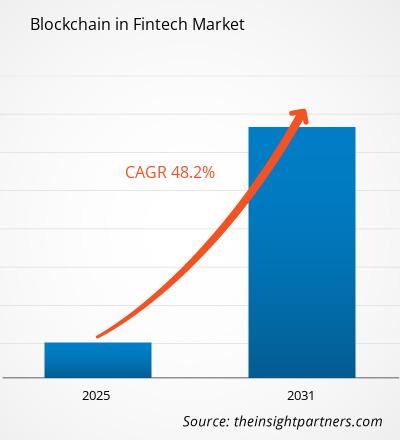
The Blockchain in Fintech Market is growing rapidly, driven by increasing end-user demand due to factors such as evolving consumer preferences, technological advancements, and greater awareness of the product's benefits. As demand rises, businesses are expanding their offerings, innovating to meet consumer needs, and capitalizing on emerging trends, which further fuels market growth.
Blockchain in Fintech Market Share Analysis by Geography
Asia-Pacific region is expected to grow fastest in the coming years, driven by massive digital transformation and government-led blockchain initiatives. Emerging markets in South & Central America, the Middle East, and Africa also present significant untapped opportunities for decentralized payment providers and digital asset custody services to expand.
The blockchain in fintech market is undergoing a radical transformation, moving from a niche cryptographic experiment to the foundational infrastructure of global finance. Growth is driven by the urgent need for real-time settlement, the rise of decentralized finance (DeFi), and the institutionalization of digital assets. Below is a summary of market share and trends by region:
1. North America
- Market Share: Holds the largest share globally, due to a high concentration of blockchain developers and significant institutional capital.
- Key Drivers:
- Widespread adoption of spot crypto ETFs and institutional-grade digital asset custody.
- Strong presence of industry giants like Coinbase, Ripple, and Circle.
- High venture capital investment in Web3 and decentralized infrastructure startups.
- Trends: Integration of blockchain with traditional brokerage services and the mainstreaming of stablecoins for institutional B2B payments.
2. Europe
- Market Share: A dominant and highly regulated segment, anchored by a mature banking sector and advanced legal frameworks.
- Key Drivers:
- Implementation of the MiCA (Markets in Crypto-Assets) regulation providing pan-European legal certainty.
- High demand for private and consortium blockchains among traditional Tier-1 banks.
- Strong government support for digital Euro initiatives and blockchain-based bond issuance.
- Trends: A strategic shift toward green blockchain protocols and the use of distributed ledgers for automated regulatory reporting and transparency.
3. Asia-Pacific
- Market Share: The fastest-growing region, with countries like China, India, and Singapore acting as primary for retail and wholesale blockchain adoption.
- Key Drivers:
- Massive consumer base utilizing mobile-first digital wallets and decentralized payment rails.
- Government-supported central bank digital currency (CBDC) pilots and digital sandbox initiatives.
- Rapid urbanization and a young, tech-savvy population seeking alternatives to traditional banking.
- Trends: Heavy reliance on blockchain for cross-border trade finance and the integration of blockchain into regional super-apps for seamless financial services.
4. South and Central America
- Market Share: An emerging market with a rapidly growing sector in countries like Brazil, Argentina, and El Salvador.
- Key Drivers:
- Increasing use of blockchain and stablecoins as a hedge against high local currency volatility.
- Modernization of remittance corridors to reduce high fees associated with traditional money transfer operators.
- Rising interest in decentralized lending platforms for small and medium-sized enterprises (SMEs).
- Trends: Growth of P2P payment networks and the introduction of blockchain-based micro-insurance and credit scoring models.
5. Middle East and Africa
- Market Share: A developing market with deep strategic focus, transitioning toward formalized digital economies.
- Key Drivers:
- Strategic investments in smart city initiatives and blockchain-based government financial services in the UAE and Saudi Arabia.
- High demand for mobile-based blockchain banking solutions in unbanked African regions.
- Regional focus on supply chain finance using transparent ledger technology.
- Trends: Implementation of modern digital identity systems to formalize the informal economy, coupled with a focus on tokenizing real-world assets like real estate and gold.
High Market Density and Competition
Competition is intensifying due to the presence of established leaders such as IBM Corporation, Ripple, and Coinbase. Global technology providers like AWS and Microsoft, alongside fintech innovators such as Circle and Block Inc., contribute to a diverse and rapidly expanding market landscape.
This competitive environment pushes vendors to differentiate through:
- Infrastructure Scalability and Security: Positioning blockchain as a superior alternative to legacy databases by emphasizing transaction speed, finality, and military-grade encryption for health-conscious financial institutions.
- Diverse Product Ecosystems: Blockchain solutions now include more than just payment rails. Companies offer smart-contract-based lending, automated compliance tools, and high-end tokenization platforms for real-world assets.
- Full-Stack Vertical Integration: Providers manage the entire ecosystem, from the base-layer protocol (L1/L2) to the user-facing application. This ensures quality, transparency, and meets strict regulatory clean-label standards.
Opportunities and Strategic Moves
- Partner with Tier-1 Financial Institutions: Collaborate with traditional banks and e-commerce platforms to tap into the surging demand for instant settlement and programmable payments in Asia-Pacific and North American markets.
- Adopt Sustainable and Compliant Architectures: Incorporate energy-efficient consensus mechanisms and built-in regulatory compliance features to appeal to environmentally conscious institutional investors and Gen Z consumers seeking ethical financial alternatives.
Major Companies operating in the Blockchain in Fintech Market are:
- AWS
- IBM
- Microsoft
- Ripple
- Earthport
- Bitfury
- Circle
- Oracle
- Factom
- Abra
Disclaimer: The companies listed above are not ranked in any particular order.
Blockchain in Fintech Market News and Recent Developments
- In January 2026, DXC Technology announced a strategic partnership with Ripple, a financial technology company that offers crypto solutions for businesses, to help banks seamlessly adopt digital asset custody and payment capabilities at enterprise scale. As regulated financial institutions navigate an era of exponential change, digital asset adoption depends on accessible, secure blockchain infrastructure. Through this collaboration, DXC and Ripple enable financial institutions and fintechs to access digital asset technology seamlessly, bridging legacy financial systems with on-chain finance.
- In October 2025, Oracle announced the Digital Assets Data Nexus, a soon-to-be-released platform expected to enable banks and financial institutions to more easily launch and leverage blockchain-based digital assets in financial products. Enterprise-grade platform leverages Oracle Blockchain, Oracle AI Database 26ai, and AI agent workflow orchestration to enable financial organizations to issue and govern digital assets securely and at scale.
Blockchain in Fintech Market Report Coverage and Deliverables
The Blockchain in Fintech Market Size and Forecast (2021–2034) report provides a detailed analysis of the market covering below areas:
- Blockchain in Fintech Market size and forecast at global, regional, and country levels for all the key market segments covered under the scope
- Blockchain in Fintech Market trends, as well as market dynamics such as drivers, restraints, and key opportunities
- Detailed PEST and SWOT analysis
- Blockchain in Fintech Market analysis covering key market trends, global and regional framework, major players, regulations, and recent market developments
- Industry landscape and competition analysis covering market concentration, heat map analysis, prominent players, and recent developments in the Blockchain in Fintech Market.
- Detailed company profiles
Frequently Asked Questions

- Comprehensive Market Sizing and Forecast Analysis
- Detailed Segmentation Analysis
- In-Depth Market Dynamics Assessment
- Regional and Country-Level Insights
- Competitive Landscape and Company Benchmarking
- Strategic Business Intelligence
Recent Reports
Testimonials

The Insight Partners' SCADA System Market report is comprehensive, with valuable insights on current trends and future forecasts. The team was highly professional, responsive, and supportive throughout. We are very satisfied and highly recommend their services.
RAN KEDEM Partner, Reali Technologies LTDs
I requested a report on a very specific software market and the team produced the report in a few days. The information was very relevant and well presented. I then requested some changes and additions to the report. The team was again very responsive and I got the final report in less than a week.
JEAN-HERVE JENN Chairman, Future Analytica
We worked with The Insight Partners for an important market study and forecast. They gave us clear insights into opportunities and risks, which helped shape our plans. Their research was easy to use and based on solid data. It helped us make smart, confident decisions. We highly recommend them.
PIYUSH NAGPAL Sr. Vice President, High Beam Global
The Insight Partners delivered insightful, well-structured market research with strong domain expertise. Their team was professional and responsive throughout. The user-friendly website made accessing industry reports seamless. We highly recommend them for reliable, high-quality research services
YUKIHIKO ADACHI CEO, Deep Blue, LLC.
This is the first time I have purchased a market report from The Insight Partners.While I was unsure at first, I visited their web site and felt more comfortable to take the risk and purchase a market report.I am completely satisfied with the quality of the report and customer service. I had several questions and comments with the initial report, but after a couple of dialogs over email with their analyst I believe I have a report that I can use as input to our strategic planning process.Thank you so much for taking the extra time and making this a positive experience.I will definitely recommend your service to others and you will be my first call when we need further market data.
JOHN SUZUKI President and Chief Executive Officer, Board Director, BK Technologies
I wish to appreciate your support and the professionalism you displayed in the course of attending to my request for information regarding to infectious disease IVD market in Nigeria. I appreciate your patience, your guidance, and the fact that you were willing to offer a discount, which eventually made it possible for us to close a deal. I look forward to engaging The Insight Partners in the future, all thanks to the impression you have created in me as a result of this first encounter.
DR CHIJIOKE ONYIA MANAGING DIRECTOR, PineCrest Healthcare Ltd.Reason to Buy
- Informed Decision-Making
- Understanding Market Dynamics
- Competitive Analysis
- Identifying Emerging Markets
- Customer Insights
- Market Forecasts
- Risk Mitigation
- Boosting Operational Efficiency
- Strategic Planning
- Investment Justification
- Tracking Industry Innovations
- Aligning with Regulatory Trends





 Get Free Sample for