
BTE Hearing Aids Market Size, Trends & Demand by 2034
Coverage: By Product Type (Digital Signal Processing Hearing Aids, Simulated Signal Processing Hearing Aids); End User (Hospital, ENT clinics, Homecare, Others), and Geography (North America, Europe, Asia Pacific, and South and Central America)
- Status : Data Released
- Report Code : TIPRE00018292
- Category : Life Sciences
- No. of Pages : 150
- Available Report Formats :


- Last update date : August 11, 2026


2025 Market Size
US$ 2.75 Bn
Base year value
2034 Forecast
US$ 5.02 Bn
Projected by 2034
CAGR 2026-2034
6.92 %
Growth rate
Addressable Market
US$ 35.10 Bn
(2026-2034)
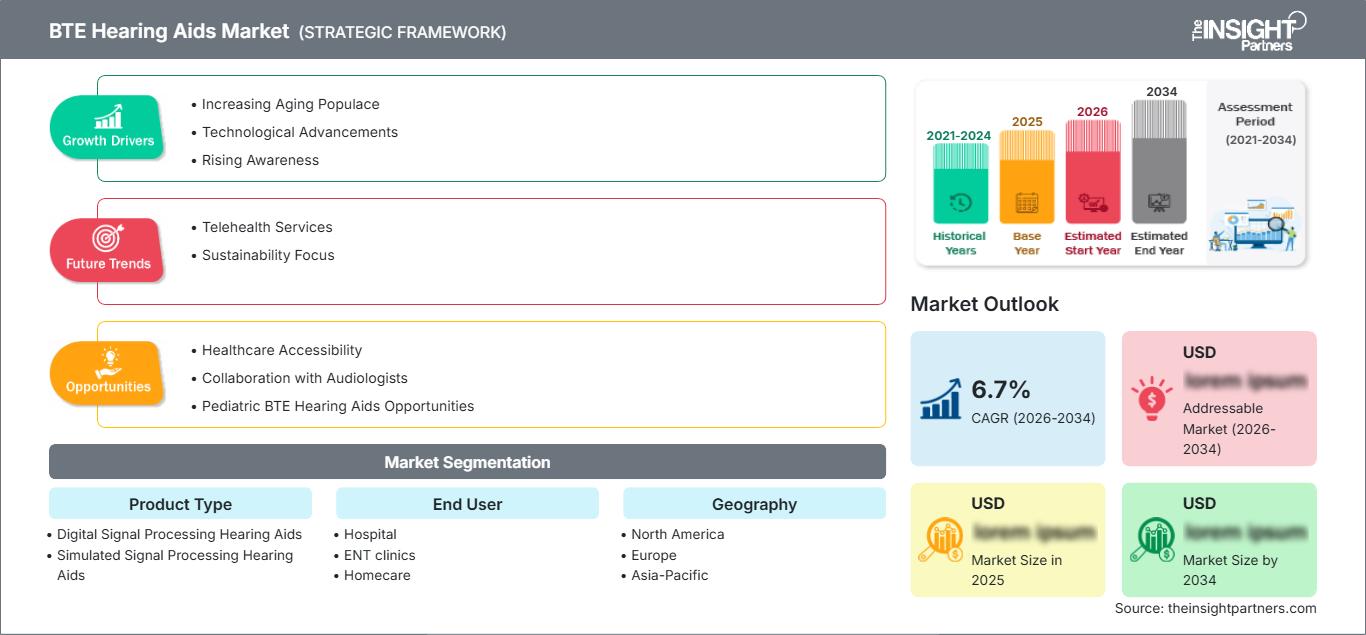
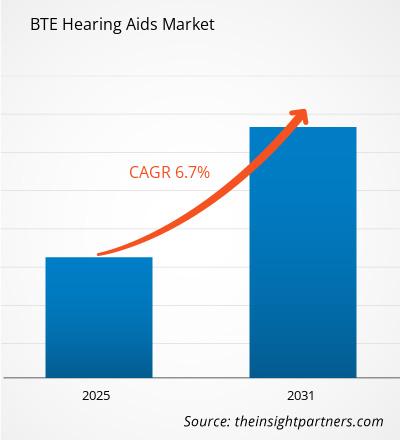
The BTE Hearing Aids Market size stood at US$ 2.75 Billion in 2025 and is anticipated to increase to US$ 5.02 Billion by 2034, increasing at a CAGR of 6.92% from 2026–2034. The drivers include growing cases of hearing impairment due to age, increased adoption of rechargeable hearing aids, and adoption of digital hearing aids in clinical and homecare settings.
The BTE Hearing Aids Market in North America is forecast to increase at a CAGR of 6.4–6.8% during 2026–2034. This is driven by well-developed networks of audiology centers, high reimbursement visibility, and early adoption of artificial intelligence (AI)-based fittings. Increased retail audiology services and aging population eligible for Medicare are also boosting demand for replacements through hospitals, ENT clinics, and homecare settings.
BTE Hearing Aids Market Assessment and Insights
- North America held 34–37% share in 2025 and is growing at a CAGR between 2026–2034 of 6.4–6.8%, supported by audiology-led dispensing, premium rechargeable adoption, and strong replacement cycles among older adults.
- US accounted for 78–82% of North America in 2025 and is growing at a CAGR between 2026–2034 of 6.3–6.7%, driven by high clinic density and connected device uptake.
- Europe captured 27–30% share in 2025 and is growing at a CAGR between 2026–2034 of 6.1–6.5%, with Germany, the UK, and France leading due to reimbursement depth and fitting infrastructure.
- Asia Pacific represented 22–25% share in 2025 and is growing at a CAGR between 2026–2034 of 7.8–8.4%, led by China, Japan, India, South Korea, and Australia.
- Largest Segment Digital Signal Processing Hearing Aids held 72–76% market share in 2025, with a CAGR range of 7.0–7.4% during 2026–2034, reflecting clinical preference for adaptive programming.
- High Growth Segment Homecare held 18–22% market share in 2025, with a CAGR range of 8.0–8.6% during 2026–2034, supported by remote fitting and aging-in-place models.
- Key companies analyzed in detail: Demant A/S, Sonova Holding AG, GN Store Nord A/S, Actavis LLC, WS Audiology A/S, Widex A/S, Sivantos Group, Starkey Laboratories, Inc., Benson Hearing, GN ReSound, Medtronic plc, RION Co., Ltd., Audina Hearing Instruments, Inc.
Source: The Insight Partners' analysis based on proprietary research, government publications, company annual reports, investor presentations, industry databases, and expert interviews.
Innovation in technology has driven the BTE Hearing Aids Market from simple amplification devices into advanced sound environments incorporating directionality, Bluetooth LE Audio, rechargeable power sources, and noise management using neural network technologies. The production trends are now favoring modular systems capable of accommodating several form factors, multiple software versions, and regional fitting needs. Receptors, shells, and batteries are being revamped by manufacturers to minimize servicing while enabling clinics to perform rapid fittings.
The growth in the future is expected to be influenced by audiology networks being set up in the Asia Pacific region and selective expansion of access in the Middle East. Increased focus on assistive technology, primary-care screening, and hearing rehabilitation services will lead to an increased number of referrals for device purchases. Investors' focus is now shifting towards digital aftercare services, AI-enabled fitting assistance, and hearing care retail operations due to specialist shortage problems in these areas.
BTE Hearing Aids Market Report Scope
| Report Attribute | Details |
|---|---|
| Market size in 2025 | US$ 2.75 Billion |
| Market Size by 2034 | US$ 5.02 Billion |
| Global CAGR (2026 - 2034) | 6.92% |
| Historical Data | 2021-2024 |
| Forecast period | 2026-2034 |
BTE Hearing Aids Market Analysis
BTE Hearing Aids Market growth is dependent on the quantifiable unmet need as per WHO, which suggests that there are hundreds of millions of individuals requiring hearing rehabilitation, although their needs are not being met sufficiently. Behind-the-ear products continue to be relevant since they offer severe-to-profound amplification capabilities, ease-of-use for seniors, and compatibility with directional microphone and telecoil technology.
The supply chain consists of component manufacturers, chipset developers, acoustic engineers, audiologists, ENT doctors, distribution channels, and aftercare systems. The dynamics of supply are changing to include platform-based manufacturing, which allows a single processor series to be used in many products and performance categories. This reduces duplication efforts and speeds up regional product launches. Demand is driven by the clinic as fit, counseling, and follow-ups remain important factors.
BTE Hearing Aids Market report reveals concentration of competition through leading companies including Sonova Holding AG, Demant A/S, GN Store Nord A/S, WS Audiology A/S, Starkey Laboratories, Inc., Widex A/S, and Sivantos Group that create premium offerings. GN ReSound and RION Co., Ltd. add to specialist portfolio, whereas Audina Hearing Instruments, Inc. and Benson Hearing fill up some value/service niches.
Competitive strategies are becoming more determined by AI-based sound classification, connectivity, rechargeability, and software efficiency for professionals. Medtronic plc has a relevance to hearing health care paths through implantable and specialist hearing aids, while Actavis LLC looks peripheral to hearing aids devices competition. Investment is going into proprietary chips, wax management systems, remote services, and integration of retail with audiologists services.
● REPORT CUSTOMIZATION
Tailor This Report To Align With Your Specific Business Requirements
This report can be customized to align precisely with your business objectives, scope, and target markets. Customization options include tailored segmentation, geography, competitive analysis, and strategic insights to support informed decision-making.
Customize This Report →WHAT YOU CAN ADJUST
- ● Segmentations
- ● Geography
- ● Competitive Analysis
- ● Language Preferences
BTE Hearing Aids Market: Strategic Insights
Regional Insights
North America BTE Hearing Aids Market
North America accounted for 34–37% share in 2025 and is projected to grow at a CAGR range of 6.4–6.8% during 2026–2034. The region benefits from established audiology practice networks, high awareness of age-related hearing impairment, and continued replacement of older analog or basic digital devices with rechargeable, AI-enabled behind-the-ear products.
The BTE Hearing Aids Market share in North America is supported by strong prescription channels and high adoption of connected devices among active older adults. Structural demand is also reinforced by WHO-reported hearing rehabilitation needs and lower stigma around professionally fitted devices. Manufacturers prioritize this region for premium launches because clinics can support advanced fitting, remote adjustments, and accessory-driven upgrades.
U.S. BTE Hearing Aids Market
In 2025, the U.S. made up 78-82% of North America and is anticipated to grow with a CAGR of 6.3-6.7% between 2026 and 2034. The demand will be driven by a substantial elderly population, high audiologists' involvement, and more rapid adoption of Bluetooth hearing aids for use in conversations, multimedia streaming, work-related interaction, and tele-audiology follow-up treatment.
There are many players on the market such as Sonova Holding AG, Starkey Laboratories, Inc., GN Store Nord A/S, Demant A/S, and WS Audiology A/S, having effective marketing and sales strategies. Behind-the-ear hearing aids are still popular in moderate to severe losses, for children, and the elderly since they are easy to handle, powerful and compatible with earmolds and accessories.
Europe BTE Hearing Aids Market
Europe occupied a share of 27–30% in 2025 and expected a growth rate within the range of 6.1–6.5% during the period of 2026–2034. Germany was the leading country owing to reimbursement processes, referrals to ENT specialists, and structured retail audiology network. The UK continues to be important due to the NHS and private sectors with the use of BTE design for durability and consistent fit results.
Germany demonstrates high demand for the premium and reimbursed categories owing to developed fitting system and specialty hearing care chain stores. The UK market comprises public and private procurement resulting in the need for standard and advanced digital BTEs. France, Italy, and Spain bring scale owing to aging population, better screenings, and adoption of rechargeable and application based hearing aid designs.
APAC BTE Hearing Aids Market
The share of APAC was estimated at 22-25% in 2025 and is projected to expand at the CAGR rate of 7.8-8.4% for 2026-2034. China leads because of its large population, increasing capabilities of audiology and specialized retail outlets. Japan and South Korea focus on the advanced technology use, while India and Australia rely on screening and expansion of private care.
Drivers of adoption in APAC include infrastructure development, localization of medical devices and increased awareness about assistive technologies. The fast adoption rate in the region is driven by under-penetration and not exclusively due to replacement of the premium product. Adoption of BTE Hearing Aids is based on ENT examination in cities and homecare demand from older patients.
Middle East & Africa BTE Hearing Aids Market
MEA is projected to witness a CAGR growth of 6.7%–7.3% over 2026–2034, driven by healthcare development, investments in specialist hospitals, and increased availability of audiology services in Saudi Arabia. The UAE will benefit from private healthcare services and medical tourism, whereas South Africa will be the most organized market within sub-Saharan Africa.
Government income and infrastructure spending from energy sectors will fuel expansion of hospitals in the GCC countries along with providing ENT and rehabilitation facilities. Demand from RoMEA is fragmented owing to issues related to costs, shortage of specialists, and availability of facilities. With time, there will be incremental demand created from screening programs, procurement by public hospitals, and training of hearing care professionals.
Segmentation Analysis
Product Type
The Product Type segment is expected to grow at a CAGR range of 6.8–7.2% during 2026–2034. The BTE Hearing Aids Market scope across product type reflects the transition from basic amplification toward digitally programmable, connected, and environment-aware solutions. Digital devices dominate because they support adaptive sound processing and clinic-controlled fine tuning, while simulated signal processing remains relevant in lower-cost and basic care settings.
- Digital Signal Processing Hearing Aids: This sub-segment held the strongest market position due to superior noise reduction, feedback cancellation, and wireless compatibility, making it strategically central to premium upgrades and professional fitting models.
- Simulated Signal Processing Hearing Aids: Demand remains concentrated in budget-sensitive channels where basic amplification, simpler controls, and lower acquisition costs are prioritized over advanced connectivity or AI-supported sound management.
End User
The End User segment is expected to grow at a CAGR range of 6.9–7.5% during 2026–2034. Hospitals and ENT clinics remain central to diagnosis and prescription, while homecare is gaining momentum as aging users seek convenient follow-up, remote adjustment, and assisted living support. The segment also reflects the increasing role of hybrid care models that connect audiologists, caregivers, and digital aftercare platforms.
- Hospital: Hospitals sustain demand through diagnostic referrals, complex hearing-loss cases, pediatric assessment, and multidisciplinary care, making them important for clinically validated device selection and advanced fitting workflows.
- ENT clinics: ENT clinics are high-influence channels because they combine diagnosis, medical evaluation, counseling, and referrals, supporting steady demand for professional BTE fittings across adult and elderly patients.
- Homecare: Homecare is strategically important as remote fitting, caregiver involvement, and aging-in-place preferences increase demand for durable, rechargeable, easy-to-maintain BTE devices outside traditional clinic environments.
Opportunity Snapshot
| Segment Name | Revenue Contribution | Trend Tag | Adoption Stage |
| Hospital | High | Clinical Fit | Mature |
| ENT clinics | High | Specialist Referral | Mature |
| Homecare | Medium | Remote Care | Scaling |
| Others | Low | Access Support | Emerging |
BTE Hearing Aids Market Growth Drivers and Impact Analysis
Rising Hearing Rehabilitation Need Across Aging Populations
Aging of the population would be the most resilient driver of the adoption of hearing devices since hearing loss becomes more common among people over the age of 60. According to WHO, more than 430 million people need rehabilitation for disabling hearing loss. As life expectancy increases, this population is bound to grow even larger. For the market, the effect will be quite straightforward: higher numbers of patients screened in hospitals and ENT clinics, more opportunities for replacement, and fittings for both ears for hearing care specialists. BTE products are particularly promising for the aging population since these devices are easier to use, have better amplification capabilities, and have a strong battery system.
AI Sound Processing and Connectivity Improving User Outcomes
AI-enabled sound classification, directional microphones, and Bluetooth LE Audio are changing user expectations in professionally fitted devices. Advanced BTE platforms can now identify listening environments, suppress background noise, and support direct streaming from smartphones, televisions, and public audio systems. The market impact is seen in higher willingness to upgrade from older digital devices, especially among active seniors and working adults with mild-to-moderate loss. Clinics also benefit because automated environment adaptation can reduce repeated fine-tuning visits. As manufacturers compete on neural processing, battery efficiency, and app control, product differentiation is shifting from amplification power toward measurable listening comfort and connected daily use.
Hybrid Care Models Expanding Access Beyond Clinics
Hybrid care is expanding the addressable market by combining in-clinic diagnosis with remote follow-up, home visits, and app-based support. This model is particularly relevant for older adults, rural populations, and mobility-limited users who may delay care because repeated clinic visits are inconvenient. The market impact includes improved adherence, faster troubleshooting, and higher satisfaction after fitting. BTE devices suit hybrid care because they are durable, easier for caregivers to manage, and compatible with remote programming ecosystems. For manufacturers and distributors, hybrid models create opportunities to bundle devices, software, accessories, and aftercare services into recurring engagement pathways.
BTE Hearing Aids Market Future Trends
Neural Processing Becoming Standard in Premium Devices
BTE Hearing Aids Market trends are moving toward embedded neural processors that classify complex sound scenes directly on the device. Over the forecast period, premium BTE platforms are expected to use larger training datasets, lower-latency chips, and more efficient algorithms to improve speech clarity in restaurants, transport hubs, workplaces, and group conversations. This trend will raise expectations for default performance, not only manual program switching. Clinics may increasingly compare devices based on real-world speech-in-noise evidence, power consumption, and fitting simplicity. As AI becomes standard, differentiation will depend on how naturally devices preserve environmental awareness while reducing listening effort.
Auracast and Public Audio Integration Reshaping Connectivity
Public audio connectivity is expected to become a stronger differentiator as Auracast-enabled venues expand across airports, theaters, classrooms, worship centers, and transport systems. BTE devices are well suited to this transition because their battery capacity and antenna architecture can support reliable streaming. Over time, users may view hearing aids as mainstream communication devices rather than only medical tools. This will influence purchase decisions, particularly among younger seniors who expect seamless mobile and venue integration. Manufacturers that support compatibility across smartphones, televisions, remote microphones, and public broadcasts will gain stronger ecosystem stickiness and better upgrade potential.
BTE Hearing Aids Market Opportunities
Homecare-Centered Service Models for Elderly Users
Homecare offers the clearest near-term investment opening because it addresses mobility constraints, caregiver involvement, and the need for ongoing adjustment after fitting. BTE Hearing Aids Market Forecasts indicate that service-led growth will be strongest where device supply is paired with remote counseling, doorstep support, app-based fine tuning, and battery or accessory management. Providers can build differentiated models by targeting assisted living facilities, senior communities, and chronic-care networks. The opportunity is not only device sales but also higher retention through structured aftercare. Companies that simplify maintenance and caregiver education can improve adherence and reduce abandonment after initial purchase.
Mid-Premium Devices for Emerging Audiology Networks
Emerging markets need products that balance clinical performance, affordability, durability, and scalable fitting workflows. Mid-premium BTE devices with rechargeable batteries, robust feedback cancellation, and simplified software can meet demand in China, India, the Gulf countries, and select African urban centers. The opportunity is strongest for companies that localize distribution, train hearing-care personnel, and collaborate with ENT clinics. Price-sensitive users may not immediately adopt the highest AI tiers, but they increasingly expect digital quality and wireless functions. Manufacturers that create modular platforms for multiple income bands can capture volume while preparing users for future upgrades.
Recent Developments
- October 2025: Oticon A/S announced Oticon Zeal, a discreet in-the-ear hearing aid that combines rechargeability, connectivity, and second-generation AI sound processing. The launch is relevant to the broader BTE competitive landscape because it shows manufacturers are transferring advanced processing, smaller design architecture, and flexible fitting concepts across form factors.
- October 2025: Phonak introduced Infinio Ultra, adding improved AI-based sound adaptation, EasyGuard wax management, and two RIC models under the Infinio platform. The company stated that the platform recognizes 18 times more sound scenarios and improves environment detection precision by 24%, strengthening premium hearing aid competition.
- February 2025: GN Store Nord A/S launched ReSound Vivia and ReSound Savi, expanding its AI and Bluetooth LE Audio portfolio. ReSound Vivia uses a dedicated deep neural network chip trained on 13.5 million spoken sentences, while the range also supports Auracast broadcast audio for next-generation hearing connectivity.
Frequently Asked Questions

- Comprehensive Market Sizing and Forecast Analysis
- Detailed Segmentation Analysis
- In-Depth Market Dynamics Assessment
- Regional and Country-Level Insights
- Competitive Landscape and Company Benchmarking
- Strategic Business Intelligence
Recent Reports
Testimonials

The Insight Partners' SCADA System Market report is comprehensive, with valuable insights on current trends and future forecasts. The team was highly professional, responsive, and supportive throughout. We are very satisfied and highly recommend their services.
RAN KEDEM Partner, Reali Technologies LTDs
I requested a report on a very specific software market and the team produced the report in a few days. The information was very relevant and well presented. I then requested some changes and additions to the report. The team was again very responsive and I got the final report in less than a week.
JEAN-HERVE JENN Chairman, Future Analytica
We worked with The Insight Partners for an important market study and forecast. They gave us clear insights into opportunities and risks, which helped shape our plans. Their research was easy to use and based on solid data. It helped us make smart, confident decisions. We highly recommend them.
PIYUSH NAGPAL Sr. Vice President, High Beam Global
The Insight Partners delivered insightful, well-structured market research with strong domain expertise. Their team was professional and responsive throughout. The user-friendly website made accessing industry reports seamless. We highly recommend them for reliable, high-quality research services
YUKIHIKO ADACHI CEO, Deep Blue, LLC.
This is the first time I have purchased a market report from The Insight Partners.While I was unsure at first, I visited their web site and felt more comfortable to take the risk and purchase a market report.I am completely satisfied with the quality of the report and customer service. I had several questions and comments with the initial report, but after a couple of dialogs over email with their analyst I believe I have a report that I can use as input to our strategic planning process.Thank you so much for taking the extra time and making this a positive experience.I will definitely recommend your service to others and you will be my first call when we need further market data.
JOHN SUZUKI President and Chief Executive Officer, Board Director, BK Technologies
I wish to appreciate your support and the professionalism you displayed in the course of attending to my request for information regarding to infectious disease IVD market in Nigeria. I appreciate your patience, your guidance, and the fact that you were willing to offer a discount, which eventually made it possible for us to close a deal. I look forward to engaging The Insight Partners in the future, all thanks to the impression you have created in me as a result of this first encounter.
DR CHIJIOKE ONYIA MANAGING DIRECTOR, PineCrest Healthcare Ltd.Reason to Buy
- Informed Decision-Making
- Understanding Market Dynamics
- Competitive Analysis
- Identifying Emerging Markets
- Customer Insights
- Market Forecasts
- Risk Mitigation
- Boosting Operational Efficiency
- Strategic Planning
- Investment Justification
- Tracking Industry Innovations
- Aligning with Regulatory Trends





 Get Free Sample for