
Deaf Aid Market Size, Growth & Trends by 2034
Coverage: By Product (Receiver-in-the-Ear Hearing Aids, In-the-Ear Hearing Aids, Behind-the-Ear Hearing Aids, and Canal Hearing Aids); Technology (Digital Hearing Aids, and Analog Hearing Aids); Distribution Channel (Government Purchases, Retail Sales, and e-Commerce), and Geography (North America, Europe, Asia Pacific, and South and Central America)
- Status : Data Released
- Report Code : TIPRE00021564
- Category : Life Sciences
- No. of Pages : 150
- Available Report Formats :


- Last update date : August 27, 2026


2025 Market Size
US$ 2.61 Bn
Base year value
2034 Forecast
US$ 4.61 Bn
Projected by 2034
CAGR 2026-2034
6.52 %
Growth rate
Addressable Market
US$ 32.64 Bn
(2026-2034)
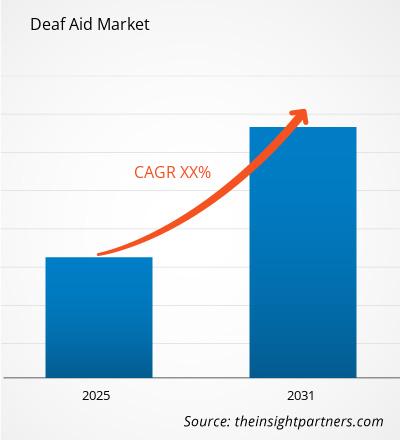
The Deaf Aid Market represents a growing segment within hearing healthcare, addressing rising demand for assistive hearing solutions across aging populations and individuals with hearing impairments. The market was valued at US$ 2.61 Billion in 2025 and is projected to reach US$ 4.61 Billion by 2034, expanding at a CAGR of 6.52% during 2026–2034. Increasing adoption of advanced hearing technologies, improved accessibility, and healthcare initiatives are shaping market development.
North America continues to demonstrate steady adoption of hearing assistance technologies due to favorable reimbursement frameworks, expanding audiology networks, and higher awareness regarding early hearing intervention. The regional Deaf Aid Market size is supported by increasing demand from older demographics and technological improvements in digital devices, with growth expected at a CAGR range of 6.0–7.0% during 2026–2034. Integration of wireless connectivity, remote fitting capabilities, and personalized hearing solutions further supports regional expansion.
Deaf Aid Market Assessment and Insights
- North America demonstrates strong market maturity with established healthcare infrastructure and reimbursement support. The region accounted for a 38–42% share in 2025 and is expected to grow at a CAGR of 6.0–7.0% between 2026–2034.
- US remains the leading contributor within North America due to advanced hearing care adoption and provider networks. The country represented a 28–32% share in 2025 and is projected to expand at a CAGR of 6.2–7.2% during 2026–2034.
- Europe maintains significant demand driven by aging populations and healthcare accessibility programs across Germany, the UK, France, Italy, and Spain. The region held a 27–31% share in 2025 and is anticipated to register a CAGR of 5.8–6.8% between 2026–2034.
- Asia Pacific is emerging as a high-potential region due to increasing healthcare investments in China, Japan, South Korea, and India. The region captured a 20–24% share in 2025 and is expected to achieve a CAGR of 7.0–8.0% during 2026–2034.
- Largest Segment: Receiver-in-the-Ear Hearing Aids held a prominent position with a market share of 30–34% in 2025 and is projected to grow at a CAGR of 6.3–7.3% during 2026–2034.
- High Growth Segment: e-Commerce distribution is gaining momentum with a market share of 12–16% in 2025 and is estimated to expand at a CAGR of 7.5–8.5% during 2026–2034.
- Key companies analyzed in detail: Medtronic, MED-EL, WIDEX USA, Inc., Starkey, Benson Hearing, Phonak, GN Store Nord A/S, Sivantos Pte. Ltd., William Demant Holding A/S, Sonova, Hansaton Akustik GmbH, Horentek, Soundrise Hearing Solutions Pvt. Ltd., Cochlear Ltd., Audina Hearing Instruments, Inc., Microson, Oticon, Inc., Rion Co., Ltd.
Source: The Insight Partners' analysis based on proprietary research, government publications, company annual reports, investor presentations, industry databases, and expert interviews.
The development of hearing aid technology has been fueled by the advancement in miniaturization, digital signal processing, and the incorporation of connectivity options. Hearing device producers are moving towards intelligent hearing devices from traditional amplifying devices due to their ability to adapt to and control sound, and to change settings remotely. Investments in the development of audiological infrastructure and a personalized approach are strengthening Market growth. Product innovations have made the devices more comfortable and energy-efficient across different age groups.
Future market growth would be driven by new healthcare markets, government accessibility programs, and greater collaboration between hearing device makers and health organizations. Online selling channels and a direct-to-consumer business model would provide further growth prospects. The regulatory initiatives in hearing awareness and early hearing diagnostics are likely to open new avenues for demand.
Deaf Aid Market Report Scope
| Report Attribute | Details |
|---|---|
| Market size in 2025 | US$ 2.61 Billion |
| Market Size by 2034 | US$ 4.61 Billion |
| Global CAGR (2026 - 2034) | 6.52% |
| Historical Data | 2021-2024 |
| Forecast period | 2026-2034 |
Deaf Aid Market Analysis
There is increased demand for hearing aids as cases of hearing loss rise, especially among older adults. The Deaf Aid Market growth will be determined by cooperation among healthcare providers, audiologists, manufacturers, and distributors across the value chain. Advances in technology, such as Bluetooth, rechargeable batteries, and sound management systems, have increased the utility of the equipment.
The supply side is affected by the actions of global manufacturers to ensure effective production processes, component availability, and product differentiation. The manufacturing process is being advanced to ensure reliability in accordance with the stipulated regulations.
The competitive positioning in the Deaf Aid Market report highlights an increased focus on innovation, product portfolio, and geographical reach. Firms like Sonova, GN Store Nord A/S, Starkey, and William Demant Holding A/S have continued to expand their market presence through superior hearing products and networks. Firms such as Medtronic, MED-EL, WIDEX USA, Inc., and Cochlear Ltd. are working to improve their capabilities by developing advanced technology and collaborating with the healthcare sector.
Increasing investments are being made in smart hearing aids, cloud-based audiology solutions, and healthcare innovations. Manufacturers are targeting growth opportunities in emerging economies by improving hearing healthcare systems. The competitive landscape revolves around improving the performance, access, and experience of hearing aid devices, as well as meeting consumers’ needs.
● REPORT CUSTOMIZATION
Tailor This Report To Align With Your Specific Business Requirements
This report can be customized to align precisely with your business objectives, scope, and target markets. Customization options include tailored segmentation, geography, competitive analysis, and strategic insights to support informed decision-making.
Customize This Report →WHAT YOU CAN ADJUST
- ● Segmentations
- ● Geography
- ● Competitive Analysis
- ● Language Preferences
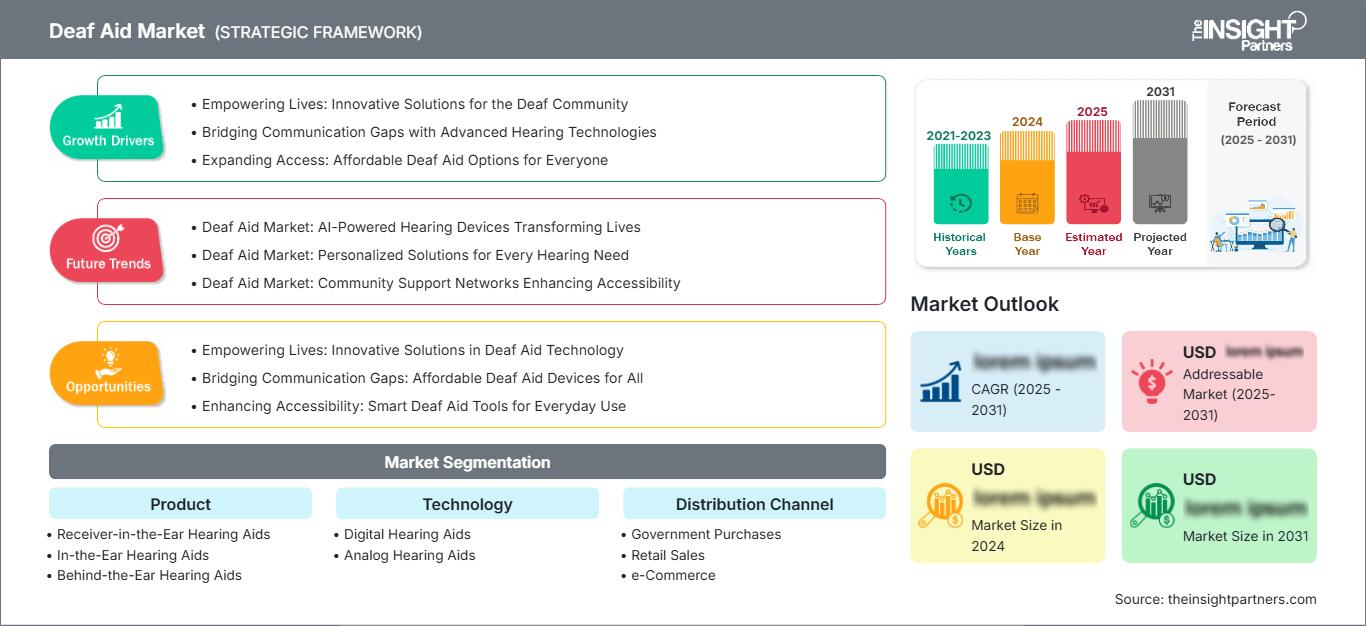
Deaf Aid Market: Strategic Insights
Regional Insights
North America Deaf Aid Market
North America maintains a leading position due to established healthcare systems, high awareness levels, and greater access to hearing professionals. The region represented a 38–42% share in 2025 and is forecast to expand at a CAGR of 6.0–7.0% from 2026–2034. Aging demographics and increasing diagnosis rates remain important structural drivers supporting adoption.
The contributions of the US and Canada in terms of reimbursement schemes, audiological services, and manufacturers have been remarkable. Integration of digital hearing technologies, including rechargeable and connectivity-enabled devices, has seen increasing adoption in recent times. The growing demand for discreet and customized solutions is anticipated to propel the growth in the region over the forecast period.
U.S. Deaf Aid Market Market
The US represents the largest contributor within North America, accounting for a 28–32% share of the regional market in 2025. The country is projected to grow at a CAGR of 6.2–7.2% during 2026–2034, supported by healthcare accessibility, increasing awareness, and expanding hearing care services. Established companies maintain significant operational presence across manufacturing and distribution networks.
Growing acceptance of advanced hearing devices, including digital and wireless models, is influencing consumer purchasing decisions. Retail channels, professional audiology centers, and online platforms are expanding access. Regulatory developments and improving insurance coverage continue to support adoption among older adults and individuals requiring long-term hearing assistance.
Europe Deaf Aid Market
Europe accounted for a 27–31% share in 2025 and is expected to register a CAGR of 5.8–6.8% during 2026–2034. The region benefits from established healthcare infrastructure, aging demographics, and government-supported hearing care programs. Germany remains a leading country due to strong medical device manufacturing capabilities, while the UK continues to emphasize accessible hearing services through public healthcare frameworks.
Germany demonstrates consistent adoption of advanced hearing solutions supported by specialist networks and technology-focused healthcare providers. The UK market is influenced by public hearing support programs and rising awareness of early intervention. France, Italy, and Spain are also contributing through expanding audiology services, improving healthcare accessibility, and increasing acceptance of digital hearing devices among older populations.
APAC Deaf Aid Market
Asia Pacific represented a 20–24% share in 2025 and is projected to grow at a CAGR of 7.0–8.0% during 2026–2034. China leads regional demand due to its large population base, expanding healthcare infrastructure, and increasing focus on hearing health. Japan, South Korea, India, and Australia are also contributing through technological adoption and healthcare modernization.
Regional growth is supported by industrial development, improving medical device access, and government initiatives focused on disability support. Rising healthcare expenditure in India and digital healthcare expansion across Asia Pacific are expected to improve availability of hearing solutions in urban and developing markets.
Middle East & Africa Deaf Aid Market
The Middle East & Africa region is developing steadily, supported by healthcare infrastructure expansion and increasing awareness of hearing impairment management. The region is estimated to account for a 7–11% share in 2025 and is expected to expand at a CAGR of 5.0–6.0% during 2026–2034. Saudi Arabia leads regional adoption through healthcare transformation initiatives.
The UAE and South Africa are improving access through advanced healthcare facilities and specialized audiology services. Investments in medical infrastructure, healthcare modernization programs, and improved distribution networks across the Rest of MEA are creating opportunities. Energy sector investments indirectly support healthcare development by strengthening regional infrastructure capabilities.
Segmentation Analysis
Product
The product segment is a major component, with a projected CAGR of 6.0–7.0% during 2026–2034. Demand is influenced by patient preference for comfortable, discreet, and technologically advanced devices. Manufacturers are focusing on improving sound processing, battery efficiency, and connectivity features to enhance user experience across different hearing requirements.
- Receiver-In-The-Ear Hearing Aids are commonly used thanks to their combination of comfort, quality of sound, and discrete look. These hearing aids cater to the needs of users interested in the amplification that provides good connectivity options and adjustment features.
- In-The-Ear Hearing Aids stay relevant for users who prefer custom-made devices. The small size and direct fit feature make these hearing aids popular among users.
- Behind-The-Ear Hearing Aids stay relevant due to their durability, high amplification, and ability to suit different degrees of hearing impairment.
- Canal Hearing Aids suit the demand for small hearing aids placed inside the ear canal.
Technology
The technology segment is undergoing changes at a rate of CAGR estimated at 6.4–7.4% for 2026–2034 as players are moving towards intelligent hearing devices. The Market is becoming reflective of the requirements of automation in sound processing, wireless connectivity, and adaptive performance. With growing accuracy and user personalization, digital technologies are gaining increasing importance.
- Digital Hearing Aids are a major technological type owing to advancements in the field of signal processing, wireless connectivity and compatibility with the healthcare ecosystem. Personalization of hearing is possible by using software features.
- Analog Hearing Aids will remain significant for certain types of users requiring simple amplification technologies. They are important due to their cost-effectiveness and ease of use.
Distribution Channel
The distribution channel segment is expected to record a CAGR of 6.5–7.5% during 2026–2034. The Deaf Aid is experiencing changes in purchasing behavior as consumers increasingly explore digital channels alongside traditional healthcare providers. The segment benefits from expanding online accessibility, improved consultation services, and broader product availability.
- Government Purchases still retain their importance in places where government-run healthcare systems offer hearing aids. The process of institutional purchases will increase the market presence and accessibility of devices for those entitled to them.
- Retail Sales also offer individual consultations and fittings by means of hearing aid specialists and clinics. The need for professional fitting services maintains this channel.
- E-Commerce is gaining in popularity due to its convenience, variety of products, and growing customer experience in online healthcare shopping.
Opportunity Snapshot
| Distribution Channel | Revenue Contribution (High/Medium/Low) | Trend Tag | Adoption Stage |
|---|---|---|---|
| Government Purchases | Medium | Public Access | Mature |
| Retail Sales | High | Clinic Services | Mature |
| e-Commerce | Medium | Digital Buying | Scaling |
Deaf Aid Market Growth Drivers and Impact Analysis
Rising Global Hearing Impairment Awareness
Hearing loss detection and management have become more prominent, thus driving the demand for hearing assistance products. Health care providers and health initiatives are promoting early detection and have made it easier to accept treatment due to previous patient hesitation. The effect has expanded the potential pool of users of hearing assistance devices. There have been improvements on educating health care professionals on identifying hearing disorders. It can be seen through greater utilization of advanced products, greater demands for hearing fittings and greater investments in hearing assistance technology.
Advancements in Digital Hearing Technologies
Innovation and advancement in digital hearing aids are revolutionizing the way devices work and the experience of the users. Modern hearing aids are built with elements such as artificial intelligence, wireless technology, smartphone integration, and automatic adjustments, which enhance the ability of the devices to make sound clearer. This progress is motivating current users to update their hearing aids and making it easier to attract new customers who require hearing solutions. Companies are investing in research and development for small, efficient, and advanced devices.
Expansion of Healthcare Accessibility Programs
There have been several government and health access programs that have opened up new avenues for hearing devices. Healthcare systems, better insurance policies, and disability support programs have been contributing to overcoming some of the hurdles related to hearing aid devices. Developing nations have also been developing their medical infrastructure in order to provide new avenues of distributing hearing aid devices. Such programs affect the purchase decision due to the provision of better accessibility and availability of devices for marginalized communities.
Deaf Aid Market Future Trends
Integration of Artificial Intelligence in Hearing Devices
The integration of artificial intelligence into products is anticipated to be an upcoming deaf aid market trend, with manufacturers creating devices capable of environmental analysis and automatic sound-setting adjustments. The technologies based on AI can increase speech recognition abilities, reduce noise levels, and personalize. Future products will integrate hearing-assistive functionalities with digital health systems, thus providing better monitoring and support at a distance. It is a reflection of the increased consumer demand for intelligent healthcare devices with adaptive capabilities and ease of use.
Growth of Remote Hearing Care Services
Remote hearing care services are expected to expand as digital healthcare platforms become more widely adopted. Tele-audiology solutions can improve accessibility by allowing users to receive consultations, adjustments, and follow-up support without frequent clinic visits. This trend may particularly benefit individuals in rural and underserved locations where specialist availability remains limited. Integration between hearing devices and digital platforms is expected to create more continuous care models. Manufacturers and healthcare providers are likely to explore remote service capabilities as part of broader strategies to improve patient engagement and healthcare efficiency.
Deaf Aid Market Opportunities
Expansion Through Emerging Healthcare Markets
There are new markets for hearing aids which offer manufacturers an opportunity to enhance their distribution network and provide more options for hearing aid solutions. With growing investments in healthcare, heightened awareness, and improved healthcare facilities in the Asia-Pacific region, Latin America, and some Middle Eastern countries, a positive environment is being created for future use. Manufacturers can enhance their market position by developing affordable solutions, establishing local service arrangements, and collaborating with healthcare institutions. According to the Deaf Aid Market Forecasts, demand is expected to be driven by increasing accessibility, distribution, and healthcare delivery systems.
Development of Connected Hearing Healthcare Ecosystems
Incorporating hearing devices into the healthcare ecosystem enables businesses to leverage them by integrating them with digital platforms, mobile apps, and telehealth services. Investment in software capabilities, a personalized approach based on analytics, and connectivity can give the company a differentiated solution both for patients and healthcare practitioners. Collaboration with IT vendors and healthcare organizations is one option to consider to improve services. Further growth potential is seen in solutions that incorporate hardware capabilities alongside digital ones.
Recent Developments
- March 2026: Sonova expanded its hearing care technology initiatives through continued development of advanced hearing solutions integrating connectivity and personalized sound processing capabilities. The company emphasized digital healthcare approaches, including improved user interaction and service models designed to enhance accessibility for individuals requiring hearing support.
- November 2025: GN Store Nord A/S introduced advancements across its hearing technology portfolio by focusing on intelligent hearing solutions, enhanced connectivity features, and digital platforms. These developments support the company’s strategy of combining hearing devices with software-driven experiences and expanding access to modern hearing care solutions.
- June 2025: WS Audiology A/S continued strengthening its hearing technology capabilities through innovation initiatives focused on improving device performance, user experience, and digital hearing services. The company’s activities reflected broader industry movement toward personalized hearing solutions and technology-enabled care models.
Frequently Asked Questions

- Comprehensive Market Sizing and Forecast Analysis
- Detailed Segmentation Analysis
- In-Depth Market Dynamics Assessment
- Regional and Country-Level Insights
- Competitive Landscape and Company Benchmarking
- Strategic Business Intelligence
Recent Reports
Testimonials

The Insight Partners provided valuable market intelligence that supported our global go-to-market strategy. Their team was professional, responsive, and attentive to our feedback, providing thoughtful analysis and helpful methodological clarifications throughout the project.
Junmo Kim Chief Financial Officer (CFO), Enertech Co., Ltd.
The Insight Partners' SCADA System Market report is comprehensive, with valuable insights on current trends and future forecasts. The team was highly professional, responsive, and supportive throughout. We are very satisfied and highly recommend their services.
RAN KEDEM Partner, Reali Technologies LTDs
I requested a report on a very specific software market and the team produced the report in a few days. The information was very relevant and well presented. I then requested some changes and additions to the report. The team was again very responsive and I got the final report in less than a week.
JEAN-HERVE JENN Chairman, Future Analytica
We worked with The Insight Partners for an important market study and forecast. They gave us clear insights into opportunities and risks, which helped shape our plans. Their research was easy to use and based on solid data. It helped us make smart, confident decisions. We highly recommend them.
PIYUSH NAGPAL Sr. Vice President, High Beam Global
The Insight Partners delivered insightful, well-structured market research with strong domain expertise. Their team was professional and responsive throughout. The user-friendly website made accessing industry reports seamless. We highly recommend them for reliable, high-quality research services
YUKIHIKO ADACHI CEO, Deep Blue, LLC.
This is the first time I have purchased a market report from The Insight Partners.While I was unsure at first, I visited their web site and felt more comfortable to take the risk and purchase a market report.I am completely satisfied with the quality of the report and customer service. I had several questions and comments with the initial report, but after a couple of dialogs over email with their analyst I believe I have a report that I can use as input to our strategic planning process.Thank you so much for taking the extra time and making this a positive experience.I will definitely recommend your service to others and you will be my first call when we need further market data.
JOHN SUZUKI President and Chief Executive Officer, Board Director, BK Technologies
I wish to appreciate your support and the professionalism you displayed in the course of attending to my request for information regarding to infectious disease IVD market in Nigeria. I appreciate your patience, your guidance, and the fact that you were willing to offer a discount, which eventually made it possible for us to close a deal. I look forward to engaging The Insight Partners in the future, all thanks to the impression you have created in me as a result of this first encounter.
DR CHIJIOKE ONYIA MANAGING DIRECTOR, PineCrest Healthcare Ltd.Reason to Buy
- Informed Decision-Making
- Understanding Market Dynamics
- Competitive Analysis
- Identifying Emerging Markets
- Customer Insights
- Market Forecasts
- Risk Mitigation
- Boosting Operational Efficiency
- Strategic Planning
- Investment Justification
- Tracking Industry Innovations
- Aligning with Regulatory Trends





 Get Free Sample for