
Deep Space Exploration Market Size, Share & Growth by 2034
Coverage: By Mission Type (Robotic Missions, Manned Missions); Spacecraft Type (Orbiter, Lander, Rover); Propulsion System (Chemical Propulsion, Electric Propulsion, Nuclear Propulsion); End-Use Industry (Government Space Agencies, Private Space Companies, Research Institutions); and Geography (North America, Europe, Asia Pacific, South & Central America, Middle East & Africa)
- Status : Upcoming
- Report Code : TIPRE00043094
- Category : Aerospace and Defense
- No. of Pages : 150
- Available Report Formats :


- Last update date : March 05, 2026


2025 Market Size
US$ 27.38 Bn
Base year value
2034 Forecast
US$ 45.20 Bn
Projected by 2034
CAGR 2026-2034
5.83 %
Growth rate
Addressable Market
US$ 330.64 Bn
(2026-2034)
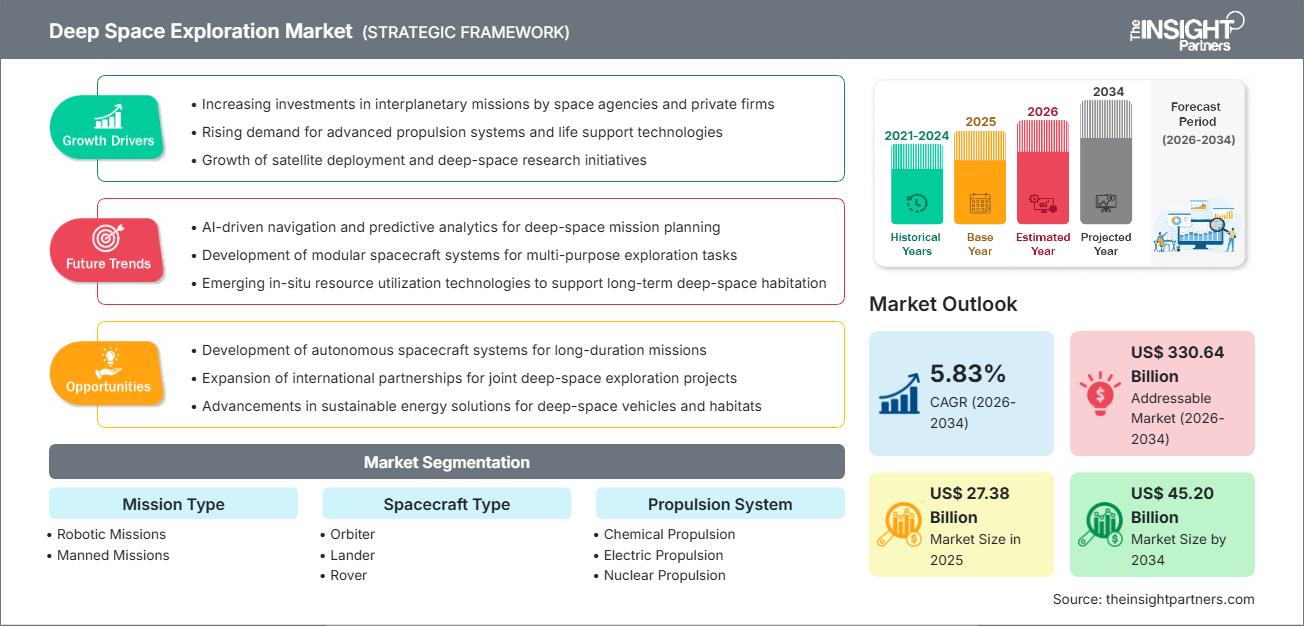
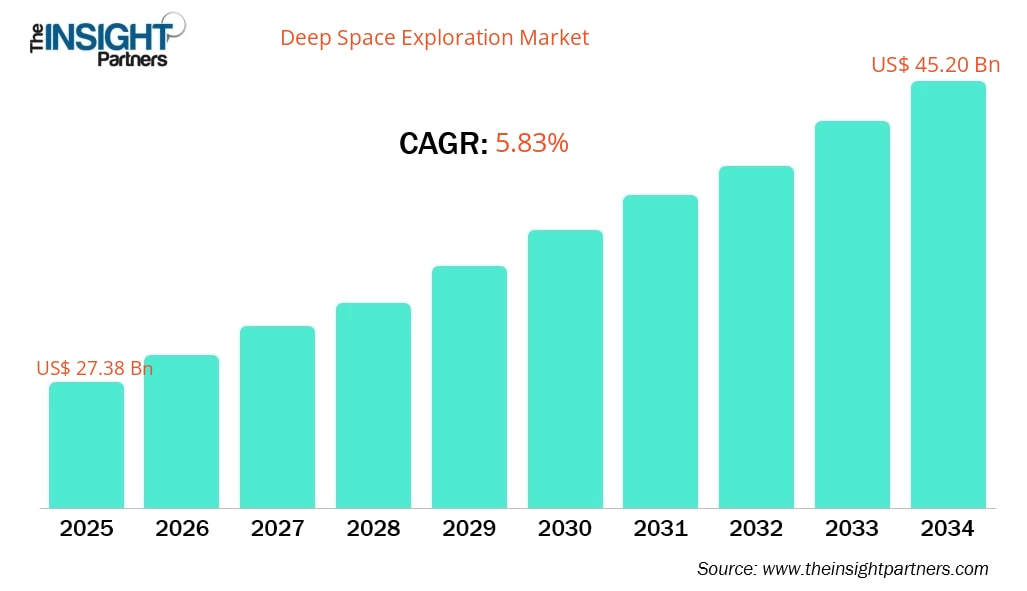
The Deep Space Exploration Market size is expected to reach US$ 45.20 billion by 2034 from US$ 27.38 billion in 2025. The market is anticipated to register a CAGR of 5.83% during 2026–2034.
Deep Space Exploration Market Analysis
The Deep Space Exploration Market is poised for significant growth, driven by advancements in propulsion technologies, international collaborations, and increasing investments in space missions. The integration of AI and machine learning in mission planning and data analysis is enhancing mission success rates. Additionally, the development of reusable spacecraft and in-situ resource utilization technologies is reducing mission costs and increasing sustainability.
Deep Space Exploration Market Overview
Deep space exploration involves missions beyond Earth's orbit to study celestial bodies such as the Moon, Mars, asteroids, and distant exoplanets. These missions aim to expand human knowledge of the universe, search for extraterrestrial life, and develop technologies for future space colonization. The market encompasses spacecraft, propulsion systems, launch services, and mission planning and support services.
Market Assessment and Insights
- Global market for Deep Space Exploration was valued at US$ 27.38 Billion in 2025
- Annual market size is expected to reach US$ 45.20 Billion by 2034
- Total addressable market (TAM) during 2026-2034 is projected to reach approximately US$ 330.64 Billion
- Market is anticipated to register a CAGR of 5.83% during the forecast period
- The United States represents a key market, supported by Increasing investments in interplanetary missions by space agencies and private firms, Rising demand for advanced propulsion systems and life support technologies, Growth of satellite deployment and deep-space research initiatives, as well as evolving industry dynamics
- Market analysis covers North America, Europe, Asia-Pacific, South and Central America, Middle East and Africa, with growth evaluated across the forecast period
- Market opportunities such as Development of autonomous spacecraft systems for long-duration missions, Expansion of international partnerships for joint deep-space exploration projects, Advancements in sustainable energy solutions for deep-space vehicles and habitats are expected to influence market dynamics and addressable market
- Report profiles industry participants, including Space Exploration Technologies Corp. (SpaceX), National Aeronautics and Space Administration (NASA), European Space Agency (ESA), China National Space Administration (CNSA), Blue Origin LLC, Roscosmos State Corporation, Lockheed Martin Corporation, Northrop Grumman Corporation, The Boeing Company, Japan Aerospace Exploration Agency (JAXA), while analyzing competitive strategies and innovation developments
-
Source: The Insight Partners' analysis based on proprietary research, government publications, company annual reports, investor presentations, industry databases, and expert interviews.
● REPORT CUSTOMIZATION
Tailor This Report To Align With Your Specific Business Requirements
This report can be customized to align precisely with your business objectives, scope, and target markets. Customization options include tailored segmentation, geography, competitive analysis, and strategic insights to support informed decision-making.
Customize This Report →WHAT YOU CAN ADJUST
- ● Segmentations
- ● Geography
- ● Competitive Analysis
- ● Language Preferences
Deep Space Exploration Market: Strategic Insights
-
Get Top Key Market Trends of this report.This FREE sample will include data analysis, ranging from market trends to estimates and forecasts.
Deep Space Exploration Market Drivers and Opportunities
Market Drivers:
- Advancements in Propulsion Technologies: Innovations in propulsion systems, such as ion and nuclear thermal propulsion, are enabling faster and more efficient travel to distant celestial bodies.
- International Collaborations: Partnerships between space agencies like NASA, ESA, and private companies are pooling resources and expertise, accelerating mission timelines, and reducing costs.
- Increased Government Investments: Nations are increasing funding for space exploration to enhance scientific knowledge, technological capabilities, and national prestige.
Market Opportunities:
- Private Sector Participation: Private companies are entering the market, offering innovative solutions and driving competition, which can lead to cost reductions and technological advancements.
- Asteroid Mining Potential: Exploration of asteroids for mining resources presents opportunities for economic benefits and technological development.
- Space Tourism: Developments in deep space exploration technologies may pave the way for commercial space tourism, opening new markets and revenue streams.
Deep Space Exploration Market Report Segmentation Analysis
The Deep Space Exploration Market share is analyzed across various segments to provide a clearer understanding of its structure, growth potential, and emerging trends. Below is the standard segmentation approach used in most industry reports:
By Mission Type:
- Robotic Missions
- Manned Missions
By Spacecraft Type:
- Orbiter
- Lander
- Rover
By Propulsion System:
- Chemical Propulsion
- Electric Propulsion
- Nuclear Propulsion
By End-Use Industry:
- Government Space Agencies
- Private Space Companies
- Research Institutions
By Geography:
- North America
- Europe
- Asia Pacific
- South & Central America
- Middle East & Africa
Deep Space Exploration Market Report Scope
| Report Attribute | Details |
|---|---|
| Market size in 2025 | US$ 27.38 Billion |
| Market Size by 2034 | US$ 45.20 Billion |
| Global CAGR (2026 - 2034) | 5.83% |
| Historical Data | 2021-2024 |
| Forecast period | 2026-2034 |
| Segments Covered |
By Mission Type
|
| Regions and Countries Covered |
North America
|
| Market leaders and key company profiles |
|
Deep Space Exploration Market Players Density: Understanding Its Impact on Business Dynamics
The Deep Space Exploration Market is growing rapidly, driven by increasing end-user demand due to factors such as evolving consumer preferences, technological advancements, and greater awareness of the product's benefits. As demand rises, businesses are expanding their offerings, innovating to meet consumer needs, and capitalizing on emerging trends, which further fuels market growth.
Deep Space Exploration Market Share Analysis by Geography
North America
- Market Share: Holds the largest market share due to advanced space exploration programs and private sector involvement.
- Key Drivers: Robust funding for NASA missions, the presence of private companies like SpaceX, and technological advancements in propulsion systems.
- Trends: Increased collaboration between government agencies and private companies, development of reusable spacecraft, and focus on Mars exploration.
Europe
- Market Share: Significant share due to the European Space Agency's (ESA) active participation in deep space missions.
- Key Drivers: Collaborative missions with other space agencies, development of advanced scientific instruments, and focus on lunar exploration.
- Trends: Emphasis on international partnerships, development of lunar landers, and participation in asteroid exploration missions.
Asia Pacific
- Market Share: A Growing share due to increasing investments in space exploration by countries like China and India.
- Key Drivers: Government-led space programs, advancements in satellite technology, and interest in lunar and Mars missions.
- Trends: Development of indigenous spacecraft, participation in international space missions, and focus on space research and development.
South and Central America
- Market Share: Emerging market with potential for growth in space exploration activities.
- Key Drivers: Government initiatives to develop space programs, collaboration with international space agencies, and interest in space science education.
- Trends: Development of small satellite programs, participation in regional space missions, and establishment of space research centers.
Middle East and Africa
- Market Share: Developing market with increasing interest in space exploration.
- Key Drivers: Government investments in space programs, collaboration with international space agencies, and focus on space technology development.
- Trends: Establishment of space agencies, development of satellite programs
Deep Space Exploration Market Players Density: Understanding Its Impact on Business Dynamics
The Deep Space Exploration Market demonstrates a moderate-to-high player density, characterized by the presence of both established government space agencies and an increasing number of private aerospace enterprises. This competitive landscape is reshaping the market’s business dynamics, driving innovation, partnerships, and accelerated mission timelines.
High market density leads to:
- Intensified Innovation Cycles: The participation of multiple public and private organizations encourages the rapid development of new propulsion technologies, autonomous navigation systems, and reusable spacecraft designs.
- Collaborative Mission Models: Agencies and private players are forming strategic alliances to share mission costs, leverage technological capabilities, and mitigate operational risks.
- Market Expansion through Commercialization: The entry of private companies like SpaceX, Blue Origin, and Rocket Lab is transforming deep space exploration from a government-funded endeavor into a commercially viable sector.
This evolving ecosystem fosters a dynamic competitive environment where technological leadership, cost efficiency, and strategic collaboration are key differentiators influencing market share, mission success, and long-term growth sustainability.
Key Companies Operating in the Deep Space Exploration Market
- Space Exploration Technologies Corp. (SpaceX)
- National Aeronautics and Space Administration (NASA)
- European Space Agency (ESA)
- China National Space Administration (CNSA)
- Blue Origin LLC
- Roscosmos State Corporation
- Lockheed Martin Corporation
- Northrop Grumman Corporation
- The Boeing Company
- Japan Aerospace Exploration Agency (JAXA)
Other Companies Analysed During the Course of Research
- Rocket Lab USA, Inc.
- Arianespace SA
- Thales Alenia Space
- United Launch Alliance (ULA)
- ISRO (Indian Space Research Organisation)
- Sierra Space Corporation.
- Firefly Aerospace
- Virgin Galactic
- Astrobotic Technology, Inc.
- Relativity Space
Deep Space Exploration Market News and Recent Developments
- NASA’s Artemis Program and Lunar Gateway (2025): NASA advanced its Artemis program to return humans to the Moon. The Lunar Gateway modules, built with ESA and JAXA, entered final testing to support future Mars missions.
- SpaceX Starship Flight Success (2025): SpaceX completed a full flight test of Starship, its reusable deep space rocket, marking progress toward lunar cargo transport and Mars expeditions.
- ESA–Thales Alenia Mars Sample Return (2024): ESA and Thales Alenia Space advanced development of the Earth Return Orbiter for NASA’s Mars Sample Return program.
- Blue Origin’s New Glenn Nears Launch (2025): Blue Origin reported major milestones in New Glenn rocket testing, preparing it for NASA lunar payload and Mars mission contracts.
- CNSA Expands Lunar and Mars Missions (2025): China’s CNSA launched Chang’e 7 and announced a Mars sample return by 2030, supporting its long-term space infrastructure goals.
- ISRO’s Chandrayaan-3 Success (2024): ISRO achieved a successful lunar south pole landing with Chandrayaan-3 and confirmed future missions Chandrayaan-4 and Gaganyaan.
- NASA and Lockheed Martin Nuclear Propulsion Project (2025): NASA and Lockheed Martin advanced the DRACO nuclear propulsion project, aimed at faster travel for deep space missions.
- Rocket Lab Expands Photon Deep Space Use (2024): Rocket Lab enhanced its Photon spacecraft to support interplanetary research and small payload delivery.
Deep Space Exploration Market Report Coverage and Deliverables
The “Deep Space Exploration Market Size and Forecast (2021 – 2034)” report provides a detailed analysis covering the following areas:
- Deep Space Exploration Market size and forecast at global, regional, and country levels for all key market segments covered under the scope
- Market trends, as well as market dynamics such as drivers, restraints, and key opportunities
- Detailed PEST and SWOT analysis
- Deep Space Exploration Market analysis covering key market trends, global and regional framework, major players, regulations, and recent market developments
- Industry landscape and competition analysis covering market concentration, heat-map analysis, prominent players, and recent developments in the Deep Space Exploration Market
- Detailed company profiles
Frequently Asked Questions
1. Mission Type (Robotic Missions, Manned Missions)
2. Spacecraft Type (Orbiter, Lander, Rover)
3. Propulsion System (Chemical Propulsion, Electric Propulsion, Nuclear Propulsion)
4. End-Use Industry (Government Space Agencies, Private Space Companies, Research Institutions)
5. Geography (North America, Europe, Asia Pacific, South & Central America, Middle East & Africa)

- Comprehensive Market Sizing and Forecast Analysis
- Detailed Segmentation Analysis
- In-Depth Market Dynamics Assessment
- Regional and Country-Level Insights
- Competitive Landscape and Company Benchmarking
- Strategic Business Intelligence
Recent Reports
Testimonials

The Insight Partners' SCADA System Market report is comprehensive, with valuable insights on current trends and future forecasts. The team was highly professional, responsive, and supportive throughout. We are very satisfied and highly recommend their services.
RAN KEDEM Partner, Reali Technologies LTDs
I requested a report on a very specific software market and the team produced the report in a few days. The information was very relevant and well presented. I then requested some changes and additions to the report. The team was again very responsive and I got the final report in less than a week.
JEAN-HERVE JENN Chairman, Future Analytica
We worked with The Insight Partners for an important market study and forecast. They gave us clear insights into opportunities and risks, which helped shape our plans. Their research was easy to use and based on solid data. It helped us make smart, confident decisions. We highly recommend them.
PIYUSH NAGPAL Sr. Vice President, High Beam Global
The Insight Partners delivered insightful, well-structured market research with strong domain expertise. Their team was professional and responsive throughout. The user-friendly website made accessing industry reports seamless. We highly recommend them for reliable, high-quality research services
YUKIHIKO ADACHI CEO, Deep Blue, LLC.
This is the first time I have purchased a market report from The Insight Partners.While I was unsure at first, I visited their web site and felt more comfortable to take the risk and purchase a market report.I am completely satisfied with the quality of the report and customer service. I had several questions and comments with the initial report, but after a couple of dialogs over email with their analyst I believe I have a report that I can use as input to our strategic planning process.Thank you so much for taking the extra time and making this a positive experience.I will definitely recommend your service to others and you will be my first call when we need further market data.
JOHN SUZUKI President and Chief Executive Officer, Board Director, BK Technologies
I wish to appreciate your support and the professionalism you displayed in the course of attending to my request for information regarding to infectious disease IVD market in Nigeria. I appreciate your patience, your guidance, and the fact that you were willing to offer a discount, which eventually made it possible for us to close a deal. I look forward to engaging The Insight Partners in the future, all thanks to the impression you have created in me as a result of this first encounter.
DR CHIJIOKE ONYIA MANAGING DIRECTOR, PineCrest Healthcare Ltd.Reason to Buy
- Informed Decision-Making
- Understanding Market Dynamics
- Competitive Analysis
- Identifying Emerging Markets
- Customer Insights
- Market Forecasts
- Risk Mitigation
- Boosting Operational Efficiency
- Strategic Planning
- Investment Justification
- Tracking Industry Innovations
- Aligning with Regulatory Trends





 Get Free Sample for