
Diabetes Nutrition Market Size, Share & Growth by 2034
Coverage: By Product Type (Crowns, Bridges, Dentures, Veneers / Inlays & Onlays, Abutments, Dental Implants), Material Type (Metal / Metal Alloys, Ceramic, Composites / Polymers, and Others), End User (Dental Hospitals & Clinics, Dental Laboratories, Other), and Geography (North America, Europe, Asia Pacific, the Middle East and Africa, and South and Central America), and Geography (North America, Europe, Asia Pacific, the Middle East and Africa, and South and Central America)
- Status : Upcoming
- Report Code : TIPRE00043075
- Category : Life Sciences
- No. of Pages : 150
- Available Report Formats :


- Last update date : July 06, 2026


2025 Market Size
US$ 12.45 Bn
Base year value
2034 Forecast
US$ 21.85 Bn
Projected by 2034
CAGR 2026-2034
6.45 %
Growth rate
Addressable Market
US$ 155.16 Bn
(2026-2034)
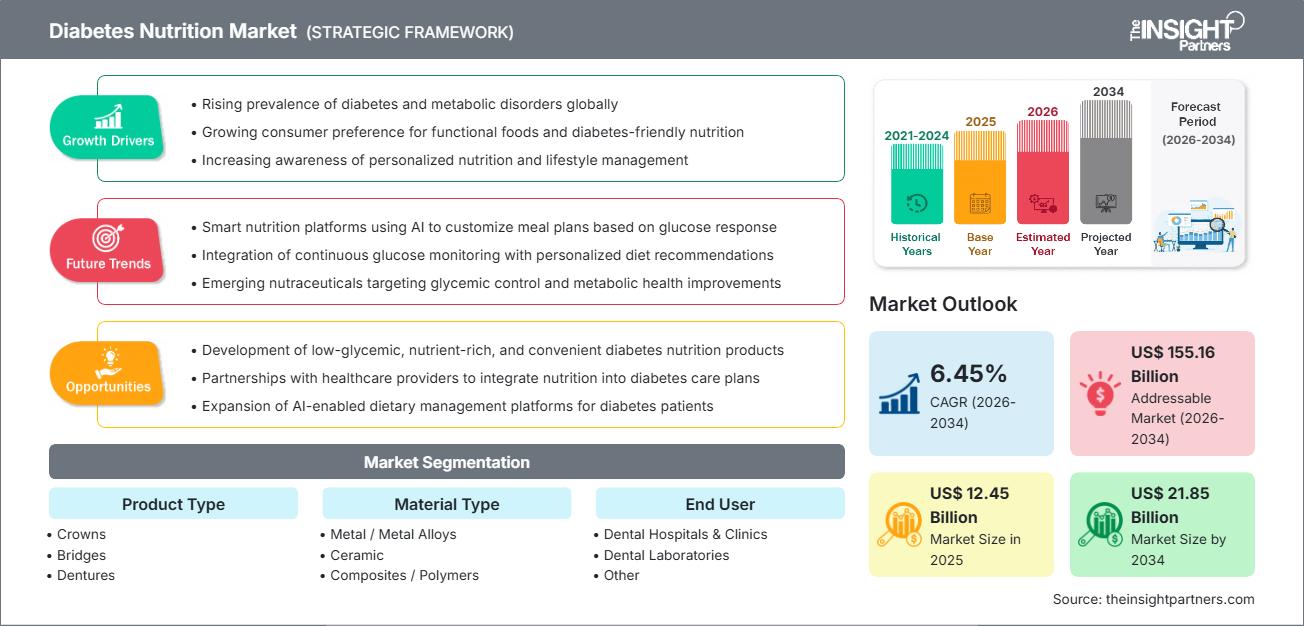
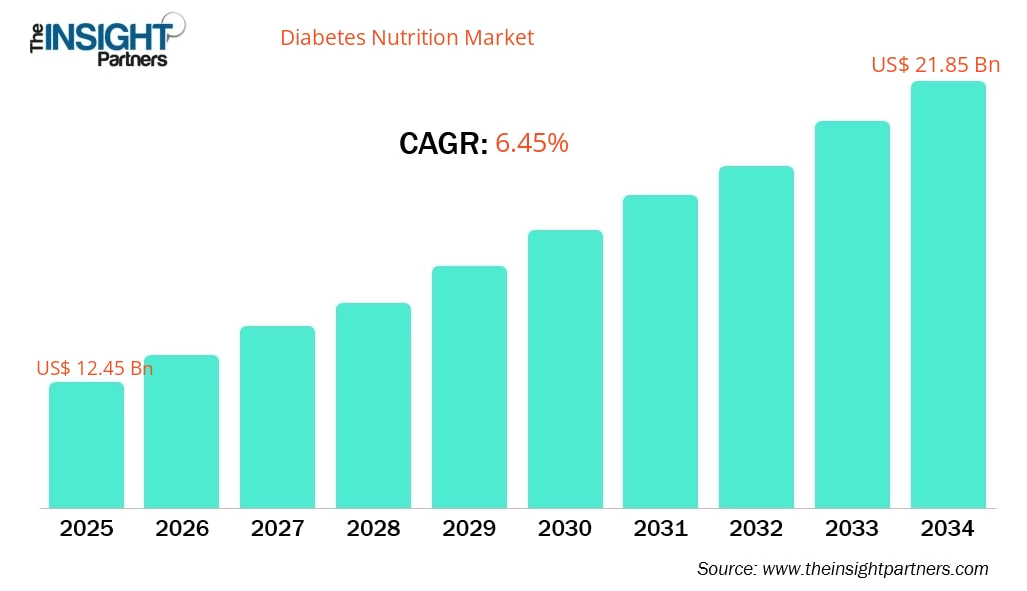
The Diabetes Nutrition Market is gaining strategic importance within the broader diabetes management ecosystem as nutrition-based interventions become increasingly integrated into clinical care pathways. The market is valued at US$12.45 billion in 2025 and is projected to reach US$21.85 billion by 2034, advancing at a CAGR of 6.45% during 2026–2034. Rising diabetes prevalence, increasing awareness of glycemic control, and growing demand for disease-specific nutritional products continue to support long-term market expansion.
North America remains a pivotal revenue-generating region for the Diabetes Nutrition Market and is anticipated to register a CAGR of approximately 6.1% through 2034. Growth is supported by high diabetes incidence, established reimbursement structures, and widespread adoption of clinically formulated nutritional solutions. Increasing physician recommendations, consumer interest in preventive healthcare, and continuous innovation from leading nutrition companies further reinforce regional demand.
Diabetes Nutrition Market Assessment and Insights
- North America: Holds 34–37% share in 2025, growing at a CAGR of 6.1–6.8% during 2026–2034, driven by strong reimbursement systems, rising diabetes prevalence, and increasing physician-led nutritional management.
- US: Accounts for 75–79% of the North American diabetes nutrition market size in 2025, expanding at a CAGR of 6.2–6.9% due to increasing adoption of clinical nutrition products, advanced healthcare infrastructure, and rising demand for personalized dietary interventions.
- Europe: Represents 27–30% share in 2025, growing at a 5.8–6.4% CAGR, led by Germany, the UK, and France through preventive healthcare policies, aging populations, and expanding clinical nutrition awareness.
- Asia Pacific: Holds 24–27% share in 2025, expanding at a 7.0–7.8% CAGR, led by China, India, and Japan with rapid urbanization, rising diabetic populations, and improving healthcare access.
- Largest Segment: Product Type holds the largest diabetes nutrition market share in 2025, growing at a 6.0–6.6% CAGR due to sustained demand driven by increasing adoption of clinical nutrition products and rising disease management requirements.
- High Growth Segment: Material Type – Ceramic is expected to achieve the fastest growth at a CAGR of 7.1–7.8% during 2026–2034, supporting the diabetes nutrition market forecast, driven by increasing preference for aesthetics, durability, and biocompatibility.
- Key companies analyzed in detail: Abbott Laboratories; Nestlé Health Science S.A.; Danone S.A.; Fresenius Kabi AG; Glanbia plc; Unilever PLC; WK Kellogg Co; PepsiCo, Inc.; Bayer AG; BASF SE.
Source: The Insight Partners' analysis based on proprietary research, government publications, company annual reports, investor presentations, industry databases, and expert interviews.
The Diabetes Nutrition Market report has evolved from a niche therapeutic category into an essential component of comprehensive diabetes care. Advancements in nutritional science, greater understanding of metabolic health, and stronger clinical evidence supporting nutrition-based interventions have expanded product utilization across healthcare and consumer settings. Market participants increasingly focus on specialized formulations that address glycemic control, weight management, and cardiovascular risk reduction.
Over the coming decade, market development will be shaped by personalized nutrition, digital health integration, and preventive healthcare strategies. Manufacturers are investing in research-backed ingredients, consumer education, and healthcare partnerships to strengthen market positioning. Expanding access to nutritional counseling and increasing acceptance of disease-specific nutrition products are expected to create sustained growth opportunities across developed and emerging economies.
Diabetes Nutrition Market Report Scope
| Report Attribute | Details |
|---|---|
| Market size in 2025 | US$ 12.45 Billion |
| Market Size by 2034 | US$ 21.85 Billion |
| Global CAGR (2026 - 2034) | 6.45% |
| Historical Data | 2021-2024 |
| Forecast period | 2026-2034 |
Diabetes Nutrition Market Analysis
Growing diabetes prevalence remains the primary force influencing market dynamics. Healthcare systems increasingly recognize nutrition as a critical pillar alongside medication and lifestyle modification. Demand is expanding across hospitals, clinics, long-term care facilities, and home-based care settings where nutritional interventions are used to support blood glucose management and overall metabolic health.
The value chain encompasses ingredient suppliers, formulation developers, manufacturers, healthcare providers, distributors, and retail channels. Strong collaboration between nutrition companies and healthcare professionals has improved product credibility and adoption. Scientific validation and regulatory compliance continue to play decisive roles in market acceptance and commercial success.
Competition is characterized by innovation, clinical research, portfolio diversification, and geographic expansion. Companies such as Abbott Laboratories, Nestlé Health Science, Danone S.A., Fresenius Kabi AG, Glanbia PLC, Unilever PLC, Kellogg Company, PepsiCo Inc., Bayer AG, and BASF SE continue to strengthen their positions through product development and strategic partnerships.
Investment activity increasingly targets precision nutrition, functional ingredients, and digital health-enabled nutrition management platforms. Diabetes nutrition market participants are prioritizing differentiated formulations, consumer engagement programs, and evidence-based claims to improve competitive positioning. Long-term success is expected to depend on the ability to combine scientific rigor with consumer-centric product innovation.
● REPORT CUSTOMIZATION
Tailor This Report To Align With Your Specific Business Requirements
This report can be customized to align precisely with your business objectives, scope, and target markets. Customization options include tailored segmentation, geography, competitive analysis, and strategic insights to support informed decision-making.
Customize This Report →WHAT YOU CAN ADJUST
- ● Segmentations
- ● Geography
- ● Competitive Analysis
- ● Language Preferences
Diabetes Nutrition Market: Strategic Insights
Regional Insights
North America Diabetes Nutrition Market
North America accounts for the largest share of the Diabetes Nutrition Market and is projected to expand at a CAGR of approximately 6.1% through 2034. The region benefits from advanced healthcare infrastructure, extensive diabetes screening programs, and strong physician awareness regarding nutritional interventions. Consumers increasingly seek products that support blood sugar management while aligning with broader wellness objectives.
A favorable reimbursement environment and widespread availability of specialized nutrition products support market penetration. Growing adoption of continuous glucose monitoring technologies has also increased interest in personalized dietary solutions. Clinical nutrition providers continue to collaborate with healthcare institutions to develop evidence-based diabetes nutrition programs.
U.S. Diabetes Nutrition Market
The U.S. represents roughly 70–75% of the North American diabetes nutrition market and is anticipated to record a CAGR near 6.0% over the forecast period. High diabetes prevalence, rising obesity rates, and increasing healthcare expenditures contribute significantly to market demand. Nutrition-based disease management programs are becoming more common across healthcare systems.
Major industry participants maintain substantial operational and commercial footprints within the country. Product adoption is increasingly linked to personalized healthcare strategies, digital coaching platforms, and medically tailored nutrition programs. Clinical nutrition products designed for glycemic control are gaining broader acceptance among healthcare providers and patients seeking integrated diabetes management solutions.
Europe Diabetes Nutrition Market
Europe contributes approximately 25–30% of global Diabetes Nutrition Market revenue and is expected to grow at a CAGR of around 5.8%. Demand is supported by aging populations, increasing diabetes incidence, and strong public health initiatives focused on chronic disease management. Healthcare providers increasingly emphasize nutritional intervention as part of long-term treatment strategies.
Germany maintains its dominant position in the regional diabetes nutrition market owing to its highly developed health care infrastructure, advanced reimbursement system, and acceptance of medical nutrition products. The cooperation of health care organizations and companies producing nutrition products contributes to innovation and the use of such products in health care.
The UK, France, Italy, and Spain combined provide a considerable market. High awareness of preventive medicine, interest in functional nutrition, and the availability of disease-specific nutrition products contribute to the region's expansion prospects.
United Kingdom: Rising awareness of diabetes and disease management systems is driving growth in the UK diabetes nutrition market. Health care providers are increasingly including nutritional counseling in care programs, resulting in high demand for diabetes nutrition products.
Germany: Germany holds the leading revenue position in the region due to high health care expenditure and widespread use of specialty nutrition products. Clinical evidence and physician involvement constitute key drivers of product usage.
France, Italy, and Spain: Demand for products in these regions is increasing due to demographic changes and the rising prevalence of chronic diseases. Acceptance of functional and medically customized nutrition products is improving in Southern Europe.
APAC Diabetes Nutrition Market
Asia-Pacific is the fastest-growing regional market and is projected to achieve a CAGR exceeding 7.5% through 2034. The region currently accounts for approximately 20–25% of global revenue. Rapid urbanization, changing dietary habits, and rising diabetes prevalence are creating substantial opportunities for nutrition-focused healthcare solutions.
China dominates the regional market because of its large number of diabetics, greater investment in healthcare, and growing use of preventive measures. Government programs aimed at treating chronic diseases will continue to drive market growth.
Countries like Japan, South Korea, India, and Australia are experiencing higher demand for nutritional foods. Higher healthcare awareness, growth in middle-class populations, and increased access to healthcare facilities are contributing to market growth. Non-communicable disease-oriented policy initiatives will enhance growth potential.
Middle East & Africa Diabetes Nutrition Market
The Middle East & Africa Diabetes Nutrition Market is expected to expand steadily at a CAGR of approximately 5.7% through 2034. Rising diabetes prevalence and increasing healthcare investments are contributing to market development. Governments across the region are strengthening chronic disease management frameworks and expanding healthcare infrastructure.
Saudi Arabia represents the leading country market due to high diabetes incidence and substantial healthcare expenditure. Demand for disease-specific nutrition products is increasing as healthcare providers place greater emphasis on preventive care and metabolic health management.
The UAE, South Africa, and other regional markets are benefiting from expanding healthcare access and growing awareness regarding nutritional interventions. Infrastructure modernization and healthcare capacity expansion continue to create favorable conditions for future market growth.
Segmentation Analysis
Product Type
- Crowns: Dental crowns remain among the most widely used restorative solutions for repairing damaged or weakened teeth. Demand is supported by the need for durable, biocompatible materials that provide long-lasting protection, restore chewing function, and enhance aesthetics across hospitals, dental clinics, and specialty practices.
- Bridges: Dental bridges are extensively used to replace one or more missing teeth, restoring function and appearance through multi-unit restorations. Technological advancements in digital design and precision manufacturing improve fit, durability, and aesthetics, supporting increased adoption among patients seeking reliable restorative treatments.
- Dentures: Dentures continue to serve as an essential and cost-effective tooth replacement option, particularly for elderly populations experiencing complete or partial tooth loss. Ongoing product innovations enhance comfort, fit, durability, and aesthetics, improving patient satisfaction while supporting broader adoption in restorative dentistry.
- Veneers / Inlays & Onlays: Veneers, inlays, and onlays are gaining popularity due to increasing demand for cosmetic and minimally invasive dental procedures. Advances in ceramic and composite materials, along with digital fabrication technologies, enable highly aesthetic, durable restorations while preserving more of the natural tooth structure.
- Abutments: Dental abutments are essential components that connect implants to restorative prosthetics, ensuring stability and long-term performance. Growing dental implant adoption, combined with advancements in customized CAD/CAM manufacturing and biocompatible materials, is driving demand for high-precision abutment solutions across restorative procedures.
- Dental Implants: Dental implants represent a premium restorative solution offering superior stability, functionality, and natural aesthetics for tooth replacement. Rising patient awareness, increasing preference for permanent restorations, technological advancements, and higher success rates continue to support strong demand across global restorative dentistry markets.
Material Type
- Metal / Metal Alloys: Metal and metal alloy dental restorative materials continue to play a vital role in procedures requiring exceptional strength, wear resistance, and long-term durability. Their cost-effectiveness and proven clinical performance make them suitable for crowns, bridges, implants, and other restorations where structural reliability is essential.
- Ceramic: Ceramic restorative materials are experiencing strong demand owing to their natural tooth-like appearance, excellent biocompatibility, and stain resistance. Their seamless integration with CAD/CAM and other digital dentistry technologies enables precise, customized restorations while meeting growing patient preferences for highly aesthetic dental treatments.
- Composites / Polymers: Composite and polymer-based restorative materials are increasingly adopted for direct and indirect restorations because of their versatility, affordability, and aesthetic appeal. Continuous advancements in material formulations improve mechanical strength, durability, and handling characteristics, supporting minimally invasive procedures and enhanced long-term clinical outcomes.
End User
- Dental Hospitals & Clinics: Account for the largest volume of restorative procedures due to direct patient engagement and comprehensive treatment capabilities.
- Dental Laboratories: Play an essential role in customized prosthetic production through advanced manufacturing and digital design technologies.
Opportunity Snapshot
| End User | Revenue Contribution | Trend Tag | Adoption Stage |
| Dental Hospitals & Clinics | High | Chairside Care | Mature |
| Dental Laboratories | Medium | Digital Fabrication | Scaling |
| Other | Low | Specialty Support | Emerging |
Diabetes Nutrition Market Growth Drivers and Impact Analysis
Rising Global Burden of Diabetes and Metabolic Disorders
With the widespread rise of diabetes in both developing and mature economies, the specialized nutrition market remains exceptionally dynamic. Growing acknowledgment amongst medical communities that lifestyle and nutritional interventions play a critical role in regulating blood glucose and can reduce long-term health risks has elevated the profile of such offerings. As the incidence of cost-prohibitive chronic illness within health systems rises, the strategic implications of preventative nutritional interventions become paramount. Nutrition products designed to manage blood glucose, allow diabetic individuals to maintain improved metabolic profiles, and work in synergy with prescribed drug treatments contribute to both their immediate health and have implications for future health expenditure. It is these trends that will continue to drive investment in product development, portfolio expansion, and scientific validation of dietary treatments.
Growing Acceptance of Medical Nutrition in Clinical Care
As clinical acceptance of disease-specific nutrition strengthens year over year, practitioners are increasingly recommending customized products in the diabetes management space to assist their patients, in collaboration with registered dietitians and health systems. The increasing adoption of integrated nutrition as a component of care delivery enhances patient engagement and outcomes, providing a promising outlook for product adoption in both hospital/inpatient, clinic, and home health settings. Diabetes nutrition market stakeholders benefit from this added clinical validation while patients have access to customized care for their metabolic health conditions, driving a more organized and enduring demand cycle.
Expansion of Personalized and Functional Nutrition Solutions
Consumer preferences are moving toward personal health management strategies. Scientific research in the field of nutrition, biomarker tests, and technology-driven health care has brought us closer to personalized nutrition advice. Nutritional products used by diabetes patients are being designed with functional ingredients that help control glucose levels, satiety, digestion, and heart health. This trend allows manufacturers to increase product differentiation and create opportunities for premium products. Those who can offer personalized services will be able to attract high-value-added clients.
Diabetes Nutrition Market Future Trends
Integration of Digital Health with Nutrition Management
Technology advancements within digital health are changing the way consumers and healthcare providers manage diabetes. Continuous glucose monitors, mobile applications, and remote coaching solutions collect useful information that could be used for personalizing nutrition programs. The integration of nutrition and technology will become the norm in the future because more accurate solutions are needed. In addition, real-time feedback solutions help patients get information on the effect of certain foods on their glucose levels. It will lead to more compliance from patients. Future product ecosystems will include nutritional formulations and analytics.
Scientific Validation and Evidence-Based Product Development
This trend is placing greater emphasis on clinical validation and measurable outcomes within diabetes nutrition market trends. Companies are focusing on trials that prove the benefits in terms of glycemic control, weight loss, and cardiometabolic effects. Positioning based on facts increases healthcare providers’ confidence and facilitates clinical uptake. Future competition will increasingly be based on science, not brands. Companies that are able to provide strong clinical data are likely to benefit from increased market credibility and competitive advantage.
Diabetes Nutrition Market Opportunities
Untapped Potential in Emerging Healthcare Markets
Many emerging economies continue to experience rapid increases in diabetes prevalence rates of the illness and remain at quite low levels in terms of penetration of specialized nutrition products. With increased healthcare infrastructure, increased disposable income, and enhanced disease awareness, such markets present good prospects for entering. Those companies that will form strategic partnerships locally, modify their products based on regional preferences, and focus on educating customers may reap substantial benefits from such strategies.
Development of Comprehensive Nutrition Ecosystems
Another very important business opportunity lies in integrating nutritional products with advanced monitoring, education, and personalized coaching. Increasingly, there is a need for integrated offerings in the area that would not only help to achieve better results but also simplify the process of treatment. Such offerings will allow creating valuable and distinctive propositions for customers that will result in better retention and revenues for companies.
Recent Developments
- November, 2025: Abbott Laboratories launched a new formulation of Ensure Diabetes Care in India featuring enhanced myo-inositol content, high protein, and fiber designed to support blood sugar management, weight control, and metabolic health for people living with diabetes. The product expansion reflects growing investment in evidence-based diabetes nutrition solutions.
- November, 2025: Danone India reported findings from a large post-marketing survey evaluating Protinex Diabetes Care among adults with Type-2 diabetes. Results highlighted positive consumer-reported outcomes related to blood sugar management, energy levels, and physical strength, reinforcing demand for targeted nutritional interventions.
- October, 2025: Nestlé Health Science announced a strategic partnership with the University of California, Davis Innovation Institute for Food & Health to accelerate research and commercialization of nutrition-based health solutions, including metabolic health applications relevant to diabetes management and disease-specific nutrition.
Frequently Asked Questions

- Comprehensive Market Sizing and Forecast Analysis
- Detailed Segmentation Analysis
- In-Depth Market Dynamics Assessment
- Regional and Country-Level Insights
- Competitive Landscape and Company Benchmarking
- Strategic Business Intelligence
Recent Reports
Testimonials

The Insight Partners' SCADA System Market report is comprehensive, with valuable insights on current trends and future forecasts. The team was highly professional, responsive, and supportive throughout. We are very satisfied and highly recommend their services.
RAN KEDEM Partner, Reali Technologies LTDs
I requested a report on a very specific software market and the team produced the report in a few days. The information was very relevant and well presented. I then requested some changes and additions to the report. The team was again very responsive and I got the final report in less than a week.
JEAN-HERVE JENN Chairman, Future Analytica
We worked with The Insight Partners for an important market study and forecast. They gave us clear insights into opportunities and risks, which helped shape our plans. Their research was easy to use and based on solid data. It helped us make smart, confident decisions. We highly recommend them.
PIYUSH NAGPAL Sr. Vice President, High Beam Global
The Insight Partners delivered insightful, well-structured market research with strong domain expertise. Their team was professional and responsive throughout. The user-friendly website made accessing industry reports seamless. We highly recommend them for reliable, high-quality research services
YUKIHIKO ADACHI CEO, Deep Blue, LLC.
This is the first time I have purchased a market report from The Insight Partners.While I was unsure at first, I visited their web site and felt more comfortable to take the risk and purchase a market report.I am completely satisfied with the quality of the report and customer service. I had several questions and comments with the initial report, but after a couple of dialogs over email with their analyst I believe I have a report that I can use as input to our strategic planning process.Thank you so much for taking the extra time and making this a positive experience.I will definitely recommend your service to others and you will be my first call when we need further market data.
JOHN SUZUKI President and Chief Executive Officer, Board Director, BK Technologies
I wish to appreciate your support and the professionalism you displayed in the course of attending to my request for information regarding to infectious disease IVD market in Nigeria. I appreciate your patience, your guidance, and the fact that you were willing to offer a discount, which eventually made it possible for us to close a deal. I look forward to engaging The Insight Partners in the future, all thanks to the impression you have created in me as a result of this first encounter.
DR CHIJIOKE ONYIA MANAGING DIRECTOR, PineCrest Healthcare Ltd.Reason to Buy
- Informed Decision-Making
- Understanding Market Dynamics
- Competitive Analysis
- Identifying Emerging Markets
- Customer Insights
- Market Forecasts
- Risk Mitigation
- Boosting Operational Efficiency
- Strategic Planning
- Investment Justification
- Tracking Industry Innovations
- Aligning with Regulatory Trends





 Get Free Sample for