
Eco Fibers Market Trends, Size & Forecast by 2034
Coverage: By Product (Organic, Manmade/regenerated, Recycled, Natural); Application (Textiles/Apparel, Industrial, Medical, Household and furnishing, Others) , and Geography (North America, Europe, Asia Pacific, and South and Central America)
- Status : Data Released
- Report Code : TIPRE00010208
- Category : Chemicals and Materials
- No. of Pages : 150
- Available Report Formats :


- Last update date : July 28, 2026


2025 Market Size
US$ 70.56 Bn
Base year value
2034 Forecast
US$ 145.13 Bn
Projected by 2034
CAGR 2026-2034
8.34 %
Growth rate
Addressable Market
US$ 968.26 Bn
(2026-2034)
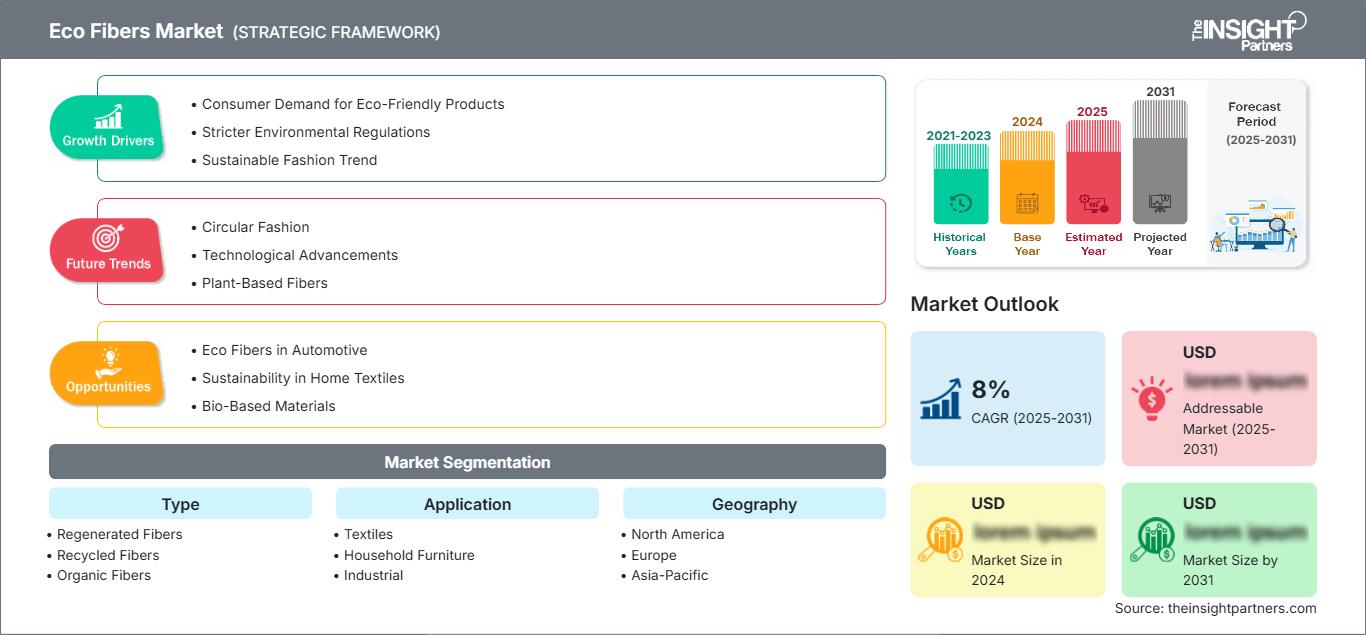
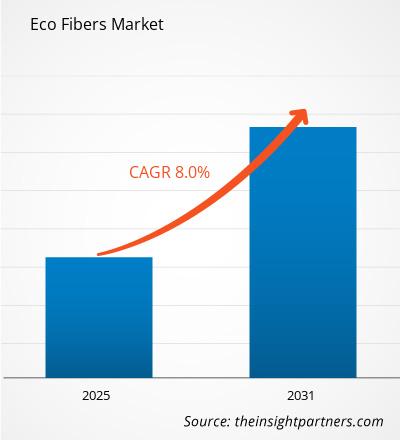
The Eco Fibers Market size stood at US$ 70.56 Billion in 2025 and is forecast to reach US$ 145.13 Billion in 2034, with a CAGR of 8.34% from 2026 to 2034. Growth is driven by textile companies shifting their raw material procurement towards regeneration, recycling, and the use of organic fibers, as sustainability, traceability, and low-impact production become integral parts of their sourcing strategy.
In North America, CAGR of 7.2–8.0% is forecast through 2034 owing to the rising trends of circular textiles, sustainability policies of retailers, and increased demand for recycled polyester, lyocell, and organic cotton blends. The outlook of the Eco Fibers Market size in this region is influenced by investment in recycling activities, higher procurement standards, and preference for eco-friendly fibers among consumers.
Eco Fibers Market Assessment and Insights
- North America: Share in 2025 of 25–28% and CAGR between 7.2–8.0%. Brand sustainability commitments, textile recycling investments, and premium apparel sourcing support steady regional demand.
- US: Share in 2025 of 78–82% of North America and CAGR between 7.3–8.1%. Retailer-led circularity programs and recycled fiber adoption continue to widen commercial usage.
- Europe: Share in 2025 of 22–25% and CAGR between 7.6–8.4%. Germany, France, Italy, Spain, and the UK lead through textile circularity policy and sustainable fashion procurement.
- Asia Pacific: Share in 2025 of 39–42% and CAGR between 8.8–9.6%. China, India, Japan, and South Korea dominate manufacturing capacity, fiber conversion, and export-linked demand.
- Largest Segment: Regenerated Fibers held market share of 46–49% in 2025 and CAGR of 8.0–8.8% during 2026–2034, supported by viscose, lyocell, modal, and branded cellulosic fiber adoption.
- High Growth Segment: Recycled Fibers held market share of 29–32% in 2025 and CAGR of 9.4–10.2% during 2026–2034, benefiting from polyester recycling and circular material commitments.
- Key companies analyzed in detail: Lenzing AG, U.S. Fibers, Polyfibre Industries Pvt. Ltd., Grasim Industries Limited, Wellman Advanced Materials, LLC, Shanghai Tenbro Bamboo Textile Co., Ltd., China Bambro Textile (Group) Co., Ltd., Pilipinas Ecofiber Corporation, Teijin Limited, David C. Poole Company, Inc.
Source: The Insight Partners' analysis based on proprietary research, government publications, company annual reports, investor presentations, industry databases, and expert interviews.
Material sourcing has shifted from sustainable positioning for niche markets to performance-focused business development. Regenerated cellulose fibers have had access to controlled supply chains of pulp, improved recovery of solvents, and branded traceability systems, while recycled fibers are establishing their credibility with mechanical and chemical recycling technologies. Sourcing of materials is increasingly focused on optimizing mixing, dyeing performance, and moisture properties to meet the needs of apparel, furniture, and industrial textiles without sacrificing sustainability claims.
Moving forward, growth will be driven by Asia Pacific manufacturing capacity, circular economy regulation in Europe, and procurement policies of North American brands. Recycled polyester production capacity, lyocell expansion, organic cotton supply chains, and technology for fiber-to-fiber recycling will receive additional funding. With maturing policy around textile waste and chain-of-custody data required from buyers, materials that can offer both cost stability and performance are expected to gain market share until 2034.
Eco Fibers Market Report Scope
| Report Attribute | Details |
|---|---|
| Market size in 2025 | US$ 70.56 Billion |
| Market Size by 2034 | US$ 145.13 Billion |
| Global CAGR (2026 - 2034) | 8.34% |
| Historical Data | 2021-2024 |
| Forecast period | 2026-2034 |
Eco Fibers Market Analysis
The Eco Fibers Market growth depends largely on the reduction in dependency on virgin synthetic fibers and traditional cotton from the part of fashion brands. There is growing demand for fibers that require less water, have lower carbon emissions, and have good end-of-life stories. It is important to mention the involvement of the following supply chain participants: certified farms, dissolving pulp mills, recycling facilities, spinning operations, mills, converters, and sourcing departments of brands; therefore, traceability and certifications are critical in commercialization.
Supply is complicated due to the fact that regenerated fibers require sustainable wood pulp, recycled fibers are dependent on the quality of waste materials, and organic fibers still have some vulnerability to agricultural yields. Nevertheless, there is demand for such fibers from textiles, home furnishing, and industrial applications as those that have sustainable credentials.
Eco-Fibers Market Analysis reveals the competitive focus on size, sustainability credentials, and application-specific performance. Lenzing AG is still focusing on specialty cellulose fibers as well as branded textiles while Grasim Industries Limited is an important player in viscose supply chains. Teijin Limited and Wellman Advanced Materials, LLC provide recycled and advanced materials capacities, and bamboo producers like Shanghai Tenbro Bamboo Textile Co., Ltd. satisfy niche demand for natural-based products.
The current investment strategy is focused on closed-loop technologies, fiber tracking, waste separation, and capacity localization. U.S. Fibers, Polyfibre Industries Pvt. Ltd., Pilipinas Ecofiber Corporation, China Bambro Textile (Group) Co., Ltd., and David C. Poole Company, Inc. are competing through serving regional converters and customer-specific fibers. Sustainable positioning now means finding the balance between low costs and sustainability credentials.
● REPORT CUSTOMIZATION
Tailor This Report To Align With Your Specific Business Requirements
This report can be customized to align precisely with your business objectives, scope, and target markets. Customization options include tailored segmentation, geography, competitive analysis, and strategic insights to support informed decision-making.
Customize This Report →WHAT YOU CAN ADJUST
- ● Segmentations
- ● Geography
- ● Competitive Analysis
- ● Language Preferences
Eco Fibers Market: Strategic Insights
Regional Insights
North America Eco Fibers Market
North America accounted for 25–28% of global revenue in 2025 and is projected to expand at a 7.2–8.0% CAGR through 2034. The Eco Fibers Market share in the region is supported by apparel retailers’ recycled-content targets, growing household textile demand, and domestic interest in closed-loop manufacturing.
Demand from structural aspects is fueled by brand commitment to proven fibers, consumer awareness about microplastics, and waste recovery of textiles. Regenerated cellulose fiber is increasingly used in high-end clothing and hygiene-related products, while recycled polyester continues to play an important role in performance textiles. Certified suppliers with logistics and product-testing facilities fare well in the region.
U.S. Eco Fibers Market
In 2025, the United States was expected to account for 78% – 82% of North America’s revenue growth, which is projected to increase with a CAGR of 7.3% – 8.1%. Retailers, sportswear manufacturers, furniture retailers, and institutions have started adopting recycled polyester, lyocell, and organic cotton blends in order to meet their sustainability objectives.
Company presence is driven by recycler firms, specialist distributors, and innovative materials suppliers. In addition, U.S. Fibers, Wellman Advanced Materials, LLC, and David C. Poole Company, Inc. provide support to recycling, engineering fiber production, and distribution, while global suppliers provide branded cellulosic and recycled fiber solutions. Application areas that generate demand include apparel, performance textile, upholstery, and industrial nonwovens.
Europe Eco Fibers Market
Europe held 22–25% of global revenue in 2025 and is expected to grow at a 7.6–8.4% CAGR. Germany is the leading country due to technical textiles, apparel sourcing discipline, and circular economy infrastructure. The UK benefits from retailer sustainability programs and consumer demand for certified lower-impact clothing.
Both France and Italy provide the necessary support through the fashion, luxury fabrics, and furniture industries, which have begun relying on certified fibers. Spain’s contribution to the market includes demand generated through connections between clothing manufacturing and recycling operations. The regulatory pressure on textile waste, eco-design, and product transparency is making it easier for buyers to follow the procurement process properly.
APAC Eco Fibers Market
APAC contributed between 39% and 42% of the world’s revenues in 2025 and is expected to have a CAGR of 8.8% to 9.6%. China dominates due to high levels of textile conversion, regenerated fibers capacities, and export-oriented manufacturing. India is growing through clothing manufacture, organic cotton, and viscose value chain developments.
Recycled and specialty fiber developments in Japan and South Korea and sustainable clothing and home textiles in Australia play a key role. High industrial policy support, exports competitiveness, and brand-sourced demands are driving regional mills towards certification, recycling collaborations, and low-impact processes. Scale economies make APAC a critical region worldwide.
Middle East & Africa Eco Fibers Market
The Middle East & Africa region is forecast to grow at a 6.6–7.4% CAGR through 2034. Saudi Arabia and the UAE are developing textile, logistics, and industrial diversification programs that may gradually increase demand for sustainable fibers in apparel, furnishing, hospitality, and infrastructure-linked textile applications.
South Africa remains the most established subregional consumer, supported by retail apparel, household textiles, and recycling awareness. Rest of MEA demand is smaller but improving as tourism, construction, and institutional procurement adopt more durable and lower-impact materials. Energy-intensive processing costs remain a constraint, making imports and partnerships important.
Segmentation Analysis
Type
The Type segment is expected to grow at a 8.3–9.1% CAGR during 2026–2034. The Eco Fibers Market scope is expanding as buyers select materials based on performance, certification, lifecycle impact, and supply reliability. Regenerated fibers dominate due to scale and softness, recycled fibers grow fastest through circularity mandates, and organic fibers maintain strategic value in premium natural textile positioning.
- Regenerated Fibers: Regenerated fibers remain the largest type due to viscose, lyocell, and modal adoption in apparel, nonwovens, and home textiles requiring softness, moisture management, and scalable processing.
- Recycled Fibers: Recycled fibers are gaining strategic importance as brands convert post-consumer bottles, textile waste, and industrial scrap into polyester and blended yarns for apparel, furnishings, and performance products.
- Organic Fibers: Organic fibers serve premium natural textile categories where buyers prioritize pesticide-free cultivation, soil stewardship, certified sourcing, and consumer-facing sustainability narratives in clothing and household applications.
Application
The Application segment is projected to advance at an 8.1–8.9% CAGR through 2034. Textiles remain the primary demand center, but household furniture and industrial applications are becoming more relevant as sustainability requirements move beyond apparel. Fiber performance, abrasion resistance, color consistency, and certification influence adoption across upholstery, mattress components, geotextiles, filtration media, packaging textiles, and technical fabrics.
- Textiles: Textiles generate the highest revenue contribution as apparel, sportswear, denim, innerwear, and fashion brands incorporate certified regenerated, recycled, and organic materials into seasonal collections.
- Household Furniture: Household furniture demand is rising in upholstery, bedding, curtains, and decorative fabrics as retailers emphasize durability, comfort, lower-impact materials, and responsible sourcing.
- Industrial: Industrial applications include filtration, automotive interiors, packaging textiles, agriculture fabrics, and specialty nonwovens where strength, consistency, recyclability, and functional performance determine commercial acceptance.
Opportunity Snapshot
| Segment Name | Revenue Contribution | Trend Tag | Adoption Stage |
| Textiles | High | Circular Apparel | Scaling |
| Household Furniture | Medium | Green Upholstery | Scaling |
| Industrial | Medium | Technical Fibers | Emerging |
Eco Fibers Market Growth Drivers and Impact Analysis
Brand Commitments to Lower-Impact Textile Sourcing
Companies producing apparel and textiles for home use worldwide are transforming their sustainable development policies into fiber-based procurement guidelines, resulting in tangible demand for regenerated, recycled, and organic fibers. The market profits from companies that need chain-of-custody information, proof of recycled content, certification of responsibly managed forests, or certification of organic farms. These factors affect the choice of mills, supplier auditing, and the formation of long-term business relationships. There is an opportunity to maximize profits from retailers that need a regular supply without the risk of making misleading statements. Companies providing testing services and certification and quality control information have an opportunity to get long-term programs instead of spot purchases.
Expansion of Fiber Recycling Infrastructure
The development of fiber recycling occurs via waste collection, sorting, mechanical recycling, depolymerization, and textile-to-textile trials. Such solutions enable the conversion of waste materials from consumers or production facilities into a valuable feedstock without using fresh materials derived from petrochemicals or agriculture. Recycled polyester, cotton recovery, and mixed-material innovations are evident in markets, yet quality assurance is not always guaranteed. Working with municipalities, brands, and recyclers will increase feedstock availability and enable implementation at a commercial scale. Manufacturers with access to the right kind of waste, effective sorting technologies, and spinning capabilities will be able to play an active part in such ecosystems.
Regulatory Pressure on Textile Waste and Transparency
Textile waste regulation, eco-design expectations, and product transparency requirements are changing how manufacturers select raw materials. Extended producer responsibility discussions and sustainability reporting rules encourage companies to document fiber origin, recyclability, chemical inputs, and environmental impacts. The Eco Fibers Market gains momentum as buyers use lower-impact fibers to reduce compliance risk and improve public reporting. This driver affects both large brands and upstream suppliers, because evidence must travel through the value chain. Companies that invest early in traceability platforms, certifications, and environmental data management may secure preferred-supplier status as regulation becomes more detailed and enforcement becomes more consistent across major consuming regions.
Eco Fibers Market Future Trends
Next-Generation Regenerated Cellulosic Platforms
Eco Fibers Market trends indicate growing emphasis on next-generation regenerated cellulosic fibers that use improved solvent recovery, certified wood pulp, textile waste pulp, and lower-impact dyeing compatibility. Future development will focus on fibers that combine softness, strength, moisture control, and verifiable sustainability data. This trend should widen adoption in denim, casualwear, innerwear, wipes, and premium home textiles. Producers that integrate pulp sourcing, processing efficiency, and customer co-development can differentiate beyond commodity viscose. Commercial success will depend on balancing environmental performance with price stability, consistent fiber quality, and scalable capacity available to mills across Asia, Europe, and North America.
Digital Traceability and Product Passport Adoption
Digital traceability is expected to become a defining feature of sustainable fiber procurement. Fiber producers, spinners, mills, and brands are moving toward systems that document origin, content, certifications, processing steps, and environmental attributes. Product passport adoption will help reduce greenwashing concerns and improve buyer confidence in regenerated, recycled, and organic fibers. The trend is particularly important for cross-border textile supply chains where verification is complex. Suppliers that can provide auditable data in standardized formats may improve access to premium buyers, regulatory-compliant markets, and long-term sourcing programs while reducing disputes over sustainability claims.
Eco Fibers Market Opportunities
Fiber-to-Fiber Recycling Partnerships
Fiber-to-fiber recycling partnerships offer a high-value route for brands, recyclers, and fiber producers seeking circular material supply. Eco Fibers Market Forecasts increasingly favor companies that can secure post-consumer textiles, separate blended fabrics, and convert waste into commercial yarn inputs. Investment opportunities exist in sorting automation, depolymerization, cotton regeneration, and blended fiber recovery. Partnerships with retailers can create predictable feedstock flows and improve collection economics. Fiber suppliers that co-invest with brands may gain early access to commercial programs, reduce raw material volatility, and build stronger evidence for circularity claims. The opportunity is most attractive where regulation, consumer awareness, and brand procurement targets converge.
Sustainable Fibers for Home and Technical Textiles
Home and technical textiles represent an underpenetrated opportunity because sustainability requirements are spreading beyond apparel. Upholstery, curtains, bedding, filtration media, automotive interiors, packaging fabrics, and agriculture textiles increasingly require durable materials with lower environmental profiles. Suppliers can create value by engineering eco fibers for abrasion resistance, dimensional stability, flame performance, moisture control, and process compatibility. This opportunity rewards companies that understand application testing and can support converters with technical data. As institutional buyers and retailers expand sustainability criteria, fiber producers can diversify revenue streams, reduce apparel-cycle exposure, and capture higher-margin applications requiring specification-based selling.
Recent Developments
- July 2025: Kao Corporation has improved a technique for creating fine fiber sheets with a two-layer structure by spraying fibers onto non-woven fabric. This new sheet combines the fine fiber membrane's properties with enhanced strength and elasticity, allowing for extensive skin coverage and greater flexibility, potentially expanding its applications beyond previous limitations.
- April 2025: UNIFI, Inc. has launched REPREVE with CiCLO technology, which features recycled polyester and nylon that can biodegrade naturally, developed in collaboration with Intrinsic Advanced Materials, LLC. This innovative fiber incorporates a patented additive to enhance its resemblance to natural fibers like wool, allowing it to decompose in soil and seawater while maintaining performance and durability. This initiative aims to address the environmental challenge of microplastic pollution caused by synthetic textiles.
Frequently Asked Questions

- Comprehensive Market Sizing and Forecast Analysis
- Detailed Segmentation Analysis
- In-Depth Market Dynamics Assessment
- Regional and Country-Level Insights
- Competitive Landscape and Company Benchmarking
- Strategic Business Intelligence
Recent Reports
Testimonials

The Insight Partners' SCADA System Market report is comprehensive, with valuable insights on current trends and future forecasts. The team was highly professional, responsive, and supportive throughout. We are very satisfied and highly recommend their services.
RAN KEDEM Partner, Reali Technologies LTDs
I requested a report on a very specific software market and the team produced the report in a few days. The information was very relevant and well presented. I then requested some changes and additions to the report. The team was again very responsive and I got the final report in less than a week.
JEAN-HERVE JENN Chairman, Future Analytica
We worked with The Insight Partners for an important market study and forecast. They gave us clear insights into opportunities and risks, which helped shape our plans. Their research was easy to use and based on solid data. It helped us make smart, confident decisions. We highly recommend them.
PIYUSH NAGPAL Sr. Vice President, High Beam Global
The Insight Partners delivered insightful, well-structured market research with strong domain expertise. Their team was professional and responsive throughout. The user-friendly website made accessing industry reports seamless. We highly recommend them for reliable, high-quality research services
YUKIHIKO ADACHI CEO, Deep Blue, LLC.
This is the first time I have purchased a market report from The Insight Partners.While I was unsure at first, I visited their web site and felt more comfortable to take the risk and purchase a market report.I am completely satisfied with the quality of the report and customer service. I had several questions and comments with the initial report, but after a couple of dialogs over email with their analyst I believe I have a report that I can use as input to our strategic planning process.Thank you so much for taking the extra time and making this a positive experience.I will definitely recommend your service to others and you will be my first call when we need further market data.
JOHN SUZUKI President and Chief Executive Officer, Board Director, BK Technologies
I wish to appreciate your support and the professionalism you displayed in the course of attending to my request for information regarding to infectious disease IVD market in Nigeria. I appreciate your patience, your guidance, and the fact that you were willing to offer a discount, which eventually made it possible for us to close a deal. I look forward to engaging The Insight Partners in the future, all thanks to the impression you have created in me as a result of this first encounter.
DR CHIJIOKE ONYIA MANAGING DIRECTOR, PineCrest Healthcare Ltd.Reason to Buy
- Informed Decision-Making
- Understanding Market Dynamics
- Competitive Analysis
- Identifying Emerging Markets
- Customer Insights
- Market Forecasts
- Risk Mitigation
- Boosting Operational Efficiency
- Strategic Planning
- Investment Justification
- Tracking Industry Innovations
- Aligning with Regulatory Trends





 Get Free Sample for