
Electric Forklifts Market Demand, Share & Growth by 2034
Coverage: By Product (Counterbalance, Warehouse); Class (Class I, Class II, Class III); End-Use (Industrial, Food and beverage, Logistics, Retail and E-commerce, Chemical, Others) , and Geography (North America, Europe, Asia Pacific, and South and Central America)
- Status : Data Released
- Report Code : TIPRE00019772
- Category : Manufacturing and Construction
- No. of Pages : 150
- Available Report Formats :


- Last update date : July 22, 2026


2025 Market Size
US$ 61.73 Bn
Base year value
2034 Forecast
US$ 195.43 Bn
Projected by 2034
CAGR 2026-2034
13.66 %
Growth rate
Addressable Market
US$ 1,112.37 Bn
(2026-2034)
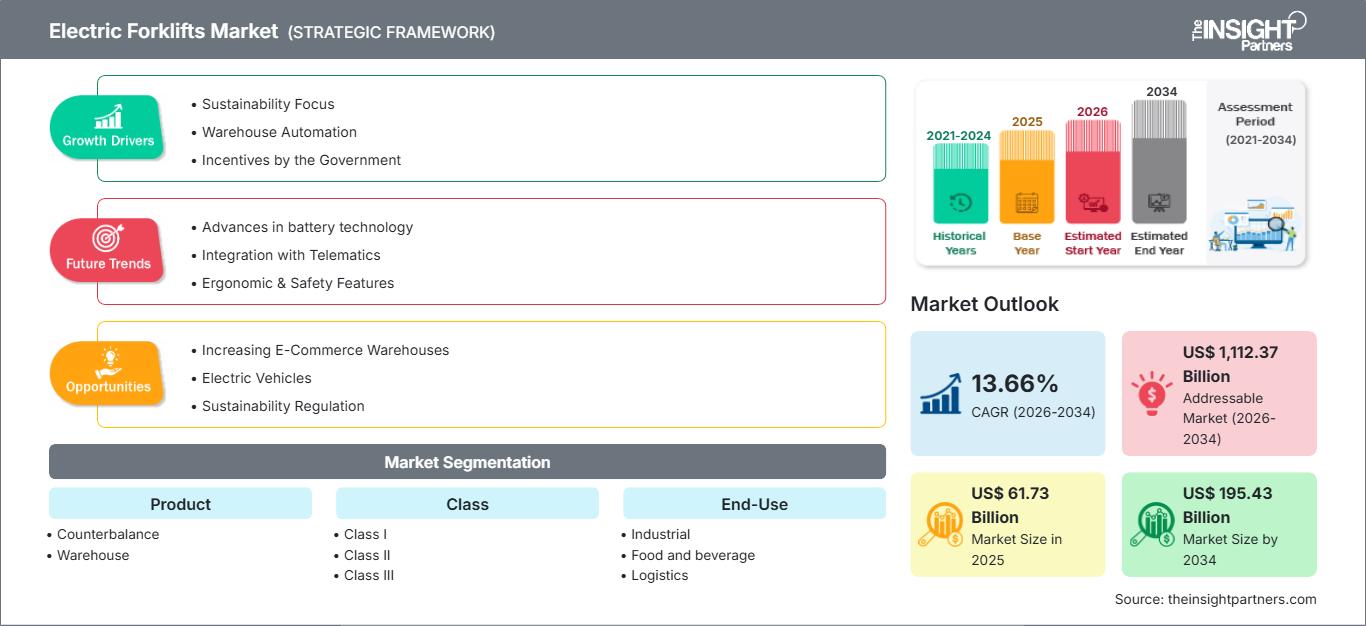
The electric forklifts market was valued at US$ 61.73 Billion in 2025 and is projected to reach US$ 195.43 Billion by 2034, registering a CAGR of 13.66% during 2026–2034. Demand is being shaped by fleet electrification, indoor air-quality rules, lower lifecycle energy costs, and rising throughput requirements across manufacturing, logistics, retail distribution, cold-chain handling, and e-commerce fulfillment operations.
Across North America, procurement teams are shifting toward lithium-ion, telematics-enabled, and warehouse-compatible lift trucks as labor constraints and clean-equipment policies reshape fleet decisions. The electric forklifts market size in the region is expected to expand at an estimated CAGR range of 12.8–13.4% during 2026–2034, supported by e-commerce distribution density, food-grade warehousing, and the replacement of internal-combustion trucks in indoor operations.
Electric Forklifts Market Assessment and Insights
- North America accounted for 27–30% share in 2025 and is expected to grow at a CAGR of 12.8–13.4% between 2026–2034, driven by warehouse automation, stricter emissions rules, and replacement demand.
- US represented 77–81% of North America in 2025 and is projected to grow at a CAGR of 12.9–13.5% between 2026–2034, led by 3PL and retail distribution.
- Europe held 20–23% share in 2025 and is forecast to grow at a CAGR of 12.2–12.9% between 2026–2034, with Germany, the UK, France, Italy, and Spain leading adoption.
- Asia Pacific captured 39–42% share in 2025 and is expected to grow at a CAGR of 14.1–14.8% between 2026–2034, supported by China, Japan, South Korea, India, and Australia.
- Largest Segment Industrial end-use held 34–38% market share in 2025 and is projected to grow at a CAGR of 12.9–13.6% during 2026–2034, supported by plant electrification.
- High-Growth Segment Retail and E-commerce held 16–19% market share in 2025 and is forecast to grow at a CAGR of 15.0–15.8% during 2026–2034, driven by fulfillment density.
- Key companies analyzed in detail: Toyota Material Handling, KION GROUP AG, Jungheinrich AG, Mitsubishi Logisnext Co., Ltd., Crown Equipment Corporation, Anhui Heli Co., Ltd., Komatsu Ltd., Hangcha Group Co., Ltd., Hyster-Yale Materials Handling, Inc., and Doosan Industrial Vehicle America Corp.
Source: The Insight Partners' analysis based on proprietary research, government publications, company annual reports, investor presentations, industry databases, and expert interviews.
Technological migration will redefine the marketplace through the migration from lead-acid to lithium-ion batteries, AC drive systems, regenerative braking, on-board diagnostics, and vehicle telematics technology. The dynamics in production are changing, as well, with Asian producers focusing on building battery-equipped trucks, and European and Japanese automotive producers prioritizing safety features, automation integration possibilities, and service network capabilities under intensive use conditions. It will bring performance closer to internal combustion engines in the case of indoor and mixed-use.
In terms of future investments, the focus will be on high-volume warehousing, food-grade material handling, cold chain logistics, and new industrial clusters in India, Southeast Asia, and the Middle East regions. The regulatory support of low-emission logistics vehicles, net-zero procurement policies, and improvements in powertrain efficiency will make trucks more common than just in the premium fleets. The next stage of the market will require suppliers to offer integrated charging, maintenance, and specialized truck design solutions.
Electric Forklifts Market Report Scope
| Report Attribute | Details |
|---|---|
| Market size in 2025 | US$ 61.73 Billion |
| Market Size by 2034 | US$ 195.43 Billion |
| Global CAGR (2026 - 2034) | 13.66% |
| Historical Data | 2021-2024 |
| Forecast period | 2026-2034 |
Electric Forklifts Market Analysis
The electric forklifts market growth is anchored in three demand layers: replacement of diesel and LPG trucks, new warehouse capacity, and automation-ready intralogistics. Manufacturers are focusing on the machines that require minimal air exchange, provide multi-shift operation capacity, and narrow aisle compatibility. The technology of lithium-ion charging, low maintenance, and steady electricity prices is making purchase decisions based not on purchase cost but rather on life-cycle productivity.
The value chain consists of OEM, battery manufacturer, charger company, rental fleet, dealer, automation integration, and warehouse software provider. Supply trends continue to be defined by cell supply, regional taxes, and local assembly. Businesses that have an integrated service network are able to assure uptime for the highest utilization clients, while small companies tend to go for standardized machines and leasing.
According to the electric forklifts market analysis, it is a highly competitive market dominated by Toyota Material Handling, KION GROUP AG, Jungheinrich AG, Mitsubishi Logisnext Co., Ltd., Crown Equipment Corporation, Anhui Heli Co., Ltd., Komatsu Ltd., Hangcha Group Co., Ltd., Hyster-Yale Materials Handling, Inc., and Doosan Industrial Vehicle America Corp. Positioning is based on product lines, distribution, lithium-ion compatibility, and automated material handling.
Investment trends involve high voltage counterbalance forklifts, smaller sizes for warehouses, connectivity of diagnostic systems, and an ecosystem of chargers. Global players protect their premium customers with contractual services and data analytics solutions, whereas Chinese players rely on competitive pricing and volume exports in lithium-powered machines.
● REPORT CUSTOMIZATION
Tailor This Report To Align With Your Specific Business Requirements
This report can be customized to align precisely with your business objectives, scope, and target markets. Customization options include tailored segmentation, geography, competitive analysis, and strategic insights to support informed decision-making.
Customize This Report →WHAT YOU CAN ADJUST
- ● Segmentations
- ● Geography
- ● Competitive Analysis
- ● Language Preferences
Electric Forklifts Market: Strategic Insights
Regional Insights
North America electric forklifts market
North America held 27–30% share in 2025 and is expected to grow at a CAGR of 12.8–13.4% during 2026–2034. The electric forklifts market share in the region is supported by indoor emissions compliance, food and beverage warehousing, cold-chain expansion, and investments in omnichannel distribution centers requiring cleaner, quieter, and more maneuverable lift equipment.
Fleet replacement is accelerating as operators compare battery uptime, charger placement, maintenance labor, and ventilation costs against conventional forklifts. Larger 3PLs are adopting telematics and lithium-ion fleets to reduce downtime, while mid-sized warehouses are using rental and leasing structures to manage upfront capital. Demand is strongest in retail distribution, manufacturing plants, grocery logistics, and temperature-controlled storage.
U.S. Electric Forklifts Market
The U.S. represented 77–81% of North America in 2025 and is projected to grow at a CAGR of 12.9–13.5% during 2026–2034. High levels of distribution density, rising costs of labor, and ongoing investments into e-commerce fulfillment operations are encouraging fleet owners to move towards electric counterbalance trucks, Class II reach trucks, and Class III pallet trucks.
Toyota Material Handling, Crown Equipment Corporation, Hyster-Yale Materials Handling, Inc., KION GROUP AG, Jungheinrich AG, and Mitsubishi Logisnext Co., Ltd. have excellent visibility through their dealer networks, availability of parts, and fleets. Application trends are focused on grocery distribution centers, parcel distribution centers, automotive component facilities, pharma facilities, and fast-paced retail warehouse facilities.
Europe Electric Forklifts Market
Europe accounted for 20–23% share in 2025 and is forecast to grow at a CAGR of 12.2–12.9% during 2026–2034. Germany remains the leading country, supported by automotive, machinery, chemical, and high-bay warehouse demand. The UK is adopting electric fleets for retail distribution and ports, helped by urban logistics and clean-air expectations.
France, Italy, and Spain show rising demand in food processing, manufacturing, and export logistics, although fleet modernization varies by capital availability and facility age. KION GROUP AG, Jungheinrich AG, and Toyota Material Handling benefit from regional manufacturing depth and service reach. Adoption increasingly favors lithium-ion configurations that support opportunity charging and lower maintenance in multi-shift operations.
APAC Electric Forklifts Market
APAC held 39–42% share in 2025 and is expected to grow at a CAGR of 14.1–14.8% during 2026–2034. China leads regional adoption through manufacturing scale, battery supply, and warehouse electrification, while Japan and South Korea prioritize automation-ready fleets for precision industries.
India and Australia are scaling demand through retail logistics, ports, mining support, and third-party warehousing. Policy attention to emissions, factory safety, and energy efficiency supports the market expansion. Hangcha Group Co., Ltd., Anhui Heli Co., Ltd., Toyota Material Handling, and Mitsubishi Logisnext Co., Ltd. are central to regional supply competition.
Middle East & Africa Electric Forklifts Market
The Middle East and Africa are projected to grow at a CAGR of 11.6–12.4% during 2026–2034, with Saudi Arabia leading regional demand. Logistics zones, ports, food storage, and infrastructure projects are increasing the need for electric handling equipment that supports lower emissions and safer indoor operations.
The UAE is investing in high-efficiency warehousing around trade corridors, while South Africa shows demand from mining support, retail distribution, and manufacturing. The rest of MEA adoption remains project-led, with charging infrastructure and service availability determining pace. Suppliers with rental options and ruggedized equipment will capture early fleet conversion opportunities.
Segmentation Analysis
Product
Product is expected to grow at a CAGR of 13.1–13.8% during 2026–2034. The electric forklifts market scope across product types reflects diverging requirements between heavy load movement and space-constrained warehousing. Counterbalance units remain essential for manufacturing and yard-linked operations, while warehouse models benefit from dense storage, rapid order picking, and automation-compatible layouts.
- Counterbalance trucks remain critical in manufacturing plants, loading docks, and mixed indoor-outdoor sites where operators require stability, lifting capacity, and flexibility across pallets, containers, and production materials.
- Warehouse products are gaining strategic importance in fulfillment centers, grocery distribution, and high-density storage environments where compact turning, efficient picking, and lower aisle widths directly improve throughput.
Class
Class is projected to grow at a CAGR of 13.3–14.0% during 2026–2034. Class selection is increasingly tied to warehouse design, load profile, operator availability, and charging strategy. Class I supports heavier electric counterbalance applications, Class II addresses narrow-aisle storage efficiency, and Class III serves high-frequency pallet movement in retail and logistics networks.
- Class I remains important for heavier indoor handling, especially in manufacturing, automotive, and chemical facilities requiring electric rider trucks with lifting power and predictable energy consumption.
- Class II supports narrow-aisle and reach-truck applications where high storage density, vertical lift capability, and warehouse space optimization are central to operating economics.
- Class III is widely used for pallet trucks and walkie units in retail, grocery, and e-commerce facilities where short-distance movement and frequent loading cycles dominate demand.
End-Use
End-Use is expected to grow at a CAGR of 13.6–14.3% during 2026–2034. Adoption patterns differ by uptime intensity, hygiene needs, emissions sensitivity, and distribution velocity. Industrial facilities lead absolute demand, while retail and e-commerce, food and beverage, logistics, and chemicals increasingly prioritize electric equipment for compliance, safety, and productivity.
- Industrial users remain the largest base because factories, component plants, and assembly lines require dependable load handling, cleaner indoor movement, and fleet standardization across production shifts.
- Food and beverage operators value electric units for hygiene-sensitive warehouses, cold rooms, and packaging lines where low noise, zero tailpipe emissions, and predictable maintenance are operational priorities.
- Logistics demand is shaped by 3PL networks, parcel hubs, and cross-docks, where uptime, compact layouts, charger access, and rapid pallet movement determine fleet productivity.
- Retail and e-commerce are the fastest-growing end-use sectors as fulfillment centers, dark stores, and omnichannel distribution sites require agile equipment for high-frequency picking and replenishment.
- Chemical facilities adopt electric forklifts to reduce indoor combustion risks, support regulated handling areas, and improve control in packaged chemicals, specialty materials, and plant logistics.
Opportunity Snapshot
| Segment Name | Revenue Contribution | Trend Tag | Adoption Stage |
| Industrial | High | Plant Electrification | Mature |
| Food and beverage | Medium | Cold Chain | Scaling |
| Logistics | High | Fleet Telematics | Scaling |
| Retail and E-commerce | High | Fulfillment Density | Scaling |
| Chemical | Medium | Safe Handling | Scaling |
| Others | Low | Selective Use | Emerging |
Electric Forklifts Market Growth Drivers and Impact Analysis
Warehouse Electrification and Indoor Emissions Compliance
The indoor logistics industry is moving away from the use of combustion forklifts as a result of ventilation concerns, employee exposure issues, and sustainability reporting requirements affecting the selection of equipment. Electric trucks minimize tailpipe emissions within manufacturing plants, food storage facilities, and warehouses, making it easier to meet air quality objectives without the need for exhaust systems. This trend is most notable within companies that have shift work going on around the clock as a result of operational savings through reduced maintenance and oil changes.
Lithium-Ion Charging Improves Fleet Utilization
Lithium-ion adoption is changing fleet economics by enabling opportunity charging, shorter recharge windows, and reduced battery maintenance compared with legacy lead-acid systems. High-utilization warehouses benefit because trucks can recharge during breaks instead of requiring battery swaps, spare battery rooms, and watering routines. This improves uptime, reduces labor intervention, and supports continuous movement in e-commerce, grocery, and manufacturing environments. Battery management systems also improve visibility into health, charge status, and duty-cycle suitability. These advantages are expanding the electric forklifts market penetration among operators that previously considered electric fleets unsuitable for demanding multi-shift applications.
Automation-Ready Intralogistics Raises Equipment Standards
Modern warehouses need machinery that can interface with the fleet software, charging infrastructure, safety systems, and other automated material storage processes. Electric forklifts are more in line with all this since electronics, regeneration, telematics, and precise maneuvering are much easier in an electric platform than in a mechanical combustion one. Drivers are utilizing data to keep track of their impacts, speed, downtime, and maintenance needs. This drives up the expectations of the customers from both OEMs and dealers and leads to competitive dynamics revolving around connectivity and software compatibility, among others.
Electric Forklifts Market Future Trends
High-Voltage Electric Counterbalance Platforms
One of the most important electric forklift market trends is the move toward high-voltage counterbalance platforms that can replace internal-combustion models in heavier-duty cycles. Future products will combine larger lithium packs, faster DC charging, advanced thermal management, and stronger drive systems for outdoor yards, loading docks, and manufacturing campuses. This trend will widen the addressable base for electric fleets by reducing the performance compromise in applications that demand higher lift capacity, gradeability, and continuous operation. Suppliers that validate reliability in rugged environments will gain credibility with conservative industrial buyers.
Fleet Intelligence and Predictive Service Models
Customer expectations of uptime, safety, and energy efficiency will be one of the major differentiators in the future through fleet intelligence. Data about charge cycles, impacts, usage, motor load, and operator activity of electric forklift trucks will enable a shift from planned to predicted maintenance. Eventually, buying considerations will involve software-based dashboards, battery analysis, charger efficiency, and dealer reaction time. This is going to help in creating an edge for those OEMs and distributors who can leverage the data into reduced downtime, better safety, and asset planning.
Electric Forklifts Market Opportunities
Charging Infrastructure Bundles for Multi-Shift Warehouses
Suppliers can capture value by bundling trucks, chargers, energy audits, battery monitoring, and financing for facilities converting entire fleets. Many warehouses hesitate because power capacity, charger placement, and downtime planning are complex. Turnkey packages reduce implementation risk and convert electrification into an operational project rather than an equipment purchase. The strongest electric forklift market forecasts point to multi-shift logistics, food distribution, and retail fulfillment as priority targets because charging design directly affects productivity. Dealers that provide site assessment and lifecycle costing will improve conversion rates.
Emerging Market Fleet Modernization Programs
There are many industrial markets that are emerging with potential for standardization of electric vehicles since their current fleet of diesel trucks is dominant in the logistics industry of warehousing, port, and manufacturing facilities. Markets like India, Southeast Asia, the Gulf and some African countries are growing in their logistics capacities but under pressure to enhance safety and efficiency in terms of energy consumption. It is important for OEMs to come up with models that are durable enough and have the right partnerships on maintenance and financial structures.
Recent Developments
- March 2026: Jungheinrich AG — introduced new electric forklift developments, including a 5-tonne high-voltage counterbalance prototype, refreshed 48 V and 400 V ranges, and the AntOn entry portfolio for standardized availability. The launches target diesel replacement, faster DC charging, and broader distribution access across warehouse and industrial applications.
- January 2025: Toyota Material Handling — expanded its portfolio with Integrated Mid and Large Electric Pneumatic Forklifts and a refreshed Core Electric Forklift series. The pneumatic models offer 8,000-to-17,500 pound capacities with integrated lithium-ion batteries, while the Core refresh targets indoor applications in retail, manufacturing, and food handling.
Frequently Asked Questions

- Comprehensive Market Sizing and Forecast Analysis
- Detailed Segmentation Analysis
- In-Depth Market Dynamics Assessment
- Regional and Country-Level Insights
- Competitive Landscape and Company Benchmarking
- Strategic Business Intelligence
Recent Reports
Testimonials

The Insight Partners provided valuable market intelligence that supported our global go-to-market strategy. Their team was professional, responsive, and attentive to our feedback, providing thoughtful analysis and helpful methodological clarifications throughout the project.
Junmo Kim Chief Financial Officer (CFO), Enertech Co., Ltd.
The Insight Partners' SCADA System Market report is comprehensive, with valuable insights on current trends and future forecasts. The team was highly professional, responsive, and supportive throughout. We are very satisfied and highly recommend their services.
RAN KEDEM Partner, Reali Technologies LTDs
I requested a report on a very specific software market and the team produced the report in a few days. The information was very relevant and well presented. I then requested some changes and additions to the report. The team was again very responsive and I got the final report in less than a week.
JEAN-HERVE JENN Chairman, Future Analytica
We worked with The Insight Partners for an important market study and forecast. They gave us clear insights into opportunities and risks, which helped shape our plans. Their research was easy to use and based on solid data. It helped us make smart, confident decisions. We highly recommend them.
PIYUSH NAGPAL Sr. Vice President, High Beam Global
The Insight Partners delivered insightful, well-structured market research with strong domain expertise. Their team was professional and responsive throughout. The user-friendly website made accessing industry reports seamless. We highly recommend them for reliable, high-quality research services
YUKIHIKO ADACHI CEO, Deep Blue, LLC.
This is the first time I have purchased a market report from The Insight Partners.While I was unsure at first, I visited their web site and felt more comfortable to take the risk and purchase a market report.I am completely satisfied with the quality of the report and customer service. I had several questions and comments with the initial report, but after a couple of dialogs over email with their analyst I believe I have a report that I can use as input to our strategic planning process.Thank you so much for taking the extra time and making this a positive experience.I will definitely recommend your service to others and you will be my first call when we need further market data.
JOHN SUZUKI President and Chief Executive Officer, Board Director, BK Technologies
I wish to appreciate your support and the professionalism you displayed in the course of attending to my request for information regarding to infectious disease IVD market in Nigeria. I appreciate your patience, your guidance, and the fact that you were willing to offer a discount, which eventually made it possible for us to close a deal. I look forward to engaging The Insight Partners in the future, all thanks to the impression you have created in me as a result of this first encounter.
DR CHIJIOKE ONYIA MANAGING DIRECTOR, PineCrest Healthcare Ltd.Reason to Buy
- Informed Decision-Making
- Understanding Market Dynamics
- Competitive Analysis
- Identifying Emerging Markets
- Customer Insights
- Market Forecasts
- Risk Mitigation
- Boosting Operational Efficiency
- Strategic Planning
- Investment Justification
- Tracking Industry Innovations
- Aligning with Regulatory Trends





 Get Free Sample for