
Electronic Fluency Device Market Overview, Growth, Trends, Analysis, Research Report (2026-2034)
Coverage: By Type (In-the-ear, Behind the Ear); End User (Hospital, Specialist Clinic, Drug Store, Others), and Geography (North America, Europe, Asia Pacific, and South and Central America)
- Status : Data Released
- Report Code : TIPRE00013715
- Category : Life Sciences
- No. of Pages : 150
- Available Report Formats :


- Last update date : July 17, 2026


2025 Market Size
US$ 1.39 Bn
Base year value
2034 Forecast
US$ 4.23 Bn
Projected by 2034
CAGR 2026-2034
13.16 %
Growth rate
Addressable Market
US$ 24.41 Bn
(2026-2034)
The global Electronic Fluency Device market was valued at US$ 1.39 billion in 2025 and is expected to reach US$ 4.23 billion by 2034; it is estimated to record a CAGR of 13.16% during 2026-2034.
Electronic Fluency Device Market Assessment and Insights
- North America: Accounted for 36–40% electronic fluency device market share in 2025 and is anticipated to expand at a CAGR of 8.8–9.4% during 2026–2034. Strong healthcare expenditure, broad speech therapy infrastructure, and favorable reimbursement policies continue supporting sustained adoption of electronic fluency devices.
- U.S.: Represented 82–86% of the North American market in 2025 and is forecast to register a CAGR of 8.9–9.5% during 2026–2034, supported by increasing clinical adoption, technological innovation, and higher awareness of speech disorders.
- Europe: Held 27–31% share in 2025 and is projected to grow at a CAGR of 8.5–9.1% during 2026–2034. Germany, the UK, and France remain leading markets owing to established healthcare systems and expanding access to speech rehabilitation services.
- Asia Pacific: Captured 21–25% share in 2025 and is expected to record the fastest regional expansion at a CAGR of 10.2–10.8% during 2026–2034. China, Japan, India, and South Korea are driving demand through healthcare modernization and improving awareness.
- Largest Segment: Hospital accounted for a 44–48% market share in 2025 and is anticipated to advance at a CAGR of 8.9–9.5% during 2026–2034, supported by multidisciplinary speech pathology services and greater procurement of advanced assistive technologies.
- High Growth Segment: Behind the Ear devices represented a 52–56% market share in 2025 and are forecast to grow at a CAGR of 9.8–10.4% during 2026–2034 because of superior comfort, longer operational duration, and improved acoustic performance.
- Key companies analyzed in detail: SpeechEasy, Stamma, VoiceAmp (Pty) Ltd, The Cigna Group, Casa Futura Technologies, Teltex, Inc., Innoflaps Remedy Private Limited, The Michaels Companies, Inc., SmallTalk, SpeakFluent.
Source: The Insight Partners' analysis based on proprietary research, government publications, company annual reports, investor presentations, industry databases, and expert interviews.
The advancement in the field of signal processing technology, miniaturization of electronics, and advancements in wearable medical devices have completely revolutionized the market in the past decade. Adaptive delay, frequency-altered feedback, wireless features, and rechargeable batteries will all be integrated into the manufacturing process of manufacturers in order to improve speech fluency and customer experience. The production trends will involve the manufacture of light-weighted items, software platforms which can be tailored and utilized through mobile applications to guarantee clinical acceptance and differentiate product from others in healthcare facilities and rehabilitation centers.
Market growth in the future will be driven by increasing investments in the digital health infrastructure, increased adoption of such devices in emerging healthcare marketplaces of Asia, and the development of artificial intelligence in speech assistance technology. The development of solutions for accessibilities, the rise in the number of tele-rehabilitation programs, and cooperation between manufacturers of medical devices and speech language therapists will facilitate the commercialization of electronic fluency devices.
Electronic Fluency Device Market Report Scope
| Report Attribute | Details |
|---|---|
| Market size in 2025 | US$ 1.39 Billion |
| Market Size by 2034 | US$ 4.23 Billion |
| Global CAGR (2026 - 2034) | 13.16% |
| Historical Data | 2021-2024 |
| Forecast period | 2026-2034 |
Electronic Fluency Device Market Analysis
Developmental stuttering cases, neurological speech disorders, and communication impairment will continue to be responsible for the ongoing demand for hospital visits, specialty clinics, and rehabilitation centers. Increasing awareness campaigns undertaken by the speech-language organizations have resulted in increasing early detection and treatment through an increasing amount of healthcare expenditures invested in technological interventions. It is clear from the analysis of the electronic fluency device that the use of the wearable technology providing Delayed Auditory Feedback and Frequency Altered Feedback remains highly attractive, since it serves more as a complement to traditional speech therapy rather than a competitor to it, hence providing enhanced results through continuous use.
The value chain consists of component manufacturers, software developers, assemblers of the medical devices, distributors, speech-language therapists, and healthcare organizations. The positive trends for the suppliers include increased focus on integration of sophisticated electronics processors, ergonomics, and wireless communications, among other factors. Continuous investment into product quality and clinical support post purchase increases competitive advantages, leading to increased market size.
The level of competition in the electronic fluency device industry is relatively concentrated, with established players focusing on innovation and clinical evidence. The electronic fluency device market report focuses on key players including SpeechEasy, Casa Futura Technologies, VoiceAmp (Pty) Ltd, Teltex, Inc., and Innoflaps Remedy Private Limited continue improving the devices’ performance with better digital signal processing abilities and ergonomic designs of their products. Geographic market expansion is achieved by expanding distribution networks and partnership with speech therapists.
Investments are currently made in areas such as artificial intelligence-driven analysis of speech, cloud-based integration into therapy processes, compatibility with smartphones, and personalization of the sound processing algorithms. Companies like Stamma continue helping in awareness campaigns that indirectly help the market, while healthcare organizations such as The Cigna Group help increase the availability of speech therapy. Product differentiation, regulation, and clinical proof are key competitive elements of positioning in the Electronic Fluency Device industry.
● REPORT CUSTOMIZATION
Tailor This Report To Align With Your Specific Business Requirements
This report can be customized to align precisely with your business objectives, scope, and target markets. Customization options include tailored segmentation, geography, competitive analysis, and strategic insights to support informed decision-making.
Customize This Report →WHAT YOU CAN ADJUST
- ● Segmentations
- ● Geography
- ● Competitive Analysis
- ● Language Preferences
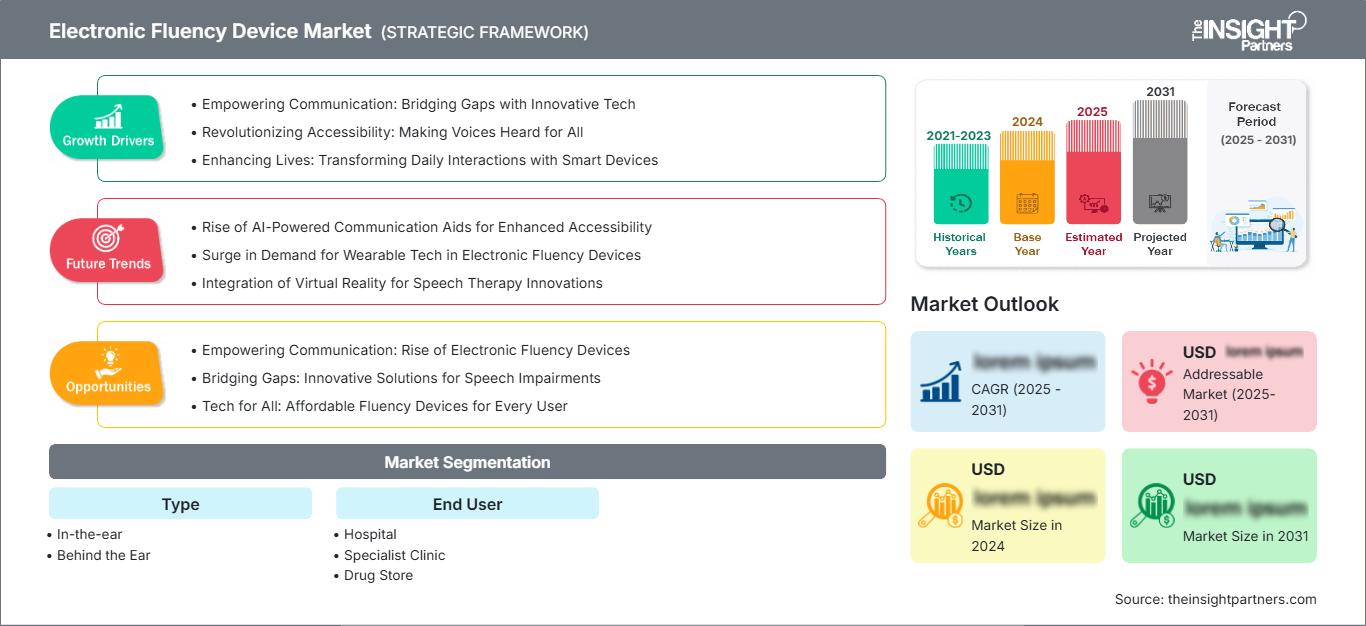
Electronic Fluency Device Market: Strategic Insights
Regional Insights
North America Electronic Fluency Device Market
North America accounted for 36–40% of the global electronic fluency device market in 2025 and is projected to expand at a CAGR of 8.8–9.4% during 2026–2034. The region benefits from high diagnosis rates of speech disorders, strong reimbursement frameworks, and widespread availability of speech-language pathology services. Healthcare providers increasingly incorporate wearable fluency devices alongside behavioral therapy to improve treatment effectiveness and long-term patient adherence.
Demand continues to rise as hospitals and specialist clinics invest in digital rehabilitation technologies that support personalized speech therapy. Greater acceptance of telehealth, favorable regulatory pathways for assistive medical devices, and continuous product innovation are encouraging adoption across pediatric and adult patient populations. Public awareness initiatives, collaborations between clinicians and technology developers, and ongoing clinical research further reinforce North America's leadership within the Electronic Fluency Device Market.
U.S. Electronic Fluency Device Market
The U.S. represented 82–86% of the electronic fluency device market in North America in 2025 and is anticipated to register a CAGR of 8.9–9.5% during 2026–2034. Strong healthcare expenditure, established reimbursement systems, and broad availability of certified speech-language pathologists create favorable conditions for electronic fluency device adoption. Hospitals, rehabilitation centers, and specialist clinics continue integrating advanced assistive communication technologies into multidisciplinary treatment pathways.
Domestic demand is further supported by increasing awareness of developmental stuttering, technological innovation, and the presence of leading medical device distributors. Healthcare providers increasingly recommend wearable delayed auditory feedback devices as complementary solutions to speech therapy, particularly for long-term patient management. Continuous investment in digital health, supportive insurance coverage, and expanding tele-rehabilitation services are factors supporting the electronic fluency device market forecast estimates.
Europe Electronic Fluency Device Market
Europe held 27–31% of the global electronic fluency device market in 2025 and is projected to expand at a CAGR of 8.5–9.1% during 2026–2034. Germany remains the leading national market because of advanced rehabilitation infrastructure, strong medical device manufacturing capabilities, and consistent investment in speech-language pathology services.
The UK market continues demonstrating steady demand as the National Health Service and private rehabilitation providers increase access to speech therapy for children and adults. Growing awareness of assistive communication technologies, favorable clinical guidelines, and expanding telehealth adoption contribute to sustained market expansion while encouraging greater use of wearable electronic fluency devices.
France, Italy, and Spain collectively represent an important regional growth cluster driven by healthcare modernization, improved patient access to rehabilitation services, and rising investment in digital medical technologies. Public healthcare initiatives supporting early intervention for speech disorders and increased collaboration between hospitals and rehabilitation specialists are expected to strengthen long-term adoption across Southern Europe.
APAC Electronic Fluency Device Market
Asia Pacific accounted for 21–25% of the global market in 2025 and is expected to register a CAGR of 10.2–10.8% during 2026–2034. China leads regional demand through expanding healthcare investment and growing rehabilitation infrastructure.
Japan and South Korea continue adopting advanced wearable assistive technologies supported by mature healthcare systems and strong digital health capabilities.
India and Australia are witnessing rising awareness of speech disorders, increasing specialist availability, supportive healthcare policies, and expanding private rehabilitation services, creating attractive long-term opportunities for manufacturers.
Middle East & Africa Electronic Fluency Device Market
The Middle East & Africa electronic fluency device market is anticipated to expand at a CAGR of 8.0–8.6% during 2026–2034. Saudi Arabia continues leading regional demand through healthcare modernization initiatives and investment in rehabilitation facilities.
The United Arab Emirates benefits from increasing adoption of digital healthcare technologies, while South Africa demonstrates gradual expansion supported by improving access to speech-language therapy services.
The remaining MEA countries continue strengthening healthcare infrastructure and specialist care capacity. Expanding rehabilitation services, greater awareness of communication disorders, and sustained healthcare investment are expected to support gradual market development throughout the forecast period.
Segmentation Analysis
Type
The type segment in electronic fluency device market is projected to register a CAGR of 9.4–10.0% during 2026–2034. Product innovation continues to focus on improving speech fluency, comfort, battery efficiency, and digital signal processing capabilities. Manufacturers increasingly develop compact wearable devices with programmable settings that support personalized therapy approaches while enhancing long-term patient compliance across different age groups.
- In-the-ear: Compact designs provide discreet daily use and appeal to users seeking minimal visibility. Continued improvements in miniaturized electronics and customizable sound processing support increasing adoption among patients requiring convenient long-term speech assistance.
- Behind the Ear: Behind-the-ear devices remain the preferred configuration because they accommodate larger batteries, advanced processors, and enhanced acoustic performance. Their ergonomic design, durability, and programmable features make them well suited for extended therapeutic applications.
End User
The End User segment is expected to expand at a CAGR of 9.0–9.6% during 2026–2034. Growing integration of assistive communication technologies into multidisciplinary treatment pathways continues supporting demand across healthcare institutions and specialized rehabilitation providers. Increased awareness, earlier diagnosis, and expanding reimbursement coverage further strengthen adoption across both public and private healthcare settings.
- Hospital: Hospitals remain the leading end-user category owing to comprehensive diagnostic capabilities, multidisciplinary speech rehabilitation services, and procurement of advanced assistive devices. Integration with neurological rehabilitation programs further supports sustained institutional demand.
- Specialist Clinic: Specialist clinics increasingly recommend wearable electronic fluency devices as complementary solutions alongside individualized speech therapy. Their focused expertise, personalized treatment planning, and long-term patient monitoring contribute to growing utilization across outpatient settings.
- Drug Store: Drug stores primarily support product accessibility through prescription fulfillment and distribution partnerships with manufacturers. Growing retail healthcare services and improved patient awareness are gradually strengthening this channel's strategic importance for device availability.
Opportunity Snapshot
| End User | Revenue Contribution | Trend Tag | Adoption Stage |
| Hospital | High | Clinical Integration | Mature |
| Specialist Clinic | High | Personalized Therapy | Scaling |
| Drug Store | Medium | Retail Access | Emerging |
Electronic Fluency Device Market Growth Drivers and Impact Analysis
Growing diagnosis rates of speech and fluency disorders
The increasing number of cases of developmental stuttering, neurological speech disorders, and communication problems has created high demand for electronic fluency devices within healthcare systems around the world. Enhanced screening programs in educational institutions, higher awareness levels on behalf of the caregivers, and easy availability of speech-language pathologists are contributing towards the process of early detection. The healthcare professionals are recommending electronic fluency devices together with behavior therapy for better speech regularity in everyday conversations. This comprehensive strategy will ensure better results for patients while ensuring clinical acceptance of the device. Due to the focus of healthcare systems on early detection and rehabilitation of patients, there is an increasing need for adaptive devices catering to all age groups and severity of cases. This expansion of the patient pool will drive the electronic fluency device market growth during the forecast period.
Advances in digital signal processing and wearable device design
Innovations made in digital electronics have been playing a crucial role in enhancing the efficiency and usability of electronic fluency devices. The current models of such devices are equipped with the following features – programmable delayed auditory feedback, frequency-altered feedback, wireless capabilities, rechargeable batteries, as well as ergonomic design making their usage more comfortable for patients. Advanced processors facilitate improved sound modulations, whereas mobility apps make it possible for clinicians to adjust the treatment parameters remotely. Thus, thanks to these innovations, users become more receptive of such devices. Besides, manufacturers are developing durable software upgrades and compact devices that retain all of their performance abilities. With continuous technological advancements, more advanced devices will eventually replace old-fashioned technologies.
Expansion of digital rehabilitation and telehealth services
With rapid advancement of digital health care ecosystems, speech rehabilitation is becoming more accessible for people from underprivileged or geographically scattered regions. Through telemedicine applications, speech language pathologists will be able to track the progression of treatment, make necessary changes in therapy programs, as well as fine-tune electronic fluency device settings without the need for constant visits. Moreover, integration with remote monitoring systems will promote better patient involvement in rehabilitation processes and adherence to the assigned therapy program. Digital infrastructure development in order to make rehabilitation more available and reduce costs of its delivery is being financed by governments and healthcare organizations. Increased acceptance of virtual care solutions will result in increased demand for electronic fluency devices which support connected care environments.
Electronic Fluency Device Market Future Trends
Artificial intelligence enabling personalized speech assistance
AI is anticipated to revolutionize the electronic fluency device market trends through personalized adaptation of speech processing based on each user’s unique patterns of speech and therapy results. Algorithms of machine learning would be able to identify the speech parameters in real time and adjust the audio feedback configuration to increase the efficiency of communication. Future electronic fluency devices will probably have the ability to perform predictive analysis, synchronize data with the cloud, and include dashboards for clinicians that provide evidence-based therapy adjustment possibilities. This would ensure not only more customization but also generate valuable information for further rehabilitation process. With growing regulatory approval and clinical trust in AI-based healthcare solutions, manufacturers of such intelligent software would be able to create more competitive products.
Connected ecosystems integrating mobile health platforms
The future developments in the field are likely to see the importance of the connectivity between wearable electronic fluency devices, mobile phones, clouds and tele-rehabilitation systems. The patients will gain from automated therapy reminders, monitoring of the progress made, software updates from distance and secure contact with the healthcare professionals through a unified digital ecosystem. There will be increasing emphasis on interoperable medical technology that would allow healthcare institutions to be more connected to other elements of the digital healthcare environment. In the wake of evolving interoperability standards, the manufacturers who will offer secure, connected and scalable speech assistance products will reap from increased opportunities in healthcare.
Electronic Fluency Device Market Opportunities
Expanding access across emerging healthcare markets
Rapid healthcare infrastructure development across Asia Pacific, Latin America, and selected Middle Eastern countries presents significant opportunities for electronic fluency device manufacturers. Governments are increasing investments in rehabilitation services, disability inclusion programs, and digital healthcare technologies, creating favorable conditions for broader adoption of assistive communication devices. Rising household incomes, expanding insurance coverage, and growing awareness of speech disorders are also improving patient access to specialized treatment. Manufacturers that establish local distribution partnerships, collaborate with regional rehabilitation centers, and develop cost-effective product portfolios can strengthen their competitive position. Tailoring devices to local reimbursement systems and clinical requirements will further improve commercial success while supporting sustainable long-term expansion across high-potential emerging markets.
Strategic partnerships with rehabilitation providers
Closer collaboration between manufacturers, hospitals, specialist clinics, academic institutions, and speech-language pathology professionals offers substantial opportunities to accelerate market development. Joint clinical studies, professional education programs, and integrated therapy solutions can improve clinician confidence while generating stronger evidence supporting device effectiveness. Healthcare providers increasingly seek comprehensive rehabilitation platforms rather than standalone products, encouraging manufacturers to combine hardware, software, and remote monitoring capabilities within unified care models. Strategic partnerships also facilitate earlier patient referrals, improved training, and wider product availability through institutional procurement channels. Organizations capable of building long-term clinical relationships and demonstrating measurable therapeutic outcomes are expected to strengthen market presence and generate sustainable revenue growth throughout the forecast period.
Recent Developments
- October 2025: STAMMA highlighted new findings from its accessibility initiative demonstrating barriers experienced by people who stammer when interacting with automated telephone systems. The organization recommended practical improvements to IVR design, speech recognition settings, and staff training to improve accessibility, providing additional evidence supporting demand for speech-assistance technologies and inclusive communication solutions.
- June 2025: Cardiff University published research showing that commercially available smart speakers can complement conventional speech therapy for children with speech difficulties. The findings reinforce growing interest in integrating connected speech technologies with rehabilitation programs, creating a favorable innovation environment for wearable electronic fluency devices and digital speech-assistance solutions.
- March 2025: Researchers from Amrita Institute of Medical Sciences and Research Centre introduced a smartphone-based visual speech feedback technology designed to improve speech production among individuals with hearing impairment. The successful pilot demonstrated the expanding role of digital assistive technologies in speech rehabilitation, supporting continued innovation across the broader speech therapy device ecosystem.
Frequently Asked Questions

- Comprehensive Market Sizing and Forecast Analysis
- Detailed Segmentation Analysis
- In-Depth Market Dynamics Assessment
- Regional and Country-Level Insights
- Competitive Landscape and Company Benchmarking
- Strategic Business Intelligence
Recent Reports
Testimonials

The Insight Partners provided valuable market intelligence that supported our global go-to-market strategy. Their team was professional, responsive, and attentive to our feedback, providing thoughtful analysis and helpful methodological clarifications throughout the project.
Junmo Kim Chief Financial Officer (CFO), Enertech Co., Ltd.
The Insight Partners' SCADA System Market report is comprehensive, with valuable insights on current trends and future forecasts. The team was highly professional, responsive, and supportive throughout. We are very satisfied and highly recommend their services.
RAN KEDEM Partner, Reali Technologies LTDs
I requested a report on a very specific software market and the team produced the report in a few days. The information was very relevant and well presented. I then requested some changes and additions to the report. The team was again very responsive and I got the final report in less than a week.
JEAN-HERVE JENN Chairman, Future Analytica
We worked with The Insight Partners for an important market study and forecast. They gave us clear insights into opportunities and risks, which helped shape our plans. Their research was easy to use and based on solid data. It helped us make smart, confident decisions. We highly recommend them.
PIYUSH NAGPAL Sr. Vice President, High Beam Global
The Insight Partners delivered insightful, well-structured market research with strong domain expertise. Their team was professional and responsive throughout. The user-friendly website made accessing industry reports seamless. We highly recommend them for reliable, high-quality research services
YUKIHIKO ADACHI CEO, Deep Blue, LLC.
This is the first time I have purchased a market report from The Insight Partners.While I was unsure at first, I visited their web site and felt more comfortable to take the risk and purchase a market report.I am completely satisfied with the quality of the report and customer service. I had several questions and comments with the initial report, but after a couple of dialogs over email with their analyst I believe I have a report that I can use as input to our strategic planning process.Thank you so much for taking the extra time and making this a positive experience.I will definitely recommend your service to others and you will be my first call when we need further market data.
JOHN SUZUKI President and Chief Executive Officer, Board Director, BK Technologies
I wish to appreciate your support and the professionalism you displayed in the course of attending to my request for information regarding to infectious disease IVD market in Nigeria. I appreciate your patience, your guidance, and the fact that you were willing to offer a discount, which eventually made it possible for us to close a deal. I look forward to engaging The Insight Partners in the future, all thanks to the impression you have created in me as a result of this first encounter.
DR CHIJIOKE ONYIA MANAGING DIRECTOR, PineCrest Healthcare Ltd.Reason to Buy
- Informed Decision-Making
- Understanding Market Dynamics
- Competitive Analysis
- Identifying Emerging Markets
- Customer Insights
- Market Forecasts
- Risk Mitigation
- Boosting Operational Efficiency
- Strategic Planning
- Investment Justification
- Tracking Industry Innovations
- Aligning with Regulatory Trends





 Get Free Sample for