
ENT Microscopes Market Growth, Trends & Forecast by 2034
Coverage: By Product Type (Wall Mount, Casters, Ceiling Mount); Type (Surgical, Examination); End User (Hospitals, Specialty Clinics, Ambulatory Surgical Centers), and Geography (North America, Europe, Asia Pacific, and South and Central America)
- Status : Data Released
- Report Code : TIPRE00019714
- Category : Life Sciences
- No. of Pages : 150
- Available Report Formats :


- Last update date : November 03, 2026


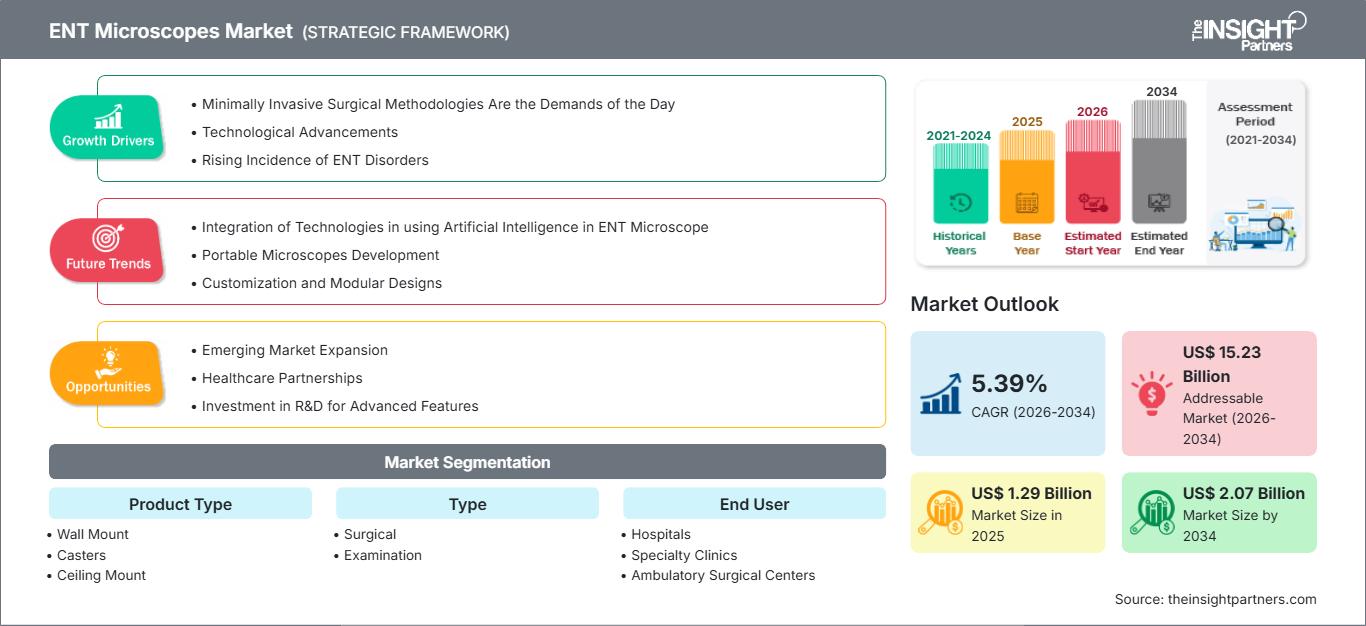
2025 Market Size
US$ 1.29 Bn
Base year value
2034 Forecast
US$ 2.07 Bn
Projected by 2034
CAGR 2026-2034
5.39 %
Growth rate
Addressable Market
US$ 15.23 Bn
(2026-2034)
The ent microscopes market was valued at US$ 1.29 Billion in 2025 and is projected to reach US$ 2.07 Billion by 2034, expanding at a CAGR of 5.39% from 2026 to 2034. Growth is supported by increasing demand for high-precision visualization in otologic and head-and-neck procedures, replacement of aging optical systems, improved illumination and imaging, and wider adoption of digitally integrated surgical environments.
North America remains a mature demand center for the ent microscopes market, with a modeled CAGR of ~5% through 2034. Replacement purchasing in established hospitals, continued investment in specialty surgical infrastructure, and demand for ergonomic visualization systems support regional expansion. The region also benefits from established ENT specialist networks and a relatively high concentration of hospitals capable of adopting advanced operating-room technologies.
ENT Microscopes Market Assessment and Insights
Regional Outlook
- North America: ~36% of the global market in 2025 | ~5% CAGR through 2034. Market position: North America holds the largest regional position, supported by established ENT surgical infrastructure, replacement demand, specialist hospitals, and adoption of advanced visualization systems that integrate imaging, documentation, and operating-room workflows.
- US: ~78% of North American market revenue in 2025 | ~5% CAGR through 2034. Market position: The US represents the principal demand center in North America, supported by high-value surgical facilities, specialist ENT practices, ambulatory care expansion, and replacement of mature microscope installations with digitally enabled systems.
- Europe: ~30% of the global market in 2025 | ~4% CAGR through 2034. Market position: Europe has a mature installed base and strong specialist capabilities. Germany leads Europe, while the UK, France, Italy, and Spain contribute through hospital modernization, outpatient care, and replacement of established microscope systems.
- Asia Pacific: ~24% of the global market in 2025 | ~7% CAGR through 2034. Market position: Asia Pacific is the fastest-growing region, driven by hospital capacity expansion, rising specialist procedure volumes, modernization of surgical departments, and increasing availability of advanced visualization technologies across China, Japan, South Korea, India, and Australia.
Segment Outlook
- Surgical: ~68% Share in 2025 | ~6% CAGR through 2034. Market position: Surgical systems lead because ENT operating procedures require stable magnification, depth perception, controlled illumination, and precise instrument visualization. Replacement cycles and demand for advanced otologic and head-and-neck procedures reinforce this position.
- Ambulatory Surgical Centers: ~12% Share in 2025 | ~7% CAGR through 2034. Market position: Ambulatory Surgical Centers represent the highest-growth end-user opportunity as selected ENT procedures migrate toward outpatient settings. Compact systems, efficient room utilization, ergonomic handling, and integrated documentation support this transition.
Competitive Coverage
Danaher Corporation, Olympus Corporation, Carl Zeiss Meditec AG, Labo America, Inc. (Labomed), ATMOS MedizinTechnik GmbH & Co. KG, Seiler Instrument Inc., HAAG-STREIT GROUP, Karl Kaps GmbH & Co. KG, GAES, M.I One Co., Ltd.
Methodology
The Insight Partners follows Data Collection & Secondary Research, Primary Research, Data Analysis, and Data Triangulation & Final Review to validate market estimates and insights.
Source: The Insight Partners' analysis based on proprietary research, government publications, company annual reports, investor presentations, industry databases, and expert interviews.
The ent microscopes market has evolved from predominantly optical operating instruments toward integrated visualization platforms combining precision optics, high-intensity LED illumination, digital cameras, ergonomic positioning, and documentation capabilities. In light of the nature of ENT operations, manufacturers have been focusing on depth of field, image clarity, thermal efficiency, and comfort of the surgeons. Consequently, product design is now moving away from magnification and towards comprehensive visualizing solutions that include examination, microsurgery, education, documentation, and data communication processes.
For future demand growth, expansion into emerging healthcare systems is projected to increase the total available market potential. Hospitals in the Asia Pacific region and select Middle East markets are building specialized surgical capabilities, while mature European and North American systems will emphasize upgrading. Infection control, quality, electrical safety, and interoperability regulations will also impact purchasing decisions. This will benefit providers that are able to integrate optical performance with infrastructure capability and installable configuration options. The ENT Microscopes Market Share is expected to be shaped by these trends as healthcare providers continue investing in advanced visualization technologies and modern surgical environments.
ENT Microscopes Market Report Scope
| Report Attribute | Details |
|---|---|
| Market size in 2025 | US$ 1.29 Billion |
| Market Size by 2034 | US$ 2.07 Billion |
| Global CAGR (2026 - 2034) | 5.39% |
| Historical Data | 2021-2024 |
| Forecast period | 2026-2034 |
ENT Microscopes Market Analysis
Demand is concentrated around procedures where visualization quality directly affects surgical precision, particularly otologic surgery, microsurgery, and selected examination applications. Hospitals typically evaluate optical resolution, illumination, working distance, maneuverability, and integration with imaging systems rather than treating the microscope as an isolated capital asset. The ENT Microscopes Market Report highlights how the market benefits from replacement demand as older systems reach the end of their useful operating life and clinical teams seek better documentation and ergonomics.
The value chain consists of optical elements, lighting systems, mechanical positioning mechanisms, cameras, screens, software interfaces, distributors, installers, and post-sale services. Supply dynamics are influenced by the production of specialized optics and reliability of mechanical functionality. Availability of the product is also determined by approval and distribution. A supplier with existing service capability mitigates the risk associated with purchasing since microscope downtime might influence operating room scheduling and availability of specialists.
Competitions in the industry revolve around differentiation based on visualization capabilities, ergonomics, digital connectivity, and specific procedure configurations. Carl Zeiss Meditec AG provides a range of microscopes for ENTs with features from general examination to advanced surgery operations, while ATMOS MedizinTechnik GmbH & Co. KG concentrates more on LED lighting, depth of field, and imaging. The competitor, Olympus Corporation, competes using a complete visualization system.
Competitors such as Danaher Corporation, Labo America, Inc. (Labomed), Seiler Instrument Inc., HAAG-STREIT GROUP, Karl Kaps GmbH & Co. KG, GAES, and M.I One Co., Ltd. provide a wider competitive landscape in terms of specific strengths in optical, diagnostic, and clinical technology. Investments have become more focused on the areas of digital imaging, system design, interoperability and services. Strategic positioning, as a result, requires the proper balance of optimal optics with flexibility and modern operating room fit.
● REPORT CUSTOMIZATION
Tailor This Report To Align With Your Specific Business Requirements
This report can be customized to align precisely with your business objectives, scope, and target markets. Customization options include tailored segmentation, geography, competitive analysis, and strategic insights to support informed decision-making.
Customize This Report →WHAT YOU CAN ADJUST
- ● Segmentations
- ● Geography
- ● Competitive Analysis
- ● Language Preferences
ENT Microscopes Market: Strategic Insights
Regional Insights
North America ent microscopes market
North America accounts for ~36% of the market in 2025 and is expected to expand at a CAGR of ~5% through 2034. The region benefits from a mature installed base, a high concentration of specialist hospitals, and established purchasing processes for capital medical equipment. Replacement activity is an important demand mechanism because hospitals periodically upgrade optical systems, cameras, illumination, and positioning technology rather than expanding microscope capacity alone. The ENT Microscopes Market Forecast reflects continued investment in advanced visualization capabilities, workflow integration, and replacement of aging equipment across established healthcare facilities through 2034.
The US is at the center of the regional market owing to the large number of hospitals and clinics carrying out ENT procedures in the country. The need for systems that can cater to surgical and examination processes is growing, helping companies increase equipment efficiency. The Canadian market adds to the region through upgrades in hospitals and expansion of specialist services, but the low installed base limits its contribution.
U.S. ent microscopes market
The US represents ~78% of North American market revenue in 2025 and is projected to grow at a CAGR of ~5% through 2034. Procurement is concentrated among hospitals and specialist facilities with established otolaryngology departments, where microscopes are used for procedures requiring high magnification and controlled illumination. Replacement purchases increasingly consider digital documentation, ergonomic positioning, and compatibility with existing operating-room systems. ENT Microscopes Market Trends indicate growing adoption of digitally integrated visualization platforms, enhanced imaging and recording capabilities, ergonomic workflow improvements, and operating-room connectivity features that support procedural efficiency and clinical documentation.
The US market is also a major environment for suppliers like Carl Zeiss Meditec AG, Olympus Corporation, Danaher Corporation, and many others. Demand does not stop at major teaching hospitals with the inclusion of some ENT operations into an outpatient setting. This is an advantage to portable and mobile systems that could handle examination and minor surgery without any major changes in room setup.
Europe ent microscopes market
Europe represents ~30% of the global market in 2025 and is expected to grow at a CAGR of ~4% through 2034. Germany is the top country in Europe due to its powerful base in the manufacturing of medical technology equipment, specialist clinical facilities, and use of advanced optical systems. In addition, Germany offers a good environment for the operations of Carl Zeiss Meditec AG, ATMOS MedizinTechnik GmbH & Co. KG, and Karl Kaps GmbH & Co. KG among other companies.
In the UK, the factors driving the market include the development of hospitals, specialist ear, nose, and throat centers and purchasing frameworks which focus on clinical performance and lifecycle value. In France, demand is driven by university hospitals and specialist surgical centers, whereas in Italy and Spain it results from replacement purchases and expansion of specialist and ambulatory surgery facilities. In these markets, one of the key drivers is replacement of existing equipment since a number of facilities have conventional operating microscopes and will replace them when there is improved performance.
The demand from Europe is also influenced by compliance with regulations on medical devices, as well as purchasing policies. This includes reliability, documentation, support services, and fit for clinical processes. Therefore, the market prefers established brands but offers niche opportunities for companies offering unique lighting and compact procedures.
APAC ent microscopes market
Asia Pacific accounts for ~24% of the global market in 2025 and is expected to expand at a CAGR of ~7% through 2034, making it the fastest-growing region. China remains the dominant nation in the Asia-Pacific region, thanks to the growth of hospitals, development of medical device technology locally, investments in specialty care, and the growing use of advanced imaging techniques during surgery.
Japan already has an established infrastructure and existing demand for precise medical equipment, whereas South Korea has its strengths in terms of advanced hospitals and technology adoption. There is an opportunity in the expansion of private hospital capacity and specialization in India. Australia also contributes due to the presence of an existing health system (both private and public).
Middle East & Africa ent microscopes market
The Middle East & Africa ent microscopes market is projected to grow at a CAGR of ~6% through 2034. Saudi Arabia and the UAE are key demand bases within the Middle East due to healthcare infrastructure development initiatives that make advanced specialist healthcare facilities accessible. The procurement process is more likely to take place in the large hospitals and high-acuity healthcare centers where imported visualization surgery systems can be operated by the specialist healthcare workforce.
South Africa is an important base for specialist healthcare demand in Africa, whereas the remaining MEA region is less organized. Healthcare infrastructure developments, the growth of medical tourism, specialist healthcare provision and replacement of obsolete equipment can all drive demand. Regional distribution and installation capabilities, training and maintenance support are important for suppliers to meet the needs of procurement when facilities differ in terms of clinical infrastructure and technology support.
Segmentation Analysis
Product Type
Product Type is a fundamental determinant of installation flexibility, operating-room configuration, and clinical workflow. Demand increasingly favors systems that can provide precise positioning while conserving space and maintaining stable visualization. Hospitals and specialist facilities evaluate the category according to room architecture, procedure duration, equipment mobility, and integration requirements. Within this main segment, Casters is expected to record a CAGR of ~6% through 2034 as facilities value mobility, shared equipment utilization, and easier repositioning across clinical spaces.
- Wall Mount: Wall-mounted configurations suit facilities seeking stable positioning and efficient use of floor space. They can support dedicated ENT rooms where predictable microscope placement and reduced equipment movement are important operational considerations.
- Casters: Caster-mounted systems provide mobility between procedure rooms and examination areas. Their flexibility is particularly relevant to facilities seeking higher equipment utilization without installing a dedicated microscope in every clinical space.
- Ceiling Mount: Ceiling-mounted systems support permanent operating-room installations and can free floor area around the surgical field. Their appeal is strongest where operating rooms have stable layouts and sufficient infrastructure for installation.
Type
Type defines the principal clinical role of the microscope and remains closely connected to equipment specifications, procurement priorities, and utilization intensity. Surgical systems generally command greater demand because they require precise magnification, stable positioning, high-quality illumination, and integration with operating-room visualization. Surgical applications are projected to expand at a CAGR of ~6% through 2034 as otologic and head-and-neck procedures increasingly emphasize visualization quality and ergonomic workflow.
- Surgical: Surgical microscopes support procedures requiring controlled magnification and precise visualization of small anatomical structures. Their importance is reinforced by complex otologic procedures and the need for stable, reproducible positioning during microsurgery.
- Examination: Examination microscopes address routine visualization and diagnostic workflows in ENT practices and outpatient facilities. Compact designs, integrated illumination, and digital documentation can improve throughput without requiring the infrastructure of a major operating room.
End User
End User influences purchasing volumes, equipment utilization, installation requirements, and service expectations. Hospitals remain central buyers because they perform a broad range of ENT procedures and maintain specialist surgical infrastructure. Specialty clinics and ambulatory facilities provide incremental growth as selected procedures become more outpatient-oriented. Within this main segment, Ambulatory Surgical Centers are expected to grow at a CAGR of ~7% through 2034, reflecting demand for efficient, compact, and flexible visualization systems.
- Hospitals: Hospitals require versatile microscopes capable of supporting routine examinations and complex surgical procedures. Their purchasing decisions typically emphasize durability, imaging quality, integration, service support, and compatibility with existing operating-room equipment.
- Specialty Clinics: Specialty clinics use microscopes where ENT procedures and examinations form a substantial part of daily activity. Compact systems and integrated documentation can improve workflow while reducing dependence on large operating-room infrastructure.
- Ambulatory Surgical Centers: Ambulatory Surgical Centers increasingly require efficient equipment for procedures performed outside traditional inpatient settings. Compact footprints, rapid room turnover, mobility, and straightforward imaging integration support adoption in these facilities.
Opportunity Snapshot
| End User | Revenue Contribution | Trend Tag | Adoption Stage |
| Hospitals | High | Complex ENT | Mature |
| Specialty Clinics | Medium | Digital Exam | Scaling |
| Ambulatory Surgical Centers | Low | Outpatient ENT | Scaling |
ENT Microscopes Market Growth Drivers and Impact Analysis
Increasing Demand for Precision Visualization in ENT Procedures
ENT procedures frequently involve narrow anatomical spaces where magnification, depth perception, illumination, and instrument control influence the surgeon’s ability to distinguish fine structures. Increasing emphasis on procedural precision therefore supports replacement and upgrade demand for advanced microscope platforms. The impact is strongest in otologic and microsurgical procedures where stable visualization is essential throughout the intervention. Hospitals are consequently evaluating not only optical magnification but also illumination consistency, working distance, ergonomic positioning, and digital documentation. For manufacturers, this shifts competition toward integrated visualization systems rather than basic optical equipment. The ent microscopes market can benefit from this transition because upgrades can be justified by workflow improvements even when the number of procedure rooms remains broadly stable.
Replacement of Aging Microscope Installations
Replacement demand provides a relatively resilient growth mechanism because installed equipment eventually requires modernization, maintenance, or substitution. Older systems may lack current digital cameras, efficient LED illumination, flexible positioning, or connectivity with clinical documentation systems. As hospitals renovate operating rooms and specialist clinics modernize examination spaces, procurement decisions increasingly compare the lifecycle cost of maintaining older equipment with the operational benefits of newer platforms. Replacement activity also creates opportunities for manufacturers to offer modular upgrades, service agreements, accessories, and installation support. In mature markets, this mechanism can be more important than rapid expansion in procedure volumes. In emerging markets, replacement demand increasingly overlaps with first-time adoption as new hospitals establish specialist ENT departments.
Expansion of Outpatient and Ambulatory ENT Care
The movement of selected ENT procedures toward outpatient and ambulatory settings creates demand for equipment designed around efficient room utilization. Ambulatory facilities generally require compact systems, straightforward positioning, reliable illumination, and documentation capabilities without the infrastructure burden associated with large operating-room installations. This changes the purchasing equation because mobility and footprint can become as important as maximum optical specifications. Suppliers that provide configurations adaptable to examination and minor surgical workflows can address a wider range of facilities. The effect is particularly relevant in markets where private healthcare networks are expanding specialist services outside major hospitals. Over time, broader outpatient adoption can diversify the customer base of microscope manufacturers and support recurring demand for service, accessories, and equipment replacement.
ENT Microscopes Market Future Trends
Digital Visualization and Workflow Integration
Future microscope development is likely to place greater emphasis on digital visualization as a component of the clinical workflow rather than an optional documentation accessory. High-resolution cameras, large displays, image capture, digital teaching, and connectivity with clinical information systems can allow surgeons and trainees to share the same visual field while preserving procedural records. This direction is already visible in systems combining high-quality optics with integrated cameras and digital interfaces. As hospitals pursue more connected operating rooms, microscope suppliers may increasingly compete on software compatibility, data handling, and interoperability. The implication for buyers is that equipment evaluation will extend beyond optical performance toward the total visualization ecosystem, including documentation, teaching, connectivity, upgradeability, and cybersecurity considerations.
Compact Systems for Distributed ENT Care
A second trend is the development of compact microscope configurations suitable for distributed clinical environments. As specialist ENT services expand beyond major hospitals, equipment must operate effectively in smaller examination rooms, outpatient departments, and ambulatory facilities. Integrated LED illumination, reduced external cabling, lightweight positioning mechanisms, and compact footprints can lower installation complexity while preserving clinically useful visualization. These characteristics may increase the addressable customer base in emerging markets and secondary healthcare facilities. For established markets, compact systems can also support flexible room allocation and shared equipment models. Manufacturers that can maintain optical quality while reducing infrastructure requirements will be positioned to capture demand from facilities where conventional fixed operating-room configurations are operationally or economically less suitable.
ENT Microscopes Market Opportunities
Localizing Distribution and Service Networks in High-Growth Markets
Asia Pacific and selected Middle Eastern markets offer opportunities for manufacturers and distributors to strengthen local sales, installation, training, and maintenance capabilities. Equipment adoption depends not only on product availability but also on the ability to commission systems, train clinical users, provide preventive maintenance, and resolve technical issues quickly. Local partnerships can therefore reduce procurement friction and improve utilization after installation. China, India, South Korea, Saudi Arabia, and the UAE offer different market structures, making country-specific channel strategies preferable to a uniform regional model. Companies that combine established microscope technology with localized technical support can improve competitiveness as specialist hospital infrastructure expands and buyers place greater emphasis on lifecycle service rather than initial equipment price alone.
Developing Integrated Examination-to-Surgery Platforms
Another opportunity lies in offering product families that span routine examination, minor procedures, and advanced surgery. Healthcare providers increasingly seek equipment that can serve multiple workflows without compromising clinical performance. A modular platform approach can allow suppliers to address specialty clinics and ambulatory facilities while maintaining higher-specification configurations for hospitals. Shared optical architecture, compatible cameras, common accessories, and scalable mounting options can simplify procurement and training across a healthcare network. Such portfolio strategies can also create recurring revenue through accessories, service, upgrades, and replacement components. For investors and manufacturers, the commercial opportunity is strongest where platform commonality can reduce manufacturing complexity while allowing configuration-specific differentiation for different levels of ENT care.
Frequently Asked Questions

- Comprehensive Market Sizing and Forecast Analysis
- Detailed Segmentation Analysis
- In-Depth Market Dynamics Assessment
- Regional and Country-Level Insights
- Competitive Landscape and Company Benchmarking
- Strategic Business Intelligence
Recent Reports
Testimonials

The Insight Partners provided valuable market intelligence that supported our global go-to-market strategy. Their team was professional, responsive, and attentive to our feedback, providing thoughtful analysis and helpful methodological clarifications throughout the project.
Junmo Kim Chief Financial Officer (CFO), Enertech Co., Ltd.
The Insight Partners' SCADA System Market report is comprehensive, with valuable insights on current trends and future forecasts. The team was highly professional, responsive, and supportive throughout. We are very satisfied and highly recommend their services.
RAN KEDEM Partner, Reali Technologies LTDs
I requested a report on a very specific software market and the team produced the report in a few days. The information was very relevant and well presented. I then requested some changes and additions to the report. The team was again very responsive and I got the final report in less than a week.
JEAN-HERVE JENN Chairman, Future Analytica
We worked with The Insight Partners for an important market study and forecast. They gave us clear insights into opportunities and risks, which helped shape our plans. Their research was easy to use and based on solid data. It helped us make smart, confident decisions. We highly recommend them.
PIYUSH NAGPAL Sr. Vice President, High Beam Global
The Insight Partners delivered insightful, well-structured market research with strong domain expertise. Their team was professional and responsive throughout. The user-friendly website made accessing industry reports seamless. We highly recommend them for reliable, high-quality research services
YUKIHIKO ADACHI CEO, Deep Blue, LLC.
This is the first time I have purchased a market report from The Insight Partners.While I was unsure at first, I visited their web site and felt more comfortable to take the risk and purchase a market report.I am completely satisfied with the quality of the report and customer service. I had several questions and comments with the initial report, but after a couple of dialogs over email with their analyst I believe I have a report that I can use as input to our strategic planning process.Thank you so much for taking the extra time and making this a positive experience.I will definitely recommend your service to others and you will be my first call when we need further market data.
JOHN SUZUKI President and Chief Executive Officer, Board Director, BK Technologies
I wish to appreciate your support and the professionalism you displayed in the course of attending to my request for information regarding to infectious disease IVD market in Nigeria. I appreciate your patience, your guidance, and the fact that you were willing to offer a discount, which eventually made it possible for us to close a deal. I look forward to engaging The Insight Partners in the future, all thanks to the impression you have created in me as a result of this first encounter.
DR CHIJIOKE ONYIA MANAGING DIRECTOR, PineCrest Healthcare Ltd.Reason to Buy
- Informed Decision-Making
- Understanding Market Dynamics
- Competitive Analysis
- Identifying Emerging Markets
- Customer Insights
- Market Forecasts
- Risk Mitigation
- Boosting Operational Efficiency
- Strategic Planning
- Investment Justification
- Tracking Industry Innovations
- Aligning with Regulatory Trends





 Get Free Sample for