
Europe Baby Food Market Analysis and Forecast by Size, Share, Growth, Trends 2031
Europe Baby Food Market Size and Forecast (2021 - 2031), Regional Share, Trend, and Growth Opportunity Analysis Report Coverage: By Product Type (Milk Formula, Fruit and Vegetable Puree, Baby Cereals and Porridge, Pureed Meat, Yogurt, Yogurt Melts, Biscuits and Cookies, Teether Crackers or Cookies, Puffed Baby Snacks, Baby Snack Bars, Juices, Shakes and Smoothies, and Others), Category (Organic and Conventional), Age Group (Upto 6 Months, 6-10 Months, 10-16 Months, 16-24 Months, and 24-36 Months), and Distribution Channel (Supermarkets and Hypermarkets, Convenience Stores, Pharmacies and Drugstores, Online Retail, and Others)
Historic Data: 2021-2023 | Base Year: 2024 | Forecast Period: 2025-2031- Status : Published
- Report Code : TIPRE00042284
- Category : Consumer Goods
- No. of Pages : 232
- Available Report Formats :




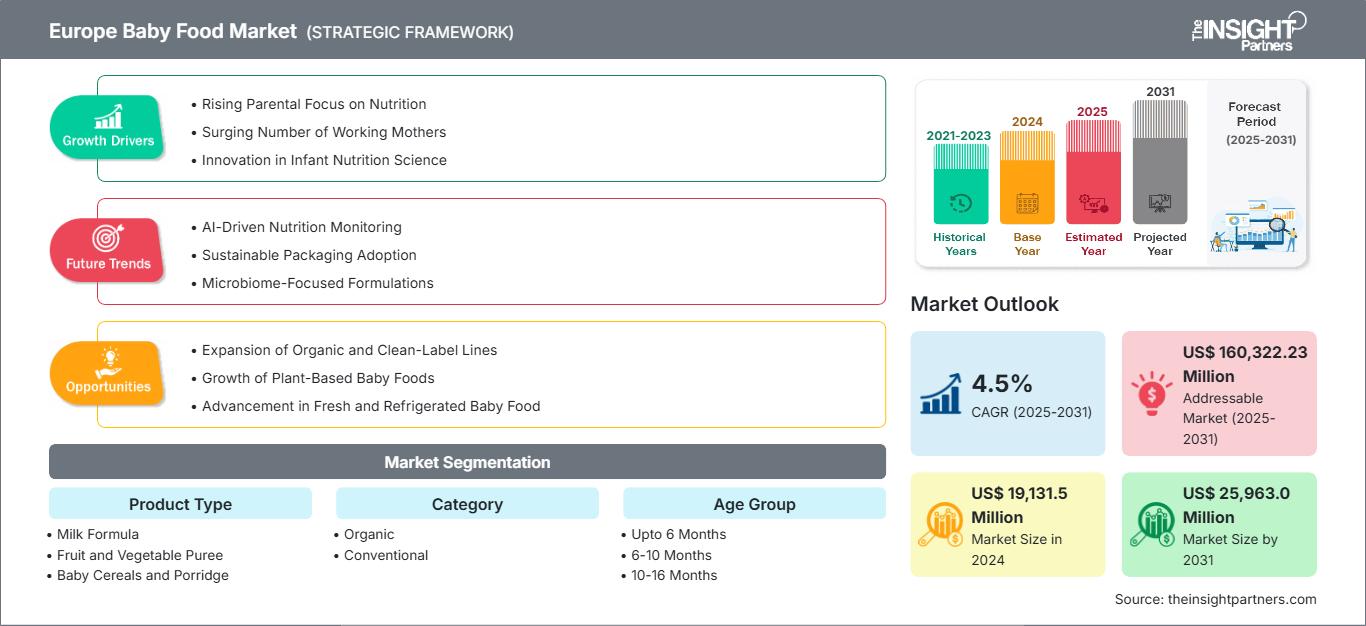
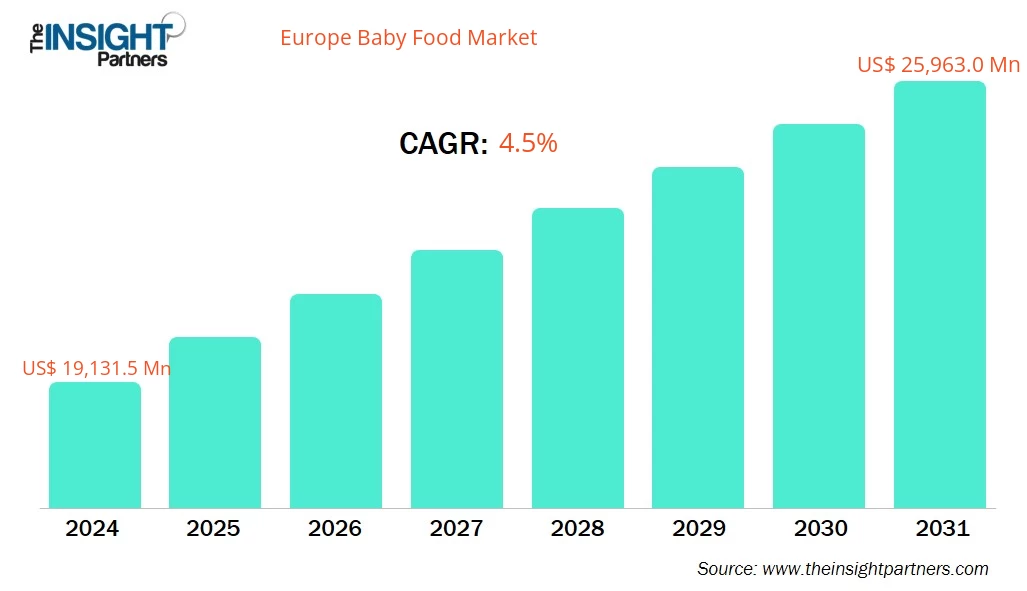
The Europe Baby Food Market size is expected to reach US$ 25,963.0 Million by 2031 from US$ 19,131.5 Million in 2024. The market is estimated to record a CAGR of 4.5% from 2025 to 2031.
Executive Summary and Europe Baby Food Market Analysis:
European parents place a strong emphasis on organic, chemical-free, and sustainably sourced products. Countries such as Germany, France, and the UK have seen a sharp increase in demand for certified organic purees, cereals, and snacks, as parents seek to minimize exposure to pesticides and artificial additives. Eco-friendly and recyclable packaging influences purchase decisions, reflecting the continent's environmental consciousness.
The increasing participation of women in the workforce propels the adoption of convenient, ready-to-feed baby foods. At the same time, urban lifestyles in countries such as Spain and Italy support modern retail formats and e-commerce distribution. Functional and fortified products, including those supporting microbiome health, immunity, or cognitive development, are increasingly popular, driven by parents seeking scientifically validated benefits. Innovation in flavors, texture progression, and stage-specific nutrition contributes to market growth. Brands such as HiPP, Milupa, and Nestle offer clean-label, organic, and functional baby foods that appeal to health-conscious European parents.
Customize This Report To Suit Your Requirement
Get FREE CUSTOMIZATIONEurope Baby Food Market: Strategic Insights
-
Get Top Key Market Trends of this report.This FREE sample will include data analysis, ranging from market trends to estimates and forecasts.
Europe Baby Food Market Segmentation Analysis:
- By Product Type, the Europe Baby Food Market is segmented into Milk Formula, Fruit and Vegetable Puree, Baby Cereals and Porridge, Pureed Meat, Yogurt, Yogurt Melts, Biscuits and Cookies, Teether Crackers or Cookies, Puffed Baby Snacks, Baby Snack Bars, Juices, Shakes and Smoothies, and Others. The Milk Formula segment dominated the market in 2024.
- By Category, the Europe Baby Food Market is segmented into Organic and Conventional. The Conventional segment dominated the market in 2024.
- By Age Group, the Europe Baby Food Market is segmented into Upto 6 Months, 6-10 Months, 10-16 Months, 16-24 Months, and 24-36 Months. The 6-10 Months segment dominated the market in 2024.
- By Distribution Channel, the Europe Baby Food Market is segmented into Supermarkets and Hypermarkets, Convenience Stores, Pharmacies and Drugstores, Online Retail, and Others. The Supermarkets and Hypermarkets segment dominated the market in 2024.
Europe Baby Food Market Report Scope
| Report Attribute | Details |
|---|---|
| Market size in 2024 | US$ 19,131.5 Million |
| Market Size by 2031 | US$ 25,963.0 Million |
| CAGR (2025 - 2031) | 4.5% |
| Historical Data | 2021-2023 |
| Forecast period | 2025-2031 |
| Segments Covered |
By Product Type
|
| Regions and Countries Covered |
Europe
|
| Market leaders and key company profiles |
|
Europe Baby Food Market Players Density: Understanding Its Impact on Business Dynamics
The Europe Baby Food Market is growing rapidly, driven by increasing end-user demand due to factors such as evolving consumer preferences, technological advancements, and greater awareness of the product's benefits. As demand rises, businesses are expanding their offerings, innovating to meet consumer needs, and capitalizing on emerging trends, which further fuels market growth.
Europe Baby Food Market Outlook
As more women enter or return to the workforce, the demand for convenient, time-saving, and dependable feeding solutions continues to grow. Dual-income households face tighter schedules, making it challenging to prepare fresh meals at home while maintaining consistent nutritional quality for infants.
Ready-to-use baby foods-such as squeezable purees, instant cereals, and pre-portioned meal kits-offer a practical alternative, enabling parents to balance work responsibilities with the desire to provide healthy meals for their children. This shift has encouraged innovations in packaging, including on-the-go formats that are easy to store, transport, and serve. Working mothers value products that require minimal preparation but still align with their standards for safety, cleanliness, and nutritional completeness.
Many seek options that reflect a homemade feel, prompting brands to develop minimally processed recipes with recognizable ingredients. The rise of urban living, long commutes, and limited access to home-cooking time intensifies reliance on convenient baby food solutions. With more women now having stronger purchasing power and higher household incomes, the demand for premium, high-quality, and trustworthy ready-made products continues to rise. The increasing participation of mothers in the workforce is shaping product development and market expansion.
Europe Baby Food Market Country Insights
By country, the Europe Baby Food Market is segmented into Germany, France, Italy, Spain, the United Kingdom, Rest of Europe. The Rest of Europe held the largest share in 2024.
The Netherlands, Belgium, and Switzerland are among the key nations contributing to the baby food market in the Rest of Europe. Parents prioritize organic, clean-label, and fortified products that support immunity, digestive health, and cognitive development. Urbanization and workforce participation create demand for convenient, ready-to-use meals. Local brands highlight regional sourcing and sustainability, while imported products appeal to premium-conscious consumers. Retail modernization and e-commerce facilitate access to domestic and international products. Environmental concerns, including a preference for recyclable or low-plastic packaging, are increasingly influencing purchasing decisions.
Europe Baby Food Market Company Profiles
Some of the key players operating in the market include Abbott Laboratories, Nestle SA, Danone SA, Reckitt Benckiser Group Plc, Royal FrieslandCampina NV, Nature's Path, The Hain Celestial Group Inc, China Mengniu Dairy Co Ltd, Hero Group, Little Spoon, Inc
These players are adopting various strategies such as expansion, product innovation, and mergers and acquisitions to provide innovative products to their consumers and increase their market share.
Europe Baby Food Market Research Methodology
The following methodology has been followed for the collection and analysis of data presented in this report:
Secondary Research
The research process begins with comprehensive secondary research, utilizing internal and external sources to gather qualitative and quantitative data for each market. Commonly referenced secondary research sources include, but are not limited to:
- Company websites, annual reports, financial statements, broker analyses, and investor presentations
- Industry trade journals and other relevant publications
- Government documents, statistical databases, and market reports
- News articles, press releases, and webcasts specific to companies operating in the market
Note:
All financial data included in the Company Profiles section has been standardized to US$. For companies reporting in other currencies, figures have been converted to US$ using the relevant exchange rates for the corresponding year.Primary Research
The Insight Partners conducts a significant number of primary interviews each year with industry stakeholders and experts to validate its data analysis and gain valuable insights. These research interviews are designed to:
- Validate and refine findings from secondary research
- Enhance the expertise and market understanding of the analysis team
- Gain insights into market size, trends, growth patterns, competitive dynamics, and future prospects
Primary research is conducted via email interactions and telephone interviews, encompassing various markets, categories, segments, and sub-segments across different regions. Participants typically include:
- Industry stakeholders: Vice Presidents, Business Development Managers, Market Intelligence Managers, and National Sales Managers
- External experts: Valuation specialists, research analysts, and key opinion leaders with industry-specific expertise

- Historical Analysis (2 Years), Base Year, Forecast (7 Years) with CAGR
- PEST and SWOT Analysis
- Market Size Value / Volume - Regional, Country
- Industry and Competitive Landscape
- Excel Dataset
Recent Reports
Testimonials

The Insight Partners' SCADA System Market report is comprehensive, with valuable insights on current trends and future forecasts. The team was highly professional, responsive, and supportive throughout. We are very satisfied and highly recommend their services.
RAN KEDEM Partner, Reali Technologies LTDs
I requested a report on a very specific software market and the team produced the report in a few days. The information was very relevant and well presented. I then requested some changes and additions to the report. The team was again very responsive and I got the final report in less than a week.
JEAN-HERVE JENN Chairman, Future Analytica
We worked with The Insight Partners for an important market study and forecast. They gave us clear insights into opportunities and risks, which helped shape our plans. Their research was easy to use and based on solid data. It helped us make smart, confident decisions. We highly recommend them.
PIYUSH NAGPAL Sr. Vice President, High Beam Global
The Insight Partners delivered insightful, well-structured market research with strong domain expertise. Their team was professional and responsive throughout. The user-friendly website made accessing industry reports seamless. We highly recommend them for reliable, high-quality research services
YUKIHIKO ADACHI CEO, Deep Blue, LLC.
This is the first time I have purchased a market report from The Insight Partners.While I was unsure at first, I visited their web site and felt more comfortable to take the risk and purchase a market report.I am completely satisfied with the quality of the report and customer service. I had several questions and comments with the initial report, but after a couple of dialogs over email with their analyst I believe I have a report that I can use as input to our strategic planning process.Thank you so much for taking the extra time and making this a positive experience.I will definitely recommend your service to others and you will be my first call when we need further market data.
JOHN SUZUKI President and Chief Executive Officer, Board Director, BK Technologies
I wish to appreciate your support and the professionalism you displayed in the course of attending to my request for information regarding to infectious disease IVD market in Nigeria. I appreciate your patience, your guidance, and the fact that you were willing to offer a discount, which eventually made it possible for us to close a deal. I look forward to engaging The Insight Partners in the future, all thanks to the impression you have created in me as a result of this first encounter.
DR CHIJIOKE ONYIA MANAGING DIRECTOR, PineCrest Healthcare Ltd.Reason to Buy
- Informed Decision-Making
- Understanding Market Dynamics
- Competitive Analysis
- Identifying Emerging Markets
- Customer Insights
- Market Forecasts
- Risk Mitigation
- Boosting Operational Efficiency
- Strategic Planning
- Investment Justification
- Tracking Industry Innovations
- Aligning with Regulatory Trends
Unlock Exclusive Report Discounts
Enquire Now




 Get Free Sample For