Foam Market Size & Overview
The Foam Market was valued at US$ 116.64 Billion in 2025 and is projected to reach US$ 201.08 Billion by 2034, registering a CAGR of 6.24% during 2026–2034. Demand is supported by building insulation requirements, protective packaging, vehicle lightweighting, furniture manufacturing, and specialized cushioning applications. Material performance, processing efficiency, durability, and thermal management continue to influence purchasing decisions. Manufacturers are also evaluating recycled feedstocks, renewable raw materials, and improved product designs as customers balance cost, technical performance, and environmental considerations across industrial and consumer applications.
The North American Foam Market Size is supported by renovation activity, building energy-efficiency requirements, established automotive manufacturing, and demand for engineered cushioning materials. Its modeled CAGR is ~5% through 2034. Construction insulation benefits from efforts to improve building envelopes, while packaging and furniture applications generate recurring demand for flexible and protective materials. The region's established chemical industry, distribution networks, and technical capabilities support product development and customer qualification. However, construction cycles, feedstock costs, regulatory requirements, and competition from alternative materials can influence purchasing patterns and manufacturers' capacity decisions.
The key reason behind the growth of the Foam Market is the synergy between the diversified demands from end users and the possibilities of engineering foams for specific performance needs. For instance, construction requires insulation and sealing; packaging demands cushioning and protection properties; the automobile industry and furniture producers need lightness, comfort, durability, and ease of designing products. The supply chain starts with polymers and chemicals, additives, and equipment used for production. Foaming, curing, cutting, molding, laminating, and converting into components are the processes of manufacturing foams. The demand is driven not only by the volume of consumption but also by product design and manufacturing operations. Supply issues are dependent on factors such as feedstock availability and pricing, cost of energy, capacity utilization, and proximity of suppliers to consumers. While integrated chemical suppliers will have an advantage of feedstock access and knowledge of formulations, specialized suppliers will leverage on the processing ability, niche products, and technical assistance to the consumer. The issue of logistics should not be ignored given the weight and volume of some foam products as compared to their value, but packaging and industrial foam suppliers will overcome this problem by either processing material near consumers or packing their products in such a way as to minimize the volume transported.
According to the Foam Market Report, competition involves the combination of major chemical producers together with foam producers that cater to specific applications. The companies BASF SE and Covestro AG have strengths in polymer chemistry and formulation, whereas Armacell International S.A. is focused on insulation and engineered foam products. Recticel, JSP, and Kaneka Corporation provide insulation, cushioning, and polymer material products respectively for their target markets. Rogers Corporation and Zotefoams plc are competitors in highly technical applications where consistency of the material and specific processing methods are essential. Sealed Air Corporation is a competitor in protective packaging while Arkema provides advanced materials and chemical technologies pertinent to engineered applications. Increasingly, investment decisions have to consider a trade-off between efficiencies of production and product differentiation. Producers can increase competitiveness by using automation, process control, optimization of yields, customer formulation and selective expansion of capacity. R&D efforts can help produce materials with higher performance, feedstock with reduced impact and better recovery technologies, but their commercialization will require testing and certification where appropriate, as well as compatibility with the production process used by customers. Companies that operate diverse product lines can use their development capabilities in several different end-markets, whereas specialist companies can target technical niches. Purchasers have to take into consideration supplier reliability, consistency in specifications and total cost, including installation cost, in addition to prices per unit.
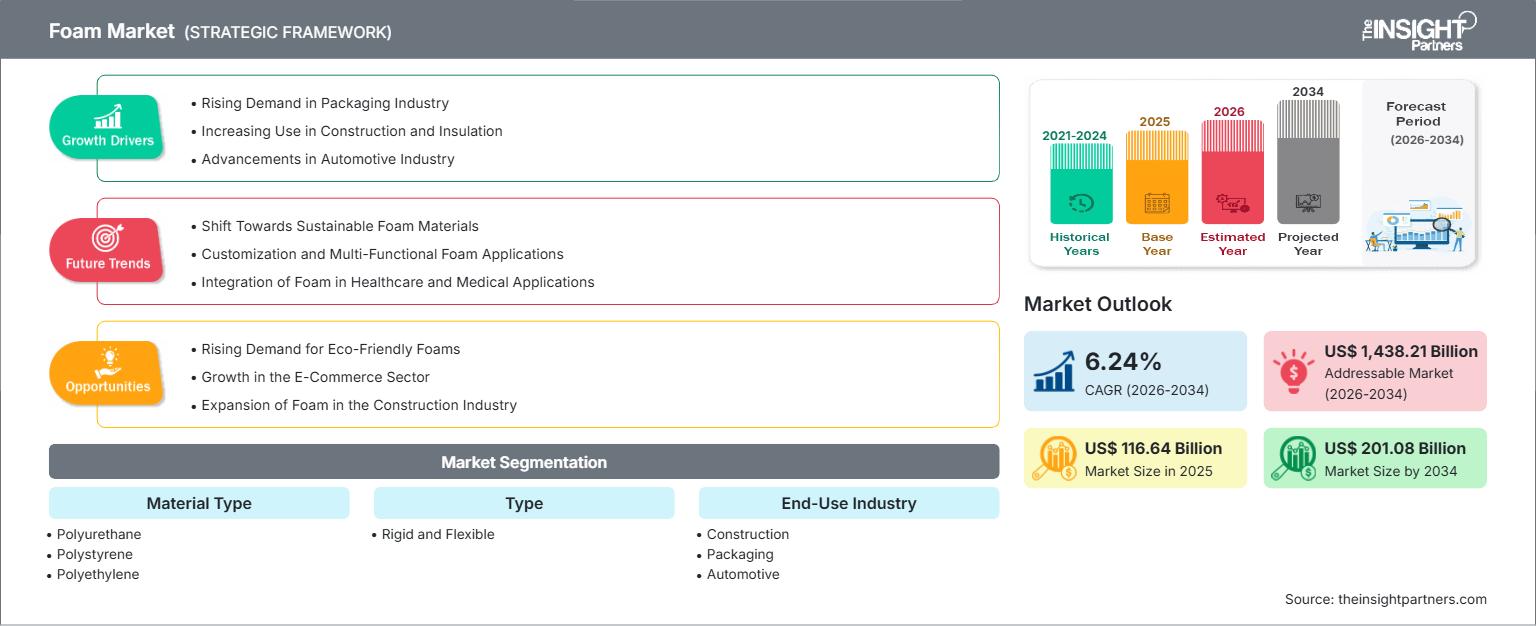
Foam Market Assessment and Insights
Regional Outlook
- North America: ~26% of the global market in 2025 | ~5% CAGR through 2034. Market position: A major established market supported by construction insulation, automotive production, packaging, and furniture demand. Technical capabilities and established supply networks support adoption, although construction cycles and raw-material costs influence growth.
- US: ~75% of North American market revenue in 2025 | ~5% CAGR through 2034. Market position: The largest national contributor within North America, supported by extensive construction, packaging, automotive, and furniture applications. Established chemical manufacturing and product development capabilities sustain demand for conventional and engineered foam products.
- Europe: ~25% of the global market in 2025 | ~5% CAGR through 2034. Market position: A mature market shaped by building renovation, insulation standards, automotive engineering, and sustainability requirements. Germany is the leading country in Europe under this model, with the UK, France, Italy, and Spain contributing through construction and industrial demand.
- Asia Pacific: ~39% of the global market in 2025 | ~8% CAGR through 2034. Market position: The largest and fastest-growing region in this model, supported by manufacturing capacity, urban development, packaging consumption, and expanding vehicle production. China is the leading country in Asia Pacific, while India and Southeast Asian manufacturing hubs provide additional expansion opportunities.
Segment Outlook
- Flexible Foam: ~56% share in 2025 | ~7% CAGR through 2034. Market position: Flexible foam has broad exposure to furniture, bedding, cushioning, automotive interiors, and consumer applications. Its comfort, resilience, and ability to be converted into customized shapes support established demand and continued product development.
- Construction: ~28% share in 2025 | ~7% CAGR through 2034. Market position: Construction is a strategically important end-use segment because insulation, sealing, and energy-efficiency improvements require materials that deliver thermal performance and reliable installation. Renovation and building-envelope upgrades support continued demand.
Competitive Coverage
BASF SE, Armacell International S.A., JSP, Kaneka Corporation, Recticel, Rogers Corporation, Sealed Air Corporation, Arkema, Zotefoams plc, Covestro AG.
Methodology
The Insight Partners follows Data Collection & Secondary Research, Primary Research, Data Analysis, and Data Triangulation & Final Review to validate market estimates and insights.
Source: The Insight Partners' analysis based on proprietary research, government publications, company annual reports, investor presentations, industry databases, and expert interviews.
Foam Market Trends
Transition Toward Recycled and Bio-Based Foam Materials
Foam Market trends increasingly include the evaluation of recycled inputs, renewable feedstocks, mass-balance approaches, and material designs intended to reduce dependence on virgin fossil resources. These approaches differ in their chemistry, traceability, and end-of-life implications, so their environmental benefits must be assessed against the actual formulation and production process. Manufacturers may need to validate performance, processing stability, durability, and compatibility with existing equipment before introducing alternative feedstocks at scale. Customers are also likely to scrutinize material declarations and environmental claims more closely. Commercial adoption will depend on reliable supply, transparent verification, and acceptable costs. Producers that can demonstrate both application performance and credible material provenance may strengthen their position with customers pursuing lower-impact products.
Development of High-Performance Foams for Advanced Applications
The next phase of product development is likely to emphasize engineered cellular structures and formulations designed for demanding thermal, acoustic, mechanical, and protective applications. Electronics, transport, industrial equipment, and specialized consumer products can require tighter tolerances and more consistent performance than conventional commodity applications. Advanced processing methods can help manufacturers control cell structure, density, dimensional stability, and conversion behavior. Product qualification may take time because customers need evidence of reliability under real operating conditions. Suppliers can differentiate themselves through application engineering, testing capabilities, and collaboration with equipment manufacturers and component designers. Commercial opportunities will favor products that solve specific technical problems and justify their cost through improved functionality, easier assembly, reduced weight, or longer service life.
Foam Market Growth Factors
Growing Demand for Energy-Efficient Building Insulation
Building energy performance is a structural demand driver because insulation can reduce heat transfer through walls, roofs, floors, and building services when installed as part of a suitable envelope design. Renovation programs, energy-cost considerations, and updated building requirements can encourage builders and property owners to evaluate insulation materials during construction and refurbishment. Foam products compete through thermal properties, installation speed, moisture behavior, durability, and compatibility with building systems. The commercial impact extends beyond raw material sales to installation services, prefabricated components, and technical support. Suppliers that provide reliable specifications and installation guidance can improve customer confidence. However, adoption remains sensitive to upfront costs, fire-safety requirements, construction activity, and local building practices.
Increasing Use of Lightweight Foam in Automotive Manufacturing
Automotive manufacturers use foam to meet competing objectives involving vehicle weight, passenger comfort, acoustic performance, component integration, and manufacturing efficiency. Foam can be incorporated into seating, interior panels, seals, cushioning, and selected energy-absorbing structures. The effect on demand depends on vehicle production, design specifications, platform changes, and supplier qualification cycles. Electric vehicles may create additional design considerations around cabin acoustics, packaging constraints, and thermal management, but adoption remains application-specific rather than automatic. Suppliers need to demonstrate repeatable quality, stable supply, and compatibility with assembly processes. Materials that satisfy performance and cost requirements can benefit from long-running component programs, while changes in vehicle platforms and procurement strategies can create both opportunities and switching risks.
Expanding Protective Packaging Requirements Across Industries
Protective packaging demand is shaped by the movement of electronics, medical equipment, industrial components, appliances, and other products that can be damaged by shock, vibration, or compression. Foam inserts and cushioning systems allow converters to design protection around product geometry and shipping conditions. Their economic value depends on the cost of damage, return logistics, product fragility, and packaging efficiency. E-commerce and complex global supply chains can increase the importance of dependable protection, although packaging redesign may also reduce material use or substitute other protective formats. Suppliers can compete by improving fit, optimizing material consumption, and supporting testing and design work. Cost, recyclability, transport efficiency, and end-of-life handling remain important considerations for packaging buyers.
Foam Market Opportunities
Investment in Foam Manufacturing Capacity Across Emerging Economies
Foam Market Forecasts point to opportunities for carefully targeted investment in manufacturing locations close to expanding construction, automotive, packaging, furniture, and footwear industries. Regional production can reduce transport costs for bulky materials, improve customer responsiveness, and help manufacturers adapt products to local specifications. However, a capacity project should be supported by identifiable downstream customers, credible demand assumptions, suitable feedstock access, and an assessment of local competition. Investors should also evaluate utilities, workforce skills, logistics, environmental permits, and the economics of operating at different utilization levels. Partnerships with established converters or industrial customers may reduce market-entry risk. The strongest investment cases are likely to combine customer commitments with flexible production capability and a clear route to technical qualification.
Commercialization of Circular Foam Solutions and Advanced Insulation Products
A second opportunity lies in developing products and recovery systems that address insulation performance, packaging efficiency, and material circularity. Manufacturers can explore designs that simplify separation, improve recyclability where technically feasible, incorporate verified recycled or renewable inputs, or extend service life. In construction, products that combine dependable thermal performance with practical installation can serve renovation and retrofit projects. In packaging, optimized designs can balance protection with reduced material consumption and easier handling after use. Commercialization requires more than a new formulation: suppliers need validation, customer trials, consistent feedstock quality, and an economically workable recovery pathway. Investors should distinguish established commercial solutions from early-stage concepts and evaluate whether sustainability attributes translate into customer demand, regulatory alignment, or measurable operating benefits.
Segmentation Analysis
Material Type
Material type segment in the Foam Market determines processing compatibility, mechanical behavior, thermal performance, cost structure, and suitability for specific applications. Demand depends on the performance requirements of downstream manufacturers and the availability of qualified formulations and conversion processes. Material selection also reflects product lifetime, processing efficiency, and relevant safety or environmental requirements. Polyurethane is modeled as a strategically important material family because it serves varied cushioning, insulation, and component applications. The CAGR of ~7% for polyurethane foam during 2026–2034 is a modeled sub-segment estimate reflecting its diversified application base.
- Polyurethane: Polyurethane foam is used in cushioning, furniture, bedding, automotive interiors, insulation, and specialized components. Formulation flexibility allows manufacturers to tailor comfort, resilience, density, and thermal performance to different customer specifications.
- Polystyrene: Polystyrene foam serves insulation and protective packaging applications where low weight, shape retention, and thermal performance matter. Adoption depends on product requirements, local waste-management systems, applicable regulations, and competition from alternative materials.
- Polyethylene: Polyethylene foam is valued for impact absorption, moisture resistance, flexibility, and protective packaging performance. It is used in transport protection, industrial packaging, sports products, and cushioning applications requiring reliable handling characteristics.
- Polypropylene: Polypropylene foam supports lightweight components, reusable packaging, automotive applications, and protective structures. Its processing characteristics and potential for weight reduction can appeal to manufacturers seeking durability and efficient material use.
- Phenolic: Phenolic foam is associated with insulation applications where fire performance and thermal properties are important selection factors. Adoption depends on application-specific performance requirements, handling characteristics, installation methods, and the economics of competing insulation solutions.
- PET: PET foam is used in lightweight structural and sandwich-core applications, including transport, industrial equipment, and selected construction systems. Its relevance increases where stiffness, low weight, and compatibility with composite manufacturing are important.
Type
Rigid and flexible foam classifications reflect differences in deformation, structural behavior, and end-use requirements. The category in the foam market serves both high-volume applications and products requiring specialized material properties. Flexible foam is modeled as the largest sub-segment, with ~56% share in 2025, because of its extensive use in cushioning, furniture, bedding, and vehicle interiors. Its modeled CAGR is ~7% through 2034, supported by replacement demand, consumer product manufacturing, and continued development of performance-oriented formulations.
- Rigid: Rigid foam is used where structural stability, thermal insulation, or dimensional retention is required. It serves building envelopes, refrigeration, industrial insulation, and selected lightweight structural systems, with performance and installation requirements shaping material selection.
- Flexible: Flexible foam provides cushioning, comfort, resilience, and energy absorption across furniture, bedding, automotive interiors, and protective applications. Manufacturers differentiate products through formulation, density control, durability, and the ability to meet specific user and component requirements.
End-Use Industry
End-use demand in the Foam Market reflects the diversity of applications that consume foam materials, from building insulation and protective packaging to comfort products and vehicle components. Purchasing decisions depend on performance, reliability, manufacturing throughput, product cost, and relevant technical requirements. Construction is modeled as the largest individual end-use sub-segment, with ~28% share in 2025 and a CAGR of ~7% through 2034. Its outlook is associated with insulation upgrades, construction activity, and the need to improve building-envelope performance, although demand varies by region and project cycle.
- Construction: Foam materials support insulation, sealing, expansion control, and selected lightweight building systems. Demand is influenced by renovation, new construction, climate conditions, installation practices, and the economics of improving building energy performance.
- Packaging: Foam packaging provides cushioning, impact protection, separation, and product stabilization during storage and transport. Adoption reflects the value and fragility of shipped goods, packaging design requirements, logistics conditions, and efforts to reduce product damage.
- Automotive: Automotive manufacturers use foam for seating, interior trim, acoustic management, sealing, and lightweight components. Material qualification depends on durability, comfort, weight, production consistency, and compatibility with vehicle design and assembly processes.
- Furniture & Bedding: Furniture and bedding producers rely on foam for comfort, support, resilience, and product differentiation. Demand is linked to household formation, replacement purchases, hospitality furnishing, product design, and manufacturers' ability to manage material costs.
- Footwear: Foam materials contribute cushioning, shock absorption, flexibility, and lightweight construction in footwear. Product development is shaped by comfort expectations, performance specifications, manufacturing methods, and demand for differentiated sports, casual, and specialty footwear.
Opportunity Snapshot
| End-Use Industry | Revenue Contribution | Trend Tag | Adoption Stage |
| Construction | High | Thermal Insulation | Mature |
| Packaging | High | Protective Transit | Mature |
| Automotive | Medium | Lightweight Components | Scaling |
| Furniture & Bedding | High | Comfort Engineering | Mature |
| Footwear | Medium | Performance Cushioning | Scaling |
Regional Insights
North America Foam Market
North America constitutes one of the known demand centers for the Foam Market, representing a model market share of ~26% in 2025 and a CAGR of ~5% through 2034. The demand in the region arises from renovation of buildings, insulation of buildings for residential and commercial purposes, protective packaging, manufacture of furniture, and usage in vehicles. Most of the regional revenues for the market arise from the United States, while Canada and Mexico participate in the market based on construction, manufacturing, and supply chains. Established distribution channels and support services assist manufacturers in satisfying customers that have different demands for their products.
The future performance in the region will depend on the balance between demands arising from renovations and those arising from cyclical constructions, along with output in the automotive industry and the level of consumption in the region. Manufacturers of insulation material can capitalize on the renovation of buildings, while manufacturers of packaging material will benefit from e-commerce, industrial transportations, and protective products. Manufacturers of the material in Mexico can benefit from the presence of the manufacturing sector and the integration within it, while in Canada, building conditions, climate conditions, and industrial production influence the demand.
U.S. Foam Market
The US Foam Market is forecasted to capture roughly 75% of North American market revenues in 2025, with a CAGR of about 5% during 2034. This size is attributed to an extensive construction sector, advanced chemical industry, significant applications for packaging, production of furniture and bedding, and automotive manufacturing. The United States provides facilities for high-volume processing of foam and advanced research into specific foam materials. Companies like BASF SE, Rogers Corporation, and Sealed Air Corporation provide various solutions for the above segments using chemical systems, engineered materials, and protective packaging solutions.
Demand by application depends on the type of foam material and purchasing cycle. In construction, buyers consider insulation characteristics, installation requirements, and regulatory compliance. Automotive buyers care about weight, durability, comfort, and consistency of components. For packaging buyers, important factors include protective characteristics of foam, its efficiency, and ability to reduce the number of damaged products. Comfort, resilience, and consistent quality of produced foams are important for furniture and bedding companies. Remodeling can serve as protection against slowing of the pace of construction, but there are several drivers such as interest rates, turnover of real estate, manufacturing outputs, and consumers' spending.
Europe Foam Market
Europe is modeled to represent ~25% of the global Foam Market in 2025 and register a CAGR of ~5% through 2034. Demand is influenced by building renovation, thermal insulation, automotive engineering, furniture production, industrial equipment, and protective packaging. Germany is modeled as the leading country in Europe because of its substantial industrial base, construction-related requirements, and automotive manufacturing ecosystem. Its market role also reflects demand for engineered materials and technical products where specifications and product consistency affect supplier selection.
Renovation and insulation demand in the UK are combined with packaging, furniture, and industrial applications. Diversified construction and transport markets exist in France, whereas Italy provides packaging, furniture, footwear, and manufacturing. In Spain, the market includes building renovation, tourism facilities, consumer goods, and automotive applications. These markets vary due to differences in building stock, investment cycles, manufacturing focus, and purchasing demands, hence it would be incorrect to use a common regional growth rate for assessing countries' performance.
European manufacturers are under rising pressure to prove material efficiency, product safety, and environmental performance. Building renovations may help increase insulation demand, however, economics and installation cost of the project play an important role in adoption of products. Special cushioning, sealing, thermal protection, and lightweight parts may be required from suppliers by the automotive and industrial buyers. A mature industrial environment is typical for Europe; however, it implies that technical differentiation is important. Manufacturers should be able to control energy costs, legislation requirements, and competitive pressure.
APAC Foam Market
Asia Pacific is modeled to account for ~39% of global Foam Market Share in 2025, with a CAGR of ~8% through 2034. It is the largest and fastest-growing region in this model, reflecting extensive manufacturing capacity, urban development, packaging consumption, and growing demand for automotive, furniture, and footwear components. China is the leading country in Asia Pacific because of its broad industrial base and substantial participation in polymer processing, consumer goods, construction materials, and manufacturing supply chains.
Japan and South Korea contribute through automotive, electronics, industrial, and technically specialized applications. India offers opportunities tied to infrastructure, urban housing, consumer product manufacturing, and industrial capacity expansion. Australia contributes through construction insulation, packaging, and industrial uses. Policy priorities involving building efficiency, infrastructure investment, and domestic manufacturing can influence demand, although their effects differ by country and application. Suppliers must also consider local feedstock economics, customer qualification, competition, and logistics. Regional expansion is therefore most attractive when new capacity is aligned with identifiable downstream demand and reliable access to customers.
Middle East & Africa Foam Market
The Middle East and Africa Foam Market is expected to benefit from construction, infrastructure investment, packaging requirements, and industrial development. Its modeled CAGR is ~7% through 2034. Saudi Arabia and the United Arab Emirates are important demand centers in the Middle East because of building projects, commercial development, industrial diversification, and the need for insulation suited to demanding climate conditions. South Africa contributes through construction, automotive-related manufacturing, packaging, and consumer products, while the Rest of MEA includes markets with differing levels of industrial development and distribution access.
Energy efficiency is commercially relevant in hot climates, where insulation and building-envelope performance can reduce cooling loads when correctly designed and installed. Infrastructure programs can support demand for construction materials, while expanding retail and industrial supply chains create opportunities for protective packaging. Saudi Arabia is a key country in the Middle East & Africa region under this qualitative assessment, although a precise country share is not quantified. Market development remains uneven because project timing, imported material costs, local manufacturing capability, financing, and procurement standards differ substantially across countries. Regional suppliers must adapt products to local installation practices and customer requirements.
Foam Market Report Scope
| Report Attribute | Details |
|---|---|
| Market size in 2025 | US$ 116.64 Billion |
| Market Size by 2034 | US$ 201.08 Billion |
| Global CAGR (2026 - 2034) | 6.24% |
| Historical Data | 2021-2024 |
| Forecast period | 2026-2034 |
| Segments Covered | Material Type, Type, End-Use Industry |
| Region scope | North America, Europe, Asia-Pacific, South and Central America, Middle East and Africa |
Recent Developments
- February 25, 2026: Rogers Corporation announced the launch of PORON ReSource30 polyurethane foam, expanding its engineered foam portfolio. The development is relevant to customers evaluating material options for cushioning and other performance-sensitive applications. New formulations can help suppliers address evolving product requirements, although adoption depends on customer qualification, application fit, and commercial availability. The announcement illustrates continued product development in specialty polyurethane foam.
- December 2025: BASF SE introduced WALLTITE RSB, a closed-cell spray polyurethane foam insulation system incorporating recycled and renewable raw materials. The company positioned the product as an option for customers seeking insulation performance alongside a lower product carbon footprint than conventional formulations. The announcement highlights efforts to integrate alternative feedstocks into established building-material systems. Actual project suitability remains dependent on building requirements, installation practices, and the product's technical specifications.
Frequently Asked Questions

Recent Reports






