
Jackhammer Market Size, Share & Trends by 2034
Coverage: by Type (Pneumatic, Hydraulic, Electric); Application (Construction, Tunneling, Mining, Others) , and Geography (North America, Europe, Asia Pacific, and South and Central America)
- Status : Data Released
- Report Code : TIPRE00007849
- Category : Manufacturing and Construction
- No. of Pages : 150
- Available Report Formats :


- Last update date : July 13, 2026


2025 Market Size
US$ 1.99 Bn
Base year value
2034 Forecast
US$ 2.83 Bn
Projected by 2034
CAGR 2026-2034
3.99 %
Growth rate
Addressable Market
US$ 21.89 Bn
(2026-2034)
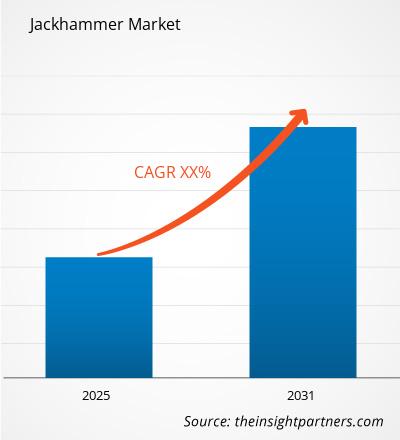
The jackhammer market size was valued at US$ 1.99 Billion in 2025 and is projected to reach US$ 2.83 Billion by 2034; it is expected to register a CAGR of 3.99% from 2026 to 2034. Demand is supported by construction, tunneling, and mining applications where controlled concrete, asphalt, and rock breaking remains essential for project productivity and site preparation.
North America is projected to experience a CAGR of 3.5% to 4.1% between 2021 and 2034, driven by transportation infrastructure repairs, trenching utilities, and renovations of commercial buildings. Established tool rental facilities and increasing safety concerns at jobsites will drive purchases toward electric and hydraulic tooling, but pneumatic power tools will remain important for municipal street work and demolitions.
Jackhammer Market Assessment and Insights
- North America: held 29–32% share in 2025 and is growing at a CAGR of 3.5–4.1% during 2026–2034, driven by highway rehabilitation, utility upgrades, and rental fleet modernization.
- US: accounted for 72–76% of North America in 2025 and is growing at a CAGR of 3.6–4.2%, led by road repair and commercial demolition.
- Europe: held 24–27% jackhammer market share in 2025 and is growing at a CAGR of 3.2–3.8%; Germany, the UK, France, Italy, and Spain lead demand through urban renewal and rail projects.
- Asia Pacific: held 30–34% share in 2025 and is growing at a CAGR of 4.4–5.1%; China, India, Japan, South Korea, and Australia anchor infrastructure and mining demand.
- Largest Segment: Construction held 58–62% jackhammer market share in 2025, with a CAGR of 3.7–4.3%, supported by roadwork, demolition, and building renovation.
- High Growth Segment: Electric held 30–34% market share in 2025, with a CAGR of 4.8–5.6%, reflecting cordless adoption, lower emissions, and indoor suitability.
- Key companies analyzed in detail: Atlas Copco AB, Einhell Germany AG, Hilti Corporation, INDECO Ind. SpA, Koki Holdings Co., Ltd., Makita Corporation, Robert Bosch GmbH, Stanley Black & Decker, Inc., Techtronic Industries Company Limited, and TR Industrial.
Source: The Insight Partners' analysis based on proprietary research, government publications, company annual reports, investor presentations, industry databases, and expert interviews.
There has been a trend shift from the use of breakers that need compressors to the adoption of different types of breakers including pneumatic, hydraulic, and electric. More and more contractors look at such factors as impact energy, vibration level, maintenance cycle time, and adaptability to being rented when choosing breaking tools. Factors of production are still connected with the forging of the steel, motor, battery, seal, and air tool assembly.
Future demand is likely to depend on new urban areas being developed, infrastructure upgrades and underground transportation facilities. The importance of labor safety, dust control, and quiet construction will make electric and hydraulic breakers preferable in the cities. The jackhammer market forecast is widening as rental firms standardize fleets, mining contractors seek durable breakers, and infrastructure agencies prioritize faster pavement removal cycles.
Jackhammer Market Report Scope
| Report Attribute | Details |
|---|---|
| Market size in 2025 | US$ 1.99 Billion |
| Market Size by 2034 | US$ 2.83 Billion |
| Global CAGR (2026 - 2034) | 3.99% |
| Historical Data | 2021-2024 |
| Forecast period | 2026-2034 |
Jackhammer Market Analysis
Demand is concentrated in construction, tunneling, and mining because these activities require repeated concrete, asphalt, and rock removal under tight schedules. The jackhammer market benefits from road rehabilitation, brownfield redevelopment, rail tunnel work, and quarry maintenance, where manual tools remain more flexible than mounted breakers in confined areas.
Steel providers, suppliers of motor and compressor components, battery packs, OEMs, distributors, and rental fleets make up the ecosystem. Supplier conditions depend on availability of alloy steel, sourcing of electronics, and aftersales services density. Analysis of jackhammer usage shows that uptime, spare parts accessibility, and tool weight are key parameters in terms of procurement by contractors running multi-site fleets.
The market has moderate fragmentation – global toolmakers compete with specialist breaker producers and local importers. Atlas Copco AB and Hilti Corporation concentrate on professional construction distribution channels, while Makita Corporation, Robert Bosch GmbH, and Techtronic Industries Company Limited focus on developing electric tool ecosystems.
The main investments include development of cordless heavy tools, vibration management, dust management, and fleet management services. Competition of Stanley Black & Decker, Inc., Koki Holdings Co., Ltd., Einhell Germany AG, INDECO Ind. SpA, and TR Industrial occurs based on application range, distribution channels, and value. Jackhammer market trends increasingly reward suppliers that combine durability with lower operating exposure.
● REPORT CUSTOMIZATION
Tailor This Report To Align With Your Specific Business Requirements
This report can be customized to align precisely with your business objectives, scope, and target markets. Customization options include tailored segmentation, geography, competitive analysis, and strategic insights to support informed decision-making.
Customize This Report →WHAT YOU CAN ADJUST
- ● Segmentations
- ● Geography
- ● Competitive Analysis
- ● Language Preferences
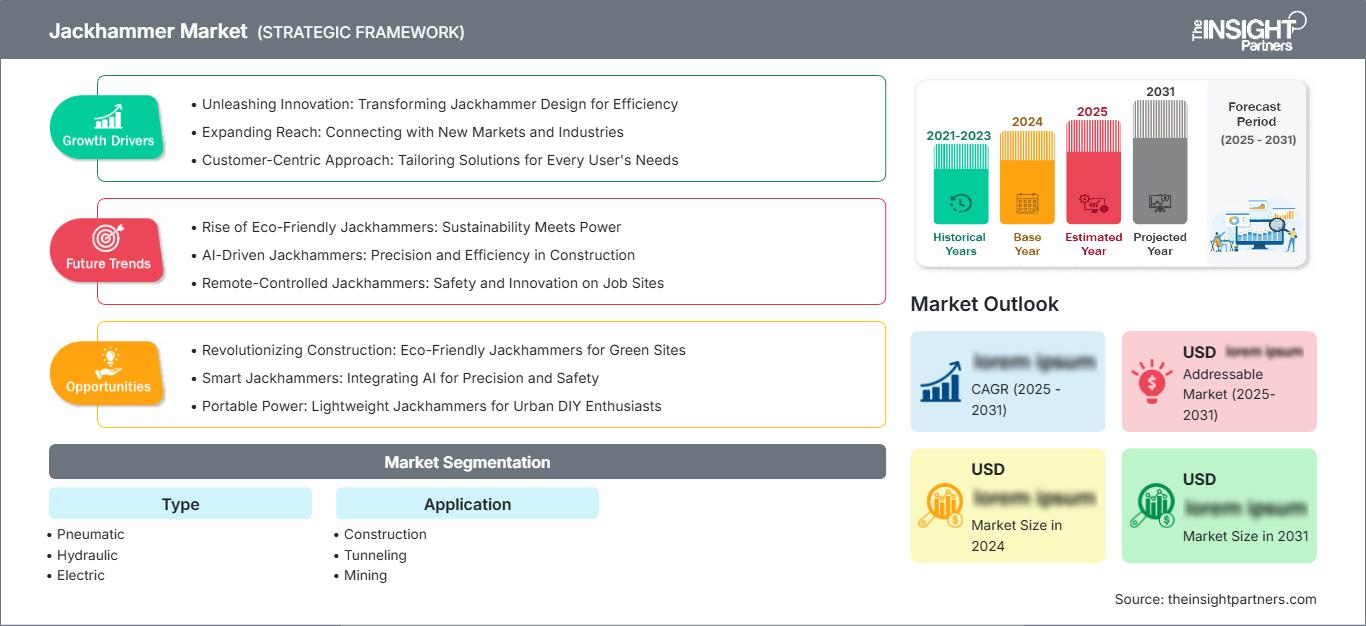
Jackhammer Market: Strategic Insights
Regional Insights
North America Jackhammer
North America held a 29-32% market share in 2025 and is expected to grow at a 3.5-4.1% CAGR up to 2034. It is driven by factors such as pavement rehabilitation, bridge deck stripping, water main replacement, and commercial building renovations. Renting of equipment by contractors is necessary to cope with peak loads during high season, thereby generating replacement needs for pneumatic/electric breakers with a known cycle of maintenance.
Fleet managers will focus on reduction of vibrations, noise reduction, and ease of battery change due to stricter restrictions regarding working hours in urban areas. Hydraulic tools continue to be effective for utility work and highway construction. Electric-powered jackhammers will be useful for interior demolition purposes.
U.S. Jackhammer Market
In 2025, the U.S. accounted for 72–76% of North America and will be posting a CAGR of 3.6–4.2% during 2026–2034. Road construction and repairs, warehouse renovations, airport construction, and utility trenches create wide demand for tools. Tool demand will also get boosted through large rental companies that move breakers between contractors, cities, and demolition teams.
Top brands such as Atlas Copco AB, Hilti Corporation, Stanley Black & Decker, Inc., Makita Corporation, and Techtronic Industries Company Limited have robust sales or service operations through professional sales channels. Demand will be shifting towards electric jackhammers for indoor renovations and pneumatic jackhammers for roads, thereby creating a mix of technologies within the jackhammer market.
Europe Jackhammer Market
In 2025, Europe held 24–27% market share and was estimated to experience CAGR of 3.2-3.8%. Active development of railways stations, road reconstruction, and commercial buildings renovation continues in the UK with preference for quiet and vibration-free equipment that is suitable for the urban environment and procurement oriented toward safety concerns.
Leading country of the region is Germany because of industrial and transport renovation and effective implementation of equipment rental programs. Consumers prefer durable, economical, and vibration exposure norm compliant tools. Hydraulic and electric platforms show increasing popularity due to better demolition, lower noise level, and higher comfort.
France, Italy, and Spain provide growth because of subway extension, building renovation, and road maintenance. Demand in Southern European countries is price-sensitive and gradually becoming more qualitative oriented. The region’s Jackhammer market growth is steady rather than cyclical because replacement demand offsets slower new construction.
APAC Jackhammer Market
APAC holds 30–34% market share in 2025 and expected growth at 4.4–5.1% CAGR. China drives regional demand via transport, utility work, and urban redevelopment projects, while India boosts contractor purchasing via metro construction, roads, and housing programs. Japan and South Korea prefer small-size, quiet electric-powered models.
Australia drives regional demand via mining services and civil infrastructure. Policy-supported infrastructure pipeline and industrial upgradation ensure growth in Jackhammer size in the region irrespective of its erratic real estate cycle.
Supplier strategy in APAC region combines quality professional-grade tools with economical versions suited to small contractors. Density of distribution network and training play crucial roles.
Middle East & Africa Jackhammer Market
The Middle East & Africa region will witness growth in the forecast period of 2034 at a rate of 3.8-4.5%. The highest growth driver for this region is Saudi Arabia due to concrete demolition and surface preparation requirements for transport lanes, tourism zones, and utilities. South Africa will contribute through mining and municipalities.
Rest of MEA regions are project-driven. Energy, Mining, and Construction contractors need sturdy pneumatic and hydraulic concrete tools capable of withstanding dust and heat conditions. Regional growth depends on infrastructure funding execution, distributor coverage, and parts availability. Rental penetration is lower than in North America but rising in major Gulf cities.
Segmentation Analysis
Type
The Type segment is expected to record a 3.8–4.4% CAGR during 2026–2034 as buyers match power source with jobsite conditions. Pneumatic systems remain dependable for heavy outdoor work, hydraulic tools serve high-force and infrastructure tasks, and electric models gain traction where emissions, noise, and portability influence procurement decisions.
- Pneumatic tools maintain a strong position in roadwork and heavy demolition because compressed-air systems deliver durability, straightforward maintenance, and reliable performance across long operating shifts.
- Hydraulic breakers serve contractors needing higher impact force, controlled operation, and compatibility with infrastructure maintenance, utility works, and demanding rock-breaking environments.
- Electric models are strategically important for indoor demolition, renovation, and urban jobsites because they reduce local emissions, simplify handling, and align with cordless fleet strategies.
Application
The Application segment is projected to grow at a 3.9–4.6% CAGR from 2026 to 2034. Construction remains the largest use case, while tunneling and mining create higher-duty demand for rugged tools. Application selection depends on material hardness, site access, energy source, and expected utilization intensity.
- Construction leads demand because jackhammers are routinely used in pavement removal, renovation, slab breaking, and utility access work across residential, commercial, and public infrastructure projects.
- Tunneling requires compact, reliable tools for controlled excavation, scaling, and support work where access constraints limit the use of larger mounted demolition equipment.
- Mining uses jackhammers for secondary breaking, drilling support, and maintenance tasks, making durability, dust tolerance, and service access central to equipment selection.
Opportunity Snapshot
| Application | Revenue Contribution | Trend Tag | Adoption Stage |
| Construction | High | Urban Repair | Mature |
| Tunneling | Medium | Metro Works | Scaling |
| Mining | Medium | Ore Access | Mature |
Jackhammer Market Growth Drivers and Impact Analysis
Infrastructure Renewal and Utility Replacement
With increasing age of infrastructure including roads, bridges, plumbing systems, and public buildings, there will be a continuous demand for controlled demolition equipment. Jackhammers are commonly employed before installing pipes, pavement resurfacing, bridge repairs, and removal of slabs due to their ability to work flexibly in places where excavators or hammer attachments cannot do so efficiently. It affects most strongly North America and Europe owing to huge backlog of infrastructure maintenance requirements, but APAC is also positively impacted by the fast growing infrastructure in cities.
Shift Toward Safer and Lower-Vibration Tools
Contractors are increasingly considering vibration risk management, comfort of grip, dust management, and noise reduction, because of the effect of workplace safety considerations on buying choices. It means evaluating the equipment based on operator strain over an entire work shift rather than solely impact power. Suppliers able to incorporate vibration management, shock proof handles, and improved percussive systems will be in demand even though cost is an important factor. The jackhammer industry market analysis is one of steady premiumization of professional equipment, especially for city building and renovation, tunneling support and municipal repairs.
Rental Fleet Expansion Across Professional Contractors
Rentals are increasing availability of advanced breakers that can be used by contractors who do not have the capability to buy specialized equipment for occasional demolitions. This will encourage the faster turnover of equipment and ensure that there is regular replacement of breakers which are strong, easy to maintain, and standard in all branches. Rentals affect the design of products in the sense that rentals prefer breakers that have tough enclosures, universal accessories, and are easy to maintain.
Jackhammer Market Future Trends
Cordless Heavy-Duty Breaking Platforms
Cordless jackhammers will move from light renovation into heavier demolition tasks as battery energy density, thermal management, and high-output packs improve. The trend will be strongest in indoor construction, utility repair, airports, hospitals, and occupied commercial sites where cables, compressors, and emissions complicate work planning. Suppliers with broad battery ecosystems can use cross-tool compatibility to lock in contractors and rental fleets. Over time, cordless platforms will reshape accessory demand, charging infrastructure, and service models, making battery strategy central to Jackhammer Market growth.
Connected Maintenance and Utilization Tracking
Digital tracking will become more relevant as rental fleets and large contractors monitor tool utilization, maintenance intervals, and loss prevention. Sensors and fleet software can help identify underused assets, schedule servicing before failures, and improve accountability across multi-site projects. Although adoption is early for handheld breakers, the economics are attractive where fleets own hundreds of tools. This trend will encourage manufacturers to package hardware, accessories, service contracts, and data features together, shifting competition from unit sales toward lifecycle productivity.
Jackhammer Market Opportunities
Localized Service Networks in Emerging Infrastructure Markets
Emerging markets in Asia, the Middle East, and Africa offer attractive potential for suppliers that invest beyond product shipment. Contractors often face downtime from limited parts availability, weak repair skills, and inconsistent distributor coverage. Establishing service hubs, technician training, and stocked accessory programs can differentiate premium brands from low-cost alternatives. This opportunity is action-oriented because it improves customer retention, supports higher tool utilization, and enables OEMs to capture aftermarket value. It also strengthens trust with infrastructure contractors working under strict project deadlines.
Application-Specific Tool Bundles for Contractors
Manufacturers can improve customer value by bundling breakers, bits, dust-control accessories, batteries, chargers, and service plans around specific jobs such as road patching, interior demolition, tunneling support, or mining maintenance. This approach simplifies procurement for contractors and helps distributors recommend complete solutions rather than single tools. Bundles also support margin discipline because accessories and service are less price-comparable than standalone units. For the Jackhammer Market, application bundles create clearer differentiation and help suppliers defend share in competitive channels.
Recent Developments
- May 2026: Milwaukee continues to expand their MX FUEL platform with the introduction of the MX FUEL 27 lb SDS MAX Demolition Hammer, delivering hard-hitting corded power without the hassles of cords, generators, or outlet chasing. Built for demanding concrete applications on walls and floors, this demolition hammer provides professional users with faster setup, improved mobility, and consistent performance across the jobsite.
- October 2025: Hilti Corporation announces the expansion of the Nuron cordless portfolio with more than 60 heavy-duty tools and accessories designed to amplify jobsite productivity like never before. These new innovations build on over 100 battery-operated tools that were introduced with the launch of the Nuron cordless platform in 2022—helping make a completely cordless tool crib more attainable than ever.
- March 2025: The third collaborative project between the ChatterBait architects at Z-Man Fishing and eminent Japanese tackle artisans Evergreen International, the JackHammer clan is due to deliver its newest offspring in just one week. Z-Man to deliver new next-gen ChatterBait JackHammer during 2025 Bassmaster Classic.
Frequently Asked Questions

- Comprehensive Market Sizing and Forecast Analysis
- Detailed Segmentation Analysis
- In-Depth Market Dynamics Assessment
- Regional and Country-Level Insights
- Competitive Landscape and Company Benchmarking
- Strategic Business Intelligence
Recent Reports
Testimonials

The Insight Partners' SCADA System Market report is comprehensive, with valuable insights on current trends and future forecasts. The team was highly professional, responsive, and supportive throughout. We are very satisfied and highly recommend their services.
RAN KEDEM Partner, Reali Technologies LTDs
I requested a report on a very specific software market and the team produced the report in a few days. The information was very relevant and well presented. I then requested some changes and additions to the report. The team was again very responsive and I got the final report in less than a week.
JEAN-HERVE JENN Chairman, Future Analytica
We worked with The Insight Partners for an important market study and forecast. They gave us clear insights into opportunities and risks, which helped shape our plans. Their research was easy to use and based on solid data. It helped us make smart, confident decisions. We highly recommend them.
PIYUSH NAGPAL Sr. Vice President, High Beam Global
The Insight Partners delivered insightful, well-structured market research with strong domain expertise. Their team was professional and responsive throughout. The user-friendly website made accessing industry reports seamless. We highly recommend them for reliable, high-quality research services
YUKIHIKO ADACHI CEO, Deep Blue, LLC.
This is the first time I have purchased a market report from The Insight Partners.While I was unsure at first, I visited their web site and felt more comfortable to take the risk and purchase a market report.I am completely satisfied with the quality of the report and customer service. I had several questions and comments with the initial report, but after a couple of dialogs over email with their analyst I believe I have a report that I can use as input to our strategic planning process.Thank you so much for taking the extra time and making this a positive experience.I will definitely recommend your service to others and you will be my first call when we need further market data.
JOHN SUZUKI President and Chief Executive Officer, Board Director, BK Technologies
I wish to appreciate your support and the professionalism you displayed in the course of attending to my request for information regarding to infectious disease IVD market in Nigeria. I appreciate your patience, your guidance, and the fact that you were willing to offer a discount, which eventually made it possible for us to close a deal. I look forward to engaging The Insight Partners in the future, all thanks to the impression you have created in me as a result of this first encounter.
DR CHIJIOKE ONYIA MANAGING DIRECTOR, PineCrest Healthcare Ltd.Reason to Buy
- Informed Decision-Making
- Understanding Market Dynamics
- Competitive Analysis
- Identifying Emerging Markets
- Customer Insights
- Market Forecasts
- Risk Mitigation
- Boosting Operational Efficiency
- Strategic Planning
- Investment Justification
- Tracking Industry Innovations
- Aligning with Regulatory Trends





 Get Free Sample for