
Leaf Blower Market Demand, Trends & Forecast by 2034
Coverage: by Product (Electric, Gas); Mobility (Handheld, Backpack, Walk Behind); Application (Residential, Commercial) , and Geography (North America, Europe, Asia Pacific, and South and Central America)
- Status : Data Released
- Report Code : TIPRE00009532
- Category : Manufacturing and Construction
- No. of Pages : 150
- Available Report Formats :


- Last update date : July 14, 2026


2025 Market Size
US$ 1.32 Bn
Base year value
2034 Forecast
US$ 3.75 Bn
Projected by 2034
CAGR 2026-2034
12.30 %
Growth rate
Addressable Market
US$ 22.18 Bn
(2026-2034)
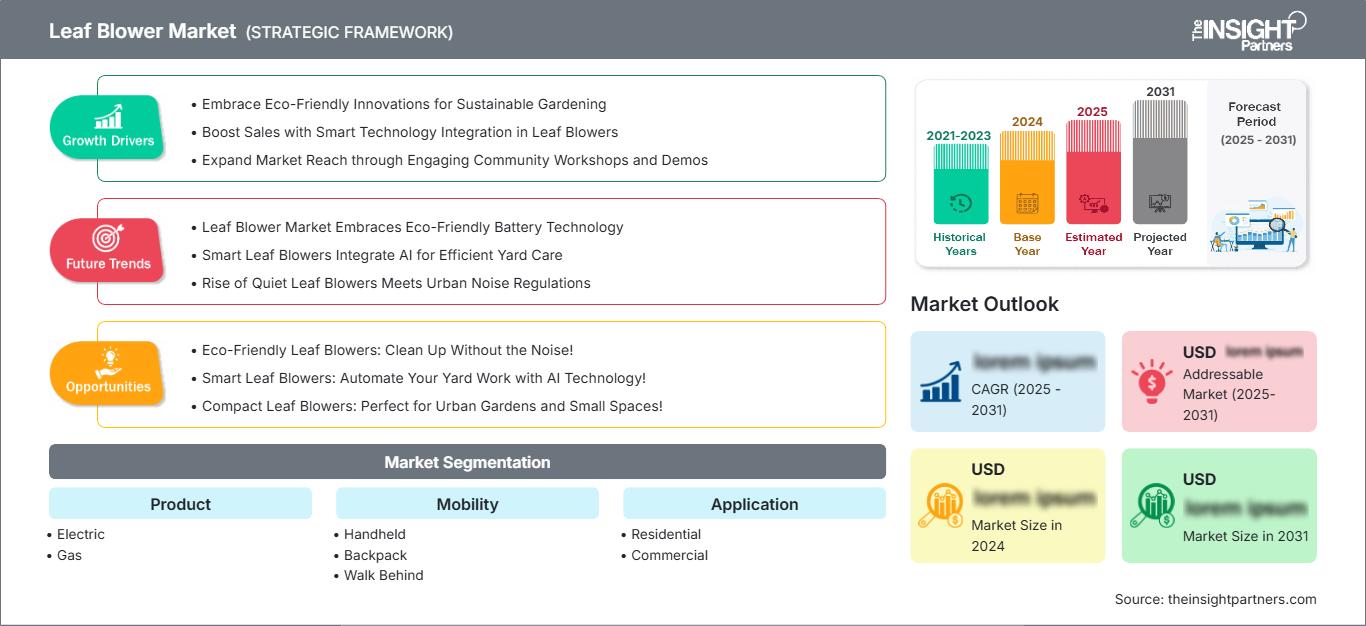
The leaf blower market size was valued at US$ 1.32 Billion in 2025 and is projected to reach US$ 3.75 Billion by 2034; it is expected to register a CAGR of 12.30% from 2026 to 2034. There is increasing demand for products which offer faster debris clearance, minimal maintenance requirements, and battery-operated solutions to address issues related to emissions, operator comfort, and noise pollution within urban areas.
North America has emerged as the most advanced market with regional demand for such products expected to register a CAGR of 10.8%–11.6% from 2026 to 2034. The market growth has been propelled by the presence of professional landscaping services, strict regulations against gasoline-powered equipment, and the increasing adoption of cordless systems.
Leaf Blower Market Assessment and Insights
- North America: The region accounted for 38–41% share in 2025 and is projected to grow at a CAGR of 10.8–11.6% during 2026–2034, supported by landscaping service density, electrification incentives, and municipal noise restrictions.
- US: The US represented 86–89% of North America in 2025 and is expected to grow at a CAGR of 10.9–11.8% during 2026–2034 as professional fleets shift toward battery systems.
- Europe: Europe held 24–27% share in 2025 and is forecast to grow at a CAGR of 11.2–12.0% during 2026–2034, led by Germany, the UK, France, Italy, and Spain.
- Asia Pacific: Asia Pacific captured 20–23% share in 2025 and is projected to grow at a CAGR of 13.1–14.0% during 2026–2034, driven by China, Japan, India, South Korea, and Australia.
- Largest Segment: Electric products held 57–60% market share in 2025 and are expected to grow at a CAGR of 13.0–13.8% during 2026–2034 due to battery adoption.
- High Growth Segment: Commercial applications held 43–46% leaf blower market share in 2025 and are projected to grow at a CAGR of 13.4–14.2% during 2026–2034 as contractors modernize fleets.
- Key companies analyzed in detail: ECHO Incorporated, EGO POWER+, Honda Motor Co., Ltd., Husqvarna AB, Positec Tool Corporation, Remington LLC, Robert Bosch Power Tools GmbH, Stanley Black & Decker, Inc., STIHL Incorporated, The Toro Company, Makita Corporation, and Greenworks Tools.
Source: The Insight Partners' analysis based on proprietary research, government publications, company annual reports, investor presentations, industry databases, and expert interviews.
Product evolution in the Leaf Blower Market is shifting from basic handheld airflow tools toward integrated outdoor power platforms. Changes in production are taking place because of brushless motors, lithium ion batteries, modular charging devices and quieter impellers." Companies have to reconcile the need for light consumer devices with robust back pack and walk behind equipment for contractors and are increasingly relying on batteries, electronics, plastics and dealers rather than engines alone.
The future market will be driven by urban green space maintenance, professionalization of landscaped services and government-driven conversions from gas-powered tools." New regions that are developing due to the need for outdoor cleaning include housing developments, parks, college campuses and tourist sites. Investment is moving toward battery ecosystems, charging infrastructure, and serviceable professional tools, making the Leaf Blower Market forecast broader than standalone equipment sales.
Leaf Blower Market Report Scope
| Report Attribute | Details |
|---|---|
| Market size in 2025 | US$ 1.32 Billion |
| Market Size by 2034 | US$ 3.75 Billion |
| Global CAGR (2026 - 2034) | 12.30% |
| Historical Data | 2021-2024 |
| Forecast period | 2026-2034 |
Leaf Blower Market Analysis
Demand is supported by time savings, seasonal yard cleanup, contractor productivity, and growing expectations for maintained outdoor spaces. The Leaf Blower Market Report benefits from household gardening activity, public landscaping budgets, and commercial property maintenance contracts where labor efficiency directly affects operating margins.
The supply chain is constituted by battery manufacturers, motor makers, plastic processors, power tools brands, distributors, retailers, rental operators, and service organizations. Supply considerations are changing due to the increasing prevalence of electric products which make use of fewer small engines and carry costs in terms of battery technology, charging requirements, and electronics.
The market continues to be fragmented and brand-oriented, with STIHL Incorporated, Husqvarna AB, ECHO Incorporated, EGO POWER+, and The Toro Company competing on performance, running time, dealership, and professional durability. Stanley Black & Decker, Inc., Makita Corporation, and Robert Bosch Power Tools GmbH improve their products through platform compatibility.
Investment trends emphasize battery production, rapid charging, fleet electrification, and connected asset management for landscapers. Strategic positioning increasingly depends on offering full outdoor power systems rather than isolated blowers, making Leaf Blower Market analysis essential for evaluating channel control, recurring battery sales, and professional replacement cycles.
● REPORT CUSTOMIZATION
Tailor This Report To Align With Your Specific Business Requirements
This report can be customized to align precisely with your business objectives, scope, and target markets. Customization options include tailored segmentation, geography, competitive analysis, and strategic insights to support informed decision-making.
Customize This Report →WHAT YOU CAN ADJUST
- ● Segmentations
- ● Geography
- ● Competitive Analysis
- ● Language Preferences
Leaf Blower Market: Strategic Insights
Regional Insights
North America Leaf Blower
North America accounted for 38–41% share in 2025 and is expected to grow at a CAGR of 10.8–11.6% during 2026–2034. The region benefits from high lawn ownership, mature landscaping contractors, organized retail distribution, and dense dealer networks. Local restrictions on gas-powered equipment in several jurisdictions are accelerating cordless replacement, particularly in suburban municipalities and campus maintenance. Commercial users are prioritizing runtime, battery interchangeability, and lower noise levels to maintain productivity under tighter ordinances. The Leaf Blower Market in North America is also supported by strong premium tool penetration, contractor training programs, and higher willingness to pay for durable equipment that reduces fuel handling, emissions exposure, and maintenance downtime.
US Leaf Blower Market
The US represented 86–89% of North America in 2025 and is forecast to grow at a CAGR of 10.9–11.8% during 2026–2034. Demand is concentrated in residential lawn care, commercial landscaping, municipal cleanup, golf courses, universities, and property management. California-style zero-emission rules and city-level restrictions have made battery performance a central purchasing criterion. Presence of the companies is extensive, with STIHL Incorporated, EGO POWER+, The Toro Company, Stanley Black & Decker, Inc., and ECHO Incorporated enjoying high channel visibility. Business purchasers now consider issues such as fleet charging, shared battery system, ergonomic harnesses, and serviceability, while household consumers opt for lightweight handheld devices for patios, driveways, sidewalks, and seasonal leaf removal.
Europe Leaf Blower Market
Europe held 24–27% share in 2025 and is projected to grow at a CAGR of 11.2–12.0% during 2026–2034. Germany is the leading country due to strong gardening culture, professional groundskeeping, and manufacturing proximity. Battery adoption is strengthened by municipal sustainability targets and consumer sensitivity to noise in dense residential neighborhoods. The UK market is influenced by landscaping services, estate maintenance, and public space maintenance in parks, schools, and housing associations. Electric and handheld equipment find favor as the buyers prefer less noise and more convenient storage. France, Italy, and Spain are influenced by hospitality landscaping, urban landscaping, and municipal cleaning. The demand is seasonal in southern Europe but professionalizing owing to the increasing use of tourism assets, resorts, and municipal spaces. Noise reduction and low-emission criteria in the local market are helping electric power adoption, even though gas-powered equipment also has its place.
APAC Leaf Blower Market
APAC accounted for 20–23% share in 2025 and is forecast to grow at a CAGR of 13.1–14.0% during 2026–2034. China leads on manufacturing scale, urban maintenance demand, and e-commerce distribution. Adoption of leaf blowers in Japan and South Korea is made easier due to urban landscaping, battery tools, and quality retail chains. In India, adoption is growing since gated communities, campuses, airports, and municipal contracts involve the mechanization of outdoor cleaning activities. Commercial landscapers in Australia rely on handheld and backpack leaf blowers for parks, schools, and other private properties. This is facilitated by the growing interest from policy makers in cleaner equipment and labor productivity. In Japan and South Korea, adoption is facilitated by small-scale urban landscaping, use of battery-operated equipment, and excellent distribution networks. In India, there is a growing adoption among gated communities, campuses, airports, and municipal contractors as they mechanize outdoor cleaning. Australia remains service-driven, with commercial landscapers using handheld and backpack models for parks, schools, and residential properties. Policy interest in cleaner equipment and worker productivity supports Leaf Blower Market growth across the region.
Middle East & Africa Leaf Blower Market
Middle East & Africa is expected to grow at a CAGR of 9.4–10.2% during 2026–2034. Saudi Arabia leads as giga-projects, hospitality assets, and landscaped public spaces expand maintenance needs. Demand in UAE is seen from hotels, airports, villas, golf courses, and city beautification efforts. Electric models have become important when noise control and adjacent indoor cleaning is a consideration. In South Africa and other parts of MEA, pricing sensitivity continues, but the need for infrastructure maintenance, landscaping, and facility maintenance exists. The challenging environment makes durability of machines and good service support important.
Segmentation Analysis
Product
The Product segment is projected to grow at a CAGR of 12.6–13.4% during 2026–2034. Purchasing is increasingly determined by emissions rules, runtime expectations, fuel cost exposure, and maintenance simplicity. Electric products are gaining share as battery platforms improve, while gas models retain relevance in heavy-duty commercial work where long continuous operation remains essential.
- Electric models dominate new product development because buyers value low noise, easier starting, reduced maintenance, and shared battery platforms across trimmers, mowers, and chainsaws.
- Gas models remain strategically important for contractors handling wet debris, large properties, and long duty cycles where refueling speed and airflow strength outweigh emissions concerns.
Mobility
The Mobility segment is expected to grow at a CAGR of 11.9–12.7% during 2026–2034. Adoption varies by property size, operator fatigue, and cleaning intensity. Handheld formats appeal to homeowners and light commercial users, backpack units support professional productivity, and walk behind systems serve large grounds where airflow volume and coverage speed determine operating economics.
- Handheld units hold broad appeal because they are lightweight, affordable, easy to store, and suitable for routine patios, driveways, lawns, and small commercial premises.
- Backpack units are favored by landscapers needing longer operation, better weight distribution, and higher airflow for parks, campuses, estates, and municipal cleanup tasks.
- Walk behind units address large open areas where operators need sustained power, wide clearing paths, and reduced manual fatigue across institutional and commercial properties.
Application
The Application segment is forecast to grow at a CAGR of 12.8–13.6% during 2026–2034. Residential use is driven by DIY gardening, smaller cordless tools, and seasonal cleanup, while commercial demand is shaped by labor productivity, fleet replacement, and regulatory compliance. Contractors increasingly evaluate total cost of ownership, including batteries, chargers, downtime, and serviceability.
- Residential demand is mature in developed markets, with buyers prioritizing low weight, quiet operation, simple storage, and compatibility with existing cordless garden tools.
- Commercial demand is strategically significant because landscapers, municipalities, hotels, campuses, and facility managers require durable equipment that reduces labor hours and supports compliance.
Opportunity Snapshot
| Application | Revenue Contribution | Trend Tag | Adoption Stage |
| Residential | High | Cordless Homes | Mature |
| Commercial | High | Fleet Electrification | Scaling |
Leaf Blower Market Growth Drivers and Impact Analysis
Regulatory Shift Toward Low-Emission Outdoor Equipment
Limitations on gas-fueled outdoors equipment have influenced buying practices in the Leaf Blower Market. Efforts to curb pollution by small off-road engines, regulations about noise levels, and incentives for buying electrical products are encouraging consumers, construction companies, and governments to favor battery-powered machines. These efforts seem to be affecting regions like North America and some parts of Europe, where there are more stringent rules regarding air pollution, public nuisance, and occupational health. This situation is advantageous for manufacturers since it leads to compliance-driven purchasing decisions rather than discretionary ones, but it requires proof of competitiveness of the new products.
Expansion of Professional Landscaping Services
There is an increase in the usage of equipment intensity in commercial landscaping services due to the need to clear large plots with less labor hours by the contractor. Leaf blowers play an important role in the routine of parks, educational institutions, corporations, malls, resorts, and residential areas. This driver helps the increase in value in terms of backpack and walk behind models. This is possible in cases where there is a dependency on constant airflow, ergonomic, and service. There is increased cost in terms of wages; therefore, the contractor can buy equipment that saves labor and time.
Battery Platform Innovation and Retail Accessibility
Advancements in battery technology have enabled more consumers to embrace platforms that provide longer runtime, faster charging, increased torque, and tool versatility. Today, consumers are purchasing battery-powered ecosystems that use a single battery on blowers, trimmers, lawn mowers, chainsaws, and hedge clippers. Battery platforms are making it easier for consumers to compare products due to retail availability through home improvement stores, online retail and dealerships. There is significant commercial value attached to battery technology, which enables the sharing of batteries between professionals across the work site.
Leaf Blower Market Future Trends
Connected Fleet Management for Contractors
Connected devices are projected to impact the Leaf Blower Market trends since the need for better visibility in terms of utilization, battery condition, charging, and servicing will drive contractors to implement such devices. With connected devices, fleet managers will be able to distribute the equipment among various crews, minimize losses of tools, and schedule servicing to prevent interruptions in their work. This trend is going to be especially useful for commercial use when several crews operate every day, and any downtime results in losses.
Quieter High-Airflow Designs for Urban Use
Future product differentiation will increasingly depend on balancing airflow strength with lower sound levels. Urban users need tools that can clear wet leaves, dust, and debris without breaching community noise expectations. Engineering improvements in fan geometry, motor control, air channels, and nozzle design will allow manufacturers to compete on productivity and acoustic comfort together. This trend benefits premium electric models because quieter operation expands permitted use windows in residential districts, schools, hospitals, hotels, and municipal areas. It also reduces operator fatigue during repeated daily use.
Leaf Blower Market Opportunities
Commercial Battery Fleet Conversion Programs
Manufacturers and distributors have an opportunity to package blowers with batteries, chargers, financing, training, and service plans for landscaping contractors. Many commercial buyers hesitate because upfront battery costs and charging logistics appear complex compared with gasoline refueling. Structured conversion programs can quantify fuel savings, maintenance reductions, compliance benefits, and productivity impacts. Dealers that provide jobsite audits, charging layouts, and replacement schedules can become strategic partners rather than transactional sellers. This opportunity is especially attractive in regions with active gas restrictions and large professional landscaping fleets.
Emerging Market Channel Expansion
Emerging markets offer room for organized distribution as urban housing, hospitality, industrial parks, and public infrastructure expand. The opportunity is not limited to premium tools; suppliers can develop tiered portfolios that match price sensitivity while preserving reliability. Local assembly, spare-part availability, and technician training can reduce ownership concerns and improve adoption among municipal and commercial buyers. E-commerce can build awareness, but dealer support remains important for walk behind and backpack products. Companies that localize product mixes can capture early brand loyalty.
Recent Developments
- May 2026: The STIHL Group increased its revenue to 5.48 billion euros in the past fiscal year, up 2.8 percent compared to 2024 (5.33 billion euros) – a good result in a persistently challenging environment. The leading manufacturer of chainsaws and motorized garden tools almost reached its record figure from 2022 (5.49 billion euros), despite the challenging tariff policy of the USA – its largest single market – and in spite of customer reluctance to buy due to a sluggish economy in many regions and negative exchange rate effects. The STIHL Group generated almost 91 percent of its revenues abroad.
- May 2026: the Alexandria City Council adopted the ordinance to prohibit the use of gas-powered leaf blowers with an 18-month phase-out period. Effective November 17, 2026, citations for use of gas-powered leaf blowers will be issued for residents and contractors.
- May 2026: North Shore officials guiding regional leaf-blower regulations said in th Highland Park City Council meeting that they are considering extending the current nine-month seasonal ban on gas-powered leaf blowers past December 2026 sunset date, as a feasibility study examining the effectiveness of the rules continues.
Frequently Asked Questions

- Comprehensive Market Sizing and Forecast Analysis
- Detailed Segmentation Analysis
- In-Depth Market Dynamics Assessment
- Regional and Country-Level Insights
- Competitive Landscape and Company Benchmarking
- Strategic Business Intelligence
Recent Reports
Testimonials

The Insight Partners' SCADA System Market report is comprehensive, with valuable insights on current trends and future forecasts. The team was highly professional, responsive, and supportive throughout. We are very satisfied and highly recommend their services.
RAN KEDEM Partner, Reali Technologies LTDs
I requested a report on a very specific software market and the team produced the report in a few days. The information was very relevant and well presented. I then requested some changes and additions to the report. The team was again very responsive and I got the final report in less than a week.
JEAN-HERVE JENN Chairman, Future Analytica
We worked with The Insight Partners for an important market study and forecast. They gave us clear insights into opportunities and risks, which helped shape our plans. Their research was easy to use and based on solid data. It helped us make smart, confident decisions. We highly recommend them.
PIYUSH NAGPAL Sr. Vice President, High Beam Global
The Insight Partners delivered insightful, well-structured market research with strong domain expertise. Their team was professional and responsive throughout. The user-friendly website made accessing industry reports seamless. We highly recommend them for reliable, high-quality research services
YUKIHIKO ADACHI CEO, Deep Blue, LLC.
This is the first time I have purchased a market report from The Insight Partners.While I was unsure at first, I visited their web site and felt more comfortable to take the risk and purchase a market report.I am completely satisfied with the quality of the report and customer service. I had several questions and comments with the initial report, but after a couple of dialogs over email with their analyst I believe I have a report that I can use as input to our strategic planning process.Thank you so much for taking the extra time and making this a positive experience.I will definitely recommend your service to others and you will be my first call when we need further market data.
JOHN SUZUKI President and Chief Executive Officer, Board Director, BK Technologies
I wish to appreciate your support and the professionalism you displayed in the course of attending to my request for information regarding to infectious disease IVD market in Nigeria. I appreciate your patience, your guidance, and the fact that you were willing to offer a discount, which eventually made it possible for us to close a deal. I look forward to engaging The Insight Partners in the future, all thanks to the impression you have created in me as a result of this first encounter.
DR CHIJIOKE ONYIA MANAGING DIRECTOR, PineCrest Healthcare Ltd.Reason to Buy
- Informed Decision-Making
- Understanding Market Dynamics
- Competitive Analysis
- Identifying Emerging Markets
- Customer Insights
- Market Forecasts
- Risk Mitigation
- Boosting Operational Efficiency
- Strategic Planning
- Investment Justification
- Tracking Industry Innovations
- Aligning with Regulatory Trends





 Get Free Sample for