
Light Gauge Steel Framing Market Share, Demand & Growth by 2034
Coverage: By Type (Skeleton Steel Framing, Wall bearing Steel Framing, and Long Span Steel Framing), End-user (Residential, Commercial, and Industrial), and Geography (North America, Europe, Asia Pacific, and South and Central America)
- Status : Data Released
- Report Code : TIPRE00008367
- Category : Manufacturing and Construction
- No. of Pages : 150
- Available Report Formats :


- Last update date : July 13, 2026


2025 Market Size
US$ 14.58 Bn
Base year value
2034 Forecast
US$ 31.64 Bn
Projected by 2034
CAGR 2026-2034
8.99 %
Growth rate
Addressable Market
US$ 206.83 Bn
(2026-2034)
The light gauge steel framing market size was valued at US$ 14.58 Billion in 2025 and is projected to reach US$ 31.64 Billion by 2034; it is expected to register a CAGR of 8.99% from 2026 to 2034. The demand is driven by the presence of industrialized construction practices, light weight structures, and increased demand for recyclable frame material in residential, commercial, and industrial constructions.
In North America, a growth rate of CAGR of 7.8%-8.6% is projected during 2026-2034. This is driven by modular housing initiatives, fire-resistant construction, and code approvals for cold-formed steel. In North America, the contractors are using panelized frames to overcome the shortage of labor and site waste. Adoption in multifamily, education, healthcare, and retail constructions will boost the Light Gauge Steel Framing Market Share.
Light Gauge Steel Framing Market Assessment and Insights
- North America: The region accounted for 28–32% share in 2025 and is projected to grow at 7.8–8.6% CAGR between 2026–2034, led by prefabrication, resilient housing, and commercial renovation activity.
- US: The US represented 78–82% of North America market in 2025 and is expected to expand at 7.9–8.7% CAGR between 2026–2034, supported by multifamily and institutional projects.
- Europe: Europe held 22–26% share in 2025 and is projected to grow at 7.2–8.0% CAGR between 2026–2034, with the UK, Germany, France, Italy, and Spain driving adoption.
- Asia Pacific: Asia Pacific accounted for 30–34% share in 2025 and is forecast to grow at 10.0–11.2% CAGR between 2026–2034, led by China, India, Japan, South Korea, and Australia.
- Largest Segment: Commercial end users held 42–46% light gauge steel framing market share in 2025 and are projected to grow at 8.4–9.2% CAGR between 2026–2034 due to repeatable, fast-track construction needs.
- High Growth Segment: Residential end users held 34–38% market share in 2025 and are expected to grow at 9.6–10.8% CAGR between 2026–2034 as affordable housing uses panelized systems.
- Key companies analyzed in detail: MiTek Inc., CRACO Manufacturing Inc., Emirates Building Systems Co. LLC, FRAMECAD Limited, FrameTech Systems LLC, Genesis Manazil Steel Framing LLC, Hadley Industries plc, Metek UK Limited, MRI Steel Framing LLC, Stowell Company, Inc., ClarkDietrich Building Systems LLC, and CEMCO.
Source: The Insight Partners' analysis based on proprietary research, government publications, company annual reports, investor presentations, industry databases, and expert interviews.
From traditional site-cut studs to engineered systems using roll-forming, BIM detailing, CNC punching, and panelization, there is a trend towards production that integrates design through linking of software for design, bill of materials, machine coding, labelling, and sequence of installation. This change in market improves accuracy, minimizes errors, and enables manufacturers to cater to needs of projects with fireproofing, earthquake-proofing, minimal waste, and scheduling predictability.
Future demand is anticipated from regions with a combination of factors such as housing shortage, infrastructure upgrades, and low-carbon building policies. While cities in the Asia Pacific and Middle East are developing capacity for off-site fabrication, refurbishment and mid-rise buildings are driving demand in North America and Europe. The Light Gauge Steel Framing Market Forecast has support from recyclable steel and stringent building performance standards.
Light Gauge Steel Framing Market Report Scope
| Report Attribute | Details |
|---|---|
| Market size in 2025 | US$ 14.58 Billion |
| Market Size by 2034 | US$ 31.64 Billion |
| Global CAGR (2026 - 2034) | 8.99% |
| Historical Data | 2021-2024 |
| Forecast period | 2026-2034 |
Light Gauge Steel Framing Market Analysis
There are three main constraints that influence demand, including quick cycles, structural resilience, and controlled material utilization. The light gauge steel framing is well-suited for dry construction, tight tolerances, and lightweight foundations, which makes it appropriate for high-density areas where labor and logistical issues are likely to arise. In addition, developers find steel to be more eco-friendly due to its recyclability and dimensional stability in moist and termite-prone environments.
The industry ecosystem consists of suppliers of steel coils, manufacturers of roll forming equipment, software vendors, manufacturers of panels, contractors, and code experts. The supply chain dynamics are influenced by the availability of galvanized steel, coating parameters, and manufacturing capabilities of the area. According to the Light Gauge Steel Framing Market report, companies able to combine design and production stages in one workflow are protected from steel prices fluctuation.
The competition is scattered among regional stud makers, prefab companies, and tech-driven platforms. FRAMECAD Limited and Metek UK Limited promote integration between design and manufacturing, whereas Hadley Industries plc, ClarkDietrich Building Systems LLC, CEMCO, and MRI Steel Framing LLC operate on diversification of their products, regulatory compliance, and relations with contractors.
Funding is increasingly being allocated for automated roll formers, quality control based on computer programs, and panelizing factories near major construction corridors. MiTek Inc., Emirates Building Systems Co. LLC, Genesis Manazil Steel Framing LLC, CRACO Manufacturing Inc., FrameTech Systems LLC, and Stowell Company, Inc. gain competitive advantage through satisfying the needs of structural, non-structural, and prefab frames sectors.
● REPORT CUSTOMIZATION
Tailor This Report To Align With Your Specific Business Requirements
This report can be customized to align precisely with your business objectives, scope, and target markets. Customization options include tailored segmentation, geography, competitive analysis, and strategic insights to support informed decision-making.
Customize This Report →WHAT YOU CAN ADJUST
- ● Segmentations
- ● Geography
- ● Competitive Analysis
- ● Language Preferences
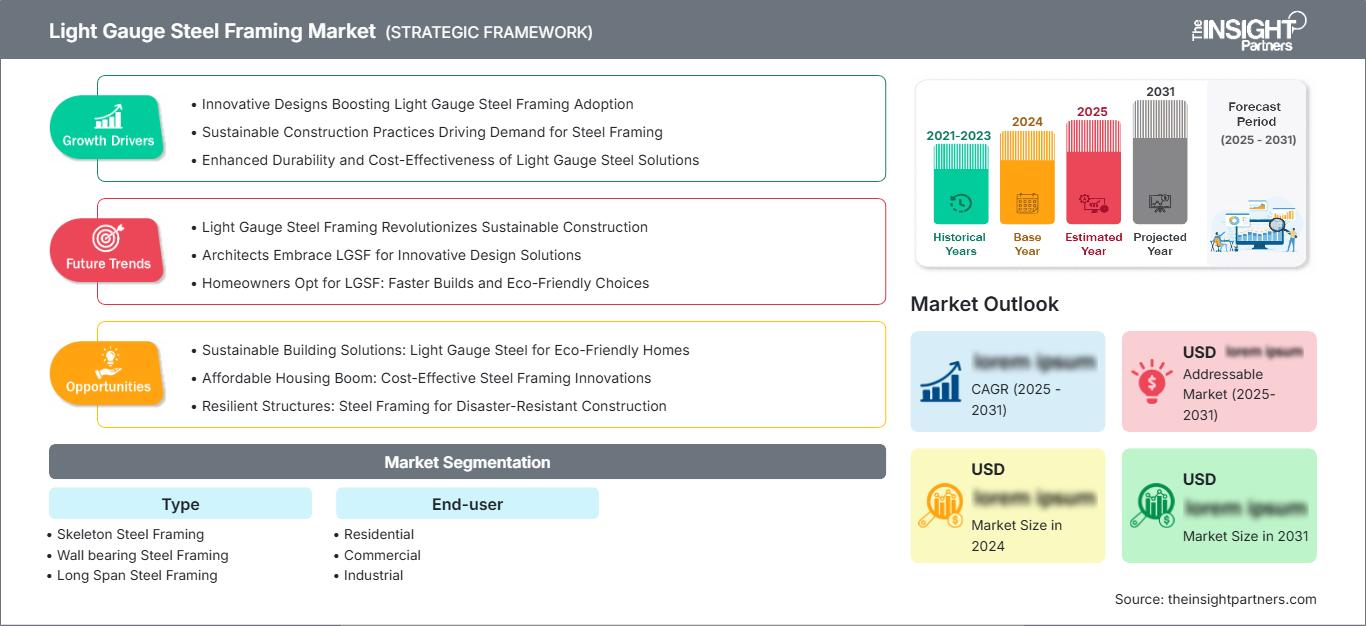
Light Gauge Steel Framing Market: Strategic Insights
Regional Insights
North America Light Gauge Steel Framing
North America held 28–32% share in 2025 and is projected to grow at 7.8–8.6% CAGR from 2026 to 2034. Adoption is driven by labor shortages, insurance pressure around fire resilience, and demand for faster delivery in multifamily, student housing, healthcare, and retail fit-out projects.
US and Canadian contractors are using factory-built panels to shorten site programs and improve dimensional control. Cold-formed steel also aligns with code-based structural design and recycled-content procurement. The Light Gauge Steel Framing Market size in the region benefits from steady renovation activity and modular construction pilots.
U.S. Light Gauge Steel Framing Market
The US accounted for 78–82% of North America in 2025 and is expected to grow at 7.9–8.7% CAGR during 2026–2034. Demand is concentrated in multifamily buildings, schools, healthcare interiors, hotels, and quick-service retail, where repetitive framing layouts support panelized manufacturing and predictable installation.
The company has wide coverage, with the key players including MiTek Inc., ClarkDietrich Building Systems LLC, CEMCO, MRI Steel Framing LLC, CRACO Manufacturing Inc., FrameTech Systems LLC, and Stowell Company, Inc. Application trends are towards assemblies that are non-combustible, lightweight structure, less waste, and quick to inspect interior framing packages.
Europe Light Gauge Steel Framing Market
Europe held 22–26% share in 2025 and is forecast to grow at 7.2–8.0% CAGR from 2026 to 2034. The UK leads regional adoption because modular housing, education buildings, and refurbishment projects use light steel systems to reduce site labor and meet tighter performance specifications.
Germany is using more in industrial buildings, logistics buildings, and energy-efficient residential buildings. The precision roll forming process ensures quality envelopes, whereas increased building energy regulations are resulting in higher adoption in engineered frames with insulation, sound control, and fire protection without adding much weight to the structure.
France, Italy, and Spain are demonstrating increased adoption in renovations, hospitality buildings, and infill developments due to reduced loading of existing foundations. Metek UK Limited and Hadley Industries plc support regional supply, while the Light Gauge Steel Framing market trends favor off-site panels and circular construction.
APAC Light Gauge Steel Framing Market
The Asia Pacific region had a market share of 30–34% in 2025, and it is expected to register growth at a CAGR of 10.0–11.2% during 2026 to 2034. China dominated in volume terms, whereas India is experiencing higher adoption due to urban housing and institutional constructions.
Japan and South Korea emphasize accuracy, earthquake resistance, and controlled manufacturing in factories. Australia makes use of steel framing for residential and modular construction due to its ability to withstand termites and its light weight.
Industrial zones and public construction projects boost the demand in the region. Policies focusing on efficient housing, urban resilience, and reduction in construction waste broaden the scope of the Light Gauge Steel Framing market.
Middle East & Africa Light Gauge Steel Framing Market
Middle East & Africa is expected to grow at 8.6–9.8% CAGR from 2026 to 2034. Saudi Arabia leads demand through housing, tourism, and social infrastructure projects requiring rapid delivery.
Steel framing is preferred for hotel buildings, office buildings, and modular constructions in the UAE. In the UAE, two companies have improved capacity for such framing: Emirates Building Systems Co. LLC and Genesis Manazil Steel Framing LLC.
Projects involving education, health facilities, and mining in South Africa and Rest of MEA will find the benefit from buildings of this kind. Light-weighted panel buildings will be suitable for energy projects.
Segmentation Analysis
Type
The type segment is expected to grow at 8.5–9.4% CAGR during 2026–2034. Demand varies by load path, span requirement, and building height. Skeleton systems suit flexible layouts, wall-bearing systems support cost-efficient repetitive housing, and long span framing addresses commercial areas needing open interiors without excessive structural weight.
- Skeleton Steel Framing is widely used where structural grids, architectural flexibility, and integration with other materials are important, especially in commercial buildings and multi-story applications.
- Wall bearing Steel Framing supports repetitive residential and accommodation projects by transferring loads through engineered wall panels, reducing installation complexity and improving factory prefabrication efficiency.
- Long Span Steel Framing is strategically important for retail, education, healthcare, and industrial spaces that require open layouts, fewer internal supports, and efficient roof or floor assemblies.
End-user
The end-user segment is projected to grow at 8.8–9.7% CAGR from 2026 to 2034. Commercial buildings lead due to standardized interiors, rapid fit-outs, and predictable code compliance. Residential demand is rising through affordable housing and modular projects, while industrial adoption is linked to warehouses, service buildings, and utility structures.
- Residential applications are scaling through townhouses, apartments, accessory dwelling units, and disaster-resilient housing, where lightweight panels support rapid assembly and consistent dimensional accuracy.
- Commercial users prioritize fast installation, fire-rated partitions, repeatable framing packages, and clean fit-outs across offices, retail, hospitality, healthcare, and education facilities.
- Industrial demand centers on warehouses, equipment rooms, workshops, and ancillary facilities that need durable, low-maintenance framing compatible with large footprints and service penetrations.
Opportunity Snapshot
| End-user | Revenue Contribution | Trend Tag | Adoption Stage |
| Residential | High | Prefab Housing | Scaling |
| Commercial | High | Fast Fitout | Mature |
| Industrial | Medium | Utility Builds | Scaling |
Light Gauge Steel Framing Market Growth Drivers and Impact Analysis
Industrialized Construction Reduces Schedule Risk
Framing operations are being shifted from busy job sites to organized factories to minimize weather problems, labor reliance, and inspection constraints. Light gauge steel framing allows for precut, tagged, and panelized materials which are already prepared for assembly. This driving factor is most effective in residential buildings, hospitality projects, student housing facilities, and healthcare facilities due to repetitive room configurations that enhance production efficiencies. Prefabrication will reduce rework and shorten the time on the construction site, allowing for better certainty with projects, and increasing the appeal of the Light Gauge Steel Framing Market.
Resilience Requirements Favor Non-Combustible Materials
Owners of buildings are now assessing building materials based on factors such as fire safety, moisture resistance, pest resistance, and dimensional stability. The use of cold-formed steel is highly desirable due to its properties of being non-warping, non-rotting, and non-flammable. This makes the material desirable in places exposed to wildfires, humid environments, and when considering insurance requirements. Engineered structural systems may also be designed to accommodate earthquake and wind forces using standard profiles, connectors, and bracing systems. The market significance of this product can be seen in places such as schools, care centers, apartments, and public buildings.
Sustainability Targets Support Recyclable Framing Systems
The use of steel frame structures is consistent with the objectives of the circular economy due to the fact that scrap can be recycled, and manufacturing in factories creates less waste than site-based construction. The contractors also make use of optimized nesting, proper creation of bill of material, and timely delivery in order to minimize inventory. As the focus of green building initiatives shifts to embodied carbon and material tracing, companies providing documented coatings, recycled materials, and efficient manufacturing operations can have an edge.
Light Gauge Steel Framing Market Future Trends
Design-to-Manufacture Platforms Become Standard
Increasingly, digital integration will become the benchmark for competitiveness, as companies link up architectural models, engineering verification, manufacturing data, labeling, quality assurance, and delivery planning. Systems that automate the transition from design through to roll forming machinery will accelerate approvals and provide traceability. Within the forecast period, manufacturers who have real-time manufacturing dashboards and automated clash checking will find themselves well equipped to serve modular builders and developers looking for repeatable performance.
Hybrid Structural Systems Expand Design Flexibility
Future buildings will combine light gauge steel with concrete cores, hot-rolled steel, engineered timber, and high-performance envelope systems to balance strength, weight, speed, and cost. This hybrid approach will be important in mid-rise residential, healthcare, education, and hospitality projects where open spaces, fire separation, acoustic performance, and prefabricated façades must work together. Suppliers that provide engineering guidance, connector systems, and tested assemblies will capture more specification influence. The trend supports broader acceptance by architects and structural engineers seeking flexible alternatives to fully traditional framing.
Light Gauge Steel Framing Market Opportunities
Affordable Housing Platforms in High-Density Cities
Affordable housing programs need repeatable, code-compliant building systems that can be delivered quickly without sacrificing durability. Light gauge steel framing market trends offers a practical platform for apartment blocks, worker accommodation, student housing, and accessory dwellings because standardized panels can be manufactured near demand centers and assembled with fewer site trades. Investors can target regional panel plants, design libraries, and partnerships with housing agencies. The opportunity is strongest where land costs, labor shortages, and public pressure for faster delivery make conventional construction schedules difficult to sustain.
Retrofit and Vertical Extension Programs
Existing buildings in mature cities require renovation, energy upgrades, and additional usable space without overloading foundations. Lightweight steel framing can support façade replacements, rooftop additions, partition upgrades, and service-zone reconfiguration while limiting disruption to occupied properties. Contractors can build retrofit offerings around surveyed digital models, pre-engineered panels, and rapid installation crews. This opportunity is particularly relevant in Europe and North America, where aging building stock, energy-efficiency mandates, and limited urban land create demand for structural solutions that add value without major demolition.
Recent Developments
- May 2026: FRAMECAD Limited published technical guidance explaining cold formed steel and light gauge steel terminology, reinforcing market education around design, production, and specification consistency for manufacturers and builders adopting steel framing workflows.
- March 2026: Steel Framing Industry Association (SFIA) Annual Meeting and SFIA General Session came to New Orleans in conjunction with BUILD26: AWCI’s Convention + Expo. The SFIA meetings covered the theme: “Supporting Members Through Certification and Industry Alignment,” revealed an approved updated steel framing compliance program and held a special awards ceremony.
- October 2024: FRAMECAD announced the launch of FRAMECAD Nexa, the first end-to-end production management platform designed specifically for cold-formed steel framing.
Frequently Asked Questions

- Comprehensive Market Sizing and Forecast Analysis
- Detailed Segmentation Analysis
- In-Depth Market Dynamics Assessment
- Regional and Country-Level Insights
- Competitive Landscape and Company Benchmarking
- Strategic Business Intelligence
Recent Reports
Testimonials

The Insight Partners' SCADA System Market report is comprehensive, with valuable insights on current trends and future forecasts. The team was highly professional, responsive, and supportive throughout. We are very satisfied and highly recommend their services.
RAN KEDEM Partner, Reali Technologies LTDs
I requested a report on a very specific software market and the team produced the report in a few days. The information was very relevant and well presented. I then requested some changes and additions to the report. The team was again very responsive and I got the final report in less than a week.
JEAN-HERVE JENN Chairman, Future Analytica
We worked with The Insight Partners for an important market study and forecast. They gave us clear insights into opportunities and risks, which helped shape our plans. Their research was easy to use and based on solid data. It helped us make smart, confident decisions. We highly recommend them.
PIYUSH NAGPAL Sr. Vice President, High Beam Global
The Insight Partners delivered insightful, well-structured market research with strong domain expertise. Their team was professional and responsive throughout. The user-friendly website made accessing industry reports seamless. We highly recommend them for reliable, high-quality research services
YUKIHIKO ADACHI CEO, Deep Blue, LLC.
This is the first time I have purchased a market report from The Insight Partners.While I was unsure at first, I visited their web site and felt more comfortable to take the risk and purchase a market report.I am completely satisfied with the quality of the report and customer service. I had several questions and comments with the initial report, but after a couple of dialogs over email with their analyst I believe I have a report that I can use as input to our strategic planning process.Thank you so much for taking the extra time and making this a positive experience.I will definitely recommend your service to others and you will be my first call when we need further market data.
JOHN SUZUKI President and Chief Executive Officer, Board Director, BK Technologies
I wish to appreciate your support and the professionalism you displayed in the course of attending to my request for information regarding to infectious disease IVD market in Nigeria. I appreciate your patience, your guidance, and the fact that you were willing to offer a discount, which eventually made it possible for us to close a deal. I look forward to engaging The Insight Partners in the future, all thanks to the impression you have created in me as a result of this first encounter.
DR CHIJIOKE ONYIA MANAGING DIRECTOR, PineCrest Healthcare Ltd.Reason to Buy
- Informed Decision-Making
- Understanding Market Dynamics
- Competitive Analysis
- Identifying Emerging Markets
- Customer Insights
- Market Forecasts
- Risk Mitigation
- Boosting Operational Efficiency
- Strategic Planning
- Investment Justification
- Tracking Industry Innovations
- Aligning with Regulatory Trends





 Get Free Sample for