
Middle East & Africa Hearing Aids Market Analysis and Forecast by Size, Share, Growth, Trends 2031
Middle East & Africa Hearing Aids Market Size and Forecast (2021 - 2031), Regional Share, Trend, and Growth Opportunity Analysis Report Coverage: By Type (Prescription Hearing Aids and OTC Hearing Aids), Product Type [Hearing Aid Devices {Behind the Ear (BTE) Hearing Aid, In the Ear (ITE) Hearing Aid, Receiver In the Canal (RITE) Hearing Aid, Canal Hearing Aid, and Other Hearing Aid Devices} and Hearing Implants (Cochlear Implants and Bone Conduction Implants)], Technology (Conventional Hearing Aids and Digital Hearing Aids), Type of Hearing Loss (Sensorineural Hearing Loss and Conduction Hearing Loss), Patient Type (Adults and Pediatrics), and Distribution Channel (Pharmacies, Retail Stores and Online)
Historic Data: 2021-2023 | Base Year: 2024 | Forecast Period: 2025-2031- Status : Published
- Report Code : TIPRE00042098
- Category : Life Sciences
- No. of Pages : 153
- Available Report Formats :




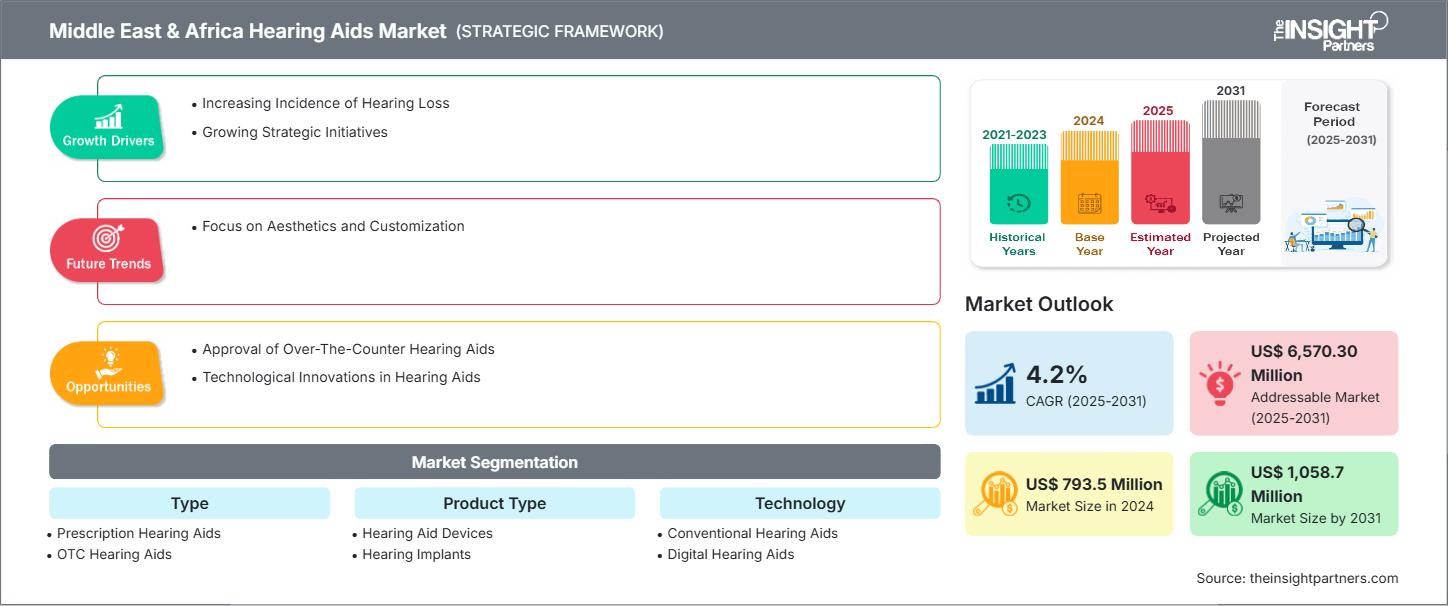
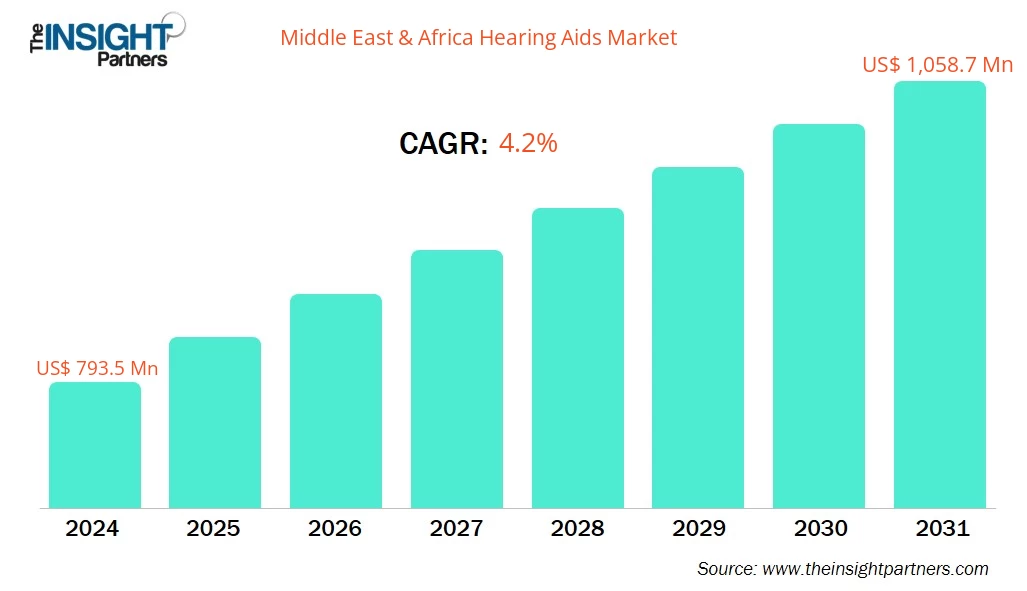
The Middle East & Africa Hearing Aids Market size is expected to reach US$ 1,058.7 Million by 2031 from US$ 793.5 Million in 2024. The market is estimated to record a CAGR of 4.2% from 2025 to 2031.
Executive Summary and Middle East & Africa Hearing Aids Market Analysis:
The hearing aids market in the Middle East & Africa is segmented into the UAE, Saudi Arabia, South Africa, and the Rest of MEA. The growth of the hearing aids market in the Middle East & Africa is driven by several interrelated factors, such as the region's demographic shift with an increasing aging population, particularly in countries such as the UAE, Saudi Arabia, and South Africa, where age-related hearing loss is becoming more prevalent. The rising awareness about hearing health, fueled by government initiatives and nonprofit campaigns, is leading to greater demand for early diagnosis and treatment. Additionally, improvements in healthcare infrastructure and access to audiology services are enabling more people to obtain hearing aids. Technological advancements, such as the development of digital and Bluetooth-enabled hearing aids, have made devices more user-friendly and appealing. The growing prevalence of noise-induced hearing loss due to urbanization and industrialization is contributing to the market's expansion.
Customize This Report To Suit Your Requirement
Get FREE CUSTOMIZATIONMiddle East & Africa Hearing Aids Market: Strategic Insights
-
Get Top Key Market Trends of this report.This FREE sample will include data analysis, ranging from market trends to estimates and forecasts.
Middle East & Africa Hearing Aids Market Segmentation Analysis:
- By Type, the Middle East & Africa Hearing Aids Market is segmented into Prescription Hearing Aids and OTC Hearing Aids. Prescription Hearing Aids held the largest share of the market in 2024.
- By Product Type, the Middle East & Africa Hearing Aids Market is segmented into Hearing Aid Devices and Hearing Implants. Hearing Aid Devices held the largest share of the market in 2024.
- By Hearing Aid Devices, the Middle East & Africa Hearing Aids Market is segmented into Behind the Ear (BTE) Hearing Aid, In the Ear (ITE) Hearing Aid, Receiver In the Canal (RITE) Hearing Aid, Canal Hearing Aid, and Others. Behind the Ear (BTE) Hearing Aid held the largest share of the market in 2024.
- By Hearing Implants, the Middle East & Africa Hearing Aids Market is segmented into Cochlear Implants and Bone Conduction Implants. Cochlear Implants held the largest share of the market in 2024.
- By Technology, the Middle East & Africa Hearing Aids Market is segmented into Conventional Hearing Aids and Digital Hearing Aids. Conventional Hearing Aids held the largest share of the market in 2024.
- By Type Of Hearing Loss, the Middle East & Africa Hearing Aids Market is segmented into Sensorineural Hearing Loss and Conduction Hearing Loss. Sensorineural Hearing Loss held the largest share of the market in 2024.
- By Patient Type, the Middle East & Africa Hearing Aids Market is segmented into Adults and Pediatrics. Adults held the largest share of the market in 2024.
- By Distribution Channel, the Middle East & Africa Hearing Aids Market is segmented into Pharmacies, Retail Stores, and Online. Pharmacies held the largest share of the market in 2024.
Middle East & Africa Hearing Aids Market Report Scope
| Report Attribute | Details |
|---|---|
| Market size in 2024 | US$ 793.5 Million |
| Market Size by 2031 | US$ 1,058.7 Million |
| CAGR (2025 - 2031) | 4.2% |
| Historical Data | 2021-2023 |
| Forecast period | 2025-2031 |
| Segments Covered |
By Type
|
| Regions and Countries Covered |
Middle East and Africa
|
| Market leaders and key company profiles |
|
Middle East & Africa Hearing Aids Market Players Density: Understanding Its Impact on Business Dynamics
The Middle East & Africa Hearing Aids Market is growing rapidly, driven by increasing end-user demand due to factors such as evolving consumer preferences, technological advancements, and greater awareness of the product's benefits. As demand rises, businesses are expanding their offerings, innovating to meet consumer needs, and capitalizing on emerging trends, which further fuels market growth.
Middle East & Africa Hearing Aids Market Outlook
Hearing aids are transforming remarkably. The once-basic hearing aids have now become multifunctional medical instruments and are projected to evolve in the coming years. These latest devices in the market are moving from a basic to a complex digital assistant. The future devices will be smaller and smarter, featuring advanced biosensor integration to treat hearing loss. These devices will also be enhanced, small but powerful, and customized, which can replicate natural hearing. Technological advancements equip these hearing devices with geotagging, Bluetooth connectivity, compactness, seamless hearing, and health measures tagging. This is a significant trend among the market players to cater to the expanding product demand among the global patient population. With innovations in hearing-based technologies, such as hearing aids and many other devices that measure various health parameters through the ear, a new era of hearing-related treatments is forthcoming. Companies are trying to transform the hearing aid into a healthcare device that can serve as a translation machine.
Integrating artificial intelligence (AI) and machine learning in hearing devices is becoming a popular trend in the market. The advent of AI is leading to the development of in-built smart services for patients, such as adaptive sound and active noise cancellation. Latest technology, such as machine learning, multimodal signal processing, and mobile health technology, is expected to improve speech enhancement, individual fitting, and communication training, thus offering better support for all hearing-impaired patients, including older patients with disabilities or declining cognitive skills.
Manufacturers of both OTC and prescription hearing aids are working toward developing hearing aids that are virtually invisible and include capabilities such as Bluetooth streaming, rechargeable batteries, directional microphones, and background noise reduction. As per a 2022 survey titled "Hearing Aid Benefit and Satisfaction Results from the MarkeTrak,” technological advancements in hearing aids, including rechargeable batteries, noise-canceling AI, and wireless connectivity, are becoming increasingly widespread. Modern hearing technology has also updated the way hearing care is provided. In the past, wearers would often live with uncalibrated and outdated technology. Virtual consultations, predictive data analytics, and automated calibration help offer the wearers a significantly improved experience, emerging as a significant trend in the hearing aids market.
Middle East & Africa Hearing Aids Market Country Insights
By country, the Middle East & Africa Hearing Aids Market is segmented into Saudi Arabia, South Africa, the United Arab Emirates, and the Rest of Middle East & Africa. South Africa held the largest share in 2024.
Hearing impairment remains a significant health issue in South Africa. According to the World Health Organization (WHO) report, ~40 million people live with hearing loss in Africa, and the figure is estimated to reach 54 million by 2030. ~20% of the country’s population experiences some degree of hearing loss, which can range from mild to total. In 2021, 9.24 million people experienced a mild degree of hearing loss, and 2.1 million people experienced moderate hearing loss in South Africa. According to the Status Report on ear and hearing care in the WHO African region, released at the African Summit on Hearing Impairment in October 2024, hearing loss significantly affects individuals and economies, costing Africa US$ 27 billion yearly. The use of hearing aids and alternative communication methods plays a crucial role in this context. In addition, though 33 million Africans could benefit from a hearing aid, only ~10% have access due to a lack of ear and hearing care (EHC) financing, and consequent high costs.
Middle East & Africa Hearing Aids Market Company Profiles
Some of the key players operating in the market include Demant AS, Sonova Holding AG, WS Audiology AS, Starkey Laboratories Inc, Cochlear Ltd, GN Store Nord AS, Audina Hearing Instruments Inc, SeboTek Hearing Systems LLC, Earlens Corp, Sonic Innovations Inc, Amplifon Hearing Health Care Corp.
These players are adopting various strategies such as expansion, product innovation, and mergers and acquisitions to provide innovative products to their consumers and increase their market share.
Middle East & Africa Hearing Aids Market Research Methodology
The following methodology has been followed for the collection and analysis of data presented in this report:
Secondary Research
The research process begins with comprehensive secondary research, utilizing internal and external sources to gather qualitative and quantitative data for each market. Commonly referenced secondary research sources include, but are not limited to:
- Company websites, annual reports, financial statements, broker analyses, and investor presentations
- Industry trade journals and other relevant publications
- Government documents, statistical databases, and market reports
- News articles, press releases, and webcasts specific to companies operating in the market
Note:
All financial data included in the Company Profiles section has been standardized to US$. For companies reporting in other currencies, figures have been converted to US$ using the relevant exchange rates for the corresponding year.Primary Research
The Insight Partners conducts a significant number of primary interviews each year with industry stakeholders and experts to validate its data analysis and gain valuable insights. These research interviews are designed to:
- Validate and refine findings from secondary research
- Enhance the expertise and market understanding of the analysis team
- Gain insights into market size, trends, growth patterns, competitive dynamics, and future prospects
Primary research is conducted via email interactions and telephone interviews, encompassing various markets, categories, segments, and sub-segments across different regions. Participants typically include:
- Industry stakeholders: Vice Presidents, Business Development Managers, Market Intelligence Managers, and National Sales Managers
- External experts: Valuation specialists, research analysts, and key opinion leaders with industry-specific expertise

- Historical Analysis (2 Years), Base Year, Forecast (7 Years) with CAGR
- PEST and SWOT Analysis
- Market Size Value / Volume - Regional, Country
- Industry and Competitive Landscape
- Excel Dataset
Recent Reports
Testimonials

The Insight Partners' SCADA System Market report is comprehensive, with valuable insights on current trends and future forecasts. The team was highly professional, responsive, and supportive throughout. We are very satisfied and highly recommend their services.
RAN KEDEM Partner, Reali Technologies LTDs
I requested a report on a very specific software market and the team produced the report in a few days. The information was very relevant and well presented. I then requested some changes and additions to the report. The team was again very responsive and I got the final report in less than a week.
JEAN-HERVE JENN Chairman, Future Analytica
We worked with The Insight Partners for an important market study and forecast. They gave us clear insights into opportunities and risks, which helped shape our plans. Their research was easy to use and based on solid data. It helped us make smart, confident decisions. We highly recommend them.
PIYUSH NAGPAL Sr. Vice President, High Beam Global
The Insight Partners delivered insightful, well-structured market research with strong domain expertise. Their team was professional and responsive throughout. The user-friendly website made accessing industry reports seamless. We highly recommend them for reliable, high-quality research services
YUKIHIKO ADACHI CEO, Deep Blue, LLC.
This is the first time I have purchased a market report from The Insight Partners.While I was unsure at first, I visited their web site and felt more comfortable to take the risk and purchase a market report.I am completely satisfied with the quality of the report and customer service. I had several questions and comments with the initial report, but after a couple of dialogs over email with their analyst I believe I have a report that I can use as input to our strategic planning process.Thank you so much for taking the extra time and making this a positive experience.I will definitely recommend your service to others and you will be my first call when we need further market data.
JOHN SUZUKI President and Chief Executive Officer, Board Director, BK Technologies
I wish to appreciate your support and the professionalism you displayed in the course of attending to my request for information regarding to infectious disease IVD market in Nigeria. I appreciate your patience, your guidance, and the fact that you were willing to offer a discount, which eventually made it possible for us to close a deal. I look forward to engaging The Insight Partners in the future, all thanks to the impression you have created in me as a result of this first encounter.
DR CHIJIOKE ONYIA MANAGING DIRECTOR, PineCrest Healthcare Ltd.Reason to Buy
- Informed Decision-Making
- Understanding Market Dynamics
- Competitive Analysis
- Identifying Emerging Markets
- Customer Insights
- Market Forecasts
- Risk Mitigation
- Boosting Operational Efficiency
- Strategic Planning
- Investment Justification
- Tracking Industry Innovations
- Aligning with Regulatory Trends
Unlock Exclusive Report Discounts
Enquire Now




 Get Free Sample For